

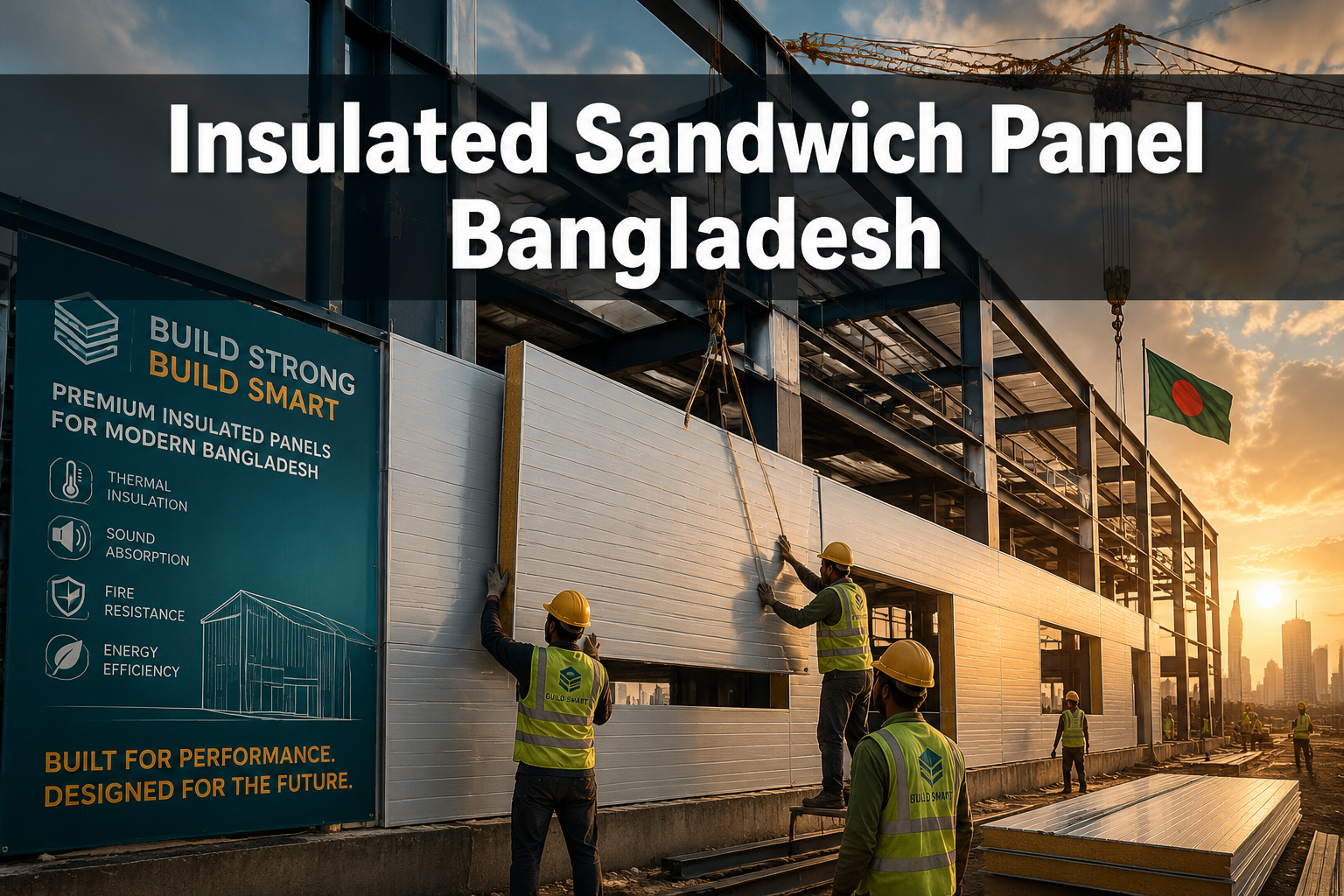
Last updated: May 15, 2026
Quick Answer
Insulated sandwich panels in Bangladesh are prefabricated building panels made of two metal face sheets bonded to an insulating core (typically EPS, PU, or rock wool). They are widely used in factories, cold storage facilities, clean rooms, and commercial buildings across Bangladesh because they cut construction time by 40–60% compared to conventional brick-and-mortar methods (industry estimate based on standard project timelines). Prices vary by core type, thickness, and supplier, but local manufacturers now offer competitive rates that make these panels accessible for mid-to-large scale projects.
Key Takeaways
- 🏗️ Three core types dominate the Bangladesh market: EPS (expanded polystyrene), PU/PIR (polyurethane), and rock wool — each suited to different applications.
- 💰 Cost varies significantly by panel thickness and core material; getting quotes from local sandwich panel manufacturers in Bangladesh is essential before budgeting.
- ⏱️ Installation is fast — a skilled crew can erect a sandwich panel structure in days rather than weeks.
- 🌡️ Thermal performance is the primary driver for most buyers, especially for cold storage and pharmaceutical facilities.
- 🔥 Fire rating matters — rock wool panels offer significantly better fire resistance than EPS panels.
- 📦 Local manufacturing has grown substantially, reducing lead times and import costs compared to five years ago.
- ✅ Quality certifications (ISO, fire rating tests) should be requested from any supplier before signing a contract.
- 🏭 Common applications include garment factories, food processing plants, cold rooms, prefab offices, and clean rooms.
- 📐 Custom sizing is available from most Bangladeshi manufacturers, which reduces on-site cutting waste.
What Is an Insulated Sandwich Panel and Why Does It Matter in Bangladesh?
An insulated sandwich panel is a three-layer building component: two rigid outer skins (usually galvanized steel or aluminum) with an insulating core material bonded between them. The result is a single panel that provides structural support, thermal insulation, and weather protection in one unit.
In Bangladesh, the construction sector has shifted toward these panels for several practical reasons:
- Climate demands — Bangladesh's hot, humid climate makes thermal insulation critical for energy efficiency in industrial and commercial buildings.
- Speed of construction — the RMG (ready-made garment) sector, pharmaceutical industry, and food processing sector all need fast, code-compliant facilities.
- Cost pressures — rising labor costs make faster installation methods economically attractive.
- Urban industrial growth — export processing zones (EPZs) in Dhaka, Chittagong, and Gazipur have driven demand for modular, scalable building systems.
Key point: Insulated sandwich panels are not just a construction trend in Bangladesh — they are increasingly a regulatory and operational necessity for industries with strict temperature, hygiene, or fire safety requirements.
What Types of Insulated Sandwich Panels Are Available in Bangladesh?
Bangladesh suppliers offer three main core types. Choosing the wrong one is one of the most common and costly mistakes buyers make.
| Core Type | Thermal Performance | Fire Resistance | Best For | Relative Cost |
|---|---|---|---|---|
| EPS (Expanded Polystyrene) | Good | Low (flammable) | Warehouses, general industrial | Lowest |
| PU/PIR (Polyurethane) | Excellent | Moderate | Cold storage, clean rooms | Medium |
| Rock Wool (Mineral Wool) | Good | Excellent | Pharmaceutical, food, fire-rated zones | Highest |
Choose EPS if: budget is the primary constraint and fire risk is low (e.g., a dry goods warehouse with proper fire suppression systems).
Choose PU/PIR if: the application requires maximum thermal efficiency, such as cold storage or controlled-temperature pharmaceutical facilities.
Choose rock wool if: fire safety compliance is non-negotiable — for example, garment factories, which face strict fire safety audits from international buyers.
Explore the full range of sandwich panel products available from local manufacturers to compare specifications before deciding.
How Much Do Insulated Sandwich Panels Cost in Bangladesh?
Pricing depends on panel thickness, core material, steel gauge, and order volume. The following are general market estimates for 2026 — actual quotes will vary by supplier and project scope.
Typical price influencers:
- Panel thickness: Ranges from 50mm to 200mm; thicker panels cost more but deliver better insulation.
- Steel skin thickness: 0.4mm to 0.6mm PPGI (pre-painted galvanized iron) is standard; heavier gauges cost more.
- Core material: Rock wool panels typically cost 20–35% more than equivalent EPS panels (market estimate).
- Order volume: Bulk orders of 1,000+ square meters usually attract better per-unit pricing.
- Custom fabrication: Non-standard dimensions or special coatings add to cost.
For accurate, project-specific pricing, check the current sandwich panel price in Bangladesh from verified local suppliers. Always compare at least three quotes and ensure they specify the same thickness and steel gauge for a fair comparison.
Common mistake: Comparing prices without specifying core density. Two EPS panels at the same thickness can have very different densities (and therefore very different insulation values and structural performance). Always ask for the core density in kg/m³.
Where Is Insulated Sandwich Panel Bangladesh Used Most?
The demand for insulated sandwich panels in Bangladesh is concentrated in specific sectors, each with distinct technical requirements.
Top application sectors:
- Garment and textile factories — Fast construction, fire-rated panels required for international compliance audits (ACCORD, Alliance successor programs).
- Cold storage and food processing — PU-core panels are standard; hygiene-grade interior finishes are often specified.
- Pharmaceutical manufacturing — Clean room panels with smooth, non-porous surfaces and validated thermal performance.
- Prefabricated offices and site cabins — Lightweight EPS panels work well for temporary or semi-permanent structures.
- Export processing zones (EPZs) — High volume, fast-track construction for new factory units.
- Poultry and aquaculture facilities — Moisture-resistant panels with proper vapor barriers.
For a closer look at how sandwich panels are used in room construction, see this guide on sandwich panel room applications in Bangladesh.
How Do You Choose a Reliable Insulated Sandwich Panel Manufacturer in Bangladesh?
Not all suppliers are equal. Bangladesh has seen rapid growth in local manufacturing, which is largely positive — but it also means quality varies widely.
Checklist for evaluating a supplier:
- ✅ Can they provide ISO certification or equivalent quality documentation?
- ✅ Do they offer fire test certificates for their panels?
- ✅ Can they supply reference projects (with contact details) in similar applications?
- ✅ Do they manufacture in-house or source panels from third parties?
- ✅ What is their production lead time and delivery reliability record?
- ✅ Do they provide installation support or technical drawings?
- ✅ Is their steel sourced from verified mills (BSRM, KSRM, or equivalent)?
For a detailed framework on evaluating suppliers, read this guide on choosing the best sandwich panel manufacturer and supplier for your construction needs.
Also, reviewing a manufacturer's client portfolio gives a practical sense of the scale and type of projects they have handled successfully.
What Are the Key Advantages and Limitations of Insulated Sandwich Panels in Bangladesh?
Advantages:
- Speed: Panels arrive pre-fabricated; on-site assembly is fast and requires fewer skilled workers than conventional construction.
- Thermal efficiency: Dramatically reduces cooling and heating loads — critical for Bangladesh's climate and rising energy costs.
- Lightweight: Reduces structural load, which can lower foundation costs.
- Hygienic surfaces: Smooth steel faces are easy to clean, which is important for food and pharma applications.
- Scalability: Buildings can be extended or reconfigured more easily than brick structures.
Limitations:
- Not load-bearing in isolation: Sandwich panels require a steel or concrete structural frame; they are cladding and infill, not primary structure (in most standard systems).
- Moisture vulnerability at joints: Poorly installed joints can allow water ingress, leading to core degradation over time. Proper sealing is critical.
- Fire risk with EPS: EPS-core panels should not be used in high fire-risk environments without additional fire suppression measures.
- Maintenance: Surface coatings can degrade in Bangladesh's coastal and high-humidity zones; re-coating may be needed after 10–15 years.
- Upfront cost vs. brick: Initial material cost per square meter can be higher than brick for simple structures, though total project cost (including labor and time) is usually lower.
What Should You Know About Installation of Insulated Sandwich Panels in Bangladesh?
Correct installation is where many projects succeed or fail. Even high-quality panels underperform if installed poorly.
Key installation steps:
- Structural frame completion — Ensure the steel or concrete frame is plumb, level, and dimensionally accurate before panels arrive.
- Panel handling — Panels must be lifted and stored correctly to avoid face sheet damage or core delamination.
- Joint sealing — All longitudinal and transverse joints must be sealed with approved sealant or tape; this is the most commonly skipped step.
- Fastener specification — Use manufacturer-specified self-drilling screws with EPDM washers; under-fastening is a common site error.
- Vapor barrier continuity — For cold storage and clean rooms, vapor barrier continuity at all penetrations is essential.
- Inspection before handover — Check all joints, penetrations (for pipes, cables, doors), and panel surfaces before the building is commissioned.
Edge case: In coastal areas of Bangladesh (Chittagong, Cox's Bazar), specify panels with a higher-grade PVDF or SMP coating rather than standard polyester to resist salt air corrosion.
FAQ: Insulated Sandwich Panel Bangladesh
Q: What is the lifespan of an insulated sandwich panel building in Bangladesh?
A: With proper installation and maintenance, sandwich panel structures typically last 20–30 years. The steel frame often outlasts the panel skins, which may need re-coating after 10–15 years in humid or coastal environments.
Q: Can sandwich panels be used for roofing in Bangladesh?
A: Yes. Roof sandwich panels are a separate product with a trapezoidal or standing-seam profile designed for water drainage. They are widely used in industrial buildings across Bangladesh.
Q: Are insulated sandwich panels suitable for Bangladesh's cyclone-prone coastal regions?
A: They can be, but the structural frame must be engineered to local wind load requirements. The panels themselves are not the limiting factor — the connection to the frame is. Always use a structural engineer familiar with BNBC (Bangladesh National Building Code) wind load provisions.
Q: How long does it take to construct a 5,000 sq ft factory using sandwich panels in Bangladesh?
A: A typical 5,000 sq ft single-story industrial building with a pre-engineered steel frame and sandwich panel cladding can be erected in 4–8 weeks after the foundation is ready (estimate based on standard project timelines; actual duration depends on design complexity and crew size).
Q: Do local manufacturers in Bangladesh offer custom panel sizes?
A: Most established manufacturers offer custom lengths (up to 12 meters or more) and can accommodate non-standard widths. Confirm lead times for custom orders, as they typically take longer than standard stock sizes.
Q: What thickness is recommended for cold storage panels in Bangladesh?
A: For cold storage applications in Bangladesh's climate, 100mm PU-core panels are a common starting point for rooms operating at 0–5°C. Rooms operating at -18°C or below typically require 150mm or 200mm panels. An insulation engineer should calculate the exact specification.
Q: Is there a local standard or certification for sandwich panels in Bangladesh?
A: Bangladesh follows BNBC for building construction. For sandwich panels specifically, buyers often reference international standards (BS EN 14509 for European-spec panels) or require third-party fire test certificates. Ask suppliers for their specific test documentation.
Q: Can sandwich panels be recycled or reused?
A: Steel face sheets are recyclable. EPS and PU cores have limited recyclability in Bangladesh's current waste management infrastructure. Rock wool can be reused if panels are carefully dismantled. Reuse of intact panels is possible if they are removed without damage.
Q: Where can I see completed sandwich panel projects in Bangladesh?
A: Reputable manufacturers maintain project portfolios. Reviewing a supplier's completed projects gives a realistic sense of their capabilities and finish quality.
Q: What is the minimum order quantity for sandwich panels in Bangladesh?
A: This varies by manufacturer. Some suppliers will fulfill small orders (under 100 sq m) for cold room or prefab office projects, while others focus on large industrial orders. Check directly with suppliers through their contact page.
Conclusion: Actionable Next Steps for Buyers in Bangladesh
Insulated sandwich panels are one of the most practical building solutions available in Bangladesh in 2026 — particularly for industrial, commercial, and temperature-controlled applications. The local manufacturing base is mature enough to support most project types, and lead times have improved significantly compared to even three years ago.
Here is what to do next:
- Define your application first — cold storage, clean room, factory, or office? The application determines the correct core type and thickness before any price comparison makes sense.
- Get at least three quotes — specify the same panel thickness, core type, core density, and steel gauge in every RFQ so you are comparing equivalent products.
- Verify supplier credentials — request ISO certificates, fire test reports, and at least two reference project contacts before committing.
- Budget for installation — panel cost is typically 60–70% of total installed cost; factor in frame, fasteners, sealants, and labor.
- Plan for maintenance — schedule a surface inspection every 3–5 years, especially in coastal or high-humidity locations.
For further reading, explore the sandwich panel blog for technical updates, application case studies, and market developments relevant to the Bangladesh construction sector.
References
- Bangladesh National Building Code (BNBC), 2020. Government of Bangladesh, Ministry of Housing and Public Works.
- BS EN 14509:2013 — Self-supporting double skin metal faced insulating panels. British Standards Institution, 2013.
- International Finance Corporation (IFC). Green Buildings in Emerging Markets. IFC, 2022. https://www.ifc.org