

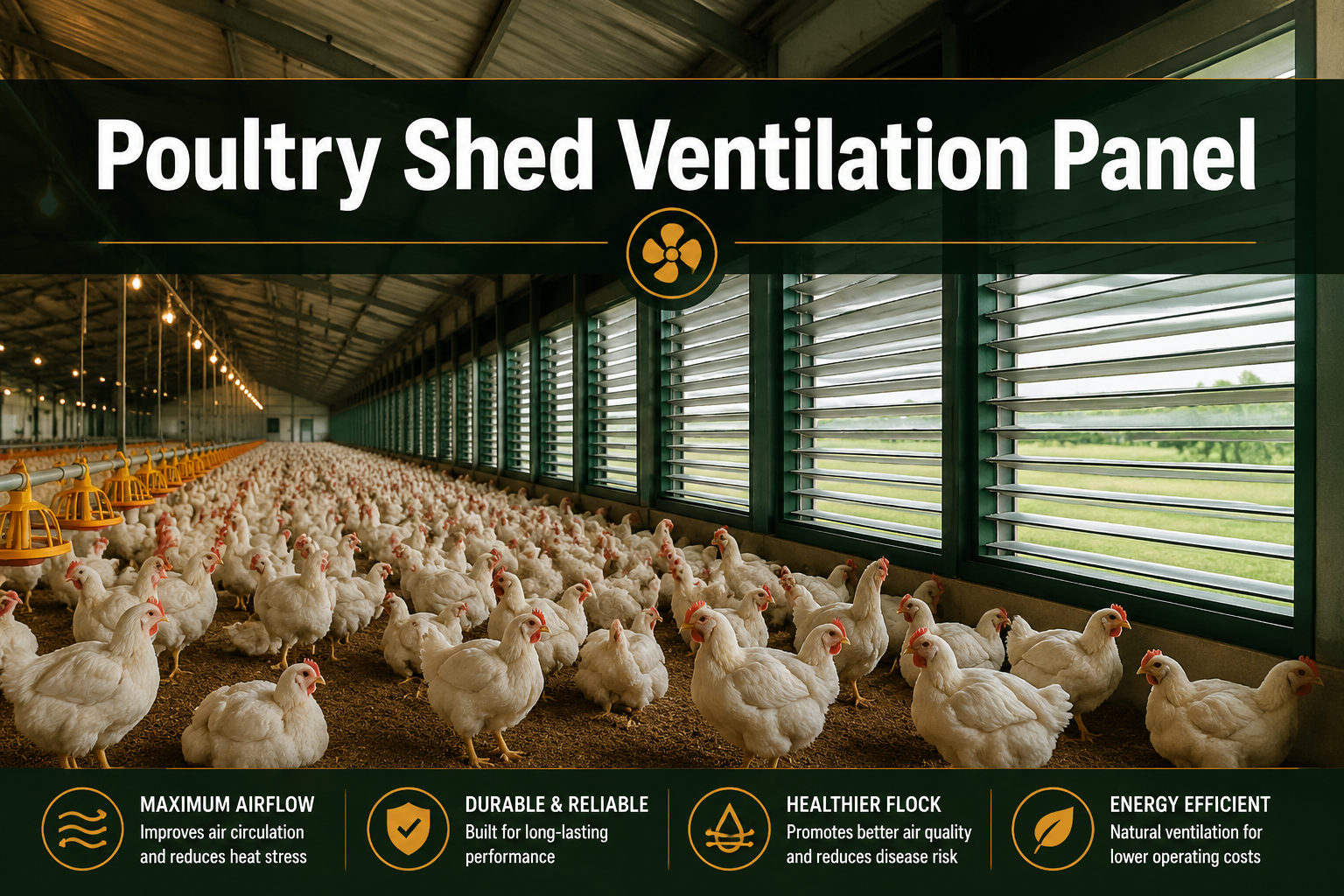
A 1°C rise in internal shed temperature above the thermal comfort zone can reduce broiler weight gain by up to 5% — and poor ventilation is the leading cause of dangerous heat buildup in commercial poultry houses. The poultry shed ventilation panel sits at the center of this challenge, acting as the first line of defense against heat stress, ammonia buildup, and respiratory disease. Choosing, sizing, and maintaining the right ventilation panels can mean the difference between a thriving flock and devastating production losses.
Key Takeaways 📌
- A properly designed poultry shed ventilation panel controls temperature, humidity, and air quality simultaneously.
- Panel material, size, and placement all directly affect flock health and feed conversion ratios.
- Insulated sandwich panels used alongside ventilation panels dramatically reduce energy costs.
- Tunnel ventilation systems paired with quality panels are the gold standard for large-scale broiler and layer houses.
- Regular maintenance of ventilation panels prevents disease outbreaks and extends panel lifespan by years.
What Is a Poultry Shed Ventilation Panel?
A poultry shed ventilation panel is a purpose-built building component installed in the walls or roof of a poultry house to regulate airflow, temperature, and humidity. Unlike a simple opening or window, a ventilation panel is engineered to:
- Allow controlled air exchange
- Block rain, pests, and predators
- Provide adjustable airflow rates
- Integrate with mechanical or natural ventilation systems
These panels come in several forms: louvered side-wall panels, curtain-drop panels, ridge ventilation panels, and inlet baffle panels. Each type serves a specific function depending on the shed's design, climate, and flock density.
💡 Pull Quote: "Ventilation is not just about fresh air — it is about removing heat, moisture, ammonia, carbon dioxide, and dust that silently erode flock performance every single day."
Why Ventilation Panels Matter More Than Most Farmers Realize
The Hidden Cost of Poor Airflow
Many producers focus on feed quality and genetics while underestimating the structural role of ventilation. Research consistently shows that ammonia concentrations above 25 ppm damage the respiratory tracts of poultry, making birds far more susceptible to Newcastle disease, infectious bronchitis, and Marek's disease.
Poor ventilation also creates moisture-laden litter, which accelerates the growth of Clostridium perfringens (causing necrotic enteritis) and Eimeria species (causing coccidiosis). Both conditions are among the top five causes of economic loss in commercial poultry production worldwide.
Key Environmental Parameters Ventilation Panels Must Manage
| Parameter | Ideal Range | Risk Threshold |
|---|---|---|
| Temperature (broilers) | 18–24°C | >28°C = heat stress |
| Relative Humidity | 50–70% | >75% = litter problems |
| Ammonia (NH₃) | <10 ppm | >25 ppm = respiratory damage |
| CO₂ | <2,500 ppm | >3,000 ppm = immune suppression |
| Air Speed at bird level | 0.2–2.5 m/s | >3 m/s = cold stress |
Types of Poultry Shed Ventilation Panels
1. 🔲 Louvered Side-Wall Panels
The most common type. Fixed or adjustable louvers allow air to enter at a controlled angle, preventing direct drafts on birds. Aluminum or galvanized steel louvers are preferred for their corrosion resistance and ease of cleaning.
2. 🪟 Curtain-Drop Ventilation Panels
Popular in naturally ventilated tropical and subtropical sheds. A heavy-duty curtain (often polypropylene or canvas) rolls up or drops down to adjust the size of the opening. Simple, low-cost, and effective for warm climates.
3. 🏠 Ridge Ventilation Panels
Installed at the roof peak, these panels allow hot air — which naturally rises — to escape. They work best in combination with side-wall inlets to create a stack effect or chimney-style airflow pattern.
4. ⚙️ Mechanical Inlet Baffle Panels
Used in tunnel ventilation systems, these motorized panels open and close automatically based on thermostat or sensor readings. They offer the highest level of environmental control and are essential for high-density, climate-controlled sheds.
Choosing the Right Poultry Shed Ventilation Panel: Key Factors
Climate and Geographic Location
In hot, humid climates (such as Bangladesh, Southeast Asia, or sub-Saharan Africa), maximum airflow capacity is the priority. Tunnel ventilation with large inlet panels and powerful exhaust fans is the preferred approach. In temperate climates, a minimum ventilation system that operates even in winter to remove moisture and ammonia is equally critical.
Flock Density and Bird Type
| Bird Type | Recommended Air Volume | Panel System |
|---|---|---|
| Broilers (high density) | 5–7 m³/hr per kg live weight | Tunnel + mechanical inlets |
| Layer hens | 4–6 m³/hr per kg | Cross-ventilation or tunnel |
| Breeders | 4–5 m³/hr per kg | Controlled environment |
| Turkeys | 6–8 m³/hr per kg | High-capacity tunnel |
Panel Material Selection
The material of the ventilation panel affects durability, hygiene, and thermal performance:
- Galvanized steel louvers — Durable, cost-effective, widely used
- Aluminum frames — Lightweight, corrosion-resistant, ideal for humid environments
- HDPE plastic panels — Easy to clean, chemical-resistant, hygienic
- Composite/sandwich panel surrounds — Excellent insulation around ventilation openings
For the structural walls surrounding ventilation openings, insulated sandwich panels are the industry benchmark. Reviewing a complete guide to poultry farm sandwich panels can help producers understand how wall panel selection interacts with ventilation design.
Integrating Ventilation Panels with Insulated Wall Systems
Why Wall Insulation and Ventilation Work Together
A ventilation panel installed in a poorly insulated wall loses much of its effectiveness. Heat conducts through uninsulated walls, raising the internal temperature regardless of airflow rate. This forces ventilation systems to work harder, consuming more energy and still failing to maintain comfort zones.
Insulated sandwich panels used for the main wall structure create a thermal barrier that:
- Reduces radiant heat gain from the sun
- Keeps internal temperatures stable between ventilation cycles
- Lowers the energy demand of mechanical fans
Selecting the best sandwich panel for a poultry farm involves matching the panel's thermal resistance (R-value) to the local climate and the ventilation system's capacity.
Panel Thickness and Thermal Performance
Thicker insulation cores reduce heat transfer significantly. For poultry sheds in tropical climates, a minimum of 75mm EPS or 50mm PU core is recommended for wall panels. Understanding how to choose sandwich panel thickness is a practical starting point for any new shed construction or retrofit project.
💡 Pull Quote: "The ventilation panel and the wall panel are not separate decisions — they are two parts of the same climate control system."
Designing a Poultry Shed Ventilation Panel System: Step-by-Step
Step 1: Calculate the Required Air Exchange Rate
Use the formula:
Total CFM required = (Number of birds × live weight kg × air volume m³/hr) ÷ 60
Convert to the fan and panel capacity needed to achieve this exchange rate at peak summer conditions.
Step 2: Determine Inlet-to-Exhaust Ratio
For tunnel ventilation, the inlet area should be 1.25× the exhaust fan area to maintain a slight negative pressure inside the shed. This negative pressure ensures air is drawn in through the ventilation panels in a controlled, uniform manner.
Step 3: Position Panels for Uniform Airflow
- Place inlet panels at the opposite end from exhaust fans in tunnel systems
- Space side-wall inlets evenly along the length of the shed
- Avoid placing inlets directly above bird resting areas to prevent cold drafts
Step 4: Select Automation Level
Manual curtain systems suit small-scale farms with lower capital budgets. Automated sensor-driven inlet panels suit large commercial operations where labor costs and production scale justify the investment.
Step 5: Plan for Biosecurity
All ventilation panel openings must include bird-proof mesh (minimum 12mm galvanized wire mesh) to prevent wild bird entry — a critical biosecurity requirement for avian influenza prevention. Panels should also be designed for easy removal and cleaning during flock changeovers.
Maintenance of Poultry Shed Ventilation Panels
Neglected ventilation panels are a silent productivity killer. Dust, feathers, and biofilm accumulate on louvers and mesh, reducing airflow by 20–40% within a single production cycle.
Maintenance Schedule
| Task | Frequency |
|---|---|
| Visual inspection of all panels | Weekly |
| Brush/blow dust from louver surfaces | Every flock changeover |
| High-pressure wash with disinfectant | Between every flock |
| Lubricate mechanical actuators | Every 3 months |
| Replace damaged mesh or louvers | As needed |
| Full system airflow test | Annually |
For broader guidance on keeping panel systems in top condition, the complete guide to sandwich panel maintenance provides detailed protocols applicable to poultry shed environments.
Common Mistakes to Avoid with Poultry Shed Ventilation Panels
❌ Undersizing inlet panels — Creates high-velocity cold jets that chill birds near inlets while the rest of the shed remains hot.
❌ Ignoring roof ventilation — Heat stratifies near the ceiling; without ridge panels or roof exhausts, temperature gradients become extreme.
❌ Using non-hygienic materials — Porous or rough-surfaced panels harbor bacteria and are nearly impossible to fully disinfect. Smooth, antibacterial wall panels are strongly recommended for surfaces near ventilation openings.
❌ Blocking panels with equipment — Feed lines, water lines, and electrical conduits are often routed in ways that partially obstruct ventilation panels, reducing their effective area.
❌ Skipping seasonal adjustments — A panel configuration optimal for summer may cause dangerous cold stress in winter. Seasonal adjustment protocols must be documented and followed.
Poultry Shed Ventilation Panel Costs and ROI
Typical Cost Ranges (2026)
| Panel Type | Cost per Unit (Approx.) | Lifespan |
|---|---|---|
| Manual curtain panel (3m wide) | $80–$150 | 5–8 years |
| Fixed aluminum louvered panel | $120–$250 | 15–20 years |
| Motorized inlet baffle panel | $300–$600 | 10–15 years |
| Ridge vent panel (per linear meter) | $40–$90 | 20+ years |
Return on Investment
Studies from commercial broiler operations consistently show that upgrading from basic curtain ventilation to a properly designed tunnel ventilation system with quality panels delivers:
- 3–5% improvement in feed conversion ratio (FCR)
- 4–8% reduction in mortality rates
- 10–15% reduction in cooling energy costs when paired with insulated walls
- Payback period typically 18–36 months for large-scale operations
For producers evaluating the full construction cost of a new shed, understanding thermal insulation sandwich panel options in Bangladesh provides useful benchmarking data for the wall and roof components that work alongside ventilation panels.
Poultry Shed Ventilation Panel: Regulatory and Biosecurity Considerations
In 2026, regulatory pressure on commercial poultry operations continues to tighten globally. Key compliance areas related to ventilation panels include:
- Animal welfare codes — Minimum air exchange rates are legally mandated in many jurisdictions
- Avian influenza prevention — Wild bird exclusion through mesh on all openings is non-negotiable
- Environmental regulations — Ammonia emissions from poultry sheds are subject to limits in the EU, UK, and increasingly in Asia
Producers building new sheds should consult local agricultural authorities and ensure their ventilation panel specifications are documented as part of the building permit application.
Conclusion: Actionable Next Steps for Poultry Producers
The poultry shed ventilation panel is not a commodity component — it is a precision tool that directly determines flock health, feed efficiency, and profitability. Here is a practical action plan for 2026:
- Audit existing panels — Measure actual airflow rates against design specifications. Many sheds operate at 60–70% of intended capacity due to panel degradation.
- Match panels to wall insulation — Upgrade wall panels to insulated sandwich panels if the current structure lacks adequate thermal resistance. Review the best sandwich panel options for poultry farms to find the right specification.
- Invest in automation — If managing more than 20,000 birds, motorized inlet panels with thermostat control deliver measurable ROI within two production cycles.
- Implement a maintenance schedule — Treat ventilation panel cleaning as a biosecurity event, not a cosmetic task.
- Consult a specialist — Work with a qualified poultry house engineer to model airflow patterns before finalizing panel placement in new builds or major renovations.
Healthy birds start with clean air. And clean air starts with the right ventilation panel system.
References
- Czarick, M., & Fairchild, B. (2012). Poultry Housing Tips: Tunnel Ventilation. University of Georgia Cooperative Extension.
- Yahav, S. (2015). Alleviating heat stress in domestic fowl: different strategies. World's Poultry Science Journal, 71(3), 481–492.
- Gates, R. S., Xin, H., & Casey, K. D. (2009). Method for measuring ammonia emissions from poultry houses. Journal of the Air & Waste Management Association, 59(2), 214–228.
- Aviagen. (2018). Ross Broiler Management Handbook. Aviagen Group.
- Tabler, T., & Berry, I. (2011). Ventilation for Broiler Production Houses. Mississippi State University Extension Service.