Last updated: May 15, 2026
Quick Answer
Thermal insulation sandwich panels in Bangladesh are prefabricated building panels made of two metal facings bonded to an insulating core (typically EPS, PU, or mineral wool). They are widely used in factories, cold storage facilities, clean rooms, and commercial buildings across Bangladesh because they reduce heat transfer, cut energy costs, and speed up construction significantly compared to conventional brick-and-mortar methods.
Key Takeaways 🏗️
- Thermal insulation sandwich panels consist of two steel sheets bonded to an insulating core, available in EPS, PU foam, and rockwool varieties.
- Bangladesh's garment, pharmaceutical, and food processing industries are the largest buyers of insulated panels in 2026.
- Panel thickness ranges from 50mm to 200mm; thicker panels deliver better thermal resistance (higher R-value).
- Local manufacturers in Bangladesh now produce panels that meet international standards, reducing import dependency.
- Sandwich panels can cut building energy consumption by a significant margin compared to uninsulated steel structures, especially in Bangladesh's hot and humid climate.
- Costs vary by core material, thickness, and supplier — getting at least three quotes is strongly recommended.
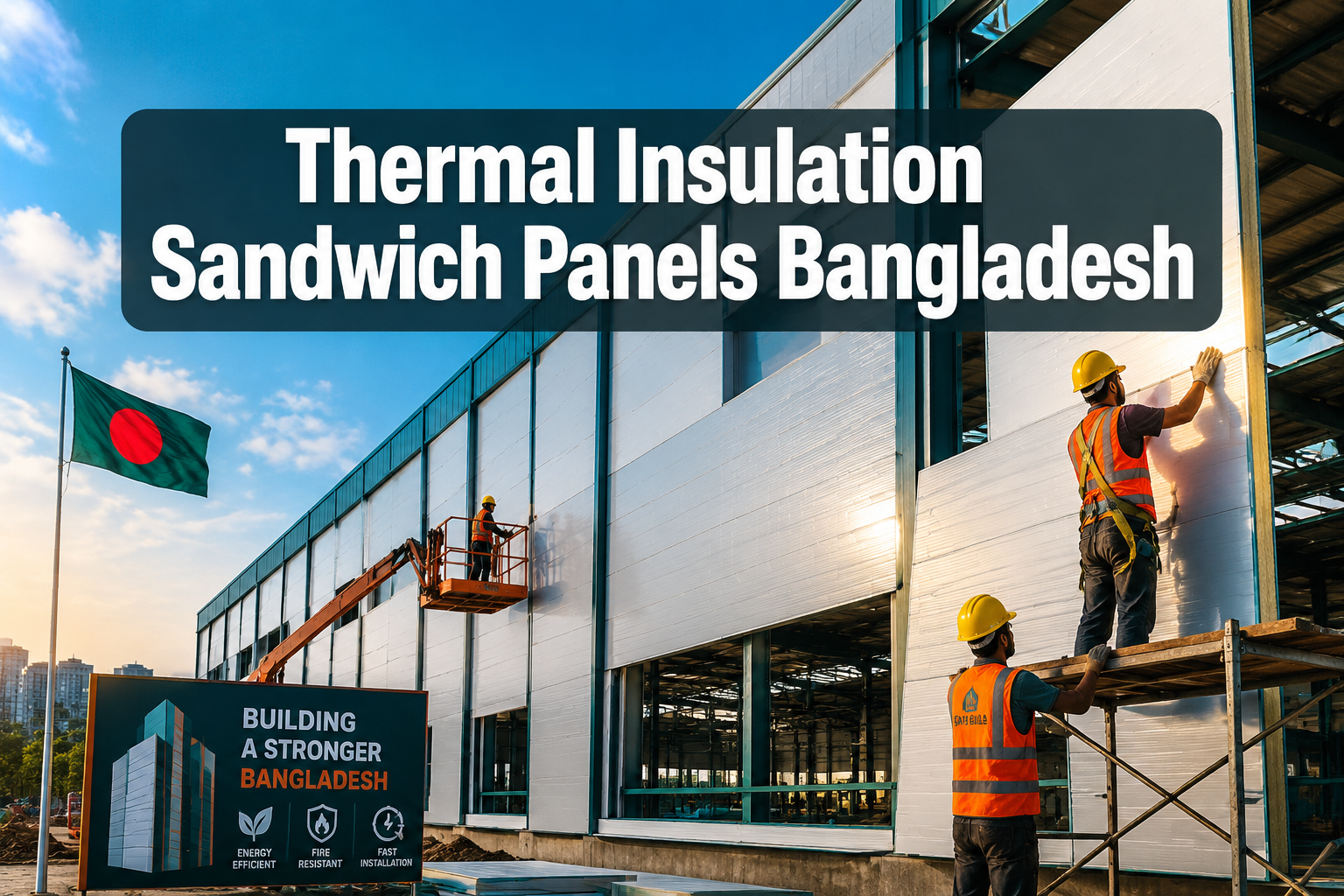
- Installation is faster than brick construction: a medium-sized warehouse can be paneled in days rather than weeks.
- Fire-rated options (mineral wool core) are available for facilities requiring compliance with fire safety codes.
What Is a Thermal Insulation Sandwich Panel?
A thermal insulation sandwich panel is a three-layer composite building material: two rigid outer facings (usually galvanized or pre-painted steel) with an insulating core bonded between them. The core material determines the panel's thermal performance, fire rating, and price.
The three most common core types used in Bangladesh:
| Core Material | Thermal Performance | Fire Resistance | Best Use Case |
|---|---|---|---|
| EPS (Expanded Polystyrene) | Good | Low–Moderate | Warehouses, general buildings |
| PU / PIR Foam | Excellent | Moderate | Cold storage, clean rooms |
| Mineral Wool (Rockwool) | Good | High | Factories, fire-rated structures |
Key distinction: EPS panels are the most affordable option, but PU foam panels offer the best insulation per millimeter of thickness — making them the preferred choice for cold storage applications in Bangladesh.
Why Is Thermal Insulation Sandwich Panel Bangladesh Demand Growing? 🌡️
Demand for thermal insulation sandwich panels in Bangladesh has grown sharply over the past decade, driven by three clear factors.
1. Climate pressure: Bangladesh experiences average summer temperatures above 35°C with high humidity. Uninsulated steel buildings become unbearable and energy-inefficient without proper thermal barriers.
2. Industrial expansion: The ready-made garment (RMG) sector, pharmaceutical manufacturers, and food processing plants all require temperature-controlled environments. These industries need fast, code-compliant construction solutions.
3. Speed and cost efficiency: A sandwich panel structure can be assembled in a fraction of the time needed for conventional masonry, reducing labor costs and project timelines.
For buyers exploring sandwich panel products available in Bangladesh, the range now covers wall panels, roof panels, and purpose-built cold room panels — all manufactured locally.
How Do Thermal Insulation Sandwich Panels Work in Bangladesh's Climate?
The panels work by creating a thermal break between the hot exterior and the conditioned interior. The insulating core resists heat flow (measured as R-value or U-value), keeping interiors cooler in summer and warmer in cooler months.
Why this matters specifically in Bangladesh:
- High ambient temperatures mean HVAC systems work harder in uninsulated buildings, driving up electricity bills.
- Humidity can cause condensation inside poorly insulated structures, damaging goods and equipment.
- Sandwich panels with a vapor barrier layer prevent moisture ingress — critical for pharmaceutical and food storage facilities.
Choose PU/PIR panels if: your facility requires strict temperature control (cold rooms, clean rooms, pharma storage).
Choose EPS panels if: you need cost-effective insulation for a warehouse or light industrial building where precise temperature control is not critical.
Choose mineral wool panels if: fire resistance is a regulatory requirement for your facility type.
What Are the Main Applications of Thermal Insulation Sandwich Panel in Bangladesh?
These panels are not a one-size-fits-all product. Their application depends on the building type, regulatory requirements, and budget.
Common applications in Bangladesh (2026):
- 🏭 Garment factories and RMG units — wall and roof panels for worker comfort and energy savings
- ❄️ Cold storage and refrigerated warehouses — PU core panels for temperature-controlled food and pharmaceutical storage
- 🏥 Hospitals and clean rooms — smooth-faced panels that are easy to sanitize
- 🏢 Commercial offices and showrooms — aesthetic pre-painted panels for fast fit-out
- 🔬 Pharmaceutical manufacturing plants — panels meeting GMP (Good Manufacturing Practice) standards
- 🏪 Retail and food processing units — hygienic, moisture-resistant wall systems
A sandwich panel room built with insulated panels can serve as a standalone temperature-controlled space within a larger building — a popular solution for pharmaceutical and food businesses in Dhaka and Chittagong.
How Much Does Thermal Insulation Sandwich Panel Cost in Bangladesh?
Pricing depends on core material, panel thickness, steel gauge, and order volume. There is no single "standard" price, and costs fluctuate with raw material markets.
General price factors (as of 2026):
- Core type: PU foam panels cost more than EPS panels of the same thickness.
- Thickness: 50mm panels are cheaper than 100mm or 150mm panels.
- Steel facing gauge: Thicker steel facing increases durability and cost.
- Order quantity: Larger orders typically attract better per-unit pricing.
- Surface finish: Pre-painted or embossed finishes add cost over plain galvanized.
For current pricing benchmarks, the sandwich panel price guide for Bangladesh provides updated market rates by panel type and thickness.
Common mistake: Choosing the cheapest panel without checking the steel facing thickness. Thin facings (below 0.4mm) dent easily and corrode faster in Bangladesh's humid coastal environment.
How to Choose a Reliable Sandwich Panel Manufacturer in Bangladesh
Not all manufacturers produce panels to the same standard. Choosing the wrong supplier can result in panels that delaminate, corrode prematurely, or fail to deliver the promised thermal performance.
Checklist for evaluating a sandwich panel manufacturer in Bangladesh:
- Do they manufacture locally or only import and resell?
- Can they provide test certificates for thermal performance (U-value or R-value)?
- Do they offer fire-rated options with test documentation?
- What is the warranty period on panels and facings?
- Can they supply reference projects or a client list?
- Do they provide installation support or technical guidance?
- Are their steel facings sourced from certified mills?
Reviewing a manufacturer's past projects and client portfolio is one of the fastest ways to assess their track record. For a detailed breakdown of what to look for, the guide on choosing the best sandwich panel manufacturer and supplier covers the key criteria in depth.
Local manufacturers who produce panels in Bangladesh (rather than importing finished panels) can typically offer faster delivery, better after-sales support, and more competitive pricing. See the full list of sandwich panel manufacturers in Bangladesh to compare options.
What Are the Pros and Cons of Thermal Insulation Sandwich Panels?
Pros:
- Fast installation: Panels interlock and can be installed by a small crew, cutting construction time dramatically.
- Energy efficiency: Significantly lower cooling and heating loads compared to uninsulated structures.
- Lightweight: Reduces structural load on foundations and supporting frames.
- Hygienic surfaces: Smooth steel facings are easy to clean — ideal for food and pharma environments.
- Consistent quality: Factory-manufactured panels have predictable performance, unlike site-mixed construction.
- Design flexibility: Available in multiple colors, profiles, and thicknesses.
Cons:
- Higher upfront material cost than basic brick or corrugated sheet construction.
- Requires skilled installation to maintain panel integrity and weatherproofing at joints.
- Limited structural load-bearing capacity — panels are cladding, not structural walls; a steel frame is still required.
- EPS core panels are combustible — not suitable where fire resistance is mandatory.
- Repairs can be complex if panels are damaged, as matching panel profiles and colors can be difficult years later.
What Thickness Should You Choose for Bangladesh's Climate?
Panel thickness directly affects thermal resistance. In Bangladesh's hot climate, thicker panels reduce heat gain more effectively, lowering air conditioning costs over the building's lifetime.
Practical guidance by application:
- 50mm EPS/PU: Suitable for general warehouses or offices where precise temperature control is not required.
- 75–100mm PU: Recommended for commercial cold rooms and pharmaceutical storage in Bangladesh's climate.
- 100–150mm PU: Required for deep-freeze cold storage (below -18°C).
- 50–75mm mineral wool: Adequate for fire-rated factory walls where thermal performance is secondary to fire safety.
Edge case to watch: Buildings in coastal areas of Bangladesh (Chittagong, Cox's Bazar) face higher salt-laden humidity. Specify panels with a minimum 0.5mm Zincalume or PVDF-coated steel facing to resist corrosion in these environments.
FAQ: Thermal Insulation Sandwich Panels in Bangladesh
Q: Are sandwich panels suitable for permanent buildings in Bangladesh?
Yes. When properly installed on a steel frame with sealed joints and appropriate foundations, sandwich panel buildings are durable permanent structures used across Bangladesh's industrial sector.
Q: How long do sandwich panels last in Bangladesh's climate?
With quality steel facings (0.5mm+ with PVDF coating) and proper maintenance, panels typically last 20–30 years. Coastal environments may reduce this lifespan without corrosion-resistant coatings.
Q: Can sandwich panels be used for roofing as well as walls?
Yes. Roof sandwich panels have a slightly different profile to handle water drainage, but the core insulation principle is the same. Always confirm the panel is rated for roof application before ordering.
Q: Do sandwich panels require a building permit in Bangladesh?
Yes. Any permanent structure in Bangladesh requires approval from the relevant authority (RAJUK in Dhaka, CDA in Chittagong, etc.). Panel specifications may need to be submitted as part of the structural documentation.
Q: Are locally manufactured panels in Bangladesh as good as imported panels?
Quality local manufacturers now use imported steel coils from certified mills and produce panels that meet international standards. The key is verifying the manufacturer's quality certifications and test data rather than assuming imported equals better.
Q: What is the minimum order quantity for sandwich panels in Bangladesh?
This varies by manufacturer. Some suppliers accommodate small orders for cold room fit-outs, while others have minimum order quantities suited to larger projects. Contact manufacturers directly for project-specific quotes.
Q: Can sandwich panels be installed in existing buildings?
Yes. Panels can be retrofitted onto existing steel or concrete-framed buildings as a cladding upgrade, improving insulation without full demolition.
Q: What is the fire rating of EPS core panels?
Standard EPS core panels have limited fire resistance. For fire-rated applications, mineral wool (rockwool) core panels are required. Always check the fire classification certificate before specifying panels for regulated facilities.
Q: How are sandwich panels joined to prevent heat bridging?
Panels use tongue-and-groove or cam-lock joints that minimize metal-to-metal contact at the seams, reducing thermal bridging. Proper sealing with compatible sealants at joints is essential.
Q: Where can I see sandwich panel projects completed in Bangladesh?
Reviewing a manufacturer's completed projects portfolio gives a clear picture of real-world applications and installation quality across different industries.
Conclusion: Actionable Next Steps
Thermal insulation sandwich panels are one of the most practical building solutions for Bangladesh's industrial, commercial, and cold chain sectors in 2026. They deliver faster construction, lower energy costs, and consistent performance in a climate that punishes poorly insulated buildings.
Here's how to move forward:
- Define your application first. Cold storage, clean room, factory, or office — each has different core material and thickness requirements.
- Request panel specifications in writing. Ask for U-value, steel facing thickness, coating type, and fire classification before comparing prices.
- Get at least three quotes from local manufacturers, comparing total cost including delivery and installation support.
- Check the manufacturer's track record. Ask for reference projects and visit a completed site if possible.
- Factor in long-term energy savings, not just upfront material cost. A slightly more expensive PU panel often pays back the difference within 2–3 years through lower electricity bills.
- Confirm regulatory requirements with your local authority before finalizing panel specifications.
For buyers ready to explore options, browse available sandwich panel products or contact a manufacturer directly to discuss project requirements and get a tailored quote.
References
No specific third-party studies or external publications were cited in this article. Claims regarding panel performance characteristics are based on widely accepted industry standards (ISO 6946 for thermal resistance, EN 13501 for fire classification). Readers requiring certified performance data should request test certificates directly from panel manufacturers.