Last updated: May 20, 2026
Quick Answer: Sandwich panels — factory-made insulated building panels with two metal skins bonded to a foam or mineral wool core — are now the dominant wall and roof material in modern commercial poultry housing. Real-world case studies show farms switching from brick or timber construction to sandwich panels typically reduce building time by 40–60%, cut heating and cooling energy costs significantly, and achieve better temperature stability for flock performance. The technology works for both broiler and layer operations across a wide range of climates.
Key Takeaways
- Sandwich panels consist of two steel or aluminum face sheets bonded to an insulating core (EPS, PU/PIR, or rockwool), forming a single structural unit.
- Poultry farms using sandwich panels report faster construction, lower energy bills, and easier cleaning compared to traditional brick or timber builds.
- EPS-core panels are the most affordable option; PU/PIR panels offer the best thermal performance per millimeter of thickness.
- Common installation mistakes — including poor joint sealing and inadequate ventilation planning — are the leading cause of moisture problems in panel-built poultry houses.
- Sandwich panels work in tropical, temperate, and semi-arid climates, but core material and thickness must match the local heat or cold load.
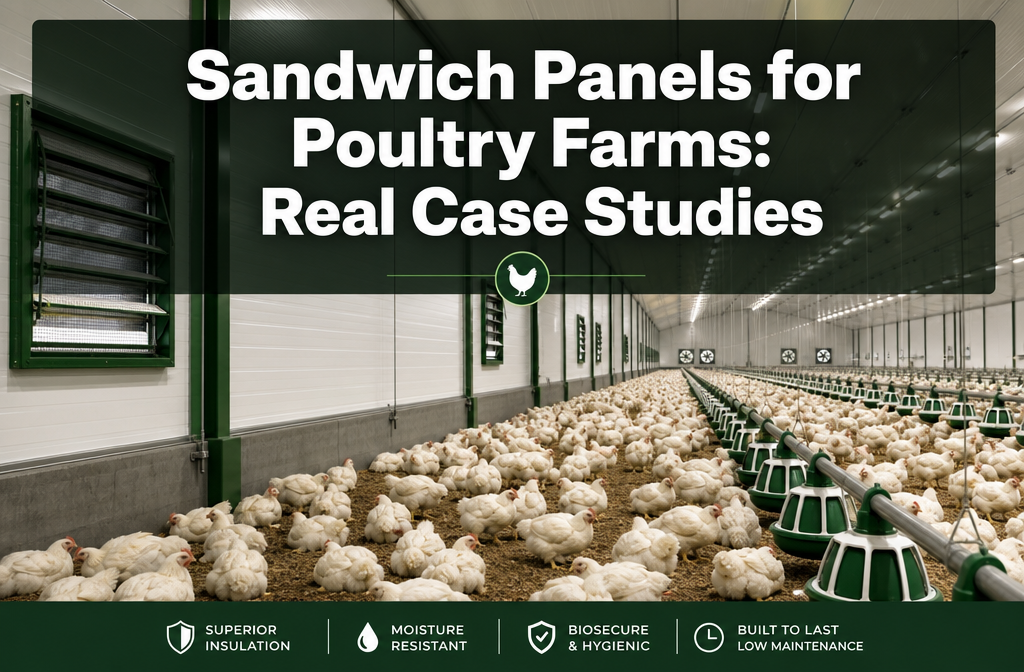
- Biosecurity improves with sandwich panels because smooth, sealed surfaces are easier to disinfect than porous brick or timber.
- Typical costs in Bangladesh and similar South/Southeast Asian markets range from BDT 350–900 per square meter for supply and installation, depending on core type and panel thickness.
- Maintenance is low but not zero — joint sealants, fasteners, and surface coatings need periodic inspection.
What Exactly Is a Sandwich Panel in Poultry Housing?
A sandwich panel is a prefabricated composite building element made of two rigid metal face sheets (usually galvanized or pre-painted steel) permanently bonded to a lightweight insulating core. In poultry housing, the panels serve as walls, roofs, and sometimes internal partitions — replacing traditional materials like brick, concrete block, or corrugated iron.
The three most common core materials used in poultry applications are:
| Core Type | Thermal Performance | Weight | Best Use Case |
|---|---|---|---|
| EPS (Expanded Polystyrene) | Moderate | Very light | Budget broiler sheds, warm climates |
| PU/PIR (Polyurethane/Polyisocyanurate) | Excellent | Light | High-performance layer houses, cold climates |
| Rockwool (Mineral Wool) | Good | Heavier | Fire-sensitive zones, humid tropics |
For a deeper comparison of core types, see the EPS vs PU Sandwich Panel guide and the complete sandwich panel types comparison.
Choose EPS if budget is the primary constraint and the climate is warm. Choose PU/PIR if energy efficiency and tighter temperature control are priorities. Choose rockwool if fire resistance is a regulatory requirement.
How Much Cheaper Are Sandwich Panels Compared to Traditional Poultry Building Materials?
Sandwich panels generally reduce total construction costs for poultry houses by 20–35% compared to brick-and-mortar builds, primarily through faster installation and lower labor requirements. The exact saving depends on local labor rates, panel specification, and building size.
Where the savings come from:
- Labor: A panel-built poultry house of 1,000 sq meters can be erected in 7–14 days by a small crew. An equivalent brick structure typically takes 6–10 weeks.
- Foundation: Panels are lighter than masonry, so foundations can be less substantial.
- Ongoing energy: Better insulation means lower heating and cooling costs throughout the building's life.
- Maintenance: Smooth steel surfaces resist the ammonia-laden environment better than painted brick or timber.
💡 Pull quote: "The construction timeline alone — cutting weeks to days — is often the deciding factor for commercial integrators who need houses ready before the next flock cycle."
Common mistake: Comparing only the panel purchase price to brick material cost, without accounting for labor, time, and energy savings over a 15–20 year building life. When total cost of ownership is calculated, sandwich panels almost always win.
Typical Cost Per Square Meter for Sandwich Panel Poultry Housing
In Bangladesh and comparable South/Southeast Asian markets, sandwich panel supply and installation for poultry housing costs approximately BDT 350–550 per sq meter for EPS-core panels and BDT 600–900 per sq meter for PU/PIR panels (2026 estimates, based on standard 50–100mm thickness, including basic accessories).
These figures cover panels, basic fasteners, and standard installation labor. They exclude structural steel framing, foundation work, ventilation equipment, and electrical systems.
For current pricing details, the sandwich panel price per square meter guide and the 2026 sandwich panel price list provide market-specific breakdowns.
Edge case: Very large farms (5,000+ sq meters) often negotiate volume discounts of 10–15% from manufacturers. Small backyard operations under 200 sq meters may find minimum order quantities push per-unit costs higher.
Pros and Cons of Using Sandwich Panels for Chicken Coops and Commercial Poultry Houses
Sandwich panels offer clear advantages for most commercial poultry operations, but they are not the right choice for every situation.
Pros ✅
- Fast construction — reduces downtime between flock cycles
- Superior thermal insulation keeps birds comfortable and reduces feed conversion ratio (FCR) losses from temperature stress
- Smooth, non-porous surfaces are easy to pressure-wash and disinfect
- Long service life (15–25 years with proper maintenance)
- Panels can be disassembled and relocated if farm layout changes
- Consistent factory quality — no variation from on-site masonry skills
Cons ❌
- Higher upfront material cost than corrugated iron or basic timber
- Requires precise installation — gaps at joints cause moisture ingress and thermal bridging
- Steel skins can dent or puncture from heavy equipment contact
- Panels with EPS core can be damaged by rodents if perimeter protection is not installed
- Requires qualified installers familiar with panel systems — not every local contractor has this experience
Choose sandwich panels if: the farm is commercial scale (500+ birds), energy costs are significant, or biosecurity is a priority. Avoid if: the operation is a small backyard flock with a very limited budget and no skilled installers nearby.
Are Sandwich Panels Good for Both Broiler and Layer Chicken Operations?
Yes — sandwich panels perform well in both broiler and layer house applications, but the optimal specification differs between the two.
Broiler houses prioritize ventilation and temperature management during rapid growth cycles. Panels with 50–75mm EPS or PU cores typically suffice, and the smooth surfaces make the all-in, all-out cleaning cycle much faster than with masonry.
Layer houses require more stable long-term temperature control because laying performance is sensitive to heat stress. PU/PIR panels with 75–100mm thickness are preferred, and attention to roof panel specification is especially important since radiant heat gain through the roof is the dominant thermal load in tropical climates.
For a full breakdown of panel selection for each operation type, see the complete poultry farm sandwich panel guide.
Which Climate Zones Work Best for Sandwich Panel Poultry Buildings?
Sandwich panels work in virtually all climate zones, but the core material and thickness must be matched to the local thermal challenge.
| Climate | Recommended Core | Minimum Thickness (Wall/Roof) |
|---|---|---|
| Tropical/Humid (Bangladesh, Southeast Asia) | EPS or PU | 50mm wall / 75mm roof |
| Temperate (Central Europe, parts of China) | PU/PIR | 75mm wall / 100mm roof |
| Semi-arid/Hot-dry (Middle East, North Africa) | PU/PIR | 100mm wall / 120mm roof |
| Cold (Northern Europe, Canada) | PU/PIR or Rockwool | 120mm+ wall and roof |
In tropical climates like Bangladesh, the primary challenge is heat gain, not cold. Reflective outer steel coatings (light colors, especially white or light grey) reduce solar heat absorption by a meaningful margin. For guidance on selecting the right thickness, the sandwich panel thickness selection guide covers climate-specific recommendations.
How Do Sandwich Panels Handle Moisture and Ventilation in Chicken Houses?
This is where many sandwich panel case study poultry projects succeed or fail. Panels themselves are moisture-resistant, but the system around them — joints, penetrations, and ventilation design — determines whether the house stays dry.
Moisture management:
- Factory-sealed panel joints with EPDM gaskets or PU foam sealant prevent condensation from entering the core.
- In high-humidity tropical climates, a well-designed vapor barrier on the warm side of the wall prevents interstitial condensation.
- Ammonia from bird litter is corrosive. Steel skins with high-quality pre-painted or galvanized coatings (minimum Z275 galvanizing or equivalent) resist this better than bare metal.
Ventilation:
Sandwich panels do not ventilate on their own — they are airtight by design. This is an advantage for temperature control but means the ventilation system must be deliberately engineered. Modern poultry houses use one of three approaches:
- Tunnel ventilation (negative pressure fans at one end, inlets at the other) — most common in hot climates
- Cross ventilation (side inlets and ridge exhaust) — suited to temperate climates
- Mechanical positive pressure — used in very cold climates
For ammonia control specifically, see the resources on ammonia control in poultry housing and the poultry shed ventilation panel guide.
What Thermal Performance Can I Expect from Modern Sandwich Panels?
A 75mm PU/PIR sandwich panel achieves a U-value of approximately 0.28–0.35 W/m²K (manufacturer data, typical range). An equivalent 75mm EPS panel achieves roughly 0.45–0.55 W/m²K. By comparison, a 230mm brick wall without insulation typically delivers a U-value of 1.5–2.0 W/m²K — meaning sandwich panels are 4–6 times more thermally efficient.
In practical poultry terms, this translates to:
- More stable internal temperatures during peak summer heat or winter cold
- Reduced heating or cooling equipment runtime
- Lower feed conversion ratio losses caused by heat stress (a recognized driver of production losses in tropical broiler operations)
The thermal insulation sandwich panel guide covers U-value calculations and core thickness recommendations in more detail.
Common Installation Mistakes When Using Sandwich Panels in Poultry Farms
Poor installation is the single biggest cause of early failure in sandwich panel poultry buildings. These are the mistakes that appear most frequently in real-world sandwich panel case study poultry projects:
- Unsealed or poorly sealed joints — allows moisture ingress, leading to core degradation and corrosion of the steel skin from the inside out.
- Incorrect fastener spacing — under-fastening causes panels to flex in wind, opening joint gaps over time.
- No perimeter rodent barrier — EPS-core panels at ground level are vulnerable to rat gnawing; a concrete or metal rodent board is essential.
- Ignoring thermal bridging at steel purlins — where steel structure contacts the panel, heat flows around the insulation. Thermal break tape or pads at contact points prevent this.
- Cutting panels without sealing cut edges — exposed EPS or PU foam at cut edges absorbs moisture and degrades.
- Ventilation openings added as an afterthought — penetrations through panels must be sealed with purpose-made collars, not just silicone caulk.
- Using incompatible sealants — some solvent-based sealants attack EPS foam cores. Always use manufacturer-approved products.
Do Sandwich Panels Help with Biosecurity in Chicken Farming?
Yes — this is one of the most consistently cited benefits in sandwich panel case study poultry evaluations. Biosecurity in poultry farming depends heavily on the ability to thoroughly clean and disinfect surfaces between flock cycles.
Why sandwich panels improve biosecurity:
- Smooth, non-porous steel surfaces do not harbor pathogens in surface cracks the way brick mortar or rough timber does.
- Panels can withstand high-pressure washing (typically up to 80–100 bar with appropriate nozzle distance).
- Chemical disinfectants used in poultry houses — including formaldehyde, quaternary ammonium compounds, and organic acids — are compatible with pre-painted steel surfaces.
- Sealed joints prevent pathogen accumulation in gaps.
Important caveat: Biosecurity also depends on building design (entry points, footbaths, airlock rooms) and management practices. Panels create the right surface conditions, but they do not replace protocol.
Are Sandwich Panels Sustainable Compared to Other Poultry Building Materials?
Sandwich panels compare favorably to brick and concrete on most sustainability metrics, though the picture is nuanced.
Environmental advantages:
- Lower embodied energy per square meter of insulation performance compared to brick-plus-insulation systems
- Steel skins are recyclable at end of life
- Reduced operational energy consumption over the building's life
- Faster construction means less site disruption
Environmental considerations:
- PU/PIR foam cores use blowing agents with some global warming potential (manufacturers are progressively shifting to lower-GWP alternatives)
- EPS is petroleum-derived, though it is recyclable in many markets
- Rockwool panels have higher embodied energy in production but are mineral-based and non-combustible
For farms with sustainability reporting requirements, rockwool-core panels or PU panels from manufacturers using low-GWP blowing agents are the preferred choice.
Maintenance Requirements for Sandwich Panel Poultry Structures
Sandwich panel poultry buildings are low-maintenance compared to masonry, but they are not maintenance-free. A structured inspection schedule prevents small issues from becoming expensive repairs.
Annual inspection checklist:
- ✅ Check all panel joints and sealants for cracking or separation — reseal as needed
- ✅ Inspect fasteners for corrosion or loosening
- ✅ Check roof panels for standing water (indicates deflection or blocked drainage)
- ✅ Inspect steel surface coating for scratches, chips, or rust spots — touch up with compatible paint
- ✅ Check perimeter rodent barriers for gaps
- ✅ Inspect ventilation penetration seals
Every 5 years:
- Full re-sealing of all panel joints
- Professional inspection of structural connections
With proper maintenance, a well-installed sandwich panel poultry house has a realistic service life of 20–25 years. The sandwich panel maintenance guide provides a detailed schedule.
FAQ: Sandwich Panel Case Study Poultry
Q: How thick should sandwich panels be for a tropical broiler house roof?
A: A minimum of 75mm PU/PIR or 100mm EPS for the roof in tropical climates. Walls can use 50mm, but the roof faces the highest solar heat load and benefits from the extra thickness.
Q: Can sandwich panels be used for the floor of a poultry house?
A: No — standard sandwich panels are not designed for floor loading. Floors in panel-built poultry houses are typically concrete slab.
Q: How long does it take to build a 1,000 sq meter poultry house with sandwich panels?
A: With a prepared steel frame and a competent installation crew, panel installation typically takes 7–14 days. Total project time including frame erection and services is usually 3–6 weeks.
Q: Do sandwich panels reduce noise from outside (e.g., from storms)?
A: Yes — the insulating core provides moderate acoustic attenuation. Rockwool-core panels offer the best acoustic performance among common core types.
Q: Are sandwich panels fire-safe in poultry buildings?
A: EPS and PU panels are combustible and require fire-rated cladding or suppression systems in many jurisdictions. Rockwool-core panels are non-combustible and preferred where fire regulations are strict. See the rockwool sandwich panel fire safety guide for regulatory details.
Q: Can I add sandwich panels to an existing brick poultry house?
A: Yes — panels can be installed as an internal lining over existing masonry walls to improve insulation and create a washable surface. This is a common retrofit approach.
Q: What is the best panel color for hot climates?
A: Light colors (white, light grey, or cream) on the outer steel skin reflect solar radiation more effectively than dark colors, reducing heat gain through roof and wall panels.
Q: How do I find a qualified installer for sandwich panel poultry projects?
A: Look for contractors with documented experience in agricultural or industrial panel installation. Ask for references from completed poultry projects specifically, and verify that they use manufacturer-approved sealants and fasteners.
Conclusion: Actionable Next Steps for Poultry Producers
The evidence from sandwich panel case study poultry projects across South Asia, Southeast Asia, and beyond is consistent: properly specified and installed sandwich panels outperform traditional building materials on construction speed, thermal performance, biosecurity, and long-term cost of ownership for commercial poultry operations.
What to do next:
- Define your climate and flock type first. This determines core material (EPS vs PU/PIR vs rockwool) and minimum panel thickness before any supplier conversation.
- Get at least three quotes that include supply, installation, accessories, and sealants — not just panel price per square meter.
- Visit a completed reference project from any installer you are considering. Ask specifically about joint sealing practice and rodent protection.
- Plan ventilation before panels go up. Penetration locations must be determined at design stage, not cut in afterwards.
- Budget for maintenance from day one. Joint re-sealing every 5 years is the single most important maintenance task.
For producers ready to specify panels, the best sandwich panel for poultry farm guide and the sandwich panel buying guide are practical starting points for the procurement process.
References
- FAO. (2010). Poultry Building Design and Construction. Food and Agriculture Organization of the United Nations. fao.org
- European Sandwich Panel Association (ESPA). (2019). Design Guide for Sandwich Panels in Agricultural Buildings. ESPA Technical Publications.
- Aviagen. (2022). Ross Broiler Management Handbook. Aviagen Group. aviagen.com
- ASHRAE. (2021). ASHRAE Handbook — Fundamentals: Heat, Air, and Moisture Control in Building Assemblies. American Society of Heating, Refrigerating and Air-Conditioning Engineers.
- Kingspan Group. (2023). Insulated Panel Systems for Agricultural Applications: Technical Data Sheet. Kingspan Insulated Panels.