Sandwich Panel Manufacturers

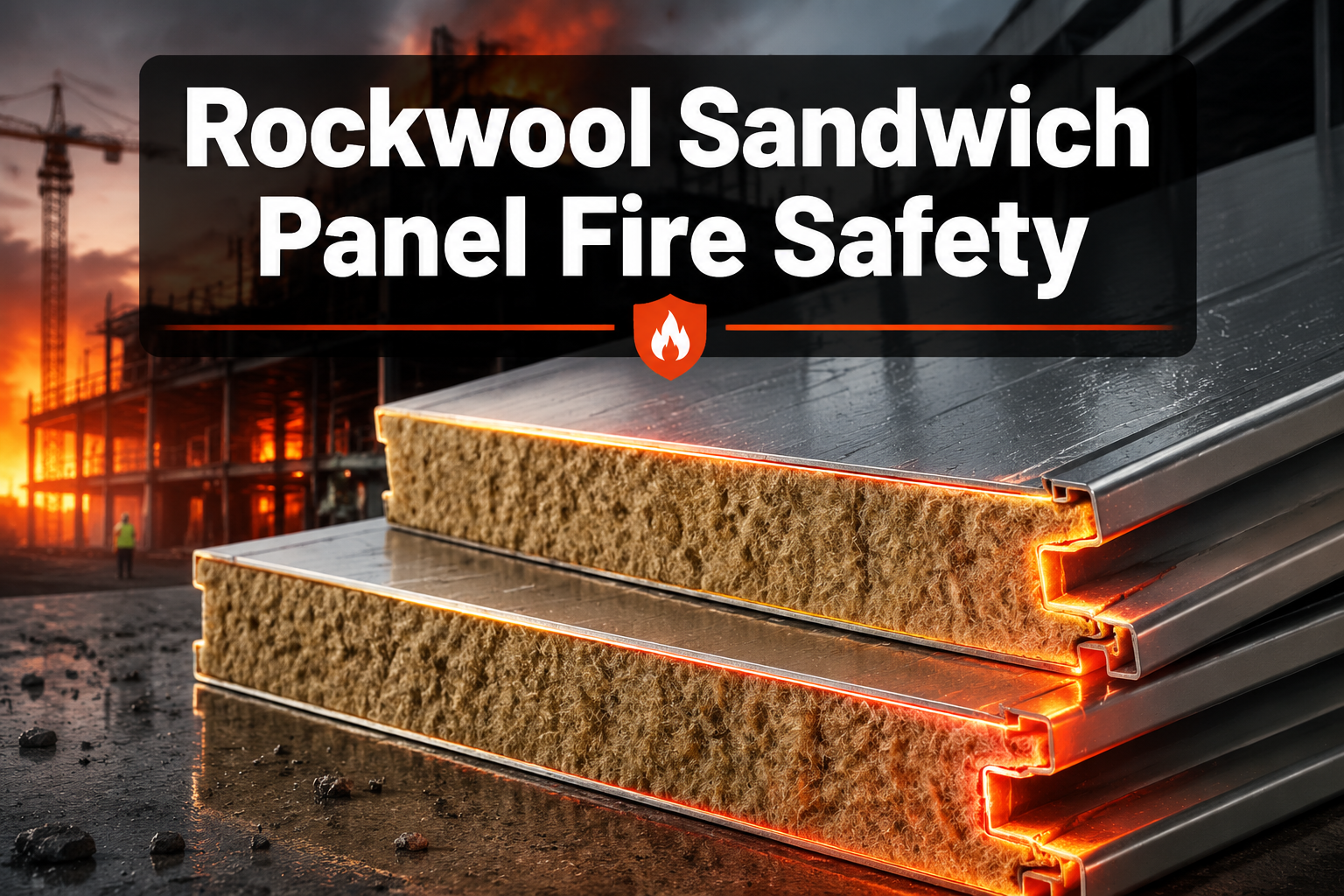
Rockwool Sandwich Panel Fire Safety: The Complete Guide for 2026

Last updated: May 15, 2026


Quick Answer

Rockwool sandwich panels offer superior fire safety compared to most other insulated panel types because the mineral wool core is non-combustible, meaning it does not ignite, spread flame, or produce significant toxic smoke when exposed to fire. These panels can achieve fire resistance ratings of up to 240 minutes depending on panel thickness, steel facing gauge, and installation method. For buildings where fire compartmentalization, occupant safety, and code compliance are priorities, rockwool-core panels are the industry benchmark.


Key Takeaways

  • šŸ”„ Rockwool (mineral wool) is classified as non-combustible under most international fire standards, including EN 13501-1 (Euroclass A1 or A2).
  • ā±ļø Properly specified rockwool sandwich panels can deliver fire resistance ratings from 30 minutes up to 240 minutes (EI 240).
  • šŸ—ļø The steel facings, joint design, and fixing method all affect the final fire performance — the core alone does not determine the rating.
  • 🚫 Unlike EPS or PIR foam-core panels, rockwool does not melt, drip, or contribute fuel to a fire.
  • šŸ“‹ Fire safety compliance requires third-party tested and certified panels, not just a mineral wool core claim.
  • šŸŒ”ļø Rockwool retains structural integrity at temperatures exceeding 1,000°C, making it suitable for high-risk industrial and commercial buildings.
  • šŸ’Ø Low smoke and toxic gas emission during fire events significantly improves evacuation safety.
  • šŸ’° Rockwool panels typically cost more than foam-core alternatives, but the fire performance and insurance benefits often justify the premium.
  • āœ… Always verify that panels carry valid fire test certificates (e.g., EN 1364, ASTM E119, or equivalent local standards) before specifying.

What Makes Rockwool Sandwich Panels Different from Other Panel Types?

Rockwool sandwich panels use a mineral wool core — made from spun volcanic basalt or slag fibers — bonded between two steel face sheets. This core is fundamentally different from polyurethane (PUR), polyisocyanurate (PIR), or expanded polystyrene (EPS) cores, which are organic polymers that burn.

Mineral wool fibers are inorganic and will not sustain combustion. When exposed to extreme heat, the fibers soften and eventually melt, but they do not ignite or contribute fuel to a fire. This physical property is the foundation of rockwool sandwich panel fire safety.

Core material comparison:

Core Type Combustible? Smoke Output Max Service Temp Typical Euroclass
Rockwool (mineral wool) No Very low 750°C+ A1 / A2
PIR foam Yes (limited) Moderate ~120°C C–D
PUR foam Yes High ~100°C E–F
EPS foam Yes High ~80°C E–F

Key point: A non-combustible core does not automatically mean the assembled panel achieves a specific fire resistance rating. The full assembly — including steel facings, joints, fixings, and substrate — must be tested together.

For a broader overview of available panel types and specifications, see the full range of sandwich panel products from certified manufacturers.


How Is Rockwool Sandwich Panel Fire Safety Measured and Certified?

Fire performance is measured through standardized tests that assess three criteria: load-bearing capacity (R), integrity (E), and insulation (I). The combined rating — for example, REI 120 or EI 60 — tells specifiers exactly how long the panel assembly resists fire under controlled conditions.

The most relevant international standards include:

  • EN 13501-1 (Europe): Reaction to fire classification — rates the core material's combustibility (A1 to F).
  • EN 1364-1 / EN 1365 (Europe): Fire resistance tests for non-load-bearing and load-bearing elements.
  • ASTM E119 (USA): Standard test method for fire resistance of building construction.
  • BS 476 (UK legacy): Parts 20–23 cover fire resistance of elements of construction.
  • Local equivalents apply in South Asia, the Middle East, and other regions — always confirm with the relevant authority.

What to look for on a fire certificate:

  1. The exact panel configuration tested (thickness, facing gauge, joint type).
  2. The test standard and date.
  3. The accredited laboratory name.
  4. The classification achieved (e.g., EI 120).
  5. Any scope limitations (e.g., maximum panel span, specific fixing pattern).

āš ļø Common mistake: Specifying a panel based on the core material's Euroclass rating (A1) without checking whether the full panel assembly has been fire-resistance tested. A panel with an A1 core can still fail EI 60 if the joints or fixings are not correctly designed.


What Fire Resistance Ratings Can Rockwool Sandwich Panels Achieve?

Rockwool sandwich panels can achieve fire resistance ratings from EI 30 up to EI 240, depending on panel thickness and assembly design. Most standard commercial applications use panels rated EI 60 to EI 120.

Typical rating ranges by application:

  • EI 30 – EI 60: Light commercial buildings, storage facilities, internal partitions.
  • EI 90 – EI 120: Industrial plants, cold stores, warehouses with moderate fire risk.
  • EI 180 – EI 240: High-risk industrial facilities, chemical plants, buildings requiring extended evacuation time.

Panel thickness is a primary driver of fire resistance. As a general guide (based on manufacturer test data, not a universal standard):

  • 80mm rockwool panel: commonly achieves EI 60
  • 100–120mm: commonly achieves EI 90 to EI 120
  • 150mm+: can achieve EI 180 to EI 240

These figures vary by manufacturer, facing thickness, and joint design. Always request the specific test certificate for the exact configuration being specified.


Where Is Rockwool Sandwich Panel Fire Safety Most Critical?

Rockwool sandwich panels are most critical in buildings where fire compartmentalization, occupant density, or hazardous materials create elevated fire risk. They are the preferred choice for any project where building codes mandate non-combustible construction or where insurers require specific fire resistance ratings.

High-priority applications include:

  • šŸ­ Industrial manufacturing plants — especially those handling flammable materials or chemicals.
  • šŸ„ Healthcare and pharmaceutical facilities — where evacuation is complex and continuity of operations matters.
  • 🧊 Cold storage and food processing — where foam-core panels have historically caused catastrophic fires.
  • šŸ« Schools and public buildings — where occupant safety and regulatory compliance are non-negotiable.
  • āœˆļø Airport hangars and logistics hubs — where large open spans and high-value assets demand maximum fire protection.
  • šŸ¢ Multi-story commercial buildings — where fire compartmentalization between floors and zones is required by code.

For construction projects in Bangladesh and the broader South Asian region, working with an experienced sandwich panel manufacturer in Bangladesh ensures panels meet local fire codes and project specifications.


How Does Rockwool Perform During an Actual Fire Event?

During a fire, rockwool sandwich panels perform in three distinct phases that set them apart from combustible-core alternatives.

Phase 1 — Initial exposure (0–10 minutes): The steel facing heats rapidly but the mineral wool core resists heat transfer. No flame spread occurs across the panel surface. No flaming droplets or burning debris fall from the panel.

Phase 2 — Sustained fire (10–60+ minutes): The mineral wool maintains its fibrous structure and continues to act as a thermal barrier. The steel facing may distort slightly but the panel maintains integrity. Joints and fixings are the most vulnerable points during this phase.

Phase 3 — Extended fire (60–240 minutes, depending on rating): Panels rated EI 120 or higher continue to prevent fire spread to adjacent compartments. Smoke production remains low, which is critical for evacuation routes.

What rockwool does NOT do in a fire:

  • It does not melt and drip flaming material onto lower floors or occupants.
  • It does not release large quantities of toxic gases (unlike burning PUR or EPS foam).
  • It does not contribute additional fuel that accelerates fire growth.

This behavior is why fire investigators and safety engineers consistently recommend mineral wool panels for buildings where life safety is the primary concern.


What Are the Limitations of Rockwool Sandwich Panels for Fire Safety?

Rockwool sandwich panels are not a universal solution, and understanding their limitations helps avoid specification errors.

Genuine limitations to consider:

  • Cost: Rockwool-core panels cost roughly 20–40% more than equivalent PIR or PUR panels (estimate based on general market observations; actual pricing varies by region and specification). See current sandwich panel pricing for regional benchmarks.
  • Weight: Mineral wool is denser than foam cores, so panels are heavier. This affects structural loading calculations and installation logistics.
  • Moisture sensitivity: Rockwool can absorb moisture if panels are damaged or improperly sealed, which reduces thermal performance over time (though fire performance is less affected).
  • Joint vulnerability: Even with a non-combustible core, poorly designed or installed joints remain the weakest point in fire resistance. Fire-rated sealants and purpose-designed joint covers are essential.
  • Not a substitute for sprinklers: Rockwool panels improve passive fire protection but do not replace active systems like sprinklers in high-risk occupancies.

Choose rockwool panels if: The project requires non-combustible construction, high fire resistance ratings (EI 60+), low smoke toxicity, or compliance with strict insurance requirements.
Consider alternatives if: Budget is the primary constraint, the building is low-risk, and local codes permit combustible insulation.


How to Specify and Install Rockwool Sandwich Panels for Maximum Fire Safety

Getting the specification right matters as much as choosing the correct panel. A correctly specified but poorly installed panel will underperform its fire rating.

Step-by-step specification checklist:

  1. Define the required fire resistance rating based on building use, occupancy, and local fire codes.
  2. Select panel thickness and facing gauge that match a tested and certified configuration from the manufacturer.
  3. Request the full fire test certificate — not just a product data sheet — and verify it covers the exact configuration being used.
  4. Specify fire-rated joint systems including appropriate sealants, fire-rated covers, and intumescent strips where required.
  5. Confirm fixing details — the type, spacing, and depth of fixings affect fire performance and must match the tested assembly.
  6. Engage a qualified installer with documented experience in fire-rated panel systems.
  7. Arrange third-party inspection at key installation stages, especially joint completion.
  8. Maintain a record of certificates and installation documentation for building consent and insurance purposes.

When evaluating suppliers, reviewing their project portfolio and client references helps confirm real-world installation experience. The projects and client portfolio of established manufacturers provides useful context.

For guidance on selecting the right supplier, the guide to choosing a sandwich panel manufacturer covers key evaluation criteria including certification, experience, and after-sales support.


FAQ: Rockwool Sandwich Panel Fire Safety

Q: Is rockwool sandwich panel truly non-combustible?
A: The mineral wool core is classified as non-combustible under EN 13501-1 (Euroclass A1 or A2). The steel facings are also non-combustible. The assembled panel does not spread flame or contribute fuel to a fire.

Q: What is the maximum fire resistance rating available for rockwool panels?
A: Most manufacturers offer tested configurations up to EI 240 (240 minutes). Higher ratings require thicker panels and specific joint designs. Always verify with the manufacturer's test certificate.

Q: Can rockwool sandwich panels replace a concrete or masonry fire wall?
A: In many applications, yes — provided the panel assembly has been tested and certified to the required fire resistance rating. Structural load-bearing requirements and local building codes determine whether panel walls are an acceptable substitute.

Q: Do rockwool panels produce toxic smoke in a fire?
A: Mineral wool produces very low levels of smoke and minimal toxic gases during fire exposure. This is a significant safety advantage over organic foam cores, which can release hydrogen cyanide and other toxic combustion products.

Q: How does moisture affect the fire performance of rockwool panels?
A: Moisture reduces thermal insulation performance but has a relatively minor effect on fire resistance. However, severely water-damaged panels should be inspected and replaced, as structural integrity may be compromised.

Q: Are rockwool sandwich panels suitable for external facades?
A: Yes, but external facade applications require panels with appropriate weather resistance and fire-rated external joint systems. Verify that the fire test certificate covers external exposure conditions.

Q: How often should fire-rated rockwool panel installations be inspected?
A: Annual visual inspections are recommended as a minimum. Any physical damage to panels or joints should be assessed and repaired immediately, as damage can compromise the fire resistance rating.

Q: What certifications should a supplier provide?
A: At minimum: a fire test certificate from an accredited laboratory, a Declaration of Performance (DoP) under the relevant standard, and a CE mark or equivalent local certification.

Q: Is rockwool sandwich panel fire safety better than PIR panels?
A: For fire resistance, yes. Rockwool panels outperform PIR panels in non-combustibility, fire resistance duration, and smoke toxicity. PIR panels may offer better thermal efficiency per millimeter at lower cost, but they are combustible and carry higher fire risk.

Q: Can existing foam-core panels be upgraded to rockwool for fire safety?
A: Replacement is the only reliable option. Retrofitting mineral wool over existing foam panels does not replicate the performance of a tested and certified rockwool sandwich panel assembly.


Conclusion: Actionable Next Steps for Specifiers and Builders

Rockwool sandwich panel fire safety is not just a product feature — it is a system-level outcome that depends on the right panel specification, certified joint design, competent installation, and ongoing maintenance.

Immediate actions for project teams:

  1. Confirm the required fire resistance rating with the project's fire engineer or authority having jurisdiction before selecting any panel product.
  2. Request fire test certificates for the exact panel configuration (thickness, facing, joint) from at least two manufacturers and compare scope limitations.
  3. Budget for the full system — fire-rated sealants, joint covers, and inspection costs are not optional extras.
  4. Work with certified installers who can provide documented experience with fire-rated panel assemblies.
  5. Document everything — certificates, installation records, and inspection reports protect both the building owner and the contractor.

For projects in Bangladesh and the region, connecting with a qualified sandwich panel manufacturer early in the design process ensures that fire safety requirements are built into the specification from the start, not added as an afterthought.

The investment in rockwool sandwich panel fire safety pays dividends in reduced insurance premiums, regulatory compliance, and — most importantly — the protection of lives and assets when fire occurs.


References

  • European Committee for Standardization. EN 13501-1: Fire Classification of Construction Products and Building Elements. CEN, 2018.
  • European Committee for Standardization. EN 1364-1: Fire Resistance Tests for Non-Loadbearing Elements. CEN, 2015.
  • ASTM International. ASTM E119: Standard Test Methods for Fire Tests of Building Construction and Materials. ASTM, 2022.
  • ROCKWOOL Group. Fire Safety with Stone Wool: Technical Documentation. ROCKWOOL, 2021. https://www.rockwool.com
  • British Standards Institution. BS 476-20: Fire Tests on Building Materials and Structures. BSI, 1987 (reaffirmed 2007).
  • Association of British Insurers. Guidance on Insulated Panels and Fire Risk. ABI, 2019. https://www.abi.org.uk

Leave a Comment

Your email address will not be published. Required fields are marked *

Scroll to Top