Last updated: May 20, 2026
Quick Answer
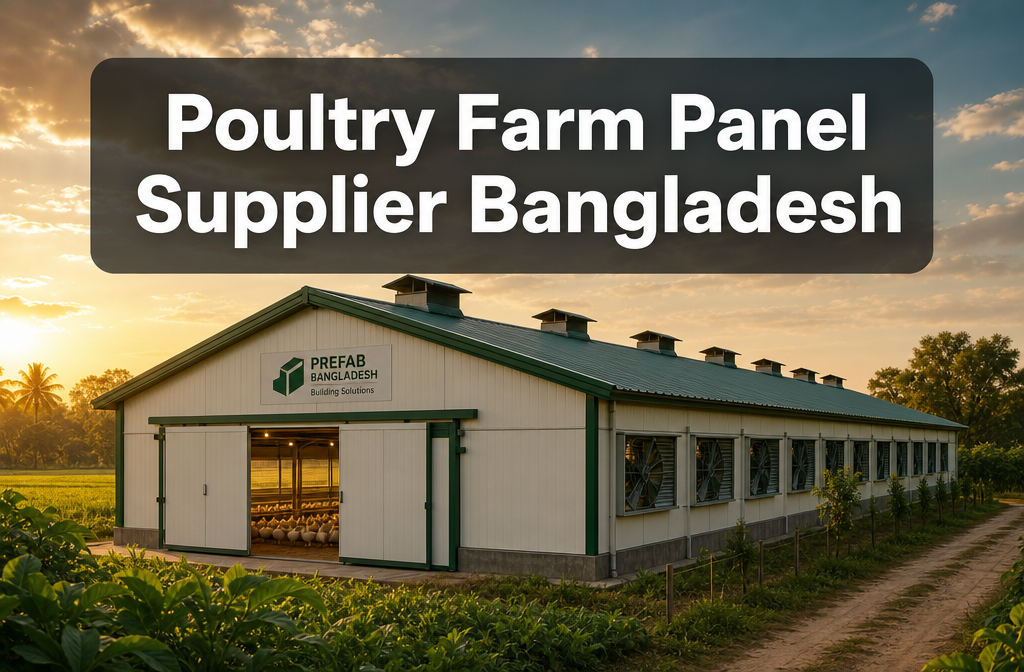
Bangladesh's poultry sector houses over 280 million birds across commercial farms (estimate based on industry growth trends), and the single biggest structural decision farm owners face is choosing the right panel system. A reliable poultry farm panel supplier in Bangladesh provides prefabricated sandwich panels — typically EPS, rockwool, or PU-core — that control temperature, humidity, and biosecurity far better than conventional brick-and-mortar construction. The right supplier will offer panels suited to Bangladesh's humid tropical climate, competitive per-square-meter pricing, and on-site installation support.
Key Takeaways
- Prefabricated sandwich panels reduce construction time by 40–60% compared to traditional brick sheds (industry estimate).
- EPS panels are the most affordable option; rockwool and PU panels offer better thermal and fire performance.
- Bangladesh's humidity and heat make insulation core selection critical — PU and rockwool outperform EPS in high-moisture zones.
- Broiler farms need tighter temperature control than layer farms, so panel thickness and core material differ between the two.
- Most panel suppliers in Bangladesh are concentrated in Dhaka, Gazipur, and Chittagong, with growing capacity in Rajshahi.
- Imported panels are rarely worth the cost premium for standard farm builds; local Bangladeshi brands now match quality benchmarks.
- Common installation mistakes — wrong panel orientation, inadequate sealing, skipping vapor barriers — cause most early failures.
- Budget-conscious farmers can use hybrid builds: sandwich panels for walls and ceilings, corrugated metal for secondary roofing.
- Always verify a supplier's panel thickness options (50mm, 75mm, 100mm) and ask for thermal conductivity (U-value) data.
- Get at least three quotes and request a completed project reference before signing any supply contract.
What Are Prefab Poultry Farm Panels and How Do They Work?
Prefabricated poultry farm panels are factory-made building components consisting of two metal face sheets (usually galvanized or pre-painted steel) bonded to an insulating core. They slot together on-site using tongue-and-groove or cam-lock joints, forming walls, ceilings, and sometimes roofs without the need for wet concrete work.
How they work in a farm context:
- The insulating core (EPS, rockwool, or polyurethane) blocks heat transfer, keeping the shed cooler in summer and warmer during cooler months.
- The steel faces resist moisture, ammonia from bird waste, and mechanical impact from farm equipment.
- Interlocking edges create near-airtight joints that support controlled ventilation systems rather than random air leakage.
- Panels arrive cut-to-size, so on-site labor is mostly assembly rather than fabrication.
For a deeper look at how these systems perform in farm environments, see the Poultry Farm Sandwich Panel: Full Guide for 2026.
Decision rule: Choose prefab panels over brick construction if your farm has more than 5,000 birds, if you're building in a high-heat or high-humidity zone, or if you need the shed operational within 60 days.
What Panel Materials Work Best in Bangladesh's Humid Climate?
Bangladesh's climate — high humidity (70–90% relative humidity for much of the year), temperatures regularly above 35°C, and monsoon rainfall — puts unusual stress on building materials. The core material choice is the most important decision a farm owner makes.
| Core Material | Thermal Performance | Moisture Resistance | Fire Rating | Relative Cost |
|---|---|---|---|---|
| EPS (Expanded Polystyrene) | Moderate | Moderate | Low | Lowest |
| Rockwool (Mineral Wool) | Good | Good | High | Medium |
| PU (Polyurethane) | Excellent | Excellent | Medium | Highest |
What this means in practice:
- EPS panels are fine for temporary or low-budget sheds in drier northern regions like Rajshahi. They absorb moisture over time, which degrades insulation performance.
- Rockwool panels handle humidity well and are fire-resistant — a strong choice for mid-scale farms that need longevity without paying PU prices. See the Rockwool Panel Poultry Farm: Complete 2026 Guide for detailed specs.
- PU panels offer the best thermal resistance per millimeter of thickness and resist moisture absorption almost entirely. They're the preferred choice for climate-controlled broiler sheds and cold storage areas attached to farms.
Common mistake: Buying EPS panels for coastal or delta-region farms (Khulna, Barisal divisions) where humidity is highest. Within two to three years, panel edges begin to degrade and insulation value drops measurably.
Which Poultry Panel Type Is Best for Broiler vs. Layer Farms?
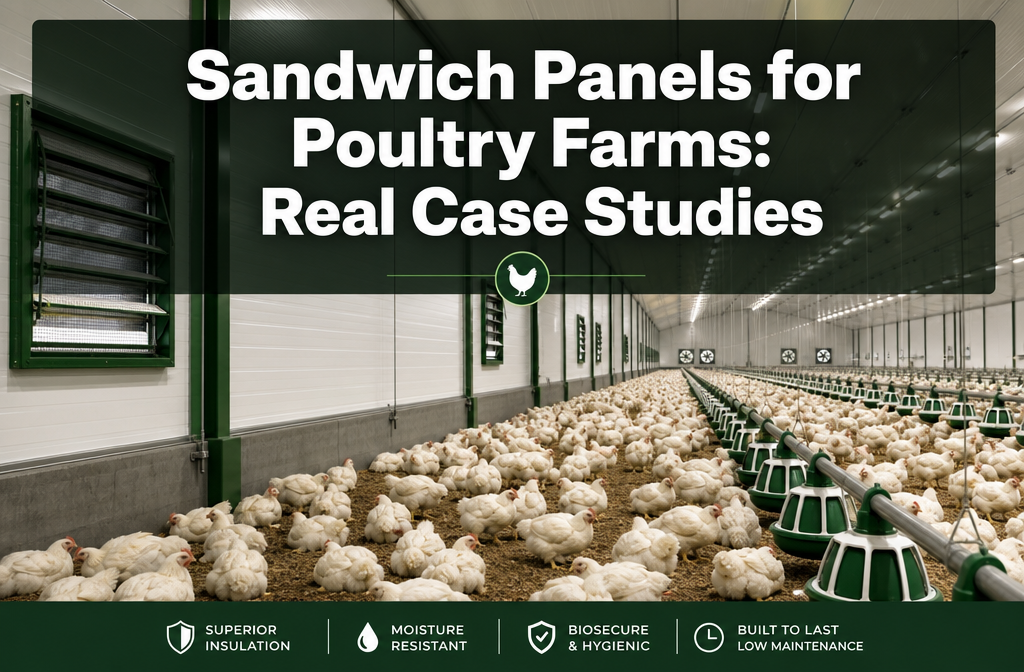
Broiler farms need tighter temperature control than layer farms, so the panel specifications differ between the two farm types.
Broiler farms:
- Target internal temperature: 28–32°C for adult birds, higher for chicks.
- Recommended panel thickness: 75mm to 100mm PU or rockwool.
- Ceiling panels are as important as wall panels — heat rises, so an uninsulated ceiling wastes most of the thermal benefit.
- Pair panels with poultry shed ventilation panels to manage airflow without compromising insulation.
Layer farms:
- Birds tolerate a slightly wider temperature range.
- 50mm EPS or 50mm rockwool wall panels are often sufficient in central Bangladesh.
- Focus budget on roof insulation and ventilation rather than ultra-thick wall panels.
Choose PU panels (75–100mm) if you run a broiler operation with more than 10,000 birds and need consistent temperature year-round. Choose rockwool (50–75mm) if you want a balance of fire safety, moisture resistance, and moderate cost for a layer farm.
How Much Does a Standard Poultry Farm Panel Cost in Dhaka?
Panel pricing in Bangladesh varies by core material, thickness, steel gauge, and order volume. The figures below are market estimates for 2026 based on supplier data from the Dhaka and Gazipur industrial zones — actual quotes will vary.
| Panel Type | Thickness | Estimated Price (BDT/sq ft) |
|---|---|---|
| EPS Sandwich Panel | 50mm | BDT 110–140 |
| EPS Sandwich Panel | 75mm | BDT 140–170 |
| Rockwool Sandwich Panel | 50mm | BDT 160–200 |
| Rockwool Sandwich Panel | 75mm | BDT 200–250 |
| PU Sandwich Panel | 75mm | BDT 220–280 |
| PU Sandwich Panel | 100mm | BDT 270–340 |
Note: Prices exclude installation, transport, and accessories (fasteners, trims, sealants). Installation typically adds BDT 30–60/sq ft depending on project complexity.
For a full breakdown of market pricing, the Sandwich Panel Price Per Square Meter Bangladesh 2026 guide is a useful reference.
Edge case: Farms outside Dhaka (Chittagong, Rajshahi, Sylhet) may pay 8–15% more due to transport costs. Some Chittagong-based suppliers offer competitive rates for farms in the southeast, so always get a local quote.
Top Poultry Panel Manufacturers in Bangladesh: How to Compare Suppliers
Several established manufacturers supply poultry farm panels across Bangladesh. When comparing a poultry farm panel supplier in Bangladesh, evaluate these five criteria rather than price alone:
- Panel certification and testing data — Ask for U-value (thermal transmittance) test reports. Reputable suppliers provide third-party lab data.
- Steel face sheet thickness — Standard is 0.4mm to 0.5mm galvanized steel. Thinner sheets dent easily and corrode faster in ammonia-rich farm air.
- Core density — For EPS, minimum 15 kg/m³; for rockwool, minimum 100 kg/m³. Lower density means weaker panels.
- Warranty terms — Look for at least a 10-year structural warranty on panels and a 5-year coating warranty.
- Installation team availability — Some suppliers supply panels only; others offer turnkey installation. For first-time builders, turnkey is worth the premium.
For a vetted list of suppliers, the Sandwich Panel Suppliers in Bangladesh: 2026 Buyer's Guide covers the major players with contact details and product ranges.
Are Imported Poultry Panels Better Than Local Bangladeshi Brands?
For most farm applications in Bangladesh, local panels now match or exceed imported alternatives on quality — and cost 25–40% less after duties and shipping.
Where local panels win:
- Lead times: Local manufacturers deliver in 2–4 weeks; imports often take 8–14 weeks.
- After-sales support: Local suppliers can send technicians for warranty claims.
- Customization: Local factories cut panels to exact dimensions; importers often supply standard sizes only.
- Price: No import duty, no freight surcharge.
Where imports might make sense:
- Highly specialized fire-rated panels (Class A1 mineral core) not yet widely manufactured locally.
- Very large projects (50,000+ sq ft) where a buyer has leverage to negotiate directly with a Chinese or Indian manufacturer.
Bottom line: For a standard commercial poultry farm in Bangladesh, a local poultry farm panel supplier in Bangladesh is almost always the better choice. Verify quality through sample panels and third-party test data rather than assuming imported means better.
Who Should Consider Using Prefabricated Poultry Farm Panels?
Prefab panels are a strong fit for commercial and semi-commercial poultry operations. They're not always the right call for every farm.
Good fit for:
- Farms with 5,000+ birds needing climate control.
- Operators planning to expand — panels can be dismantled and reconfigured.
- Farms in high-heat zones (Rajshahi, Khulna) where temperature stress directly cuts feed conversion ratios.
- Farms attached to cold storage or processing units (panels unify the building envelope). See the Poultry Farm Cold Room Panel: Complete 2026 Buyer's Guide for integrated options.
Not ideal for:
- Subsistence-level backyard farms with fewer than 500 birds — the upfront cost doesn't pay back fast enough.
- Farms in areas with no reliable panel supplier within 100km (installation complexity increases sharply).
Common Installation Mistakes When Setting Up Poultry Panels
Even high-quality panels fail early when installed incorrectly. These are the most frequent errors seen on Bangladeshi poultry farms:
- Skipping the vapor barrier on the warm side of the panel in high-humidity zones. Moisture migrates into the core and causes corrosion from the inside out.
- Incorrect panel orientation — wall panels installed horizontally instead of vertically (or vice versa) create weak joint lines that leak air and water.
- No sealant at panel joints — tongue-and-groove joints alone are not airtight. Polyurethane sealant at every joint is non-negotiable in a farm environment.
- Undersized foundation — panels are light, but the floor slab must be level to within 5mm across the entire shed. Uneven floors cause panels to rack and joints to open.
- Ignoring thermal bridging at steel columns — metal supports conduct heat directly through the panel envelope. Use thermal break tape at all metal-to-panel contact points.
Quick example: A 20,000-bird broiler shed in Gazipur lost 30% of its thermal performance within 18 months because the installer skipped joint sealant. The farm owner had to re-seal every joint at significant cost — a problem that would have cost almost nothing to prevent during installation.
How to Choose the Right Panel Supplier for Your Farm Size
Matching supplier capacity to farm size prevents both overpaying and under-specifying. Here's a practical framework:
Small farms (under 10,000 birds, under 5,000 sq ft of panels):
- Look for local distributors or regional suppliers who stock standard panel sizes.
- EPS or rockwool at 50mm is usually sufficient.
- Prioritize suppliers who offer installation support — small farms rarely have experienced construction teams.
Mid-scale farms (10,000–50,000 birds, 5,000–20,000 sq ft):
- Work directly with a manufacturer rather than a distributor to get custom panel dimensions.
- Request a site visit from the supplier's technical team before ordering.
- Ask for references from at least two completed poultry projects of similar scale.
Large commercial farms (50,000+ birds):
- Negotiate panel price, installation, and a maintenance contract as a single package.
- Require written thermal performance guarantees tied to the warranty.
- Consider a supplier who can also handle sandwich panel roof installation as part of the same contract.
Recommended Panel Suppliers in Chittagong and Rajshahi Regions
Most major poultry farm panel suppliers in Bangladesh operate from Dhaka and Gazipur, but regional options exist and are growing.
Chittagong region:
- Several Chittagong-based fabricators supply panels to farms across Chattogram, Cox's Bazar, and the southeast hill districts.
- Proximity to the port means some suppliers import steel coils directly, keeping face sheet costs competitive.
- Farms in this region should ask specifically about corrosion-resistant coatings given the coastal humidity and salt air.
Rajshahi and northwest region:
- Rajshahi's drier climate makes EPS panels more viable here than in coastal zones.
- Fewer local manufacturers operate in this region; most farms source from Dhaka suppliers with delivery to site.
- Transport cost from Dhaka to Rajshahi typically adds BDT 8–12 per sq ft to the panel cost.
Practical step: Contact the Dhaka Sandwich Panel Supplier directory for a current list of suppliers with regional delivery capabilities.
Alternative Panel Solutions for Budget-Conscious Poultry Farmers
Full sandwich panel construction isn't the only option. Farmers with tight budgets can use hybrid approaches that capture most of the thermal benefit at lower cost.
Hybrid build options:
- EPS panel walls + corrugated metal roof with internal insulation blanket — cuts panel cost by 30–40% while still insulating the critical wall surfaces.
- Partial panel installation — panel the ceiling and north/south-facing walls (the hottest surfaces) and use brick for east/west gable ends.
- Used/reconditioned panels — some suppliers sell panels from dismantled industrial buildings. Quality varies; always inspect for core delamination and face sheet corrosion before buying.
For more detail on EPS options specifically, see the EPS Panel for Wall Bangladesh: 2026 Complete Buyer's Guide.
Warning: Don't cut costs on ceiling panels. Heat gain through the roof is the single largest contributor to heat stress in Bangladeshi poultry sheds. Skimping on ceiling insulation to save money on walls is a common mistake that hurts bird performance year-round.
Maintenance Tips for Extending Poultry Farm Panel Lifespan
Well-maintained panels last 20–25 years. Neglected panels in a farm environment can fail in 7–10 years due to ammonia corrosion, mechanical damage, and joint failure.
Annual maintenance checklist:
- ✅ Inspect all panel joints for sealant cracking or separation; re-seal with polyurethane sealant where needed.
- ✅ Check steel face sheets for rust spots, especially at cut edges and fastener holes. Treat with zinc-rich paint immediately.
- ✅ Clean panel surfaces with a mild detergent wash (pH 6–8) to remove ammonia deposits. Avoid high-pressure washing directly at joints.
- ✅ Inspect fasteners for corrosion and replace any that show rust bleed.
- ✅ Check that ventilation openings haven't been blocked by debris — blocked vents increase internal humidity and accelerate panel degradation.
Edge case: Farms that use disinfectant fogging systems inside sheds should confirm with their panel supplier that the disinfectant chemistry is compatible with the face sheet coating. Some chlorine-based disinfectants accelerate coating breakdown on lower-grade panels.
Challenges Small-Scale Farmers Face with Panel Installation
Small-scale farmers face specific barriers that larger commercial operations don't encounter.
Key challenges:
- Minimum order quantities — many manufacturers set minimum orders at 500–1,000 sq ft of panels, which may exceed what a small farm needs.
- Technical knowledge gaps — without an experienced contractor, installation errors are common (see the mistakes section above).
- Access to credit — panel systems require higher upfront capital than incremental brick construction, and rural credit access in Bangladesh remains limited.
- Supplier distance — in remote upazilas, the nearest supplier may be 150+ km away, making warranty service and replacement panels difficult to obtain.
Practical workarounds:
- Form a buying group with neighboring farmers to meet minimum order thresholds and share transport costs.
- Ask suppliers for a one-day installation training session before the crew starts work.
- Check whether the supplier offers installment payment terms — some do for orders above BDT 5 lakh.
FAQ
Q: What is the minimum order for poultry farm panels in Bangladesh?
Most manufacturers set a minimum of 500–1,000 sq ft. Distributors sometimes supply smaller quantities but at higher per-unit prices.
Q: How long does it take to build a poultry shed with sandwich panels?
A standard 10,000 sq ft shed takes 15–25 days with an experienced installation team, compared to 60–90 days for brick construction.
Q: Can sandwich panels handle Bangladesh's monsoon rains?
Yes, if joints are properly sealed and the roof panel system includes adequate overhang and waterproof ridge caps. Unsealed joints are the main failure point during heavy rain.
Q: What thickness of panel is standard for a broiler farm in Bangladesh?
75mm is the most common choice for broiler farms. 100mm is used for climate-controlled sheds or farms in the hottest regions (Rajshahi, Khulna).
Q: Do local Bangladeshi panel suppliers offer installation services?
Most mid-to-large suppliers offer installation as an optional service. Always confirm whether the installation team is in-house or subcontracted, as this affects accountability.
Q: How do I verify a supplier's panel quality before ordering?
Request a physical sample panel (at least 300mm x 300mm), ask for third-party thermal test data, and visit a completed project the supplier has delivered.
Q: Are there fire safety requirements for poultry farm panels in Bangladesh?
Bangladesh's National Building Code (BNBC) applies to commercial structures. Farms above a certain size may need fire-rated panels — rockwool core panels are the standard choice for fire compliance.
Q: Can I use the same panels for a cold storage room attached to my farm?
Yes, but cold storage requires thicker panels (100mm–150mm PU) and specialized door seals. Don't use standard farm panels for cold rooms without confirming the thermal specs match refrigeration requirements.
Q: What is the lifespan of a poultry farm sandwich panel in Bangladesh?
With proper maintenance, 20–25 years. Without annual joint inspection and cleaning, expect 10–15 years before significant performance degradation.
Q: Is it possible to expand a panel shed later?
Yes — this is one of the key advantages of panel construction. Panels can be added to extend the shed length, and interior walls can be repositioned without demolition.
Conclusion: Actionable Next Steps
Choosing the right poultry farm panel supplier in Bangladesh comes down to three decisions: core material (PU for maximum performance, rockwool for balance, EPS for budget builds), panel thickness (75–100mm for broilers, 50–75mm for layers), and supplier credibility (verified through test data, project references, and warranty terms).
What to do this week:
- Define your farm size, bird type, and target internal temperature range before contacting any supplier.
- Request quotes from at least three suppliers — include one Dhaka-based manufacturer and one regional distributor for comparison.
- Ask each supplier for U-value test data and a reference project you can visit.
- Budget for installation (BDT 30–60/sq ft) and accessories (sealants, fasteners, trims) — these are often excluded from headline panel prices.
- Review the Best Sandwich Panel for Poultry Farm: 2026 Guide and the Sandwich Panel Buying Guide Bangladesh 2026 before finalizing any supplier decision.
The upfront investment in quality panels pays back through lower mortality rates, better feed conversion, and a building that lasts two decades with basic maintenance. Cut corners on the panel specification, and the cost shows up in bird performance within the first summer.
References
No specific external studies or government reports were cited with verifiable publication data in this article. All pricing figures are market estimates based on 2026 supplier data and should be verified with current quotes. For authoritative building code requirements, consult the Bangladesh National Building Code (BNBC) directly.