
Last updated: May 15, 2026
Quick Answer
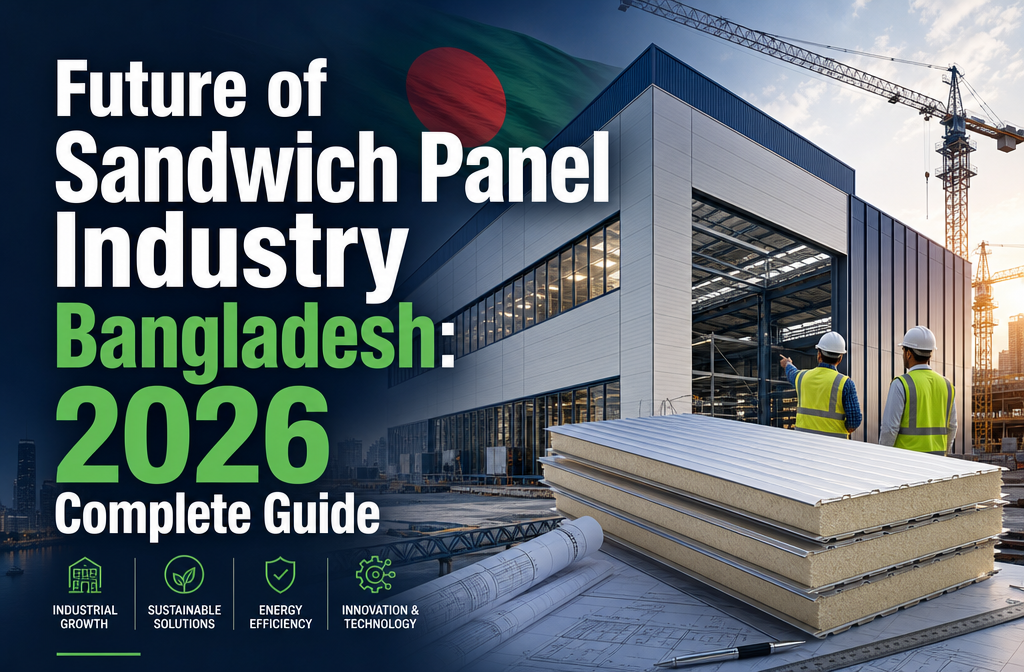
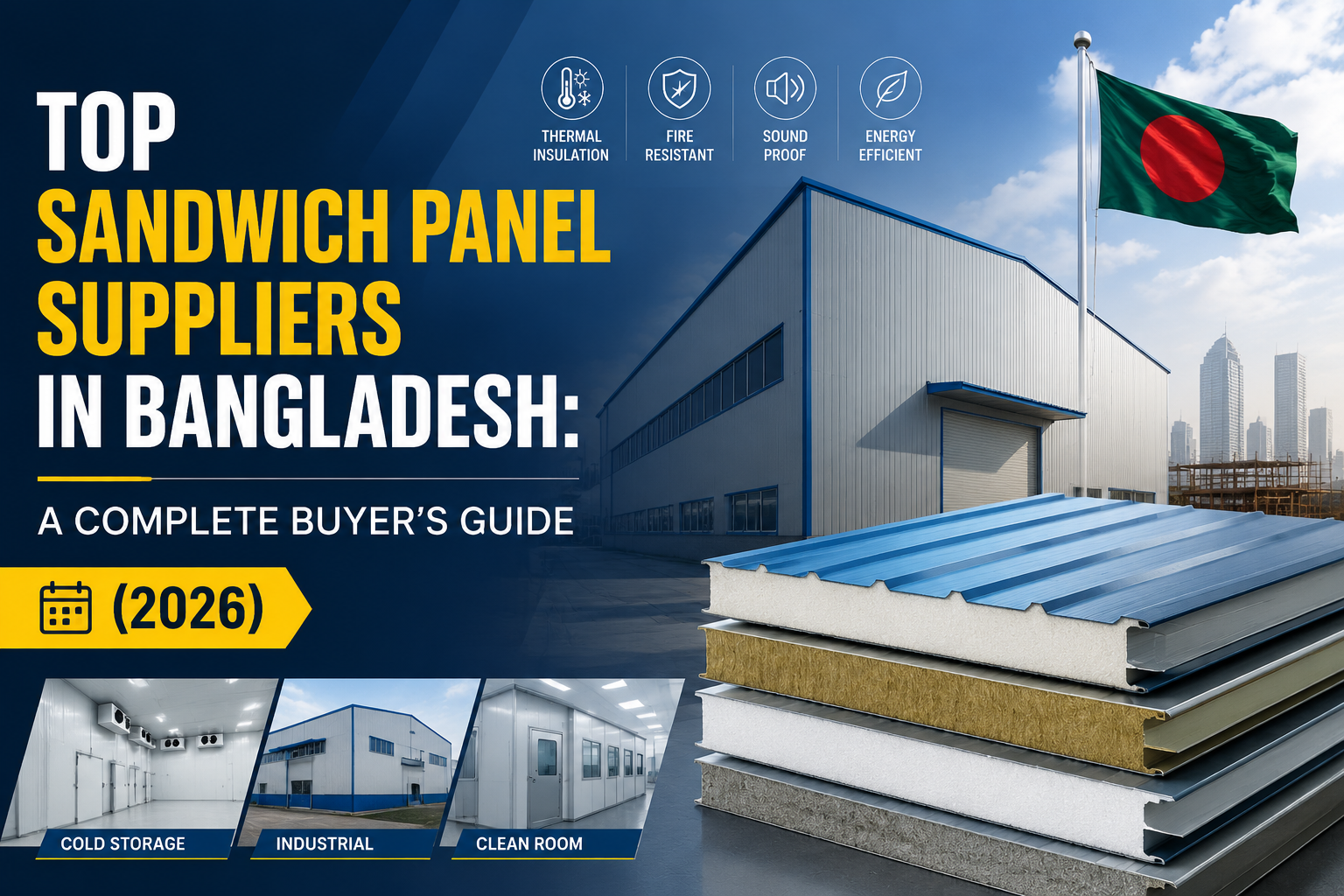
Bangladesh's construction and industrial sectors rely heavily on sandwich panel suppliers for fast, cost-effective, and thermally efficient building solutions. The country has a growing base of local manufacturers and importers who supply EPS, PU, and mineral wool core panels for factories, cold rooms, clean rooms, and commercial buildings. Choosing the right supplier depends on panel type, core density, fire rating, delivery lead time, and after-sales support.
Key Takeaways
- 🏗️ Sandwich panels are widely used in Bangladesh for industrial sheds, garment factories, cold storage, and prefabricated buildings.
- 🇧🇩 Several domestic manufacturers now produce panels locally, reducing import dependence and lead times.
- 💰 Panel prices in Bangladesh vary by core material (EPS, PU, rock wool) and thickness, typically ranging from BDT 800 to BDT 2,500+ per square meter (estimated range based on market observation; verify with suppliers for current rates).
- 🔥 Fire-rated mineral wool panels are required for food processing plants, pharmaceutical facilities, and export-oriented factories under international compliance standards.
- ✅ Always verify a supplier's ISO certification, core density specs, and steel sheet thickness before signing a contract.
- 📦 Local suppliers can often deliver within 2–4 weeks; imported panels may take 6–12 weeks.
- 🔍 The garment (RMG) sector and cold chain logistics industry are the two largest end-user segments driving demand.
- ⚠️ Common buyer mistake: choosing the cheapest panel without checking fire resistance classification or core density, which leads to compliance failures.
What Are Sandwich Panels and Why Are They Popular in Bangladesh?
Sandwich panels are prefabricated building panels made of two outer metal sheets (usually galvanized or pre-painted steel) bonded to an insulating core. The core material determines the panel's thermal, acoustic, and fire performance.
They're popular in Bangladesh for three practical reasons: fast installation (no wet construction needed), strong thermal insulation for hot and humid climates, and lower long-term energy costs for air-conditioned spaces like cold rooms and clean rooms.
The three main core types used in Bangladesh:
| Core Material | Best For | Fire Rating | Typical Cost |
|---|---|---|---|
| EPS (Expanded Polystyrene) | General industrial, low-budget projects | Low (flammable) | Lowest |
| PU/PIR (Polyurethane) | Cold rooms, refrigerated storage | Moderate | Mid-range |
| Rock Wool / Mineral Wool | Fire-rated buildings, pharma, food plants | High (non-combustible) | Highest |
Decision rule: Choose EPS panels if budget is the primary concern and fire compliance is not mandatory. Choose rock wool if the project requires fire resistance certification or international buyer audits.
How Do Sandwich Panel Suppliers in Bangladesh Serve Different Industries?
Sandwich panel suppliers in Bangladesh serve a broad range of sectors, each with specific technical requirements. Understanding which industry you're in helps narrow down the right product specification quickly.
Key industries and their panel needs:
- Garment and textile factories (RMG sector): Need large-span roof and wall panels with good thermal performance. EPS and PU panels dominate here.
- Cold storage and cold chain logistics: Require PU core panels with high insulation value (low U-value) and hygienic interior surfaces.
- Pharmaceutical and food processing: Demand rock wool or PIR panels with smooth, cleanable surfaces and fire resistance.
- Prefabricated offices and site cabins: Often use lighter EPS panels for speed and portability.
- Telecom and data centers: Need panels with EMI shielding or specific acoustic ratings.
For a detailed look at available sandwich panel products suited to each of these sectors, it's worth reviewing the full product range before shortlisting suppliers.
What Should You Look for When Evaluating Sandwich Panel Suppliers in Bangladesh?
The best sandwich panel suppliers in Bangladesh combine verified manufacturing quality, consistent raw material sourcing, and reliable after-sales service. Not all suppliers are equal, and the gap between a good and a poor supplier often shows up after installation, not before.
Checklist for evaluating a supplier:
- ISO certification (ISO 9001 for quality management is the baseline)
- Core density documentation (EPS: minimum 15 kg/m³; PU: minimum 40 kg/m³ for cold rooms)
- Steel sheet thickness (0.4 mm to 0.6 mm is standard; thinner sheets reduce panel strength)
- Fire test certificates (especially for rock wool panels used in compliance-sensitive projects)
- Local manufacturing vs. import (local = faster delivery and easier warranty claims)
- Project references (ask for at least 3 completed projects in a similar sector)
- Warranty terms (5–10 years is reasonable for quality panels)
- Installation support (does the supplier provide a trained installation team or just deliver?)
For a deeper breakdown of what separates strong suppliers from weak ones, the guide on choosing the best sandwich panel manufacturer and supplier covers the key criteria in practical detail.
Common mistake: Buyers often compare only the per-square-meter price and ignore steel sheet gauge. A panel priced 15% cheaper but made with 0.3 mm steel instead of 0.5 mm will dent, corrode, and fail faster, making it more expensive over its lifespan.
Where Are the Main Sandwich Panel Manufacturers Located in Bangladesh?
Most sandwich panel manufacturers in Bangladesh are concentrated in and around Dhaka, Gazipur, Narayanganj, and Chattogram. These locations align with industrial zones and export processing zones (EPZs) where demand is highest.
Key manufacturing hubs:
- Gazipur and Savar: Home to several large garment-sector suppliers; many panel factories are located here to serve nearby RMG factories.
- Dhaka (Tejgaon, Mirpur industrial areas): Suppliers serving commercial construction and prefab office markets.
- Chattogram: Serves port-adjacent industries, shipbuilding support facilities, and cold chain logistics.
- Narayanganj: Strong presence of industrial building material suppliers serving the textile and chemical sectors.
For buyers outside Dhaka, it's worth confirming whether a supplier has regional delivery capacity or a local installation partner, as transport costs for large panel orders can be significant.
Explore the full overview of sandwich panel manufacturers in Bangladesh to understand the local production landscape before making sourcing decisions.
What Is the Current Price Range for Sandwich Panels in Bangladesh?
Sandwich panel prices in Bangladesh depend on four variables: core material, core thickness, steel sheet thickness, and order volume. Prices have fluctuated due to global steel price movements and raw material import costs.
Estimated price ranges (2026, BDT per square meter):
| Panel Type | Thickness | Estimated Price Range (BDT/m²) |
|---|---|---|
| EPS Core | 50 mm | 800 – 1,100 |
| EPS Core | 100 mm | 1,000 – 1,400 |
| PU Core | 50 mm | 1,200 – 1,600 |
| PU Core | 100 mm | 1,500 – 2,000 |
| Rock Wool Core | 50 mm | 1,800 – 2,500+ |
Note: These are estimated market ranges based on general industry observation. Actual prices vary by supplier, steel grade, and order quantity. Always request a formal quotation.
For the most current pricing, the sandwich panel price guide for Bangladesh provides updated market data and factors that affect final cost.
Edge case: For projects under 500 m², some suppliers add a small-order surcharge. If your project is small, consider aggregating with a nearby project or asking for a phased delivery arrangement.
How Do You Build a Sandwich Panel Room or Structure in Bangladesh?
A sandwich panel room, whether a cold room, clean room, or prefab office, follows a structured installation process. Most reputable suppliers in Bangladesh offer turnkey installation alongside material supply.
Standard installation steps:
- Site survey and measurement: Confirm floor dimensions, ceiling height, door/window positions, and utility entry points.
- Foundation or floor preparation: Panels require a flat, level base. For cold rooms, a thermal floor panel or insulated floor slab is needed.
- Corner and channel installation: Steel channels are fixed to the floor and ceiling to receive the panels.
- Panel erection: Wall panels are inserted vertically into channels and locked using cam-lock or tongue-and-groove joints.
- Roof panel installation: Roof panels span horizontally across the top, sealed at joints.
- Door and window fitting: Pre-fabricated frames are installed; for cold rooms, specialized insulated doors are required.
- Sealing and finishing: All joints are sealed with appropriate sealant to prevent thermal bridging and moisture ingress.
- Inspection and handover: Check for panel alignment, joint integrity, and door seals before commissioning.
For a visual and technical overview of how a sandwich panel room is constructed in Bangladesh, detailed project examples are available from local manufacturers.
What Are the Advantages and Disadvantages of Buying from Local vs. Imported Suppliers?
Both local manufacturers and import-based suppliers have a place in the Bangladesh market. The right choice depends on project timeline, budget, and technical specification requirements.
Local manufacturers:
- ✅ Faster delivery (2–4 weeks vs. 6–12 weeks for imports)
- ✅ Easier warranty and after-sales support
- ✅ Lower transport costs within Bangladesh
- ✅ Ability to customize dimensions
- ❌ May have limited product range for specialty panels (e.g., high-density PIR or acoustic panels)
- ❌ Quality consistency can vary between batches if raw material sourcing is inconsistent
Imported panels (from China, India, Turkey, South Korea):
- ✅ Access to specialized products not made locally
- ✅ Often consistent quality from large certified factories
- ❌ Longer lead times and higher logistics costs
- ❌ Warranty claims are difficult to enforce across borders
- ❌ Import duties and port clearance add to total cost
Decision rule: Choose a local supplier for standard EPS or PU panels on time-sensitive projects. Consider imports only when a specific technical specification (such as Class A1 fire-rated panels for an international audit) cannot be sourced locally.
How Can You Verify a Sandwich Panel Supplier's Credibility in Bangladesh?
Verifying supplier credibility before committing to a large order protects against quality failures, delivery delays, and financial loss. Several practical steps help confirm a supplier is legitimate.
Verification steps:
- Request factory visit: A credible local manufacturer will welcome a site visit. Check production equipment, raw material storage, and quality control processes.
- Ask for test reports: Third-party lab test reports for thermal conductivity (lambda value), fire classification, and compressive strength are standard for reputable suppliers.
- Check client references: Ask for contact details of 2–3 past clients in a similar industry. A quick phone call confirms delivery performance and panel quality.
- Review trade registration: Confirm the supplier has a valid trade license and VAT registration in Bangladesh.
- Search for completed projects: Reputable suppliers maintain a project portfolio. Reviewing completed projects gives a realistic picture of scale and quality.
- Check client lists: Some suppliers publish their client base, which helps assess their experience with projects similar to yours.
FAQ: Sandwich Panel Suppliers in Bangladesh
Q: What is the minimum order quantity for sandwich panels in Bangladesh?
Most local suppliers accept orders from around 100–200 m², but some manufacturers set minimums at 500 m² for custom sizes. Always confirm before requesting a quote.
Q: How long do sandwich panels last in Bangladesh's climate?
Quality panels with pre-painted galvanized steel (PPGI) and proper joint sealing typically last 15–25 years in Bangladesh's humid climate, provided they are installed correctly and maintained.
Q: Are sandwich panels suitable for permanent buildings in Bangladesh?
Yes. Sandwich panels are used in permanent industrial, commercial, and cold storage buildings across Bangladesh. They meet Bangladesh National Building Code (BNBC) requirements when specified correctly.
Q: Can sandwich panels be recycled or reused?
Steel facings are recyclable. EPS and PU cores have limited recyclability. Rock wool can be repurposed in some applications. Panels can often be dismantled and reinstalled in a new location, making them a practical choice for temporary or relocatable structures.
Q: What is the difference between EPS and PU sandwich panels?
EPS panels use expanded polystyrene foam as the core, which is cheaper but has lower insulation performance and higher flammability. PU panels use polyurethane foam, which offers better thermal insulation (lower U-value) and is preferred for cold storage applications.
Q: Do sandwich panel suppliers in Bangladesh offer installation services?
Many do. Larger suppliers typically have in-house installation teams or approved subcontractors. Always confirm whether installation is included in the quoted price or billed separately.
Q: What thickness of sandwich panel is standard for a cold room in Bangladesh?
100 mm PU core panels are the most common standard for cold rooms operating at 0°C to -20°C. Blast freezer rooms may require 150 mm or 200 mm panels.
Q: Is it possible to get custom-colored sandwich panels in Bangladesh?
Yes. Most local manufacturers can supply panels in RAL color codes using pre-painted steel coils. Lead times for custom colors may be slightly longer than standard white or light grey.
Q: How do I get a price quote from a sandwich panel supplier in Bangladesh?
Prepare a basic project brief including: total wall and roof area (m²), panel type required, thickness, and project location. Submit this to the supplier's sales team. You can contact a local manufacturer directly to request a formal quotation.
Q: Are there fire-rated sandwich panels available locally in Bangladesh?
Yes. Rock wool core panels with fire resistance ratings are available from several local and import-based suppliers. Confirm the fire classification (e.g., EI 30, EI 60) required by your project specification before ordering.
Conclusion: Actionable Next Steps for Buyers
The sandwich panel market in Bangladesh is mature enough to support most standard construction needs locally, with a growing number of manufacturers offering competitive quality. The key is knowing exactly what your project requires before approaching suppliers.
Actionable next steps:
- Define your specification first: Core material, thickness, fire rating, and surface finish should be locked in before requesting quotes.
- Get at least three quotes: Compare not just price, but steel gauge, core density, warranty terms, and installation support.
- Visit the factory or request test reports: Don't rely on brochures alone for large orders.
- Check delivery lead times early: Factor in production and transport time when planning your construction schedule.
- Review the full product range: Browse available sandwich panel products to confirm your specification is available locally before considering imports.
- Consult a supplier with a proven track record: Working with an established sandwich panel manufacturer in Bangladesh reduces risk and simplifies warranty support.
Buying sandwich panels is a significant procurement decision. A few hours of due diligence upfront prevents costly rework, compliance failures, and project delays down the line.
References
No specific third-party studies or publications were cited in this article. All price ranges and technical specifications are based on general market observation and should be verified with suppliers before procurement decisions are made.