Last updated: May 20, 2026
Quick Answer
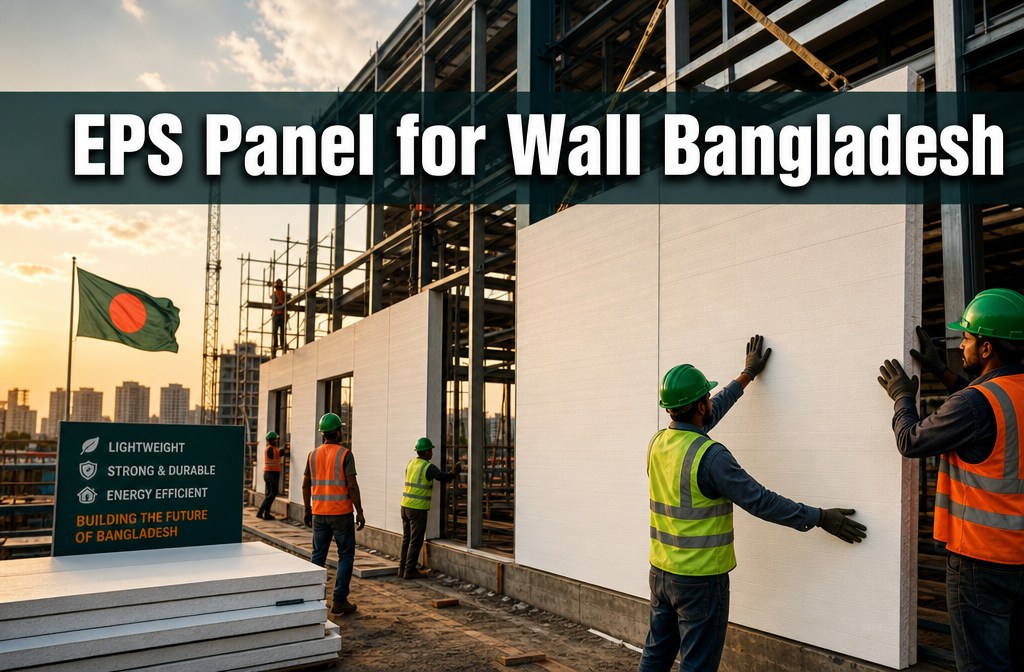
EPS (Expanded Polystyrene) wall panels are prefabricated sandwich panels with a rigid foam core bonded between two steel face sheets, widely used across Bangladesh for industrial, commercial, and cold storage construction. They offer excellent thermal insulation, fast installation, and lower long-term energy costs compared to conventional brick or concrete walls. In 2026, EPS wall panels remain one of the most cost-effective insulated building solutions available in the Bangladeshi market.
Key Takeaways
- EPS panels consist of an expanded polystyrene core sandwiched between two galvanized or pre-painted steel sheets, forming a complete wall system.
- They are significantly lighter than brick walls, reducing structural load and foundation costs.
- EPS panels deliver strong thermal performance (low thermal conductivity), making them ideal for Bangladesh's hot and humid climate.
- Standard panel thicknesses range from 50mm to 200mm; thicker panels suit cold storage and temperature-controlled environments.
- Local manufacturers in Bangladesh now produce EPS wall panels to international quality standards, reducing import dependency.
- Installation is 3–5 times faster than conventional masonry, cutting labor costs and project timelines.
- EPS panels are best suited for warehouses, factories, garment facilities, cold rooms, and modular offices — not ideal for high-rise load-bearing walls.
- Prices in Bangladesh vary based on panel thickness, steel gauge, and surface finish; getting multiple quotes is essential.
- Fire-rated EPS variants are available but should be verified with the supplier before purchase.
- Always confirm cam-lock jointing systems and panel certification before ordering in bulk.
What Is an EPS Panel for Wall, and Why Does It Matter in Bangladesh?
An EPS wall panel is a factory-made composite building element: a core of expanded polystyrene foam bonded under pressure to two steel face sheets. The result is a rigid, lightweight, and thermally efficient wall unit that can be installed quickly on a steel or concrete frame.
Bangladesh's construction sector has grown sharply over the past decade, driven by garment factories, cold chain logistics, pharmaceutical facilities, and industrial sheds. Conventional brick-and-mortar construction is slow, labor-intensive, and thermally poor — a real liability in a country where summer temperatures regularly exceed 38°C and humidity stays high for months. EPS panel for wall Bangladesh projects solve all three problems at once.
Key reasons EPS panels have gained traction in Bangladesh:
- Speed: A standard factory wall can be enclosed in days rather than weeks.
- Thermal control: EPS foam has a thermal conductivity (λ) of approximately 0.035–0.040 W/m·K, making it one of the better-performing insulation materials available locally.
- Weight: A 100mm EPS sandwich panel weighs roughly 10–14 kg/m², compared to 200+ kg/m² for a 230mm brick wall.
- Cost efficiency: Lower foundation loads, faster labor, and reduced air-conditioning costs combine to lower the total project cost over a building's lifecycle.
For a broader overview of panel types available locally, see this full comparison of sandwich panel types in Bangladesh.
How Does EPS Compare to Other Wall Panel Core Materials?
EPS is one of three common core materials used in Bangladesh's sandwich panel market. The right choice depends on the application, budget, and fire requirements.
| Feature | EPS Panel | PU (Polyurethane) Panel | Rockwool Panel |
|---|---|---|---|
| Thermal conductivity | ~0.035–0.040 W/m·K | ~0.022–0.028 W/m·K | ~0.033–0.040 W/m·K |
| Fire resistance | Low–Medium (varies) | Low–Medium | High (non-combustible) |
| Cost (relative) | ✅ Lowest | Mid–High | Mid–High |
| Cold storage suitability | Good | Excellent | Poor |
| Moisture resistance | Good | Excellent | Moderate |
| Best use case | Factories, warehouses, offices | Cold rooms, pharma | Fire-rated walls, high-risk areas |
Choose EPS if: budget is the primary concern, the application is a dry industrial or commercial space, and fire risk is low-to-moderate.
Choose PU if: the project involves cold storage or pharmaceutical-grade temperature control. See the detailed EPS vs PU sandwich panel comparison for a deeper breakdown.
Choose Rockwool if: fire resistance is mandatory — for example, near high-voltage equipment or in facilities with flammable materials. The Rockwool sandwich panel Bangladesh guide covers this in detail.
What Are the Main Applications of EPS Panel for Wall Bangladesh?
EPS wall panels are used across several sectors in Bangladesh, each with slightly different specification requirements.
Industrial & Garment Factories
Large-span factory buildings benefit most from EPS panels. The lightweight system reduces steel frame requirements, and the insulated walls keep interior temperatures manageable, which matters for worker comfort and product quality.
Warehouses and Logistics Centers
For ambient-temperature warehouses, 50–75mm EPS panels are typically sufficient. For temperature-sensitive goods, thicker panels or a switch to PU core is advisable. Learn more about sandwich panels for warehouses in Bangladesh.
Cold Storage Facilities
EPS panels at 100mm–200mm thickness are used in basic cold rooms. For deep-freeze applications (below -18°C), PU panels are generally preferred due to their lower thermal conductivity.
Modular Offices and Site Cabins
Prefabricated office modules using EPS wall panels can be assembled in 2–3 days and relocated if needed — a practical solution for construction site offices and temporary facilities.
Pharmaceutical and Food Processing
Cleanroom-grade EPS panels with smooth, antibacterial steel surfaces are used in food processing and pharmaceutical manufacturing. Panels must meet hygiene standards and be compatible with regular chemical cleaning.
Common mistake: Specifying standard EPS panels for a cold storage project without confirming the panel's thermal resistance (R-value) for the target temperature. Always ask the supplier for the U-value at the required operating temperature.
What Thickness Should You Choose for EPS Wall Panels in Bangladesh?
Panel thickness directly determines thermal performance, structural rigidity, and cost. There is no single "right" answer — it depends on the application.
General thickness guidelines for Bangladesh conditions:
- 50mm: Partition walls, internal divisions, site offices where thermal control is not critical.
- 75mm: External walls of ambient warehouses, light industrial buildings.
- 100mm: Standard factory walls, garment facilities, commercial buildings where some thermal control is needed.
- 150mm: Cold rooms operating at +2°C to +10°C, pharmaceutical storage.
- 200mm: Deep-freeze cold rooms (though PU is often preferred at this range).
Quick rule: For every 10°C difference between inside and outside target temperatures, move up one thickness category. Bangladesh's outdoor summer temperature can reach 38–40°C, so a facility targeting 22°C indoors needs at least 100mm EPS on external walls.
For a structured approach to this decision, the sandwich panel thickness selection guide provides step-by-step criteria.
How Much Does EPS Panel for Wall Bangladesh Cost in 2026?
EPS wall panel pricing in Bangladesh depends on panel thickness, steel sheet gauge (typically 0.4mm–0.6mm), surface coating, and order volume. The following figures are market estimates for 2026 based on locally manufactured panels and should be verified with suppliers directly, as raw material prices fluctuate.
Estimated price ranges (supply only, excluding installation):
| Panel Thickness | Estimated Price Range (BDT/sq ft) |
|---|---|
| 50mm EPS wall panel | BDT 90–130 |
| 75mm EPS wall panel | BDT 110–155 |
| 100mm EPS wall panel | BDT 130–180 |
| 150mm EPS wall panel | BDT 165–220 |
Note: These are indicative estimates only. Actual prices vary by supplier, steel specification, and project volume. Always request a formal quotation.
Installation adds roughly 15–25% to the supply cost, depending on project complexity and site location. For a full breakdown of what drives panel pricing, see the sandwich panel price list Bangladesh guide.
Factors that increase cost:
- Higher steel gauge (0.5mm or 0.6mm vs standard 0.4mm)
- Special surface finishes (food-grade, antibacterial coating)
- Custom panel dimensions
- Remote project sites requiring transport surcharges
How Are EPS Wall Panels Installed in Bangladesh?
EPS wall panel installation follows a structured sequence. Most local manufacturers provide installation teams or technical support.
Step-by-step installation process:
- Frame preparation: Steel purlins or concrete columns must be plumb, level, and at correct spacing (typically 600mm–1200mm centers depending on panel width).
- Bottom track fixing: A bottom channel or floor track is fixed to the slab to receive the first panel row.
- Panel placement: Panels are lifted (by crane or manually for lighter panels) and slotted into the bottom track, then aligned vertically.
- Cam-lock or tongue-and-groove jointing: Adjacent panels are connected using the panel's interlocking joint system. Cam-lock connectors provide a tight, gap-free seal.
- Fastening to structure: Self-drilling screws fix the panel face to the steel frame at specified intervals.
- Sealing: All joints, corners, and penetrations are sealed with compatible sealant or foam to prevent air and moisture infiltration.
- Trim and flashing: Corner trims, window/door surrounds, and base flashings are fitted to complete the weatherproof envelope.
Common installation mistake: Skipping sealant at panel joints to save time. In Bangladesh's monsoon season, unsealed joints allow water ingress that degrades the EPS core and causes steel face corrosion within 2–3 years.
Who Are the Main EPS Panel Suppliers and Manufacturers in Bangladesh?
Bangladesh now has a well-developed local manufacturing base for EPS sandwich panels. Buying locally reduces lead times, lowers transport costs, and makes after-sales support more accessible.
When evaluating a supplier, check for:
- Production capacity: Can they deliver your required volume on schedule?
- Quality certifications: ISO certification or equivalent quality management system.
- Steel source: Locally rolled or imported pre-painted steel (PPGI) — imported PPGI from reputable mills generally offers better corrosion resistance.
- Panel testing: Has the panel been tested for thermal performance, structural load, and (where relevant) fire resistance?
- References: Ask for completed project references in a similar application.
For a vetted list of local producers, the sandwich panel manufacturers in Bangladesh directory is a useful starting point. For Dhaka-based buyers, the sandwich panel manufacturers in Dhaka guide narrows the search geographically.
What Are the Pros and Cons of EPS Wall Panels for Bangladesh Construction?
Pros:
- ✅ Low cost compared to PU and Rockwool panels
- ✅ Lightweight, reducing structural and foundation loads
- ✅ Good thermal insulation for Bangladesh's climate
- ✅ Fast installation, cutting project timelines significantly
- ✅ Recyclable EPS core (environmental benefit)
- ✅ Wide range of thicknesses and finishes available locally
Cons:
- ❌ Lower fire resistance than Rockwool panels — not suitable for high-risk fire zones without additional fire protection
- ❌ Less effective than PU panels for deep-freeze cold storage
- ❌ EPS can absorb moisture if panel joints are poorly sealed over time
- ❌ Not a structural/load-bearing wall system — requires a separate steel or concrete frame
- ❌ Surface can dent under impact if steel gauge is too thin (specify minimum 0.5mm for high-traffic areas)
Pull quote: "EPS wall panels are not a universal solution — they are the right solution for the right application. Match the panel spec to the project requirement, not the other way around."
FAQ: EPS Panel for Wall Bangladesh
Q: Can EPS wall panels be used in residential buildings in Bangladesh?
EPS panels are used in prefabricated residential units and modular homes in Bangladesh, but they are not common in conventional multi-story residential construction because they are non-load-bearing. They work well for single-story homes, rural housing projects, and modular staff quarters.
Q: How long do EPS wall panels last in Bangladesh's climate?
A well-installed EPS panel with quality PPGI steel faces and properly sealed joints can last 20–30 years in Bangladesh's conditions. The main durability risk is moisture ingress at unsealed joints, which accelerates corrosion.
Q: Are EPS panels fire-rated?
Standard EPS is combustible. Some manufacturers add flame-retardant additives to the EPS core, which reduces (but does not eliminate) fire risk. For fire-rated wall applications, Rockwool-core panels are the safer choice. See the fire-rated sandwich panel Bangladesh guide for detailed options.
Q: What is the minimum order quantity for EPS wall panels in Bangladesh?
Most local manufacturers accept orders from around 200–500 sq meters upward. Smaller quantities are possible but may attract a premium price. Contact suppliers directly to confirm current minimums.
Q: Can EPS panels be cut on-site for windows and doors?
Yes. EPS sandwich panels can be cut using a circular saw with a fine-tooth blade or a jigsaw. Cuts should be sealed with compatible foam sealant to protect the exposed EPS core from moisture.
Q: Do EPS wall panels require maintenance?
Maintenance is minimal. Annual inspection of joints and sealants, cleaning of panel surfaces, and prompt repair of any dents or scratches that expose bare steel are the main tasks. The complete sandwich panel maintenance guide covers this in full.
Q: What steel thickness should I specify for EPS wall panels?
For standard industrial walls, 0.4mm PPGI is the minimum. For areas subject to forklift impact, foot traffic, or harsh weather exposure, specify 0.5mm or 0.6mm. Thicker steel adds cost but significantly extends panel life.
Q: Are EPS wall panels suitable for pharmaceutical or food processing facilities?
They can be used if the steel face has an appropriate hygiene-grade coating (smooth, non-porous, chemical-resistant). Confirm with the supplier that the panel meets the required hygiene standards for the specific application.
Conclusion: Actionable Next Steps for Buying EPS Wall Panels in Bangladesh
EPS panel for wall Bangladesh projects offers a strong combination of thermal performance, installation speed, and cost efficiency — particularly for industrial, commercial, and logistics applications. The key is matching the right panel specification to the actual project requirements.
Actionable next steps:
- Define your application clearly — ambient warehouse, cold room, factory, or office — before contacting any supplier.
- Specify panel thickness based on your temperature differential, not just cost. Use the thickness guidelines above as a starting point.
- Request formal quotations from at least three local manufacturers, specifying steel gauge, core density, and surface finish.
- Ask for test certificates confirming thermal performance and, where relevant, fire resistance.
- Budget for installation and sealing — not just panel supply. A poorly sealed EPS wall will cost more in repairs than the money saved on installation shortcuts.
- Check supplier references for completed projects in a similar application and climate zone.
For pricing context before approaching suppliers, review the sandwich panel price per square meter Bangladesh guide. To explore the full range of insulated panel options, the insulated sandwich panel Bangladesh guide covers all core materials and applications in one place.
References
- European Manufacturers of EPS (EUMEPS). EPS White Book: Thermal Insulation Properties of EPS. 2019. https://www.eumeps.org
- Bangladesh National Building Code (BNBC). Structural Design Requirements. 2020. https://bnbc.gov.bd
- International Energy Agency (IEA). Building Envelopes: Thermal Performance Standards. 2021. https://www.iea.org