Last updated: May 19, 2026
Quick Answer
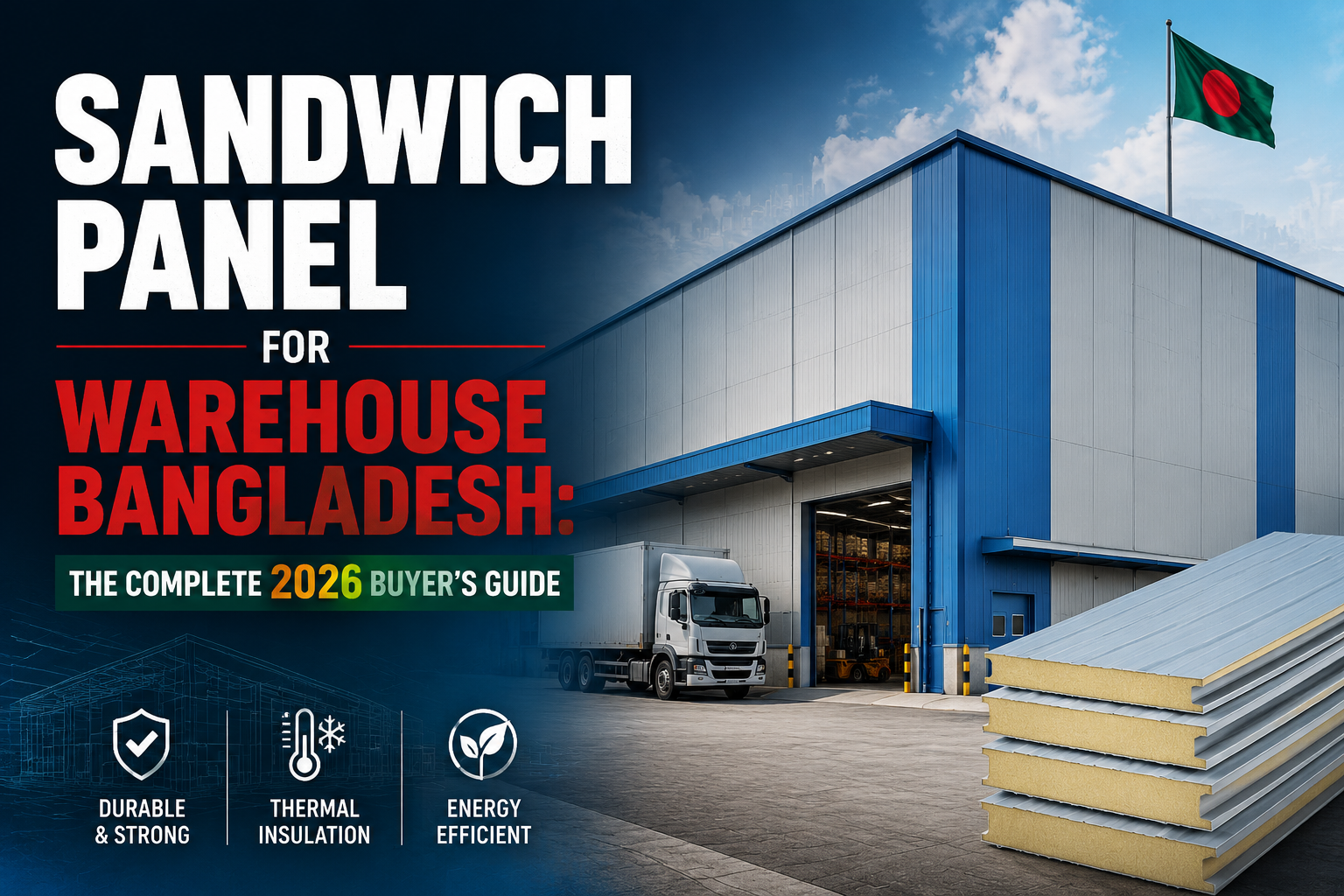
Sandwich panels are the most practical wall and roof cladding choice for warehouse construction in Bangladesh. They combine a rigid insulating core (EPS, PU, or rockwool) bonded between two steel face sheets, delivering fast installation, strong thermal performance, and lower long-term energy costs compared to traditional brick or concrete construction. For most Bangladeshi warehouse projects in 2026, EPS or PU-core panels in the 50–100mm thickness range offer the best balance of cost and performance.
Key Takeaways
- Sandwich panels cut warehouse construction time by 40–60% compared to conventional masonry methods (estimate based on typical prefabricated panel project timelines reported by contractors in South Asia).
- Three core materials dominate the Bangladesh market: EPS (expanded polystyrene), PU/PUR (polyurethane), and rockwool (mineral wool).
- EPS panels are the most affordable option; PU panels offer superior insulation; rockwool panels are best where fire resistance is a priority.
- Panel thickness for warehouse walls typically ranges from 50mm to 150mm depending on temperature control requirements.
- Local manufacturers in Dhaka and Chittagong supply panels, reducing lead times and import costs significantly.
- Proper installation — including correct joint sealing and fixing — is as important as panel selection for long-term performance.
- Cost in Bangladesh varies by core type, thickness, and order volume; always compare per-square-meter pricing from at least three suppliers.
- Maintenance is minimal but periodic inspection of joints, fasteners, and surface coatings is essential in Bangladesh's humid climate.
What Is a Sandwich Panel and Why Does It Matter for Warehouse Construction in Bangladesh?
A sandwich panel is a three-layer composite building component: two thin steel face sheets bonded to a rigid insulating core material. The result is a panel that is lightweight, structurally strong, and thermally efficient — all at the same time.
For warehouse construction in Bangladesh, this matters because:
- Bangladesh's climate — hot, humid summers and a monsoon season — puts constant thermal and moisture stress on building envelopes.
- Warehouses often store temperature-sensitive goods (pharmaceuticals, food, electronics), making insulation performance critical.
- Speed of construction is a commercial priority; a garment or FMCG company cannot afford a 12-month build schedule.
Traditional brick-and-mortar warehouse walls absorb heat, require thick sections to achieve even modest insulation values, and take months to erect. A sandwich panel for warehouse use in Bangladesh solves all three problems in a single product.
What Are the Main Types of Sandwich Panel Available in Bangladesh?
Three core materials are widely available from local and regional suppliers. Each suits different warehouse requirements.
| Core Material | Thermal Performance | Fire Resistance | Relative Cost | Best For |
|---|---|---|---|---|
| EPS (Expanded Polystyrene) | Good | Low (combustible) | Lowest | General dry storage, light industry |
| PU / PUR (Polyurethane) | Excellent | Moderate | Medium | Cold storage, pharma, food warehouses |
| Rockwool (Mineral Wool) | Good | Excellent (non-combustible) | Higher | Fire-sensitive warehouses, chemical stores |
Choose EPS if: your warehouse stores non-perishable goods, budget is tight, and fire risk is low.
Choose PU if: you need controlled temperatures (cold chain, pharma, food processing) or want the thinnest panel for a given insulation value.
Choose rockwool if: local fire codes require non-combustible cladding, or the warehouse stores flammable materials.
For a detailed comparison, see EPS vs PU Sandwich Panel: Which Is Right for You?
How Do You Choose the Right Sandwich Panel Thickness for a Warehouse in Bangladesh?
Panel thickness directly controls thermal resistance (R-value) and structural span capability. Thicker panels insulate better but cost more per square meter.
Practical thickness guidelines for Bangladeshi warehouses:
- 50mm EPS or PU: Suitable for walls and roofs of ambient-temperature warehouses (no active cooling). Good for general storage in Dhaka, Chittagong, or Gazipur industrial zones.
- 75–100mm PU: Recommended for warehouses storing goods that need mild temperature control (below 25°C), or for roofs in direct sun exposure.
- 100–150mm PU: Required for cold rooms, chilled distribution centers, or pharmaceutical warehouses needing tight temperature bands.
- 50–75mm Rockwool: Standard for fire-rated wall panels where thermal performance is secondary to fire resistance.
Common mistake: Many buyers underspecify roof panel thickness. Roof panels receive direct solar radiation in Bangladesh, so a 50mm panel that works on walls may underperform on the roof. Go at least one thickness grade up for roof applications.
For more detail on selecting the right thickness, read How to Choose Sandwich Panel Thickness (2026 Guide).
What Does Sandwich Panel for Warehouse Bangladesh Cost in 2026?
Sandwich panel pricing in Bangladesh depends on core material, thickness, steel gauge, surface finish, and order volume. The figures below are market estimates for 2026 based on typical local supplier quotations — always request a formal quote for your specific project.
Approximate price ranges (per square meter, supply only, ex-factory Bangladesh):
- EPS sandwich panel (50mm): BDT 650–900/sqm
- EPS sandwich panel (75–100mm): BDT 850–1,150/sqm
- PU sandwich panel (50mm): BDT 900–1,200/sqm
- PU sandwich panel (75–100mm): BDT 1,100–1,500/sqm
- Rockwool sandwich panel (50–75mm): BDT 1,200–1,800/sqm
Factors that push costs up:
- Higher steel gauge (0.5mm vs. 0.4mm face sheets)
- Special surface coatings (PVDF, food-grade finishes)
- Custom panel lengths or widths
- Small order volumes (below 500 sqm)
Factors that reduce costs:
- Bulk orders (above 2,000 sqm)
- Standard panel sizes
- Off-peak ordering (avoiding pre-monsoon construction rush)
For a full pricing breakdown, see Sandwich Panel Price in Bangladesh 2026 | Full Guide.
Where Can You Source Sandwich Panel for Warehouse Projects in Bangladesh?
Local manufacturers and suppliers are the most practical sourcing option for most warehouse projects. Importing panels from China or India adds lead time, freight cost, and customs complexity that rarely makes economic sense for projects under 5,000 sqm.
Key sourcing locations in Bangladesh:
- Dhaka (Gazipur, Savar, Ashulia): Highest concentration of manufacturers serving the RMG and industrial sectors.
- Chittagong: Strong supplier base serving port-adjacent warehouses and export processing zones.
- Narayanganj and Narsingdi: Growing supplier presence serving textile and pharmaceutical warehouses.
When evaluating a supplier, check:
- Do they manufacture in-house or trade (resell imported panels)?
- Can they provide test certificates for thermal conductivity and fire performance?
- What is their production lead time and minimum order quantity?
- Do they offer installation support or refer qualified installers?
For a vetted list, see Sandwich Panel Suppliers in Bangladesh: 2026 Buyer's Guide and Sandwich Panel Manufacturer in Bangladesh.
How Is Sandwich Panel Installed on a Warehouse in Bangladesh?
Correct installation is where many warehouse projects lose the performance gains that good panel selection provides. Poor joint sealing, incorrect fastener spacing, or misaligned panels create thermal bridges, water ingress, and structural weakness.
Step-by-step installation overview for warehouse walls and roofs:
- Structural frame preparation: Ensure the steel or concrete frame is plumb, level, and correctly spaced for the panel span. Sandwich panels are cladding, not structural elements — the frame carries the load.
- Panel delivery and handling: Store panels flat, off the ground, covered. Avoid point loading on panel faces during handling.
- Wall panel installation (bottom-up): Start from the base rail. Fix the first panel, check vertical alignment, then interlock subsequent panels using the tongue-and-groove or cam-lock joint system.
- Fastener installation: Use manufacturer-specified self-drilling screws at the recommended spacing (typically 300–600mm centers depending on wind load zone). Over-tightening crushes the core and reduces insulation value.
- Joint sealing: Apply butyl tape or silicone sealant at all panel-to-panel and panel-to-frame joints before closing. This step is frequently skipped and is the most common cause of water ingress in Bangladeshi warehouses.
- Roof panel installation: Work from eave to ridge. Ensure adequate overlap at end laps (minimum 200mm for Bangladeshi rainfall intensity). Install ridge caps and eave flashings before the monsoon season.
- Accessories and trim: Fit corner trims, window/door surrounds, and base flashings to complete the weathertight envelope.
For a detailed installation walkthrough, see Sandwich Panel Roof Installation Bangladesh: 2026 Guide.
What Are the Key Benefits and Limitations of Using Sandwich Panel for Warehouse Bangladesh?
Benefits:
- Fast construction: A 5,000 sqm warehouse shell can be clad in days rather than weeks.
- Thermal efficiency: Reduces air conditioning loads significantly in Bangladesh's hot climate, lowering energy bills.
- Lightweight: Reduces structural steel requirements compared to brick infill walls.
- Hygienic surfaces: Smooth steel faces are easy to clean — important for food, pharma, and FMCG warehouses.
- Modular and relocatable: Panels can be removed and reinstalled if the warehouse layout changes.
- Wide local availability: Multiple sandwich panel manufacturers in Dhaka supply stock and custom sizes.
Limitations:
- Not load-bearing: The frame must carry all structural loads; panels are envelope only.
- Susceptible to impact damage: Forklifts and heavy equipment can dent or puncture panels at lower wall levels. Specify protective barriers in high-traffic zones.
- EPS and PU cores are combustible: Where fire regulations require non-combustible cladding, rockwool panels are mandatory. Check Bangladesh National Building Code (BNBC) requirements for your occupancy class.
- Surface corrosion in coastal areas: Warehouses near Chittagong port or coastal zones need higher-grade steel coatings (AZ150 or PVDF finish) to resist salt air corrosion.
How Do You Maintain Sandwich Panels on a Warehouse in Bangladesh?
Sandwich panels in Bangladesh's climate need periodic maintenance to preserve performance and appearance. The good news: the maintenance schedule is simple and low-cost.
Annual maintenance checklist:
- Inspect all panel joints and flashings for sealant cracking or separation; re-seal as needed.
- Check fastener heads for corrosion; replace any showing rust.
- Clear debris from roof panel laps and gutters before the monsoon season (April–May).
- Wash panel surfaces with mild detergent and water to remove mold, algae, or industrial deposits.
- Inspect lower wall panels for impact damage; repair dents promptly to prevent water ingress behind the face sheet.
Edge case: In pharmaceutical or food warehouses, panel surface integrity directly affects hygiene compliance. Any crack, dent, or delamination at the panel face should be repaired immediately — not deferred to the next annual cycle.
For a full maintenance protocol, see Maintenance of Sandwich Panels: Complete 2026 Guide.
FAQ: Sandwich Panel for Warehouse Bangladesh
Q: Can sandwich panels be used for both walls and roofs of a warehouse?
Yes. Sandwich panels are manufactured in wall and roof profiles. Roof panels have a trapezoidal or standing-seam profile for water drainage; wall panels are typically flat or lightly ribbed. Always specify the application when ordering.
Q: What panel thickness is standard for a general dry-goods warehouse in Bangladesh?
50–75mm EPS or PU panels are standard for ambient-temperature dry-goods warehouses. For roofs, 75mm is a safer choice due to direct solar heat gain.
Q: Are sandwich panels compliant with Bangladesh National Building Code (BNBC)?
Panels themselves are a material, not a system — BNBC compliance depends on the overall building design, occupancy class, and fire zone. Consult a structural engineer and check fire rating requirements for your specific warehouse category.
Q: How long do sandwich panels last on a warehouse in Bangladesh?
With proper installation and annual maintenance, high-quality panels with AZ150 galvanized steel faces typically last 20–30 years in inland locations. Coastal locations near Chittagong may see reduced lifespan without upgraded corrosion-resistant coatings.
Q: Can I install sandwich panels over an existing brick warehouse wall?
Yes, in most cases. Panels can be fixed to a secondary steel sub-frame attached to the existing structure. This is a common retrofit approach to improve insulation and appearance of older warehouses.
Q: What is the minimum order quantity for sandwich panels from Bangladeshi manufacturers?
Most local manufacturers have a minimum order of 200–500 sqm. Below this, you may be buying from a distributor at a higher per-unit price.
Q: Do I need a special contractor to install sandwich panels?
General steel building contractors can install sandwich panels, but experience matters. Ask for references from previous warehouse projects and confirm the contractor understands joint sealing requirements specific to Bangladesh's monsoon conditions.
Q: What is the difference between EPS and PU sandwich panels for a warehouse?
EPS panels cost less and suit ambient-temperature storage. PU panels have a significantly higher insulation value per millimeter of thickness, making them the better choice for cold chain, pharmaceutical, or food warehouses. See the full comparison at EPS vs PU Sandwich Panel: Which Is Right for You?
Q: Are fire-rated sandwich panels available in Bangladesh?
Yes. Rockwool-core panels offer Class A non-combustible fire ratings. Some PU panels are also available with fire-retardant additives. For fire-sensitive warehouses, always request the fire test certificate from the supplier.
Q: How does Bangladesh's monsoon season affect sandwich panel installation scheduling?
Heavy monsoon rain (June–September) slows installation and increases the risk of water ingress into open panel joints before they are sealed. Most experienced contractors schedule structural steel and panel installation for October–April and plan roof completion before June.
Conclusion: Actionable Next Steps for Your Warehouse Project
Sandwich panels are the practical, cost-effective choice for warehouse construction and renovation across Bangladesh in 2026. The key decisions are core material (EPS for budget general storage, PU for temperature-controlled or insulation-critical applications, rockwool for fire-rated requirements), panel thickness (match to your thermal and span requirements), and supplier selection (prioritize local manufacturers with verifiable test certificates).
Here's how to move forward:
- Define your warehouse use case — ambient storage, cold chain, pharma, food, or general industrial — before approaching any supplier.
- Get at least three quotes specifying the same panel type, thickness, steel gauge, and surface finish so you're comparing like for like. Use Sandwich Panel Price in Bangladesh as a baseline reference.
- Verify your supplier's credentials — ask for thermal conductivity test reports and, where relevant, fire test certificates.
- Engage an experienced installer with specific sandwich panel warehouse references in Bangladesh.
- Plan installation around the monsoon calendar — target roof completion before June.
- Budget for accessories (flashings, fasteners, sealants, corner trims) — these typically add 10–15% to the panel supply cost but are essential for a weathertight result.
For a broader overview of insulated panel options in Bangladesh, the Insulated Sandwich Panel Bangladesh: Complete 2026 Guide is a useful next read.
References
- Bangladesh National Building Code (BNBC), 2020 edition. Housing and Building Research Institute (HBRI), Government of Bangladesh.
- International Energy Agency (IEA). Energy Efficiency in Buildings. IEA, 2023. https://www.iea.org/topics/buildings
- European Sandwich Panel Association (EASP). Design of Sandwich Panels for Buildings. EASP Technical Guide, 2019.
- ASHRAE. Handbook of Fundamentals: Thermal Properties of Building Materials. ASHRAE, 2021.