Last updated: May 19, 2026
Quick Answer
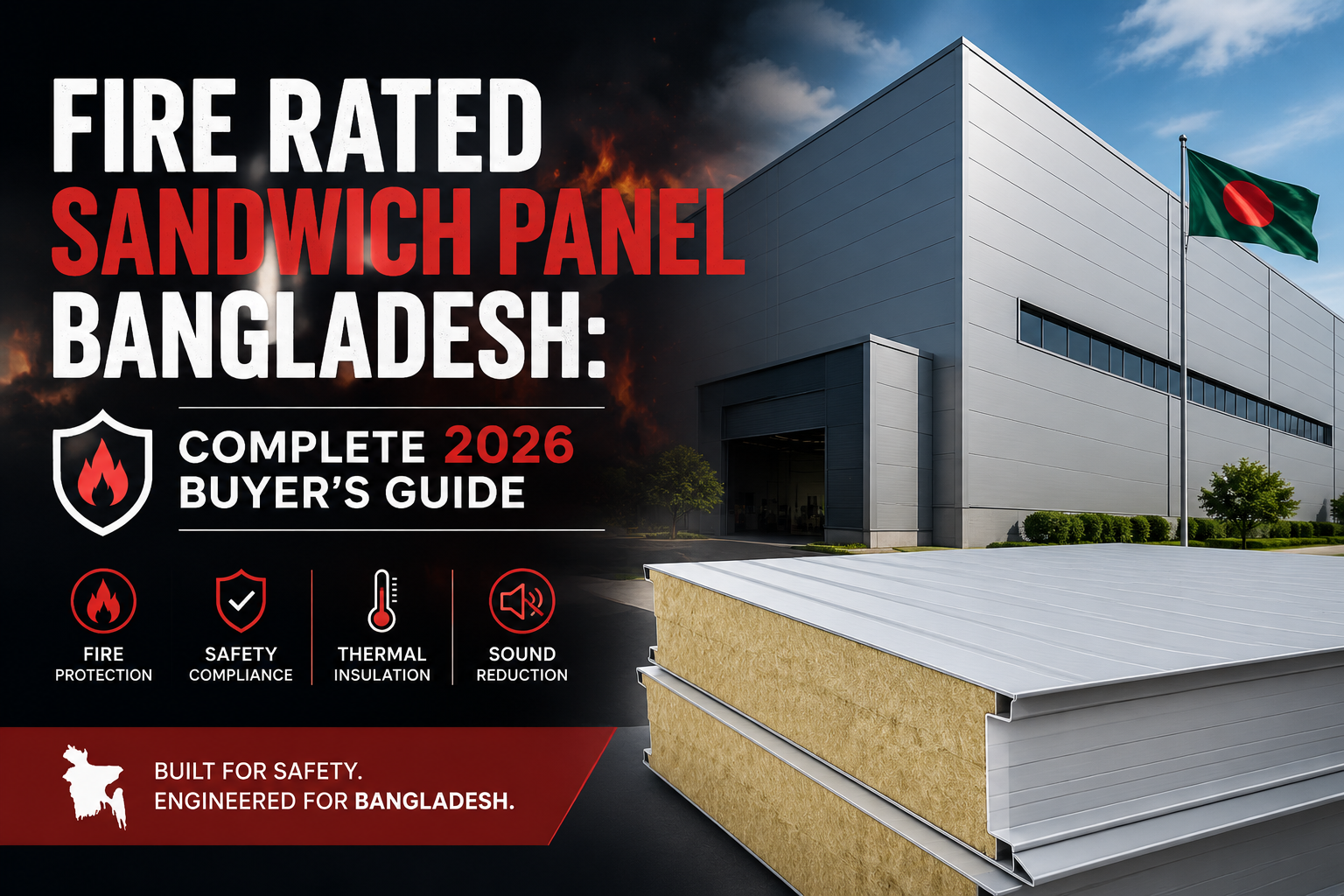
Fire rated sandwich panels in Bangladesh are composite building panels with a non-combustible or fire-resistant core (typically rockwool or mineral wool) sandwiched between two steel facings, engineered to slow or stop fire spread in commercial, industrial, and institutional buildings. They are the go-to choice for garment factories, pharmaceutical plants, cold storage facilities, and hospitals where fire safety compliance is mandatory. In Bangladesh, these panels are available from local manufacturers and importers, with prices varying by core material, thickness, and fire rating class.
Key Takeaways
- 🔥 Fire rated sandwich panels use rockwool or mineral wool cores to achieve fire resistance ratings of 30, 60, or 120 minutes.
- 🏭 Primary users include RMG factories, pharmaceutical clean rooms, food processing plants, hospitals, and data centers in Bangladesh.
- 📋 Compliance matters: Bangladesh National Building Code (BNBC) and international standards (EN 13501, UL 94) guide fire panel selection.
- 💰 Cost range: Prices vary significantly by thickness and core type — see the pricing section for a breakdown.
- ⚖️ Rockwool vs. EPS: EPS panels are cheaper but combustible; rockwool panels are the correct choice for genuine fire protection.
- 🔧 Installation quality is as critical as panel selection — poor joints and unsealed penetrations undermine fire ratings.
- 🏗️ Thickness selection depends on required fire rating, span, and load — 50mm to 150mm are common in Bangladesh.
- ✅ Always request test certificates from suppliers, not just verbal fire rating claims.
- 🌡️ Fire rated panels also provide thermal insulation, reducing cooling and heating costs in climate-controlled spaces.
- 🔗 Local manufacturers in Dhaka and Gazipur can supply custom sizes with shorter lead times than imported alternatives.
What Are Fire Rated Sandwich Panels and Why Do They Matter in Bangladesh?
Fire rated sandwich panels are three-layer building components: two steel face sheets bonded to a fire-resistant core material. The core determines the panel's fire performance. Unlike standard EPS (expanded polystyrene) panels, fire rated versions use non-combustible mineral wool or rockwool cores that resist ignition and limit flame spread.
In Bangladesh, fire safety in industrial buildings became a national priority after a series of devastating factory fires. The Rana Plaza collapse in 2013 and multiple garment factory fires before and after it exposed serious gaps in building safety standards. Today, buyers sourcing fire rated sandwich panels in Bangladesh are responding to both regulatory pressure and genuine safety responsibility.
Why this matters specifically in Bangladesh:
- Dense industrial zones (Gazipur, Narayanganj, Ashulia) concentrate high fire-risk manufacturing
- International buyers (EU, US retailers) now audit factory fire safety before placing orders
- BNBC 2020 revisions increased requirements for fire-resistant construction materials
- Insurance premiums for compliant buildings are measurably lower
What Core Materials Are Used in Fire Rated Sandwich Panels?
The core material is what determines whether a panel is truly fire rated or just marketed as one. There are three main options available in Bangladesh.
| Core Material | Fire Rating | Combustibility | Typical Use |
|---|---|---|---|
| Rockwool (Mineral Wool) | 30–120 min | Non-combustible (A1/A2) | Factories, hospitals, pharma |
| PIR (Polyisocyanurate) | 30–60 min | Limited combustibility | Cold rooms, commercial builds |
| EPS (Expanded Polystyrene) | None (standard) | Combustible | General insulation only |
The critical distinction: EPS panels are widely sold in Bangladesh and are excellent for thermal insulation, but they are not fire rated. Some suppliers loosely use the term "fire resistant" for EPS panels treated with flame retardants — these are not the same as panels with a certified fire rating. For genuine fire protection, always specify rockwool or mineral wool core panels.
For a deeper comparison of core materials, the guide on EPS vs PU sandwich panels covers performance differences in detail.
Decision rule: Choose rockwool core panels if your project requires a certified fire rating, insurance compliance, or meets BNBC fire zone requirements. Choose PIR if you need a balance of thermal performance and moderate fire resistance for cold storage applications.
How Are Fire Rated Sandwich Panels Tested and Certified?
Fire rated sandwich panels should carry test certificates from accredited laboratories. In Bangladesh, buyers should look for panels tested to internationally recognized standards.
Key standards to know:
- EN 13501-1 (European): Classifies reaction to fire from A1 (non-combustible) to F (no performance). Rockwool panels typically achieve A1 or A2.
- EN 1364 / EN 1365: Tests fire resistance of non-loadbearing and loadbearing elements (walls and floors).
- UL 94 (American): Flammability standard for plastic materials used in panels.
- BS 476 (British): Still referenced in some Bangladeshi specifications, particularly for older industrial projects.
What to ask your supplier:
- Can they provide the original lab test certificate (not a photocopy of a photocopy)?
- What standard was the panel tested to, and what rating was achieved?
- Does the certificate match the exact panel specification you are ordering (thickness, facing gauge, core density)?
A common mistake is accepting a fire rating certificate for a 100mm panel when the project calls for 50mm — the rating does not automatically transfer across thicknesses.
For rockwool panel fire safety specifics, the rockwool sandwich panel fire safety guide provides detailed technical guidance.
Where Are Fire Rated Sandwich Panels Used in Bangladesh?
Fire rated sandwich panels in Bangladesh serve a wide range of sectors. The application drives the required fire rating class and panel specification.
Industrial and manufacturing:
- RMG (ready-made garment) factories — required for compliance with ACCORD/NIRAPON safety audits
- Pharmaceutical manufacturing facilities requiring GMP-compliant, fire-safe enclosures
- Food processing plants where hygiene and fire safety intersect
Healthcare and cleanrooms:
- Hospital operating theaters and ICUs — see the hospital OT room sandwich panel guide for specific requirements
- Pharmaceutical clean room construction where fire-rated walls are a regulatory requirement
Commercial and logistics:
- Warehouses storing flammable goods
- Data centers requiring fire compartmentalization
- Cold storage facilities where PIR panels with fire ratings are used
Not the right choice for:
- Purely agricultural structures (poultry farms, for example) where standard insulated panels suffice and cost is the primary driver
- Residential construction where BNBC requirements may not yet mandate fire-rated panels for low-rise buildings
What Does Fire Rated Sandwich Panel Cost in Bangladesh?
Prices for fire rated sandwich panels in Bangladesh are higher than standard EPS panels, reflecting the cost of non-combustible core materials and certification. The following are approximate market estimates as of 2026, based on typical local supplier pricing.
| Panel Type | Thickness | Estimated Price Range (per sq ft) |
|---|---|---|
| Rockwool core (standard density) | 50mm | BDT 180–240 |
| Rockwool core (high density) | 75mm | BDT 220–290 |
| Rockwool core | 100mm | BDT 260–340 |
| PIR core (fire-rated grade) | 50mm | BDT 160–210 |
Note: These are indicative estimates only. Actual prices depend on steel facing gauge, panel width, order volume, and supplier. Always get written quotations.
For a comprehensive pricing breakdown covering all panel types, the sandwich panel price guide for Bangladesh 2026 is the most current reference.
Cost factors that move the price:
- Steel facing gauge: 0.5mm vs. 0.4mm facing adds cost but improves durability
- Core density: Higher density rockwool (e.g., 100 kg/m³ vs. 60 kg/m³) costs more but achieves higher fire ratings
- Panel width and length: Custom sizes carry a premium over standard dimensions
- Certification requirement: Panels supplied with full lab certificates may carry a 5–15% premium
How to Choose the Right Fire Rated Panel for Your Bangladesh Project
Selecting the correct fire rated sandwich panel involves matching the panel specification to the project's fire safety requirements, structural needs, and budget.
Step-by-step selection process:
- Identify the required fire rating — Check BNBC requirements for your building type and occupancy. Common requirements are 30, 60, or 120 minutes.
- Determine the application — Wall, roof, or partition? Roof panels carry structural loads; wall panels may not.
- Choose core material — Rockwool for highest fire resistance; PIR for fire-rated cold storage.
- Select thickness — Thicker panels generally achieve longer fire ratings and better thermal performance. The guide on how to choose sandwich panel thickness covers this in detail.
- Verify certifications — Request test certificates before finalizing the order.
- Check supplier capability — Can the manufacturer supply the volume you need, on time, with consistent quality?
Common mistakes to avoid:
- Specifying EPS panels and assuming flame-retardant treatment equals a fire rating
- Not checking whether the certificate matches the ordered specification
- Ignoring joint details — fire ratings assume proper installation with fire-rated sealants at all joints and penetrations
- Choosing the cheapest supplier without verifying production quality
For finding verified local suppliers, the sandwich panel suppliers in Bangladesh guide lists vetted options.
What Are the Installation Requirements for Fire Rated Sandwich Panels in Bangladesh?
A fire rated panel installed incorrectly can fail to perform as rated. The panel's fire resistance is only as good as the weakest point in the assembly.
Critical installation requirements:
- Joint sealing: All panel-to-panel joints must be sealed with fire-rated intumescent sealant or mineral wool packing. Gaps allow fire and smoke to bypass the panel's rated performance.
- Penetrations: Any pipe, conduit, or duct passing through a fire-rated panel must be fitted with a fire-rated collar or sleeve.
- Fixings: Use manufacturer-specified fixings at the correct spacing. Under-fixing compromises both structural and fire performance.
- Panel orientation: Follow manufacturer guidance on horizontal vs. vertical installation — this affects both drainage and fire performance.
- Substrate compatibility: Ensure the supporting structure (steel frame, concrete) is itself fire-rated to the same or higher level.
For roof panel installation specifics in the Bangladesh context, the sandwich panel roof installation guide covers practical steps and local considerations.
Who Are the Key Suppliers of Fire Rated Sandwich Panels in Bangladesh?
Bangladesh has a growing number of local manufacturers alongside importers bringing panels from China, India, and South Korea. Local production has expanded significantly in Dhaka, Gazipur, and Narayanganj.
Advantages of local manufacturers:
- Shorter lead times (typically 2–4 weeks vs. 6–12 weeks for imports)
- Lower transport costs and no import duties
- Easier to inspect production facilities
- Faster response for custom sizes
Advantages of imported panels:
- Some imported brands carry more widely recognized international certifications
- Certain high-density rockwool specifications may not yet be produced locally
For a current list of manufacturers, the sandwich panel manufacturers in Bangladesh page provides updated supplier information. Buyers in Dhaka specifically can also reference the sandwich panel manufacturers in Dhaka guide.
Key questions to ask any supplier:
- Do you manufacture in-house or resell imported panels?
- Can you provide a factory visit or quality inspection?
- What is your warranty policy for fire-rated panels?
- Do you have reference projects in Bangladesh with similar fire rating requirements?
FAQ: Fire Rated Sandwich Panel Bangladesh
Q: What is the difference between fire resistant and fire rated panels?
A: "Fire resistant" is a general marketing term with no standard definition. "Fire rated" means the panel has been tested to a specific standard (e.g., EN 13501) and achieved a documented rating (e.g., 60 minutes). Always ask for the specific standard and rating, not just a "fire resistant" claim.
Q: Are EPS sandwich panels fire rated?
A: Standard EPS panels are not fire rated — they are combustible. Some EPS panels include flame-retardant additives, which reduce but do not eliminate flammability. For certified fire ratings, specify rockwool or mineral wool core panels.
Q: What fire rating is required for garment factories in Bangladesh?
A: BNBC 2020 and ACCORD/NIRAPON audit standards typically require a minimum 60-minute fire resistance for structural elements and compartment walls in RMG factories. Verify the specific requirement with your compliance auditor.
Q: Can fire rated sandwich panels also provide thermal insulation?
A: Yes. Rockwool core panels provide both fire resistance and thermal insulation, though their thermal performance (U-value) is generally lower than equivalent-thickness PU or PIR panels. For applications requiring both high fire rating and high thermal performance, PIR panels with fire-rated grades offer a better balance.
Q: How long does it take to get fire rated panels delivered in Bangladesh?
A: Local manufacturers typically deliver within 2–4 weeks for standard specifications. Custom sizes or high-density rockwool panels may take 4–6 weeks. Imported panels can take 8–12 weeks including customs clearance.
Q: Do fire rated panels cost significantly more than standard panels?
A: Yes, typically 30–60% more than equivalent EPS panels, depending on core density and certification level. The cost difference is justified by compliance requirements, insurance benefits, and genuine life-safety performance.
Q: What thickness should I specify for a 60-minute fire rating?
A: This depends on the core density and manufacturer's tested specification. A common configuration for 60-minute ratings uses 75–100mm rockwool core at 100 kg/m³ density, but always verify against the supplier's actual test certificate for the specific product.
Q: Can fire rated sandwich panels be used for roofs?
A: Yes, but roof panels must also meet structural load requirements. Ensure the panel is specifically tested and rated for roof applications, not just wall use.
Q: Are fire rated sandwich panels suitable for clean rooms?
A: Yes. Fire-rated panels are commonly used in pharmaceutical clean rooms where both GMP compliance and fire safety are required. See the clean room sandwich panel guide for application-specific details.
Q: What maintenance do fire rated panels require?
A: Inspect joints and sealants annually. Replace any damaged or missing fire-rated sealant immediately. Check for corrosion on steel facings, particularly in humid Bangladeshi conditions. Avoid drilling or cutting panels without resealing penetrations with fire-rated materials.
Conclusion
Fire rated sandwich panels are no longer optional for serious industrial and commercial construction in Bangladesh — they are a baseline safety requirement for factories, hospitals, pharmaceutical plants, and any building where fire compartmentalization saves lives and protects assets.
Actionable next steps:
- Define your fire rating requirement before approaching suppliers — check BNBC 2020 and any applicable audit standards (ACCORD, NIRAPON, GMP).
- Specify rockwool core panels for genuine fire ratings; avoid accepting EPS panels marketed as "fire resistant."
- Request original test certificates that match your exact panel specification, not generic product brochures.
- Get at least three written quotations from local manufacturers and compare not just price but certification, lead time, and warranty.
- Plan installation carefully — budget for fire-rated sealants, penetration collars, and qualified installers who understand fire-rated assembly requirements.
- Document everything — keep certificates, delivery records, and installation photos for compliance audits and insurance purposes.
For pricing, supplier selection, and technical specifications, the resources at Sandwich Panel Manufacturers Bangladesh cover the full range of panel types available in the local market.
References
- Bangladesh National Building Code (BNBC) 2020, Housing and Building Research Institute, Bangladesh
- EN 13501-1:2018, Fire classification of construction products and building elements, European Committee for Standardization
- ACCORD on Fire and Building Safety in Bangladesh, Annual Progress Reports (2013–2021), accordbangladesh.org
- UL 94, Standard for Tests for Flammability of Plastic Materials for Parts in Devices and Appliances, Underwriters Laboratories, current edition