Last updated: May 19, 2026
Quick Answer
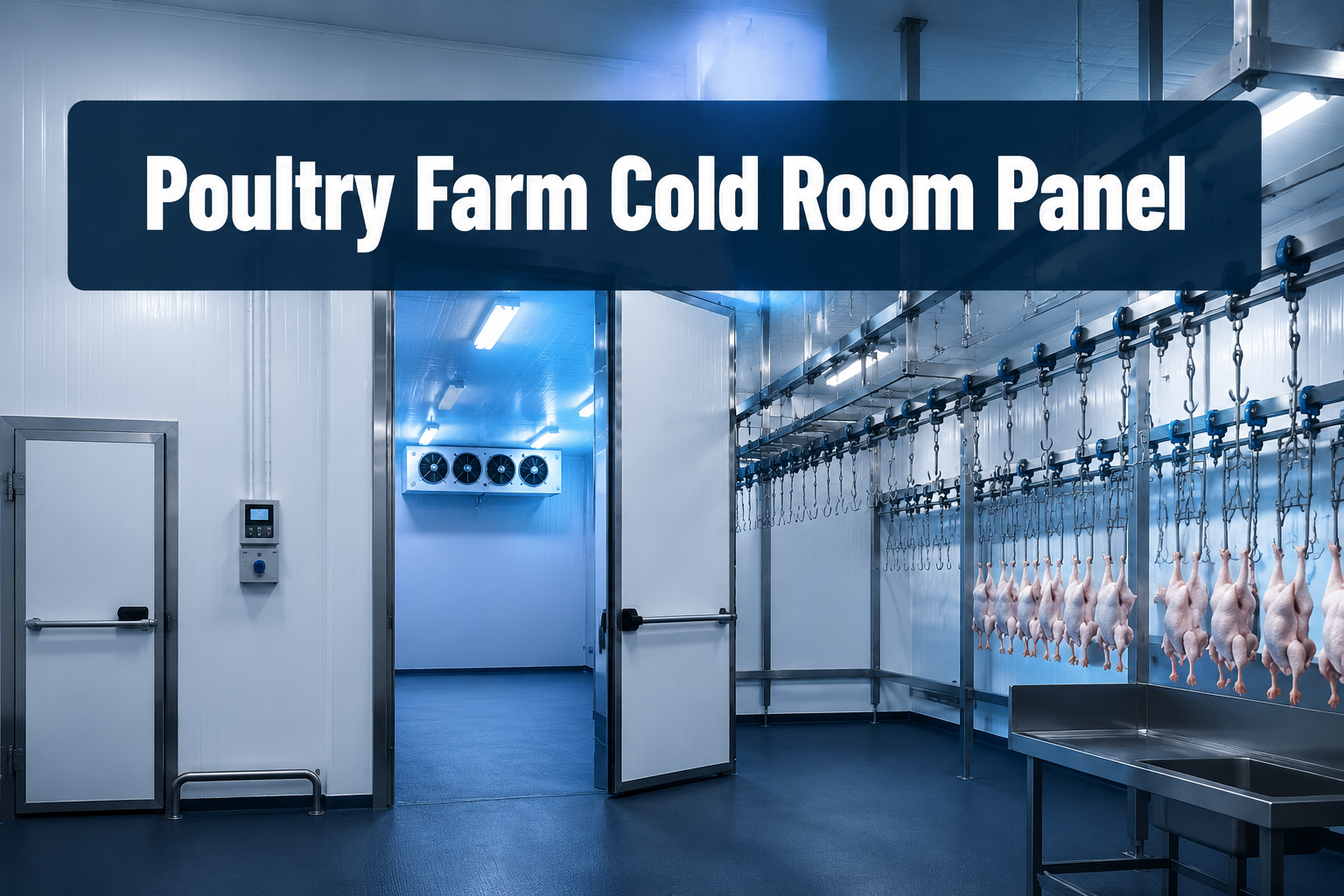
A poultry farm cold room panel is an insulated sandwich panel specifically designed to build refrigerated storage rooms on poultry farms and processing facilities. These panels maintain precise temperature control, prevent moisture ingress, and meet food-safety hygiene standards. Choosing the right panel type, thickness, and core material directly determines energy costs, product shelf life, and regulatory compliance.
Key Takeaways
- 🐔 Poultry cold rooms require panels with high thermal resistance (R-value), moisture resistance, and food-grade surface finishes.
- 🧱 PU (polyurethane) core panels are the most common choice for poultry cold rooms due to superior insulation performance.
- 📏 Panel thickness typically ranges from 75mm to 150mm depending on the target storage temperature (chiller vs. deep freeze).
- 💧 Food-grade steel facings (pre-painted galvanized or stainless steel) resist corrosion from ammonia, cleaning chemicals, and moisture.
- ⚡ Proper panel selection can reduce refrigeration energy consumption significantly compared to conventional brick-and-mortar construction.
- 🔒 Cam-lock joining systems create airtight, hygienic seams that prevent cold air leakage and bacterial buildup.
- 🌡️ Chiller rooms (0–5°C) typically use 75–100mm panels; blast freezers (−18°C to −25°C) require 100–150mm or thicker.
- ✅ Always verify panels carry food-grade certifications and comply with local building and food safety regulations.
- 🏗️ Installation quality matters as much as panel specification — poor joints cause thermal bridging and condensation.
- 💰 PU panels cost more upfront than EPS alternatives but typically deliver faster payback through lower running costs.
What Is a Poultry Farm Cold Room Panel?
A poultry farm cold room panel is a prefabricated insulated building element used to construct walls, ceilings, and floors of refrigerated rooms on poultry farms and processing plants. Each panel consists of two rigid metal facings bonded to a foam or mineral insulation core.
These panels are engineered for cold environments where temperature stability, hygiene, and structural integrity are non-negotiable. Unlike standard construction materials, cold room panels are purpose-built to handle thermal cycling, high-pressure washdowns, and the specific humidity conditions found in poultry storage areas.
For a broader overview of how these panels fit into farm building systems, see this complete guide to poultry farm sandwich panels.
Why Does Core Material Matter So Much?
The core material is the single biggest factor in a panel's thermal performance, fire behavior, and long-term durability. Three core types dominate the market for poultry cold room applications:
| Core Type | Thermal Performance | Fire Resistance | Cost Level | Best Use Case |
|---|---|---|---|---|
| PU (Polyurethane) | Excellent | Moderate (with additives) | Medium-High | Chillers, freezers, processing rooms |
| PIR (Polyisocyanurate) | Excellent | Better than PU | High | Fire-sensitive cold rooms |
| EPS (Expanded Polystyrene) | Good | Lower | Low | Budget builds, mild climates |
| Mineral Wool | Moderate | Excellent | Medium | Fire-rated walls, ambient rooms |
PU and PIR panels are the preferred choice for most poultry cold rooms. Their closed-cell foam structure resists moisture absorption, which is critical in environments with daily temperature swings and frequent washdowns.
Key decision rule: Choose PU/PIR panels for any room operating below +10°C. Choose mineral wool only when fire rating is the primary concern and the room operates at ambient or light-chill temperatures.
For a detailed breakdown of PU panel performance, the PU sandwich panel for cold room guide covers specifications, thermal values, and selection criteria in depth.
How Thick Should a Poultry Farm Cold Room Panel Be?
Panel thickness is determined by the target operating temperature and the ambient conditions outside the cold room. Thicker panels mean better insulation but also higher upfront cost.
General thickness guidelines for poultry applications:
- 75mm panels — Suitable for chiller rooms (0°C to +5°C) in moderate climates
- 100mm panels — Standard for chiller rooms in hot/humid climates, or light freezer applications (−5°C to −10°C)
- 120–150mm panels — Required for blast freezers and deep-freeze storage (−18°C to −25°C)
- 150mm+ panels — Used in ultra-low temperature or high-ambient-temperature environments
A common mistake is under-specifying thickness to save on initial cost. A panel that's too thin forces the refrigeration compressor to work harder, raising electricity bills every single day the facility operates. Over a 10-year lifespan, the energy cost difference between a 75mm and 100mm panel in a freezer application can easily exceed the panel cost difference.
For guidance on matching thickness to your specific project, see how to choose sandwich panel thickness.
What Surface Finish Is Required for Poultry Cold Rooms?
The facing material on a poultry farm cold room panel must withstand aggressive cleaning chemicals, moisture, and potential contact with poultry products. Standard options include:
- Pre-painted galvanized steel (PPGI): The most common choice. Offers good corrosion resistance and a smooth, cleanable surface. Available in food-safe white or light grey.
- Stainless steel (304 or 316 grade): Best for high-hygiene zones, processing rooms, or areas with direct product contact. More expensive but virtually corrosion-proof.
- Aluminum facing: Lightweight and corrosion-resistant. Less common in cold rooms but used in some processing areas.
Food-grade surface requirements to check:
- Smooth, non-porous finish (no exposed foam edges)
- Resistance to ammonia-based cleaning agents
- Non-toxic coatings compliant with food safety standards
- Coved or sealed corners to prevent bacterial harborage
Panels used in food processing areas should carry relevant food-grade certifications. For more on this topic, the food-grade cold room panels resource provides useful specification references.
How Are Poultry Farm Cold Room Panels Installed?
Correct installation is just as important as correct specification. Even a high-quality poultry farm cold room panel will underperform if joints are poorly sealed or panels are incorrectly supported.
Step-by-step installation overview:
- Site preparation — Level the floor slab, install floor insulation panels or raised floor system if required for freezer applications.
- Corner and base channel installation — Fix aluminum or galvanized base channels to the floor perimeter to receive wall panels.
- Wall panel erection — Stand panels vertically, engaging cam-lock connectors between adjacent panels. Work from one corner outward.
- Cam-lock tightening — Use a cam-lock key to engage and tighten each connector, compressing the panel joints for an airtight seal.
- Ceiling panel installation — Install ceiling panels supported by the wall panel tops and any intermediate steel purlins.
- Sealing — Apply food-grade sealant to all internal joints, corners, and penetrations (for pipes, electrical conduits).
- Door frame and door installation — Fit insulated cold room doors with appropriate seals and closers.
- Refrigeration penetrations — Seal all pipe and cable entries with expanding foam and food-grade sealant.
For a detailed installation walkthrough, the cold room sandwich panel installation guide covers each stage with practical tips.
Common installation mistakes to avoid:
- Leaving cam-lock connectors partially engaged (causes air leakage and condensation)
- Skipping floor panel insulation in freezer rooms (leads to frost heave under the slab)
- Using standard silicone sealant instead of food-grade variants
- Not installing anti-condensation heater cables around door frames in freezer rooms
What Are the Key Differences Between Chiller and Freezer Panel Specifications?
Chiller and freezer rooms have different requirements, and using the same panel specification for both is a frequent and costly error.
| Specification | Chiller Room (0–5°C) | Blast Freezer (−18°C to −25°C) |
|---|---|---|
| Panel thickness | 75–100mm | 100–150mm |
| Core density | Standard | Higher density recommended |
| Floor panel | Optional | Mandatory (with heating cables) |
| Door type | Standard insulated | Heavy-duty with heater frame |
| Vapor barrier | Standard | Critical — full vapor seal required |
| Sealant type | Food-grade silicone | Low-temperature rated sealant |
In freezer applications, vapor control is critical. Warm, moist air migrating through panel joints will condense and freeze inside the panel core, degrading insulation performance over time. A full vapor barrier on the warm side of the panel assembly prevents this.
How Do Poultry Farm Cold Room Panels Compare to Traditional Construction?
Traditional brick-and-mortar cold rooms are still built in some markets, but insulated sandwich panels offer clear advantages for most poultry farm applications.
Sandwich panels vs. brick construction:
- Build speed: Panel rooms can be assembled in days; brick construction takes weeks.
- Thermal performance: Panels deliver consistent, measurable R-values; brick walls require additional insulation layers.
- Hygiene: Smooth panel surfaces are easier to clean and disinfect than rendered masonry.
- Flexibility: Panel rooms can be disassembled and relocated; brick rooms cannot.
- Weight: Panels are far lighter, reducing structural load requirements.
- Long-term maintenance: Panels require minimal maintenance if correctly installed; brick rooms can develop cracks and moisture ingress over time.
The main advantage of brick construction is fire resistance, but PIR or mineral wool core panels can match or exceed the fire performance of masonry in most building code scenarios.
What Should You Check Before Buying a Poultry Farm Cold Room Panel?
Before placing an order, verify these critical specifications with your supplier:
Technical checklist:
- Core material confirmed (PU, PIR, EPS, or mineral wool)
- Panel thickness matches operating temperature requirement
- Thermal conductivity (lambda value) stated on product data sheet
- Facing material and coating confirmed as food-grade
- Cam-lock or tongue-and-groove joint system specified
- Fire rating certificate provided (if required by local code)
- Panel width and length match your room dimensions to minimize waste
- Supplier can provide matching corner pieces, ceiling panels, and accessories
Also confirm the supplier's manufacturing quality controls and whether panels are produced to recognized standards. For buyers in South Asia, the cold room panels Bangladesh resource lists regional suppliers and specification benchmarks.
FAQ: Poultry Farm Cold Room Panels
Q: What is the best core material for a poultry farm cold room panel?
PU (polyurethane) is the most widely used core for poultry cold rooms. It delivers the best thermal performance per millimeter of thickness and resists moisture absorption in humid farm environments.
Q: Can the same panels be used for both walls and ceilings?
Yes, in most systems the same panel type is used for walls and ceilings. Ceiling panels may need additional support structures depending on span width and panel thickness.
Q: How long do poultry farm cold room panels last?
Well-installed PU sandwich panels in a properly maintained cold room typically last 15–25 years. Lifespan depends heavily on cleaning practices, chemical exposure, and whether the vapor seal remains intact.
Q: Do I need a floor panel in a chiller room?
Floor insulation panels are optional in chiller rooms (0–5°C) but strongly recommended in freezer rooms (−18°C and below) to prevent frost heave and ground heat gain.
Q: What panel thickness is needed for a −20°C blast freezer?
A minimum of 120mm PU panel is generally recommended for −20°C applications in tropical or subtropical climates. In cooler ambient conditions, 100mm may be sufficient — always calculate based on local ambient temperature and required temperature differential.
Q: Are poultry cold room panels easy to clean?
Yes. Pre-painted steel or stainless steel facings with sealed joints are designed for high-pressure washdown with standard food-industry cleaning agents. Avoid abrasive cleaners that can scratch the surface coating.
Q: Can panels be cut on-site to fit irregular dimensions?
Yes, panels can be cut with appropriate tools, but factory-cut panels are preferable for clean edges and to avoid exposing the foam core. Always seal any cut edges with food-grade sealant.
Q: What is a cam-lock connector and why does it matter?
A cam-lock is a mechanical fastener built into the panel edge that locks adjacent panels together when rotated. It creates a tight, airtight joint without exposed fasteners, which is critical for hygiene and thermal performance.
Q: How much does a poultry farm cold room panel cost?
Panel pricing varies by core material, thickness, facing type, and order volume. PU panels in the 100mm range typically cost more per square meter than EPS panels of the same thickness. For current pricing in Bangladesh, the sandwich panel price guide provides a useful regional reference.
Q: Do cold room panels require planning permission?
This depends on local regulations. In most jurisdictions, permanent cold room structures require building permits. Modular panel rooms installed inside an existing building may have different requirements — always check with local authorities.
Conclusion: Actionable Next Steps
Selecting the right poultry farm cold room panel is a decision that affects energy costs, food safety, and facility lifespan for years to come. The core principles are straightforward: match panel thickness to operating temperature, choose food-grade facings, specify cam-lock joints for airtight assembly, and never compromise on installation quality.
Recommended next steps:
- Define your temperature requirements — chiller, freezer, or blast freeze — before approaching any supplier.
- Request product data sheets showing thermal conductivity (lambda value), density, and facing specifications.
- Ask for food-grade certification documentation relevant to your market's regulatory requirements.
- Get at least two or three quotes that specify the same panel thickness and core type so you're comparing like for like.
- Budget for proper installation — a qualified installer familiar with cold room panel systems will protect your investment.
- Plan for maintenance — schedule annual joint inspections and door seal checks to catch problems before they affect refrigeration performance.
For further reading, explore the best sandwich panel options for poultry farms and the cold room insulation resource library for deeper technical guidance.
References
- Food and Agriculture Organization of the United Nations (FAO). Cold Chain Management in Poultry Production. FAO Animal Production and Health Guidelines. Rome. (2010). https://www.fao.org
- ASHRAE. ASHRAE Handbook — Refrigeration. American Society of Heating, Refrigerating and Air-Conditioning Engineers. (2022). https://www.ashrae.org
- International Institute of Refrigeration (IIR). Recommendations for the Processing and Handling of Frozen Foods. 4th edition. (2006). https://www.iifiir.org
- European Food Safety Authority (EFSA). Scientific Opinion on the public health risks related to the maintenance of the cold chain during storage and transport of food. EFSA Journal. (2016). https://www.efsa.europa.eu