Last updated: May 19, 2026
Quick Answer
Sandwich panels offer construction projects faster build times, superior thermal insulation, structural strength, and lower long-term energy costs compared to traditional brick or concrete wall systems. They consist of two rigid outer skins bonded to a lightweight insulating core, and they work as walls, roofs, and floors in one integrated system. For most industrial, commercial, and controlled-environment builds, the benefits of sandwich panels in construction outweigh the higher upfront material cost.
Key Takeaways
- ⚡ Speed: Sandwich panels reduce on-site construction time by up to 50% compared to conventional masonry builds (estimate based on typical prefabricated panel installation cycles reported by manufacturers).
- 🌡️ Thermal performance: The insulating core (EPS, PU, PIR, or rockwool) dramatically cuts heat transfer, lowering HVAC energy consumption.
- 🏗️ Structural efficiency: The composite design gives panels a high strength-to-weight ratio, reducing the load on foundations and steel frames.
- 🔥 Fire safety options: Rockwool and PIR core panels can achieve fire ratings that meet international building codes. See our Rockwool Sandwich Panel Fire Safety guide for details.
- 💧 Weather resistance: Factory-bonded skins create a sealed envelope that resists moisture, wind, and dust ingress.
- 🏭 Versatile applications: Cold rooms, cleanrooms, factories, hospitals, poultry farms, and food processing facilities all benefit from sandwich panel construction.
- 💰 Lifecycle cost: Lower energy bills and minimal maintenance offset the higher initial panel cost over a building's lifespan.
- ♻️ Sustainability: Lighter structures mean less concrete and steel, reducing the overall carbon footprint of a project.
- 🔧 Ease of modification: Panels can be cut, relocated, or expanded more easily than poured concrete or brick walls.
What Are Sandwich Panels and How Do They Work?
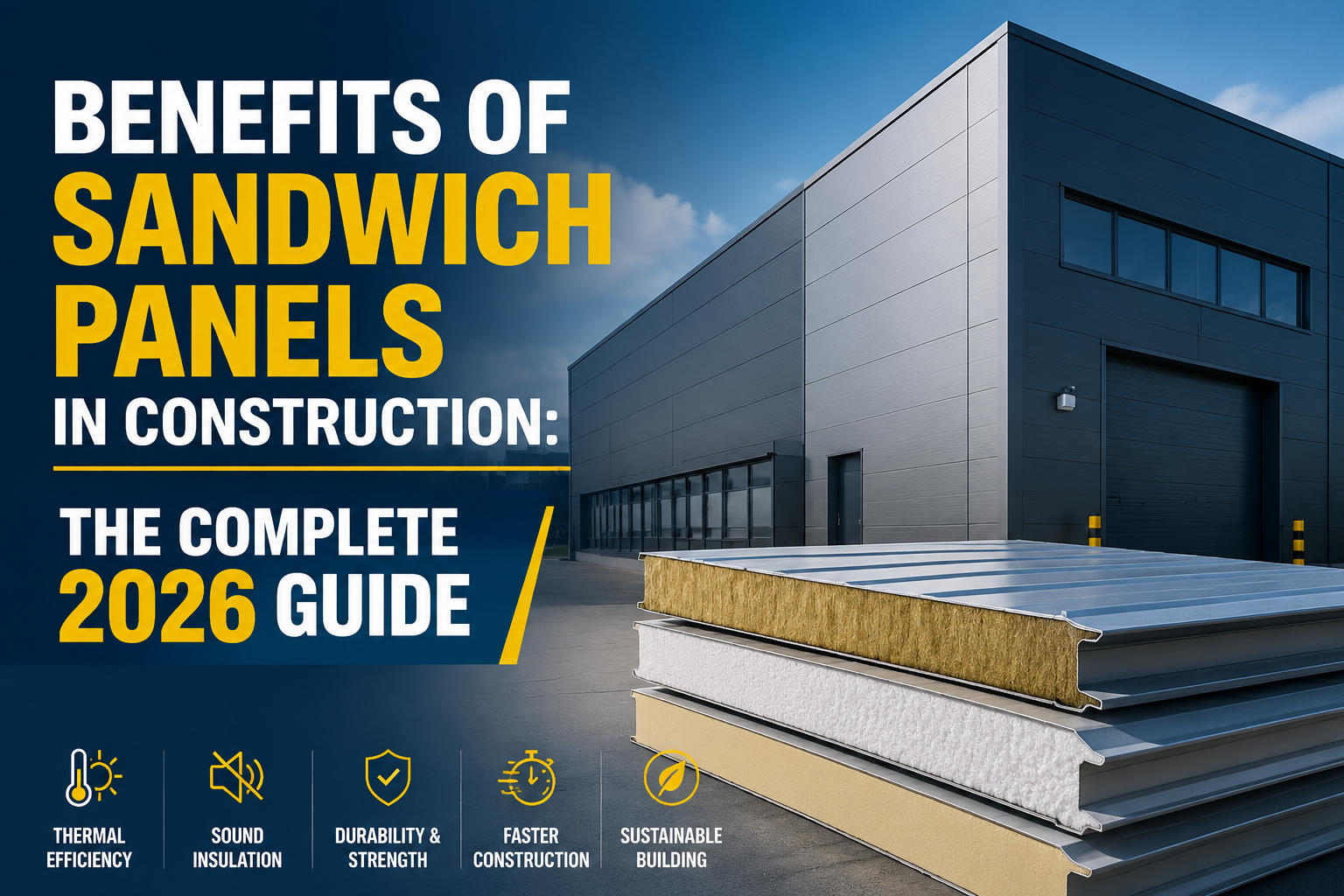
Sandwich panels are prefabricated building components made of three bonded layers: two rigid outer facings (usually galvanized or pre-painted steel) and a continuous insulating core in the middle. The core material does the thermal and acoustic work, while the steel skins carry structural loads and protect the core from physical damage and weather.
The three most common core types are:
| Core Material | Best For | Fire Rating Potential | Typical R-Value Range |
|---|---|---|---|
| EPS (Expanded Polystyrene) | General construction, roofing | Low–Moderate | Moderate |
| PU/PIR (Polyurethane/Polyisocyanurate) | Cold rooms, freezers | Moderate–High (PIR) | High |
| Rockwool (Mineral Wool) | Fire-rated walls, industrial | Very High | Moderate |
For a detailed comparison, see EPS vs PU Sandwich Panel: Which Is Right for You?
Choose EPS if your priority is cost and general insulation for roofing or walls in a temperate climate. Choose PU/PIR if you need maximum thermal efficiency for cold storage or refrigerated spaces. Choose Rockwool if fire resistance is a regulatory requirement.
What Are the Core Benefits of Sandwich Panels in Construction?
The benefits of sandwich panels in construction cover four main areas: speed, performance, cost efficiency, and design flexibility. Each benefit compounds the others, which is why sandwich panels have become the default choice for industrial and commercial builds worldwide.
1. Faster Construction Timelines
Panels arrive on-site pre-cut and pre-finished, so there's no curing time, no plastering, and no waiting for layers to dry. A skilled crew can install panels for a mid-size warehouse in days rather than weeks.
- No wet trades required (no concrete mixing, no brick-laying mortar)
- Panels interlock with tongue-and-groove joints, speeding up assembly
- Simultaneous installation of structure, insulation, and finish in one step
2. Superior Thermal Insulation
The insulating core creates a continuous thermal barrier with no cold bridges at joints when installed correctly. This is especially critical for energy efficient construction projects where HVAC costs dominate the operating budget.
Pull quote: "A well-installed sandwich panel wall can deliver thermal performance that would require a brick wall several times thicker to match."
For temperature-controlled environments like cold rooms, PU core panels are the industry standard. Learn more in the PU Sandwich Panel for Cold Room guide.
3. High Strength-to-Weight Ratio
Steel-faced sandwich panels are strong enough to span large distances without intermediate supports, yet they weigh far less than equivalent concrete or masonry walls. This reduces:
- Foundation size and cost
- Steel frame requirements
- Transport and crane costs on-site
4. All-in-One Building Envelope
One panel replaces what would otherwise be separate layers: structural wall, vapor barrier, insulation, and interior/exterior finish. That consolidation cuts both material cost and labor hours significantly.
How Do Sandwich Panels Reduce Construction Costs?
Sandwich panels reduce total project costs in three ways: lower labor costs, reduced foundation requirements, and lower lifetime energy bills. The upfront panel cost is higher than raw materials like bricks or corrugated sheets, but the total cost of ownership is typically lower.
Where the savings come from:
- Labor: Fewer trades needed on-site (no plasterers, no insulators working separately)
- Foundation: Lighter wall and roof systems mean smaller, cheaper foundations
- Energy: High insulation values cut heating and cooling costs year-round
- Maintenance: Factory-coated steel skins resist corrosion and need little upkeep (see the complete guide to maintenance of sandwich panels)
- Speed: Faster project completion means lower financing costs and earlier revenue for the building owner
Common mistake: Comparing only the panel purchase price to brick or concrete costs without accounting for labor, foundation, insulation, and finishing trades. When all costs are included, sandwich panels are almost always competitive or cheaper on a total-project basis.
Which Industries Benefit Most from Sandwich Panel Construction?
The benefits of sandwich panels in construction apply across many sectors, but some industries see especially strong returns because their buildings have strict performance requirements.
Cold Storage and Food Processing
Cold rooms and freezers need continuous, high-performance insulation with no gaps. PU core panels are the standard solution. For cold storage construction projects, the thermal efficiency of PU panels directly reduces refrigeration energy costs.
Food processing facilities also need hygienic, easy-to-clean wall surfaces. Steel-faced panels with sealed joints meet food safety construction standards far more easily than painted concrete or tiled walls.
Healthcare and Cleanrooms
Hospital operating theaters and pharmaceutical cleanrooms require controlled environments with minimal particulate contamination. Smooth-faced sandwich panels with sealed joints prevent dust accumulation and are easy to sterilize. See the Hospital OT Room Sandwich Panel guide for application-specific details.
Industrial and Factory Buildings
Large-span factory buildings benefit from the structural efficiency of sandwich panels. Fewer internal columns are needed, maximizing usable floor space. The sandwich panel for factory building guide covers load requirements and panel selection for industrial applications.
Agricultural Buildings
Poultry farms and livestock facilities need temperature control, humidity resistance, and easy cleaning. Sandwich panels handle all three. The best sandwich panel for poultry farm guide outlines the specific requirements for agricultural builds.
What Are the Fire Safety Benefits of Sandwich Panels?
Fire safety is one area where panel selection matters enormously. Not all sandwich panels offer the same fire resistance, and choosing the wrong core for a fire-rated application is a serious mistake.
Fire performance by core type:
- EPS core: Combustible. Not suitable for buildings where fire ratings are required by code.
- PU/PIR core: PIR (polyisocyanurate) offers better fire resistance than standard PU and can achieve moderate fire ratings with appropriate facings.
- Rockwool (mineral wool) core: Non-combustible. Achieves the highest fire ratings and is the correct choice for fire resistance construction applications.
Decision rule: If local building codes require a fire-rated wall or roof assembly, specify rockwool core panels. If fire rating is not a code requirement and thermal performance is the priority, PIR or PU panels are appropriate.
How Do Sandwich Panels Support Sustainable Construction?
Sandwich panels contribute to sustainable building in several measurable ways. Lighter structures require less concrete and steel, both of which are energy-intensive to produce. High insulation values reduce operational energy consumption over the building's entire lifespan.
Key sustainability benefits:
- Reduced material use: One panel replaces multiple separate building layers
- Lower operational carbon: Better insulation means less energy for heating and cooling
- Prefabrication waste reduction: Factory manufacturing generates less on-site waste than traditional construction
- Longevity: Quality steel-faced panels last 30+ years with basic maintenance, reducing replacement frequency
- Recyclability: Steel facings are recyclable at end of life
For projects targeting green building certifications, the thermal performance data for sandwich panels (U-values) can be submitted directly as part of the energy modeling documentation.
What Are the Limitations of Sandwich Panels?
No building material is right for every situation. Understanding the limitations helps avoid costly mistakes.
| Limitation | When It Matters | Workaround |
|---|---|---|
| Higher upfront material cost | Budget-constrained projects | Calculate total project cost, not just material cost |
| Requires skilled installation | All projects | Use certified installers; follow manufacturer guidelines |
| Limited acoustic performance (EPS/PU) | Noise-sensitive buildings | Specify rockwool core for acoustic applications |
| Not ideal for complex curved forms | Architectural projects with curved walls | Use conventional construction for curved sections |
| Requires careful joint sealing | Cold rooms, cleanrooms | Follow correct installation procedures |
Edge case: In regions with extreme seismic activity, sandwich panels must be integrated with a properly engineered steel frame. The panels themselves are not a substitute for seismic-resistant structural design.
How to Choose the Right Sandwich Panel for Your Project
Choosing the right panel comes down to matching core material, panel thickness, and facing type to the specific performance requirements of the building.
Step-by-step selection process:
- Define the performance requirement: Is it thermal insulation, fire resistance, acoustic control, or hygiene?
- Check local building codes: Fire ratings, wind load requirements, and thermal standards vary by region.
- Select the core material: EPS for general use, PU/PIR for cold storage, rockwool for fire-rated or acoustic applications.
- Determine panel thickness: Thicker panels = better insulation but higher cost. See how to choose sandwich panel thickness for a full breakdown.
- Choose the facing: Standard galvanized steel for most applications; food-grade or anti-corrosion coatings for food processing or coastal environments.
- Source from a reputable manufacturer: Panel quality varies significantly. Review the guide to choosing the best sandwich panel manufacturer before committing to a supplier.
FAQ: Benefits of Sandwich Panels in Construction
Q: Are sandwich panels stronger than brick walls?
Sandwich panels have a higher strength-to-weight ratio than brick, meaning they carry comparable loads at a fraction of the weight. Brick walls are stronger in compression, but for most industrial and commercial applications, sandwich panels provide more than adequate structural performance.
Q: How long do sandwich panels last?
Quality steel-faced sandwich panels typically last 25 to 40 years with basic maintenance. The lifespan depends on the quality of the steel coating, local environmental conditions, and how well joints and sealants are maintained.
Q: Can sandwich panels be used for roofing?
Yes. Sandwich panels are widely used for roofing in industrial and commercial buildings. Roof panels are designed with specific profiles and thicknesses to handle snow loads, wind uplift, and water drainage.
Q: Are sandwich panels waterproof?
The steel facings are inherently water-resistant. The joints between panels must be correctly sealed during installation to prevent water ingress. A properly installed sandwich panel roof or wall system is effectively weatherproof.
Q: Do sandwich panels provide good acoustic insulation?
EPS and PU core panels offer limited acoustic performance. Rockwool core panels provide significantly better sound attenuation and are the correct choice for buildings where noise control is important.
Q: Are sandwich panels suitable for food processing facilities?
Yes. Steel-faced sandwich panels with sealed joints are a standard choice for food processing and cold storage facilities because they are easy to clean, resist moisture, and can meet hygiene standards required by food safety regulations.
Q: Can sandwich panels be installed in hot climates?
Yes. In hot climates, sandwich panels reduce heat gain through walls and roofs, lowering air conditioning loads. PIR or PU core panels with high R-values are particularly effective in tropical and subtropical environments.
Q: What is the typical installation time for a sandwich panel building?
A small to medium industrial building (1,000 to 2,000 square meters) can typically be enclosed with sandwich panels in one to three weeks, depending on crew size and panel complexity. This is significantly faster than conventional masonry construction.
Q: How do sandwich panels compare to conventional concrete construction for cost?
When total project cost is calculated (materials, labor, foundation, insulation, and finishing), sandwich panel construction is often 15 to 30% faster to complete and can be cost-competitive or cheaper overall, despite higher material costs per square meter (estimate based on industry-reported project comparisons).
Q: Are sandwich panels environmentally friendly?
Sandwich panels support sustainable construction through reduced material use, lower operational energy consumption, and recyclable steel facings. They are not zero-impact, but they compare favorably to conventional construction on most environmental metrics.
Conclusion: Are Sandwich Panels the Right Choice for Your Build?
The benefits of sandwich panels in construction are well-established: faster build times, superior thermal performance, structural efficiency, and lower lifetime operating costs. For industrial facilities, cold storage, cleanrooms, food processing plants, healthcare buildings, and agricultural structures, sandwich panels are not just a viable option — they're often the most practical and cost-effective one.
Actionable next steps:
- Define your project's performance requirements before selecting a panel type. Thermal, fire, acoustic, and hygiene needs each point to a different core material.
- Get a total project cost estimate, not just a panel price quote. Include labor, foundation, and energy savings in the comparison.
- Verify fire rating requirements with your local building authority before specifying EPS or standard PU panels.
- Work with a qualified manufacturer who can provide panel test data, U-value certifications, and installation support.
- Plan for proper joint sealing during installation — it's the most common point of failure in otherwise well-specified sandwich panel buildings.
For projects in Bangladesh, explore the insulated sandwich panel Bangladesh guide for locally relevant specifications, pricing, and supplier information.
References
- European Sandwich Panel Association (EPSA). Sandwich Panel Design and Performance Guidelines. EPSA, 2021. https://www.epsa.info
- International Energy Agency (IEA). Buildings: A Source of Enormous Untapped Efficiency Potential. IEA, 2022. https://www.iea.org/topics/buildings
- British Standards Institution. BS EN 14509: Self-supporting double skin metal faced insulating panels. BSI, 2013. https://www.bsigroup.com
- Kingspan Group. Insulated Panel Systems Technical Manual. Kingspan, 2023. https://www.kingspan.com