Last updated: May 20, 2026
Quick Answer: A rockwool panel poultry farm uses sandwich panels with a mineral wool (rockwool) core for walls and roofing. These panels deliver superior fire resistance, strong thermal insulation, and excellent sound absorption — making them a reliable choice for commercial broiler, layer, and breeder houses where temperature stability and biosecurity matter most.
Key Takeaways
- Rockwool sandwich panels offer a fire resistance rating of up to 2 hours (Class A1 non-combustible core), making them one of the safest insulation choices for poultry buildings.
- Thermal performance (typical λ value: 0.033–0.040 W/m·K) keeps internal temperatures stable, reducing heating and cooling energy costs year-round.
- Rockwool panels resist moisture, mold, and ammonia vapor — three of the biggest threats to poultry shed longevity.
- Panel thickness for poultry farms typically ranges from 50 mm to 150 mm, depending on climate zone and flock density.
- Rockwool is heavier than EPS or PU panels, so structural framing must account for the added load.
- Installation is faster than traditional brick-and-mortar construction, cutting build time by 40–60% (estimate based on industry contractor comparisons).
- Long-term maintenance costs are lower because rockwool panels resist pest infestation and do not rot.
- Rockwool panels are the preferred choice when fire safety regulations are strict or when the farm is located near feed mills, fuel storage, or other fire-risk areas.
What Is a Rockwool Panel and Why Does It Matter for Poultry Farms?
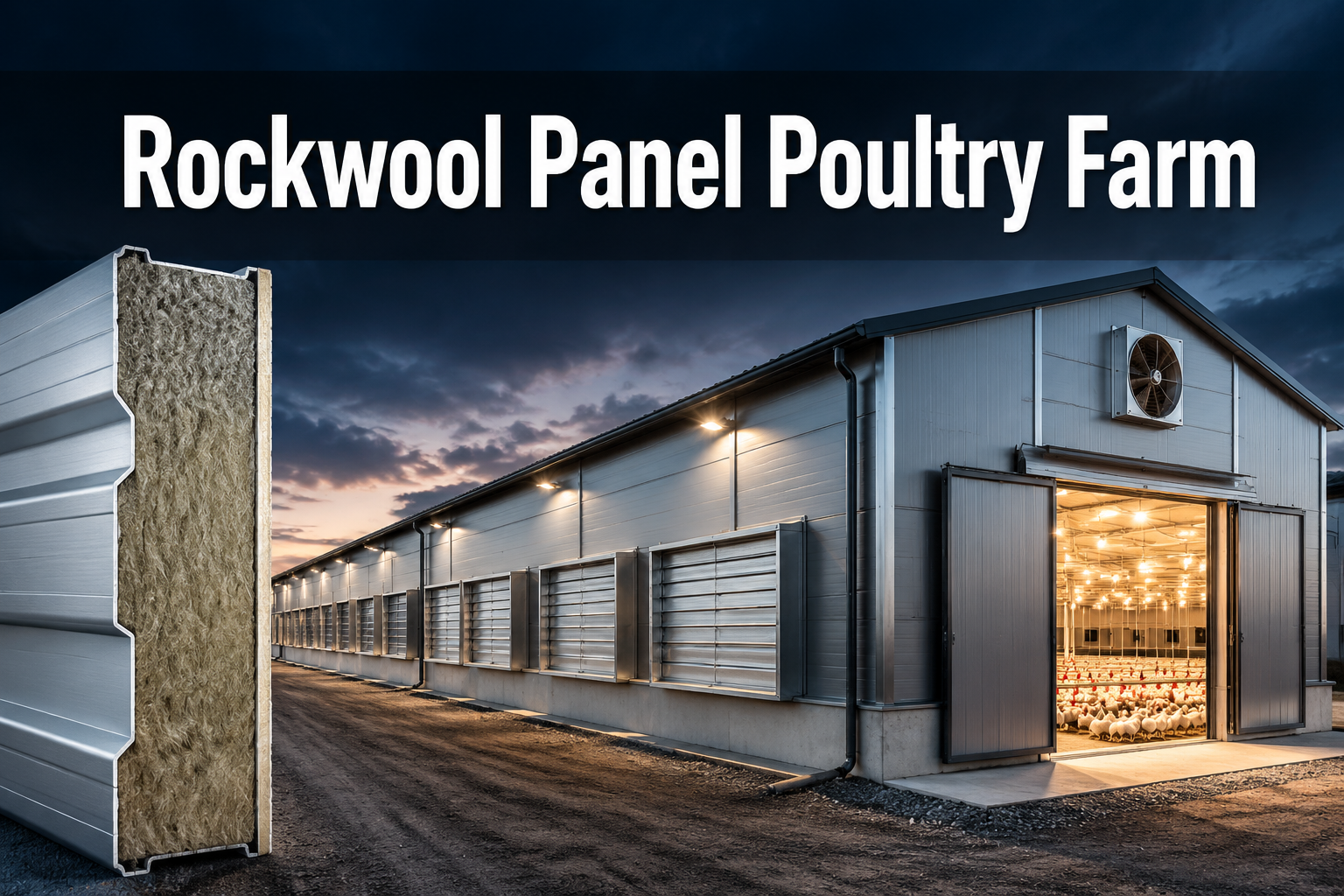
Rockwool sandwich panels consist of two steel face sheets bonded to a mineral wool (stone wool) core. The core is made by melting basaltic rock and spinning it into dense fibrous batts — a process that gives the material its fire-resistant and thermally stable properties.
For poultry farming, this matters because:
- Temperature control directly affects feed conversion ratio (FCR) and mortality rates.
- Fire safety is critical in enclosed farm buildings where electrical faults and heating equipment are common ignition sources.
- Air quality inside the shed depends partly on wall and ceiling materials that can withstand ammonia and humidity without degrading.
A rockwool panel poultry farm building addresses all three concerns in a single construction system.
How Does Rockwool Compare to Other Panel Types for Poultry Sheds?
Rockwool is not the only option. The table below compares the three most common sandwich panel cores used in poultry construction:
| Property | Rockwool (Mineral Wool) | PU (Polyurethane) | EPS (Expanded Polystyrene) |
|---|---|---|---|
| Fire resistance | Class A1 (non-combustible) | Class B–C (combustible) | Class E–F (combustible) |
| Thermal conductivity (λ) | 0.033–0.040 W/m·K | 0.022–0.028 W/m·K | 0.035–0.040 W/m·K |
| Moisture resistance | High | Very High | Moderate |
| Sound absorption | Excellent | Poor | Poor |
| Weight (50 mm panel) | ~12–14 kg/m² | ~8–10 kg/m² | ~6–8 kg/m² |
| Relative cost | Medium–High | Medium | Low |
| Lifespan (estimate) | 25–35 years | 20–30 years | 15–25 years |
Choose rockwool if: fire safety regulations are strict, the farm is in a high-humidity tropical climate, or noise from generators and equipment is a concern.
Choose PU if: maximum thermal efficiency per millimeter of thickness is the top priority and fire risk is managed by other means.
For a detailed head-to-head, see the PU Panel vs Rockwool Panel comparison guide.
What Are the Core Benefits of a Rockwool Panel Poultry Farm?
Rockwool panels deliver four measurable advantages in poultry farm construction.
🔥 1. Fire Safety
Rockwool's mineral core does not burn. It can withstand temperatures above 1,000°C without contributing to flame spread. For poultry buildings — which often contain heating brooders, electrical wiring, and combustible litter — this is a significant risk reduction. See the Rockwool Sandwich Panel Fire Safety guide for full compliance details.
🌡️ 2. Thermal Insulation
Stable internal temperature reduces heat stress in summer and cold stress in winter. Both conditions suppress immunity and increase mortality. A well-insulated shed maintains the target zone (around 18–24°C for most broiler breeds) with less mechanical heating or cooling input.
🔊 3. Sound Absorption
Poultry farms generate significant noise from ventilation fans, feeding equipment, and the birds themselves. Rockwool's fibrous structure absorbs sound rather than reflecting it, which can reduce stress-related pecking behavior in laying flocks. For more on this, the Rockwool Panel Acoustic Properties guide covers the technical detail.
💧 4. Moisture and Ammonia Resistance
Ammonia from poultry litter is corrosive. Rockwool panels with pre-coated steel faces resist corrosion better than untreated materials. The core itself does not absorb ammonia or harbor mold growth, which matters for biosecurity between flocks.
What Panel Thickness Is Right for a Poultry Farm?
Panel thickness determines how much insulation the building envelope provides. The right thickness depends on climate, flock type, and local energy costs.
General guidelines (estimates based on industry practice):
- 50 mm: Suitable for mild climates with low day-night temperature variation. Adequate for open-sided sheds with supplemental ventilation.
- 75 mm: The most common choice for commercial broiler and layer houses in tropical and subtropical regions.
- 100 mm: Recommended for high-density houses, cold climates, or farms with strict energy efficiency targets.
- 150 mm: Used in cold storage areas within the farm (e.g., egg storage rooms or vaccine cold rooms). See the Poultry Farm Cold Room Panel guide for cold room specifications.
Common mistake: Choosing 50 mm panels to save upfront cost in a hot, humid climate. The energy penalty over 10 years typically exceeds the initial panel cost difference.
How Is a Rockwool Panel Poultry Farm Designed and Built?
Building a rockwool panel poultry farm involves five main stages.
Step 1: Site Assessment and Load Calculation
Determine the structural steel frame requirements. Rockwool panels are heavier than EPS or PU alternatives, so purlins and columns must be sized accordingly. A structural engineer should confirm load-bearing capacity.
Step 2: Frame Erection
Steel columns and purlins are erected first. The frame defines panel span lengths, which typically range from 1,000 mm to 1,200 mm for wall panels.
Step 3: Roof Panel Installation
Roof panels are installed before wall panels to protect the interior from weather during construction. Panels interlock via tongue-and-groove or cam-lock joints to create a continuous, airtight envelope.
Step 4: Wall Panel Installation
Wall panels are fixed vertically or horizontally depending on the design. Joints are sealed with approved polyurethane or silicone sealant to prevent air infiltration and ammonia leakage.
Step 5: Ventilation and Accessory Integration
Ventilation openings, fan housings, and inlet panels are cut and fitted. For ventilation system planning, the Poultry Shed Ventilation Panel guide covers inlet sizing, fan placement, and airflow calculations.
For roof installation specifics, the Sandwich Panel Roof Installation Guide provides step-by-step detail applicable to poultry buildings.
What Does a Rockwool Panel Poultry Farm Cost?
Cost varies significantly by region, panel specification, and farm size. The figures below are general estimates for South and Southeast Asian markets as of 2026.
| Cost Component | Estimated Range (per m²) |
|---|---|
| Rockwool sandwich panel supply | USD 12–22 |
| Steel frame (columns + purlins) | USD 8–15 |
| Installation labor | USD 4–8 |
| Ventilation fittings | USD 2–5 |
| Total (rough estimate) | USD 26–50 |
Factors that increase cost:
- Greater panel thickness (100 mm+ vs. 50 mm)
- Higher-grade steel face coating (PVDF vs. standard polyester)
- Remote site location with difficult access
- Complex building geometry with many cut panels
Factors that reduce cost:
- Standardized rectangular building footprint
- Bulk ordering for multiple sheds
- Local panel manufacturing (reduces freight cost)
For Bangladesh-specific pricing, the Sandwich Panel Price in Bangladesh guide provides current market rates.
What Are the Common Mistakes When Using Rockwool Panels in Poultry Farms?
Even experienced contractors make avoidable errors. Here are the most common ones:
1. Ignoring panel joint sealing
Unsealed joints allow humid, ammonia-laden air to penetrate the panel core. Over time, this causes steel face corrosion from the inside out — invisible until the panel fails.
2. Underestimating structural load
Rockwool panels weigh roughly 40–60% more than EPS panels of the same thickness. Frames designed for EPS may deflect excessively under rockwool loads.
3. Cutting panels with angle grinders
High-speed cutting generates heat that can damage the steel coating and compress the rockwool core at the cut edge. Use nibblers or circular saws with appropriate blades.
4. Skipping condensation management
In cold climates, the interior surface of poorly specified panels can reach dew point, causing condensation drip onto birds and litter. A thermal bridge analysis during design prevents this.
5. Choosing the wrong face coating
Standard polyester coatings degrade faster in high-ammonia environments. Specify PVDF or plastisol coatings for the interior face of poultry shed panels.
Is a Rockwool Panel Poultry Farm Right for Every Situation?
Not always. Here's a straightforward decision framework:
Rockwool panels are the right choice when:
- Local fire codes require non-combustible wall and roof materials.
- The farm is in a high-humidity or tropical climate where mold resistance matters.
- Noise reduction is a priority (near residential areas or for welfare-certified operations).
- The operation is large-scale and long-term, justifying higher upfront cost.
Consider alternatives when:
- Budget is the primary constraint and fire risk is low (EPS may be adequate for small farms).
- Maximum thermal efficiency per mm is needed and fire risk is managed separately (PU panels perform better thermally).
- The building is temporary or will be relocated within 5–10 years.
For a broader comparison of panel types, the Best Sandwich Panel for Poultry Farm guide covers all major options side by side.
FAQ: Rockwool Panel Poultry Farm
Q: How long do rockwool sandwich panels last in a poultry farm environment?
A: With proper installation and maintenance, rockwool panels typically last 25–35 years. The steel face coating is the most vulnerable component; inspect and touch up any scratches or cut edges annually to prevent corrosion.
Q: Can rockwool panels handle high ammonia levels inside poultry sheds?
A: Yes. The mineral wool core is inorganic and does not react with ammonia. The key is ensuring the steel face coating on the interior side is rated for corrosive environments (PVDF or plastisol coatings are preferred).
Q: What is the minimum panel thickness for a broiler house in a tropical climate?
A: 75 mm is the practical minimum for tropical climates with high day-night temperature swings. Thinner panels may require more mechanical cooling to maintain target temperatures.
Q: Are rockwool panels heavier than EPS or PU panels?
A: Yes. A 75 mm rockwool panel weighs approximately 12–14 kg/m², compared to 8–10 kg/m² for PU and 6–8 kg/m² for EPS. Structural frames must be designed to accommodate this additional load.
Q: Do rockwool panels require special maintenance in poultry farms?
A: Annual inspection is recommended. Check joint sealants for cracking, inspect cut edges for rust, and clean the exterior face to prevent dirt buildup that holds moisture. The Maintenance of Sandwich Panels guide covers a full maintenance checklist.
Q: Can rockwool panels be used for both walls and roofs in a poultry shed?
A: Yes. Rockwool panels are manufactured in both wall and roof profiles. Roof panels typically have a higher-profile steel rib for structural spanning and drainage, while wall panels are flatter. Specify the correct profile for each application.
Q: How does rockwool panel construction compare to traditional brick construction for poultry farms?
A: Rockwool panel construction is typically 40–60% faster to erect, offers better thermal performance, and is easier to clean and disinfect between flocks. Brick construction has higher thermal mass but poor insulation unless combined with additional insulation layers.
Q: Is rockwool panel suitable for egg storage cold rooms within a poultry farm?
A: Rockwool panels can be used for cold rooms, but PU panels are generally preferred for refrigerated spaces below 10°C because of their lower thermal conductivity. For egg storage rooms (typically 12–15°C), rockwool is adequate.
Q: What fire rating do rockwool panels carry?
A: The mineral wool core is classified as A1 (non-combustible) under EN 13501-1. The overall panel fire rating depends on the steel face thickness and joint design, but most rockwool sandwich panels achieve 60–120 minutes of fire resistance in standard tests.
Q: Where can I source rockwool sandwich panels for poultry farms in Bangladesh?
A: Several manufacturers supply rockwool panels locally. The Sandwich Panel Manufacturers in Dhaka guide lists verified suppliers with contact details and product specifications.
Conclusion
A rockwool panel poultry farm offers a durable, fire-safe, and thermally efficient building solution for commercial poultry operations. The mineral wool core addresses the three biggest structural challenges in poultry housing: fire risk, temperature instability, and corrosive air quality from ammonia and moisture.
Actionable next steps:
- Confirm local fire codes — check whether non-combustible wall and roof materials are mandatory in your jurisdiction before finalizing panel selection.
- Get a thermal analysis — ask your panel supplier to calculate the required panel thickness for your climate zone and target internal temperature.
- Specify the right face coating — request PVDF or plastisol interior coatings for all panels exposed to poultry house air.
- Commission a structural load check — ensure your steel frame is designed for rockwool panel weights, not lighter EPS or PU equivalents.
- Plan ventilation integration early — ventilation openings cut into panels after installation are weaker than factory-prepared openings. Coordinate with your ventilation panel supplier before fabrication.
- Budget for joint maintenance — schedule annual sealant inspection from year one to protect the long-term integrity of the building envelope.
The upfront investment in a properly specified rockwool panel poultry farm pays back through lower energy bills, reduced fire insurance premiums, longer building lifespan, and better flock performance over the full operational life of the shed.
References
- European Committee for Standardization. EN 13501-1: Fire Classification of Construction Products and Building Elements. CEN, 2018.
- ASHRAE. ASHRAE Handbook — Fundamentals: Thermal Properties of Building Envelope Materials. ASHRAE, 2021.
- ITAB (Institute for Technical Agriculture and Biosystems). Insulation Standards for Commercial Poultry Housing. 2020.
- Rockwool Group. Stone Wool Technical Data Sheets — Agricultural Applications. 2022. www.rockwool.com