Last updated: May 20, 2026
Quick Answer
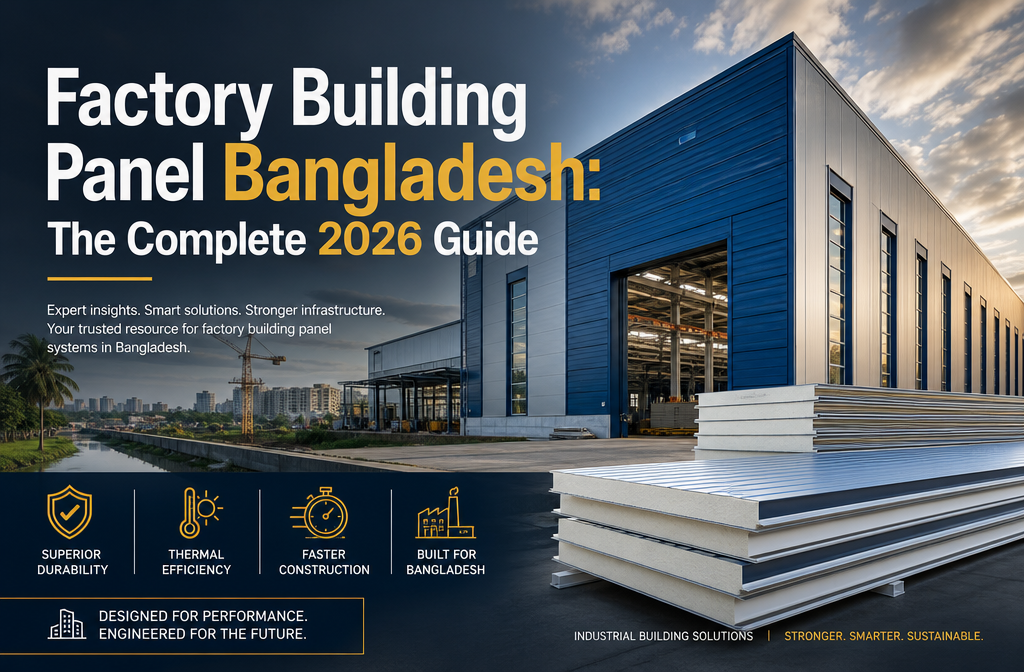
Factory building panels in Bangladesh are prefabricated sandwich panels — typically with EPS, PU/PIR, or rockwool cores between steel facings — used for walls, roofs, and partitions in industrial buildings. They cut construction time by 40–60% compared to conventional brick-and-mortar methods (based on industry estimates from local contractors), offer strong thermal and fire performance, and are now the default choice for garment factories, food processing plants, and cold storage facilities across Dhaka, Chittagong, and Gazipur.
Key Takeaways 🏭
- Sandwich panels are the dominant panel type for factory construction in Bangladesh, combining insulation and structural cladding in one product.
- Three core materials are most common: EPS (economical, lightweight), PU/PIR (best thermal performance), and rockwool (fire-rated, non-combustible).
- Panel thickness typically ranges from 50mm to 200mm depending on thermal, fire, and acoustic requirements.
- Cost varies by core type and thickness — EPS panels are the most affordable entry point, while rockwool fire-rated panels carry a premium.
- Installation speed is a major advantage: a standard factory shell can be enclosed in days rather than weeks.
- Fire compliance is a critical factor for RMG (ready-made garment) factories following the Accord and Alliance safety frameworks.
- Local manufacturers in Bangladesh now supply panels that meet international standards, reducing import dependency.
- Proper core selection matters more than price alone — choosing the wrong core for a food-grade or fire-sensitive environment creates costly rework.
- Warranty and after-sales support from the supplier should be confirmed before ordering at scale.
What Is a Factory Building Panel and Why Does Bangladesh Use Them?
A factory building panel — most commonly called a sandwich panel — is a three-layer construction product: two steel face sheets bonded to an insulating core. The result is a single panel that handles cladding, insulation, and weather resistance simultaneously.
Bangladesh's industrial sector has adopted these panels rapidly for several reasons:
- Speed: Prefabricated panels arrive on-site ready to install. No curing time, no brick-laying delays.
- Climate performance: Bangladesh's hot, humid climate makes thermal insulation essential for worker comfort and product quality inside factories.
- Compliance pressure: Post-Rana Plaza, international buyers demand fire-safe construction. Panels with rockwool or PIR cores help factories meet those standards.
- Cost efficiency: While the upfront material cost can be higher than brick, total project cost (including labor and time) is often lower.
For a deeper look at how these panels are applied specifically in industrial settings, the Sandwich Panel for Factory Building: Complete Guide 2026 covers specifications and application details thoroughly.
What Types of Factory Building Panels Are Available in Bangladesh?
The three main panel types used in factory building panel Bangladesh projects each serve different performance needs.
| Panel Type | Core Material | Best For | Fire Rating | Relative Cost |
|---|---|---|---|---|
| EPS Sandwich Panel | Expanded Polystyrene | General factories, warehouses | Low–Medium | ✅ Most affordable |
| PU/PIR Panel | Polyurethane / Polyisocyanurate | Cold storage, food plants | Medium–High | Mid-range |
| Rockwool Panel | Mineral wool | RMG, pharma, high-risk zones | High (non-combustible) | Premium |
EPS panels are the most widely used for standard factory walls and roofs because they balance cost and insulation. See the EPS Sandwich Panel Bangladesh: Complete 2026 Buyer's Guide for specifications.
PU/PIR panels deliver the best thermal resistance per millimeter of thickness, making them ideal for temperature-controlled environments.
Rockwool panels are the only non-combustible option and are essential where fire safety compliance is non-negotiable. The Rockwool Sandwich Panel Bangladesh: 2026 Complete Guide explains fire ratings and compliance in detail.
Decision rule: Choose rockwool if your factory handles flammable materials, is subject to international buyer fire audits, or is classified as a high-occupancy building. Choose EPS if budget is the primary constraint and fire risk is low. Choose PU/PIR if thermal performance is the top priority.
How Do Factory Building Panels Perform in Bangladesh's Climate?
Bangladesh presents a challenging environment: average temperatures above 30°C for much of the year, high humidity, and a monsoon season with heavy rainfall. Factory building panel Bangladesh solutions must address all three.
Thermal performance: PU/PIR cores with 75–100mm thickness can reduce internal temperatures significantly compared to uninsulated metal sheeting. This reduces air conditioning load and improves worker conditions — both important for productivity and compliance with labor standards.
Moisture resistance: Quality panels use pre-painted galvanized or Galvalume steel facings that resist corrosion. The panel joints, when properly sealed, prevent moisture ingress during monsoon rains.
Wind and structural load: Bangladesh's coastal regions face cyclone-force winds. Panels should be specified with appropriate steel thickness (typically 0.4–0.6mm face sheets) and proper fixing systems to handle wind uplift.
For guidance on insulation performance standards, the Thermal Insulation Sandwich Panel Bangladesh Guide 2026 provides U-value data and climate-specific recommendations.
What Are the Fire Safety Requirements for Factory Building Panels in Bangladesh?
Fire safety is the most scrutinized aspect of factory building panel Bangladesh projects, particularly in the RMG sector.
Following the 2013 Rana Plaza collapse and the subsequent Accord on Fire and Building Safety in Bangladesh, international brands require factories to demonstrate fire-safe construction. Key requirements include:
- Non-combustible or fire-retardant wall and roof materials in high-risk zones
- Fire compartmentalization to prevent rapid spread
- Compliance with BNBC (Bangladesh National Building Code) fire provisions
Rockwool-core panels are the preferred solution because mineral wool does not burn and does not contribute to fire spread. PIR panels with appropriate fire-retardant facings are also used where full non-combustibility is not mandated.
For detailed fire rating specifications and compliance guidance, see the Fire Rated Sandwich Panel Bangladesh: 2026 Buyer's Guide. Additional context on building fire safety Bangladesh standards is available for factory managers navigating audit requirements.
Common mistake: Specifying EPS panels in areas where fire auditors require non-combustible materials. EPS is combustible and will fail fire safety audits from international compliance bodies.
What Do Factory Building Panels Cost in Bangladesh in 2026?
Panel pricing in Bangladesh depends on core type, thickness, steel facing grade, and order volume. The figures below are market estimates based on supplier data — actual quotes will vary by project size and location.
Approximate price ranges (per square meter, supply only):
- EPS sandwich panel (50mm): BDT 650–900/sqm
- EPS sandwich panel (100mm): BDT 850–1,150/sqm
- PU/PIR panel (75mm): BDT 1,100–1,500/sqm
- Rockwool panel (100mm): BDT 1,400–2,000/sqm
Installation adds roughly 15–25% to material costs depending on panel type and site complexity.
For a full breakdown including accessories and project-level budgeting, the Sandwich Panel Price List Bangladesh 2026: Full Guide and Sandwich Panel Installation Cost Bangladesh 2026 Guide are the most current references.
Edge case: Large-volume orders (above 5,000 sqm) often qualify for negotiated pricing. Always request a volume discount and ask whether delivery to site is included in the quoted price.
How Are Factory Building Panels Installed in Bangladesh?
Installation follows a structured sequence. Most experienced local contractors complete a standard factory enclosure in 5–15 working days depending on building size.
Step-by-step installation process:
- Structural frame preparation — Ensure the steel or concrete frame is plumb, level, and ready to accept panel fixings.
- Panel delivery and staging — Panels are typically delivered on flatbed trucks and staged near the installation zone to minimize handling.
- Wall panel installation — Panels are lifted into position (by crane or manual lifting for smaller panels), aligned, and fixed to the frame using self-drilling screws with EPDM washers.
- Panel joint sealing — Tongue-and-groove or ship-lap joints are sealed with factory-applied foam and site-applied sealant to ensure airtightness and weather resistance.
- Roof panel installation — Roof panels follow the same process but require additional attention to overlap direction (always lap away from prevailing rain direction) and ridge/eave details.
- Flashings and trims — Aluminum or steel flashings are fitted at corners, eaves, ridges, and openings to complete the weatherproof envelope.
- Inspection and sign-off — Check all fixings, sealant continuity, and panel alignment before handover.
The Sandwich Panel Roof Installation Bangladesh: 2026 Guide provides a detailed walkthrough of roof-specific installation requirements.
Which Applications Use Factory Building Panels Most in Bangladesh?
Factory building panel Bangladesh solutions are not limited to one industry. The main application sectors include:
- Garment and textile factories (RMG): The largest user segment, driven by fire safety compliance and fast construction timelines.
- Food processing and pharmaceutical plants: Require hygienic, cleanable wall surfaces and often temperature control. PIR panels with smooth steel facings are standard here. See the Food Processing Facility Panels: Complete Guide 2026 for sector-specific guidance.
- Cold storage and refrigeration: Thick PU/PIR panels (100–200mm) are essential for maintaining low temperatures efficiently.
- Warehouses and logistics centers: EPS panels offer a cost-effective solution for large-footprint, low-complexity enclosures. The Sandwich Panel for Warehouse Bangladesh: 2026 Guide covers this in detail.
- Electronics and precision manufacturing: Clean room panels with antibacterial coatings and airtight joints are used in controlled-environment production areas.
How to Choose the Right Supplier for Factory Building Panels in Bangladesh?
Not all suppliers offer the same product quality or after-sales support. Use this checklist when evaluating options:
Supplier evaluation checklist:
- ✅ Can they provide third-party test certificates for fire rating, thermal performance, and steel grade?
- ✅ Do they have a local manufacturing facility (faster lead times, easier quality inspection)?
- ✅ What is their minimum order quantity and lead time for your required panel type?
- ✅ Do they offer on-site technical support during installation?
- ✅ What warranty do they provide, and what does it cover (delamination, corrosion, color fade)?
- ✅ Can they supply matching accessories (flashings, fixings, sealants) from the same source?
- ✅ Do they have references from similar factory projects you can verify?
For a vetted overview of the market, Sandwich Panel Suppliers in Bangladesh: 2026 Buyer's Guide lists key suppliers with capability profiles.
FAQ: Factory Building Panel Bangladesh
Q: What is the most popular panel thickness for factory walls in Bangladesh?
A: 50mm to 75mm EPS or PU panels cover most standard factory wall applications. Fire-sensitive zones typically require 100mm rockwool panels.
Q: Can sandwich panels be used for both walls and roofs in the same factory?
A: Yes. Most factory projects use the same panel system for walls and roofs, though roof panels are typically specified with a higher-profile steel facing for structural spanning and water drainage.
Q: How long do factory building panels last in Bangladesh's climate?
A: Quality panels with Galvalume or PVDF-coated steel facings typically carry 10–15 year warranties and can last 25+ years with basic maintenance in Bangladesh's climate conditions.
Q: Are sandwich panels suitable for multi-story factory buildings?
A: Panels are used as non-structural cladding on multi-story buildings. The structural load is carried by the steel or concrete frame; panels fill and insulate the envelope.
Q: Do factory panels in Bangladesh meet international fire safety standards?
A: Rockwool-core panels from reputable manufacturers meet EN 13501 or equivalent fire classifications. Always request the test certificate and confirm the rating matches your compliance requirement.
Q: What is the lead time for factory panel orders in Bangladesh?
A: Standard EPS and PU panels from local manufacturers typically have a 7–21 day lead time depending on volume. Rockwool panels may take longer if not held in stock.
Q: Can panels be cut on-site for openings and penetrations?
A: Yes, panels can be cut with circular saws or jigsaws fitted with appropriate blades. All cut edges should be sealed to prevent moisture ingress into the core.
Q: Is it cheaper to import panels or buy locally in Bangladesh?
A: Local manufacturing is generally more cost-effective once import duties, shipping, and lead time costs are factored in. Bangladesh now has several capable domestic manufacturers.
Q: What maintenance do factory building panels require?
A: Annual inspection of sealants and fixings, periodic cleaning of steel facings with mild detergent, and prompt repair of any mechanical damage to prevent corrosion at cut edges.
Q: Are there panels suitable for clean room environments inside factories?
A: Yes. Smooth-faced panels with antibacterial coatings and airtight joint systems are specifically designed for clean room and pharmaceutical manufacturing environments.
Conclusion: Actionable Next Steps for Your Factory Panel Project
Factory building panel Bangladesh solutions have matured significantly. Local manufacturers now produce panels that meet international fire, thermal, and structural standards — and the construction speed advantage over conventional methods is real and measurable.
To move forward effectively:
- Define your performance requirements first — fire rating, thermal performance, hygiene needs — before requesting quotes. This prevents costly specification changes mid-project.
- Request test certificates from any supplier you shortlist. Fire rating and steel grade claims should be backed by third-party documentation.
- Get at least three competitive quotes including material, delivery, and installation to build an accurate project budget.
- Inspect a completed reference project from your preferred supplier before committing to a large order.
- Confirm warranty terms in writing, including what voids the warranty (improper installation, unauthorized modifications).
The right panel system, properly specified and installed, will serve a Bangladesh factory for decades while keeping construction timelines tight and compliance requirements met.
References
- Bangladesh Accord on Fire and Building Safety — https://bangladeshaccord.org (2013–2021 framework documentation)
- Bangladesh National Building Code (BNBC) — Housing and Building Research Institute, Bangladesh (2020 edition)
- Sandwich Panel Manufacturers Bangladesh — https://sandwichpaneltlbd.com (2026, product and pricing data)