Unwanted noise costs the global economy an estimated $3.9 billion annually in lost workplace productivity — and yet most facility managers overlook one of the most effective and versatile solutions sitting right in their building envelope: the rockwool sandwich panel. Understanding rockwool panel acoustic properties is no longer optional for engineers, architects, and facility planners who want to build quieter, safer, and more efficient spaces.
This guide breaks down exactly how rockwool panels perform acoustically, what the numbers mean in practice, and how to choose the right specification for your project.
Key Takeaways 📌
- Rockwool (mineral wool) panels deliver Sound Transmission Class (STC) ratings of 40–55+, making them among the best-performing insulation core materials for noise control.
- The fibrous, porous structure of rockwool absorbs sound energy across a wide frequency range, outperforming EPS and PU foam cores in acoustic applications.
- Rockwool panel acoustic properties are enhanced by panel thickness, density, and facing material — all of which can be specified to meet project requirements.
- Rockwool panels offer a dual benefit: outstanding acoustic performance and Class A fire resistance in a single panel system.
- Proper installation — including sealing joints and avoiding flanking paths — is critical to achieving rated acoustic performance on-site.
What Is Rockwool and Why Does It Matter Acoustically?
Rockwool, also known as mineral wool or stone wool, is manufactured by melting basalt rock and spinning it into fine, randomly oriented fibers. This fibrous matrix is the key to its acoustic excellence.
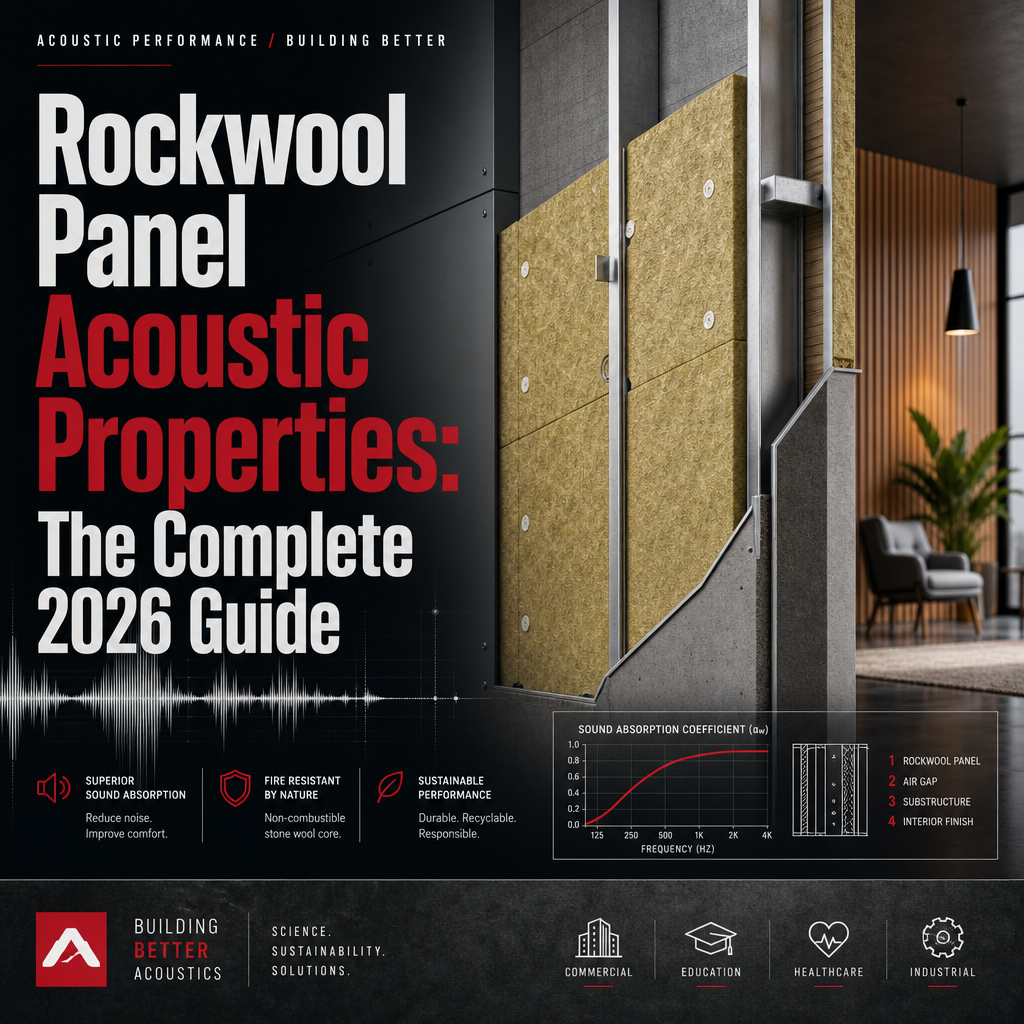
When sound waves enter a rockwool panel, they encounter millions of tiny air pockets trapped between the fibers. The sound energy is converted into heat energy through friction — a process called viscous dissipation. The result: significantly less sound passes through the panel to the other side.
💡 Pull Quote: "The random fiber orientation in rockwool creates a tortuous path for sound waves — they lose energy at every twist and turn."
Compare this to closed-cell foam cores like PU or EPS, where sound waves travel more freely through the rigid cellular structure. For a detailed comparison of core materials, see our guide on EPS vs PU Sandwich Panel: Which Is Right for You?.
Understanding the Key Acoustic Metrics
Before diving into performance data, it helps to understand the measurement standards used to evaluate rockwool panel acoustic properties.
Sound Transmission Class (STC)
STC is the most commonly used rating in North America and many international markets. It measures how well a building partition reduces airborne sound. Higher STC = better sound blocking.
| STC Rating | Perceived Performance |
|---|---|
| 25–30 | Normal speech clearly audible |
| 35–40 | Loud speech audible but not intelligible |
| 40–50 | Loud speech barely audible |
| 50+ | Very loud sounds faintly heard |
Weighted Sound Reduction Index (Rw)
Used under ISO standards (common in Europe and Asia), Rw is functionally similar to STC. A rockwool sandwich panel with a 100mm core typically achieves Rw 42–48 dB, with thicker or denser panels pushing beyond 50 dB.
Noise Reduction Coefficient (NRC)
NRC measures sound absorption (how much sound a surface absorbs rather than reflects), rated from 0 to 1. Exposed rockwool surfaces can achieve NRC values of 0.70–0.95, making them highly effective for controlling reverberation inside a space.
How Rockwool Panel Acoustic Properties Compare to Other Core Materials
| Panel Core | Typical STC/Rw | NRC (if exposed) | Fire Rating |
|---|---|---|---|
| Rockwool (Mineral Wool) | 42–55+ | 0.70–0.95 | Class A (non-combustible) |
| PU Foam | 30–40 | 0.10–0.25 | Class B–C |
| EPS Foam | 28–38 | 0.05–0.15 | Class C–D |
| PIR Foam | 32–42 | 0.10–0.20 | Class B |
The data is clear: rockwool outperforms every foam-based core in both sound transmission loss and sound absorption. This is why it is the preferred choice for applications where noise control is a primary design criterion.
Factors That Influence Rockwool Panel Acoustic Properties
Rockwool panel acoustic properties are not fixed — they vary based on several design and specification variables.
1. 🔩 Panel Thickness
Greater thickness means more fibrous material for sound waves to traverse. A 50mm rockwool panel may achieve Rw 38 dB, while a 150mm panel of the same density can reach Rw 52 dB. Choosing the right sandwich panel thickness is one of the most impactful decisions you can make for acoustic performance.
2. 🏋️ Core Density
Rockwool panels are available in densities ranging from 60 kg/m³ to 200 kg/m³. Higher density means:
- More fibers per unit volume
- Greater viscous dissipation
- Improved low-frequency sound absorption (the hardest range to control)
For demanding acoustic environments, specify minimum 100 kg/m³ core density.
3. 🔩 Facing Material and Thickness
The metal facings (typically galvanized steel) on sandwich panels contribute to the mass law — heavier facings add mass, which improves sound transmission loss. Double-skin steel facings with a combined mass of ≥10 kg/m² provide a meaningful acoustic boost.
4. 🔗 Panel Joints and Sealing
This is where real-world performance often falls short of laboratory ratings. Unsealed joints, gaps, and penetrations create flanking paths that allow sound to bypass the panel entirely. Always specify:
- Acoustic sealant at all panel joints
- Gasketed connections at wall-floor and wall-ceiling junctions
- Penetration sleeves for all services passing through panels
Rockwool Panel Acoustic Properties in Real-World Applications
Understanding how rockwool panel acoustic properties translate to specific use cases helps justify specification decisions.
🏭 Industrial Facilities and Factories
Machinery noise in manufacturing environments frequently exceeds 90 dB(A). Rockwool-cored wall panels with an STC of 50+ can reduce transmitted noise to acceptable levels for adjacent offices or residential zones. For comprehensive guidance, see our sandwich panel for factory building guide.
🏥 Hospitals and Operating Theatres
Healthcare environments demand strict acoustic separation between clinical spaces. Rockwool panels are frequently specified for operating theatre walls, where they combine acoustic performance with hygiene, fire resistance, and cleanroom compatibility. Learn more about hospital OT room sandwich panel specifications.
🧪 Clean Rooms and Pharmaceutical Facilities
In pharmaceutical manufacturing, acoustic control supports both staff wellbeing and process integrity. Rockwool panels meet GMP requirements while delivering the sound isolation needed in sensitive production environments. Our clean room sandwich panel guide for Bangladesh covers these requirements in detail.
🍗 Poultry and Agricultural Buildings
Excessive noise stress in poultry farms measurably reduces productivity. Rockwool-cored panels help maintain quieter internal environments while also delivering the thermal and hygiene benefits these facilities require. See the complete guide to poultry farm sandwich panels.
🍔 Food Processing Facilities
High-powered processing equipment generates significant noise. Rockwool panels in food processing plants must balance acoustic performance with food-grade surface requirements and washdown resistance. Our food processing facility panels guide addresses these combined demands.
Rockwool Panel Acoustic Properties vs. Fire Safety: A Dual Advantage
One of the most compelling reasons to specify rockwool panels is that acoustic performance and fire safety come packaged together — at no acoustic compromise.
Rockwool is inherently non-combustible (Euroclass A1 or A2 under EN 13501-1), meaning it does not contribute to fire load, does not produce toxic smoke, and maintains structural integrity at temperatures exceeding 1,000°C. This stands in stark contrast to foam-based cores, which may melt, burn, or emit toxic gases in a fire event.
For projects where both acoustic and fire performance are mandatory — hospitals, schools, data centres, industrial facilities — rockwool panels eliminate the need to compromise between the two. For a deeper look at the fire performance dimension, see our Rockwool Sandwich Panel Fire Safety guide.
🔥 Key Insight: Specifying rockwool panels for acoustic control automatically delivers Class A fire resistance — a significant value-add that foam-core alternatives simply cannot match.
Common Mistakes That Undermine Acoustic Performance
Even the best-specified rockwool panel system can underperform if installation errors are made. Watch for these pitfalls:
- ❌ Skipping acoustic sealant at panel joints — even a 1mm gap can reduce effective STC by 10+ points
- ❌ Rigid connections between panels and structure — creates vibration bridges that transmit structure-borne noise
- ❌ Uninsulated service penetrations — pipes and conduits act as acoustic conduits if not properly sleeved and sealed
- ❌ Mismatched panel density — specifying low-density rockwool to cut costs defeats the purpose in acoustic-critical zones
- ❌ Ignoring flanking transmission — sound travels through floors, ceilings, and connected structures even when walls are well-specified
Proper ongoing care also matters. For guidance on keeping panel systems performing as designed over time, refer to the complete guide to maintenance of sandwich panels.
Specifying Rockwool Panels: A Quick Reference Checklist ✅
Use this checklist when specifying rockwool panels for acoustic applications:
- Define target STC/Rw rating based on noise source and receiver requirements
- Select panel thickness to meet acoustic target (minimum 75mm for most commercial applications)
- Specify core density ≥ 100 kg/m³ for meaningful acoustic performance
- Confirm facing material weight and gauge
- Include acoustic sealant specification in installation drawings
- Detail all penetration sealing requirements
- Specify resilient mounts or isolation pads where structure-borne noise is a concern
- Require post-installation acoustic testing for critical spaces
Conclusion: Making the Right Choice for Your Project
Rockwool panel acoustic properties represent one of the most well-rounded performance profiles available in the sandwich panel market today. The combination of high STC/Rw ratings, excellent NRC values, Class A fire resistance, and thermal insulation makes rockwool the go-to specification for any project where noise control is a serious design objective.
Actionable next steps:
- Define your acoustic targets — work with an acoustic consultant to establish minimum STC/Rw requirements for each space type.
- Match panel specification to performance — select thickness and density based on verified acoustic data, not assumptions.
- Prioritize installation quality — commission proper sealing and detailing; acoustic performance is only as good as the weakest joint.
- Verify compliance — request third-party acoustic test certificates from your panel supplier before procurement.
- Consider the full picture — factor in fire, thermal, and hygiene requirements alongside acoustics to select the panel that delivers on all fronts.
Rockwool panels are not the cheapest option on the market — but for applications where sound control, safety, and long-term performance matter, they consistently deliver the best return on investment.
References
- Berglund, B., Lindvall, T., & Schwela, D. H. (1999). Guidelines for Community Noise. World Health Organization.
- ASTM International. (2016). ASTM E413: Classification for Rating Sound Insulation. ASTM International.
- ISO. (2012). ISO 717-1: Acoustics — Rating of sound insulation in buildings and of building elements. International Organization for Standardization.
- European Association for Panels and Profiles (EPPA). (2020). Acoustic Performance of Sandwich Panels: Technical Guidance Document. EPPA.
- Rockwool Group. (2023). Stone Wool: Technical Data and Acoustic Performance. Rockwool International A/S.
- Bies, D. A., & Hansen, C. H. (2009). Engineering Noise Control: Theory and Practice (4th ed.). Spon Press.