Last updated: May 19, 2026
Quick Answer
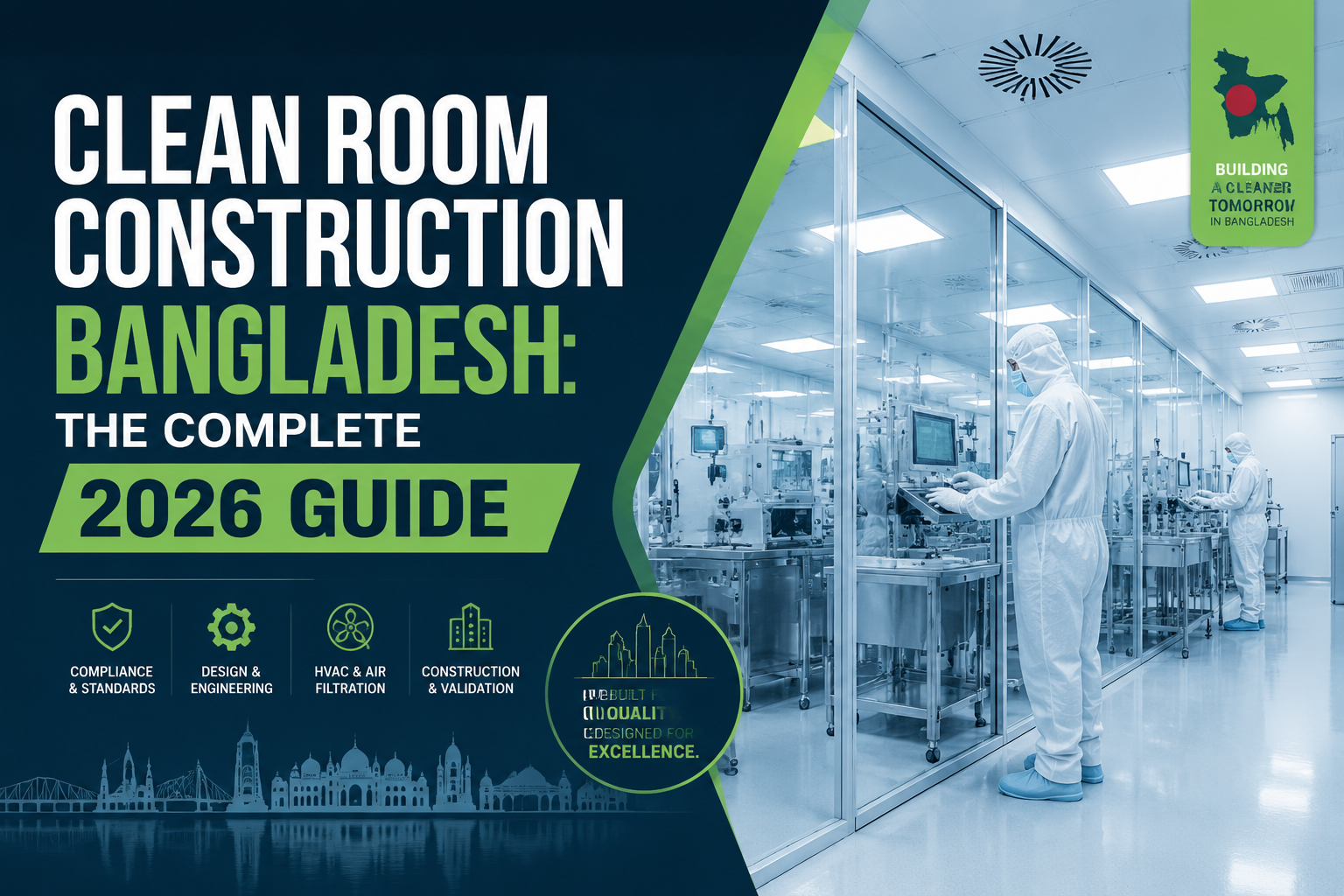
Clean room construction in Bangladesh involves building controlled environments where airborne particles, temperature, humidity, and pressure are precisely regulated to meet ISO 14644 or GMP standards. These facilities are essential for pharmaceutical manufacturing, electronics assembly, hospital operating theaters, and food processing. In Bangladesh, demand has grown sharply alongside the country's expanding pharmaceutical export sector and medical infrastructure.
Key Takeaways
- 🏭 Clean room construction in Bangladesh follows ISO 14644 classifications (ISO Class 1–9), with pharmaceutical facilities typically targeting ISO Class 5–8
- 🧱 Sandwich panels with PU or mineral wool cores are the standard wall and ceiling material for Bangladeshi clean rooms
- 💰 Construction costs vary widely based on ISO class, size, and HVAC complexity — budget estimates range from BDT 8,000 to BDT 35,000+ per square foot for turnkey builds (estimate based on market consultation; verify with local contractors)
- 🏥 Key sectors driving demand: pharmaceuticals, hospital OT rooms, electronics, and food processing
- ✅ GMP compliance is mandatory for pharmaceutical clean rooms targeting export markets (EU, US, WHO)
- ⚠️ The most common construction mistake is underspecifying the HVAC system relative to the ISO class target
- 🔧 Modular clean room systems offer faster installation and easier future reconfiguration than traditional builds
- 📋 A proper clean room project requires: design, panel selection, HVAC/filtration, electrical, validation, and commissioning phases
What Is Clean Room Construction and Why Does It Matter in Bangladesh?
Clean room construction means building an enclosed space where contamination — dust, microbes, chemical vapors — is controlled to a defined standard. Every element, from wall panels to door seals to air handling units, works together to maintain that standard continuously.
Bangladesh's pharmaceutical industry is the country's second-largest export earner after garments, with over 150 licensed manufacturers exporting to more than 160 countries (Bangladesh Drug Administration, 2023). That export growth depends directly on GMP-compliant facilities, and GMP compliance starts with proper clean room construction. Hospitals expanding surgical capacity also need validated operating theater environments. So the market for clean room construction in Bangladesh is not niche — it's a core industrial requirement.
What Are the ISO Classifications Used in Clean Room Construction Bangladesh?
ISO 14644-1 defines clean room classes by the maximum allowable concentration of airborne particles per cubic meter. The lower the ISO number, the cleaner the environment — and the more expensive it is to build and maintain.
| ISO Class | Max Particles ≥0.5µm per m³ | Typical Bangladesh Application |
|---|---|---|
| ISO 5 | 3,520 | Sterile pharmaceutical filling |
| ISO 6 | 35,200 | Aseptic processing support areas |
| ISO 7 | 352,000 | Pharmaceutical packaging, hospital OT |
| ISO 8 | 3,520,000 | General pharmaceutical manufacturing |
For most Bangladeshi pharmaceutical plants, ISO 7 and ISO 8 rooms make up the bulk of the facility footprint, with ISO 5 laminar flow zones inside them for the most critical operations. Hospital operating theaters typically target ISO 5–7 depending on procedure type.
For more on the regulatory framework, see resources tagged under cleanroom ISO 14644 standards.
What Materials Are Used in Clean Room Construction Bangladesh?
The right panel system is the foundation of a compliant clean room. The wrong one leads to particle shedding, moisture ingress, and failed audits.
Sandwich panels are the dominant wall and ceiling material for clean room construction in Bangladesh. They consist of two steel face sheets bonded to an insulating core. The three main core options are:
- Polyurethane (PU): Best thermal insulation, smooth non-porous surface, suitable for pharmaceutical and food applications. See the full buyer's guide to clean room sandwich panels in Bangladesh for specifications.
- Mineral wool (Rockwool): Fire-resistant, required in areas with strict fire codes. Slightly lower thermal performance than PU.
- EPS (Expanded Polystyrene): Lower cost, adequate for ISO 8 environments, but not recommended for sterile pharmaceutical zones.
Surface finish matters. Clean room panels must have a pre-painted galvanized steel or stainless steel face with a smooth, non-shedding finish. Coved internal corners (no right-angle joints) prevent particle accumulation and make cleaning easier.
Doors and windows must be airtight, with flush frames and no ledges. Cleanroom-specific doors with vision panels and automatic closers are standard. For door specifications, see cleanroom door options.
Flooring is typically epoxy-coated concrete or vinyl sheet, both of which are seamless and chemical-resistant.
What Does the Clean Room Construction Process Look Like in Bangladesh?
A clean room project in Bangladesh moves through six distinct phases. Skipping or rushing any phase creates compliance gaps that are expensive to fix after commissioning.
Phase 1: Design and Classification
Define the ISO class, room layout, pressure cascade (positive or negative), air change rates, and temperature/humidity targets. This phase produces the User Requirement Specification (URS) and design drawings.
Phase 2: Panel and Material Procurement
Source panels, doors, windows, and flooring. For GMP clean room panels in Bangladesh, lead times can range from 2–6 weeks depending on panel thickness and surface specification.
Phase 3: Civil and Structural Preparation
Prepare the base slab, ensure drainage, and complete any structural modifications before panel installation begins. Panels cannot be installed on uneven or damp substrates.
Phase 4: Panel Installation
Cam-lock or tongue-and-groove panels are assembled in sequence. All joints are sealed with approved sealant. Ceiling grid systems are installed to support HEPA filter housings.
Phase 5: HVAC and Electrical
This is the most technically complex phase. Air handling units (AHUs), HEPA filters, differential pressure gauges, and monitoring systems are installed and balanced. Electrical conduits must be sealed where they penetrate panel walls.
Phase 6: Validation and Commissioning
Installation Qualification (IQ), Operational Qualification (OQ), and Performance Qualification (PQ) are completed. Particle counts, air velocity, pressure differentials, and temperature uniformity are all measured and documented.
Common mistake: Many Bangladeshi projects undersize the AHU at the design stage to save cost, then fail particle count tests at commissioning. Fixing HVAC after panels are installed is extremely disruptive and expensive. Always size HVAC to 120% of calculated requirement.
How Much Does Clean Room Construction Cost in Bangladesh?
Cost depends on ISO class, room size, panel specification, and HVAC complexity. The following are market estimates based on industry consultation as of 2026 — actual quotes will vary by contractor and location.
| Room Type | Estimated Cost Range (BDT/sq ft) |
|---|---|
| ISO 8 basic pharmaceutical | 8,000 – 14,000 |
| ISO 7 pharmaceutical / hospital OT | 14,000 – 22,000 |
| ISO 6 aseptic support | 22,000 – 30,000 |
| ISO 5 sterile filling zone | 30,000 – 45,000+ |
These are rough estimates. Always get itemized quotes from at least three contractors. HVAC typically accounts for 40–55% of total clean room construction cost.
For panel material pricing specifically, the sandwich panel price guide for Bangladesh provides current market rates.
Which Industries Need Clean Room Construction Bangladesh Projects?
Several sectors in Bangladesh require controlled environments, each with different ISO class targets and regulatory frameworks.
Pharmaceuticals: The largest driver of clean room construction in Bangladesh. WHO-GMP, EU-GMP, and USFDA guidelines all specify clean room requirements. Facilities exporting to regulated markets must meet the strictest standards.
Hospital Operating Theaters: Modular OT rooms built with sandwich panels are increasingly common in both public and private hospitals. The hospital OT room sandwich panel guide covers the specific requirements for surgical environments.
Electronics and Semiconductors: A smaller but growing segment as Bangladesh attracts light electronics assembly investment.
Food Processing: High-care and high-risk food production zones require controlled environments. These typically target ISO 7–8 and prioritize antimicrobial surfaces. See the food processing facility panels guide for sector-specific detail.
Diagnostic Laboratories: PCR labs and microbiology labs need ISO 5–7 environments for accurate, contamination-free results.
How to Choose a Clean Room Construction Contractor in Bangladesh
Choosing the wrong contractor is the single biggest risk in a clean room project. A contractor who builds conventional factories does not automatically understand clean room requirements.
Check for these qualifications:
- Experience with validated pharmaceutical or medical clean rooms (ask for reference projects with contact details)
- In-house HVAC design capability or a verified HVAC subcontractor relationship
- Familiarity with ISO 14644 and GMP documentation requirements
- Ability to provide IQ/OQ/PQ documentation support
- Panel supply from a verified manufacturer (not a reseller with unknown sourcing)
Questions to ask before signing a contract:
- What ISO class projects have you completed in the last three years?
- Who supplies your panels, and can I see material test certificates?
- Do you provide commissioning and validation support, or only construction?
- What is your process for managing joints, penetrations, and sealing?
For guidance on evaluating panel suppliers specifically, see how to choose the best sandwich panel manufacturer in Bangladesh.
What Are the Most Common Mistakes in Clean Room Construction Bangladesh Projects?
Even experienced contractors make these errors. Knowing them in advance prevents costly rework.
1. Ignoring pressure cascade design. Rooms must be pressurized relative to adjacent spaces to prevent contamination ingress. A pharmaceutical facility without a validated pressure cascade will fail GMP audit.
2. Using standard construction sealants. Only pharmaceutical-grade, non-particle-shedding sealants should be used at panel joints and penetrations. Standard silicone can off-gas and contaminate the room.
3. Incorrect panel thickness. Thicker panels offer better thermal and acoustic performance but add weight and cost. Choosing the wrong thickness for the application wastes money or compromises performance. The sandwich panel thickness selection guide helps with this decision.
4. No provision for future maintenance access. HEPA filters need replacing. AHUs need servicing. If the design doesn't account for access routes, maintenance becomes a contamination event.
5. Skipping particle count testing before handover. Some contractors hand over rooms without formal particle count certification. Always insist on documented test results before accepting the build.
FAQ: Clean Room Construction Bangladesh
Q: What is the minimum ISO class required for pharmaceutical manufacturing in Bangladesh?
A: Bangladesh Drug Administration (BDA) guidelines aligned with WHO-GMP require ISO 8 as the minimum for non-sterile pharmaceutical manufacturing. Sterile product areas require ISO 5–7 depending on the operation.
Q: How long does a typical clean room construction project take in Bangladesh?
A: A small to medium ISO 7–8 room (200–500 sq ft) typically takes 6–12 weeks from design approval to commissioning. Larger or higher-class facilities can take 4–8 months.
Q: Can an existing room be converted into a clean room?
A: Yes, but it depends on the structural condition of the existing space. The ceiling height, floor condition, and HVAC access points all affect feasibility. A site survey by a qualified contractor is essential before committing.
Q: Are modular clean rooms a good option in Bangladesh?
A: Modular clean rooms using prefabricated sandwich panel systems are increasingly popular because they install faster and can be reconfigured later. They are fully compliant with ISO 14644 when properly designed and installed.
Q: What certifications should clean room panels have?
A: Look for panels with ISO 9001 manufacturing certification, fire rating certificates (relevant standard for Bangladesh), and surface finish test reports. For pharmaceutical use, panels should meet GMP surface requirements.
Q: How often do clean rooms need to be revalidated?
A: ISO 14644-2 recommends particle count requalification at least every 12 months for ISO 5–7 rooms. After any significant modification (new equipment, structural change), revalidation is required before resuming production.
Q: What is the difference between a clean room and a cold room?
A: A clean room controls airborne contamination (particles, microbes). A cold room controls temperature for storage. Some pharmaceutical facilities require both functions combined, but they are distinct engineering requirements.
Q: Who regulates clean room construction for pharmaceuticals in Bangladesh?
A: The Directorate General of Drug Administration (DGDA) under the Ministry of Health oversees pharmaceutical manufacturing standards, including facility requirements aligned with WHO-GMP guidelines.
Conclusion: Actionable Next Steps for Your Clean Room Project
Clean room construction in Bangladesh is a technical, regulatory, and logistical challenge — but it's a well-understood one with clear standards and a growing local supply chain capable of meeting them.
If you're starting a project in 2026, take these steps:
- Define your ISO class requirement based on your product type and target regulatory market before anything else.
- Commission a URS and design document from a qualified clean room engineer before approaching contractors.
- Shortlist panel suppliers with verified GMP or ISO-compliant product certifications. Review the clean room sandwich panel options available in Bangladesh to understand what's available locally.
- Get at least three contractor quotes with itemized breakdowns separating panels, HVAC, electrical, and validation costs.
- Budget for validation and commissioning from the start — this is not optional and typically adds 10–15% to construction cost.
- Plan for ongoing maintenance by including HEPA filter access, pressure monitoring, and a cleaning protocol in the design.
The difference between a clean room that passes its first audit and one that doesn't usually comes down to decisions made in the first two weeks of a project. Invest time in design and specification — it pays back many times over.
References
- Bangladesh Drug Administration. (2023). List of Licensed Pharmaceutical Manufacturers. Government of Bangladesh.
- ISO 14644-1:2015. Cleanrooms and associated controlled environments — Part 1: Classification of air cleanliness by particle concentration. International Organization for Standardization.
- ISO 14644-2:2015. Cleanrooms and associated controlled environments — Part 2: Monitoring to provide evidence of cleanroom performance related to air cleanliness by particle concentration. International Organization for Standardization.
- WHO Technical Report Series, No. 961, Annex 6. (2011). WHO good manufacturing practices for sterile pharmaceutical products. World Health Organization.