
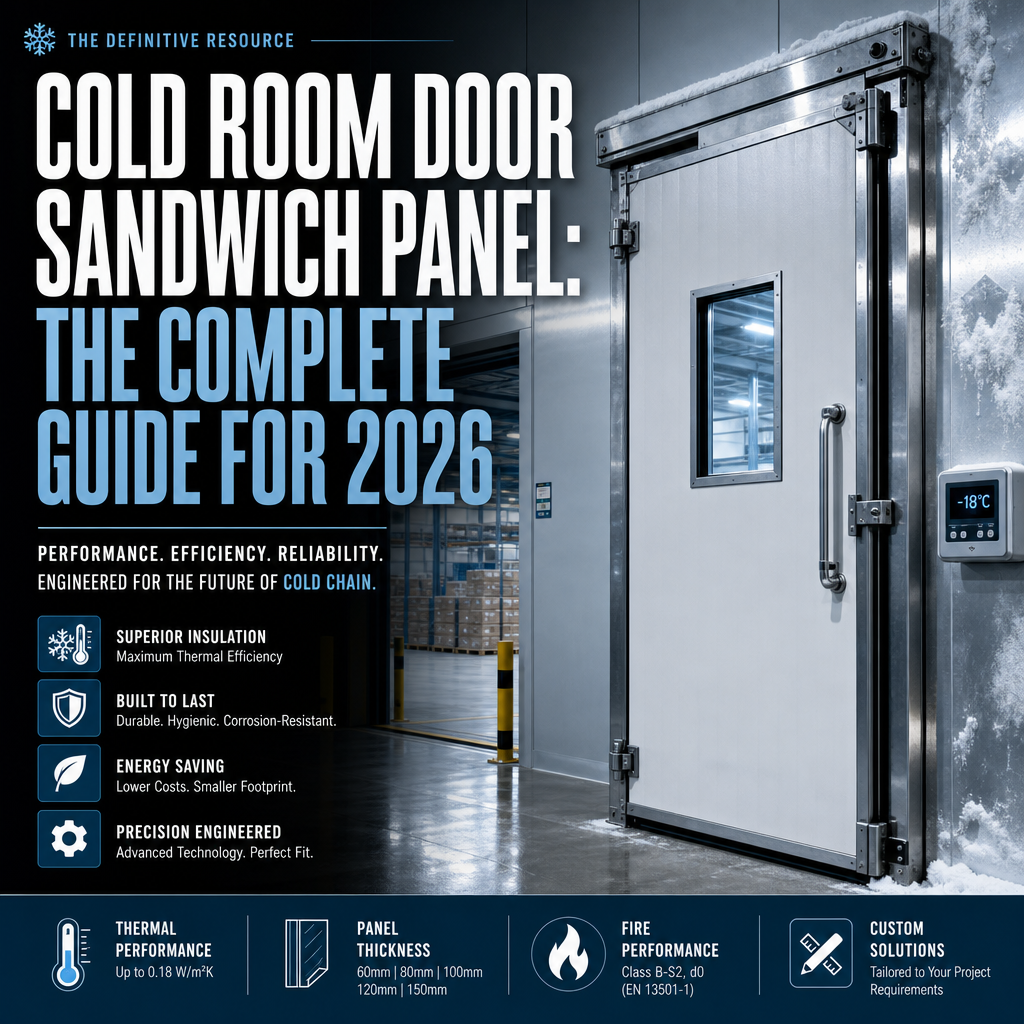
A poorly insulated cold room door can waste up to 30% of a facility's total refrigeration energy — a staggering figure that directly impacts operating costs, product safety, and regulatory compliance. Yet door selection is often treated as an afterthought in cold storage design. The cold room door sandwich panel is one of the most critical components in any refrigerated facility, and choosing the right type, thickness, and configuration can mean the difference between a profitable operation and one hemorrhaging energy costs.
This guide breaks down everything facility managers, contractors, and procurement teams need to know about cold room door sandwich panels in 2026 — from core materials and thermal performance to installation standards and maintenance best practices.
Key Takeaways 📌
- Cold room door sandwich panels combine two metal face sheets with an insulating core (typically PU, PIR, or EPS) to deliver superior thermal performance.
- Panel thickness directly determines insulation value — deeper freeze rooms require thicker panels, typically 100mm to 200mm.
- Polyurethane (PU) core panels are the industry standard for cold room doors due to their high R-value and moisture resistance.
- Proper door seals, gaskets, and cam-lock systems are essential to prevent thermal bridging and condensation.
- Correct installation and routine maintenance extend panel lifespan and protect food safety compliance.
What Is a Cold Room Door Sandwich Panel?
A cold room door sandwich panel is a prefabricated, insulated panel used to construct or line the doors of refrigerated storage rooms, cold stores, blast freezers, and chilled warehouses. Like standard wall and ceiling sandwich panels, it consists of three layers:
- Outer face sheet — typically galvanized steel, stainless steel, or aluminum
- Insulating core — polyurethane (PU), polyisocyanurate (PIR), or expanded polystyrene (EPS)
- Inner face sheet — same or similar metal material, often with a food-safe coating
The door version of this panel is engineered for repeated mechanical use — opening and closing hundreds of times daily — while maintaining airtight seals and consistent thermal performance. This is what distinguishes it from standard wall panels.
💡 Pull Quote: "The door is the most thermally vulnerable point in any cold room. Getting the panel specification right is non-negotiable for energy efficiency."
Core Material Options for Cold Room Door Sandwich Panels
Polyurethane (PU) Core — The Industry Standard
PU-core panels offer the highest thermal resistance per millimeter of thickness. With a thermal conductivity (λ) of approximately 0.022–0.025 W/m·K, they are the go-to choice for most cold room door applications. For a deeper dive into PU panel specifications, the PU sandwich panel for cold room complete guide covers selection criteria in detail.
Advantages:
- Excellent R-value
- Low moisture absorption
- Lightweight yet rigid
- Available in thicknesses from 50mm to 200mm+
Polyisocyanurate (PIR) Core
PIR offers slightly better fire resistance than standard PU and a marginally higher R-value. It is increasingly specified in food processing facilities and pharmaceutical cold stores where fire safety standards are stringent.
Expanded Polystyrene (EPS) Core
EPS is the most cost-effective option but delivers lower thermal performance per unit thickness. It is generally used in positive-temperature cold rooms (above 0°C) rather than deep-freeze applications. For a side-by-side comparison, the EPS vs PU sandwich panel guide provides a clear breakdown.
Choosing the Right Panel Thickness 📐
Panel thickness is the single biggest determinant of thermal performance. The table below provides general guidance:
| Cold Room Temperature | Recommended Door Panel Thickness |
|---|---|
| +2°C to +8°C (chiller) | 75mm – 100mm |
| -10°C to -18°C (freezer) | 100mm – 150mm |
| -20°C to -30°C (blast freeze) | 150mm – 200mm |
| Below -30°C (deep freeze) | 200mm+ |
⚠️ Note: These are general guidelines. Always consult an engineer for site-specific calculations based on ambient temperature, humidity, and door usage frequency.
For detailed thickness selection methodology, the sandwich panel thickness selection guide walks through the full calculation process.
Face Sheet Materials and Surface Finishes
The face sheets of a cold room door sandwich panel must withstand:
- Frequent physical contact and impact
- Cleaning chemicals (especially in food-grade environments)
- Condensation and moisture
- Temperature cycling stress
Common face sheet options:
| Material | Best For | Key Property |
|---|---|---|
| Galvanized steel (pre-painted) | General cold storage | Cost-effective, durable |
| Stainless steel (304/316) | Food processing, pharma | Hygienic, corrosion-resistant |
| Aluminum | Marine, high-humidity | Lightweight, rust-proof |
| GRP (fiberglass) | Chemical resistance | Non-metallic, smooth |
For food grade cold room panels, stainless steel inner faces are often mandatory under HACCP and GMP standards.
Door Types That Use Cold Room Door Sandwich Panels
Not all cold room doors are the same. The panel construction must be matched to the door type:
🚪 Hinged Doors
The most common type for smaller cold rooms and walk-in coolers. Typically 80mm–120mm thick PU panels with magnetic seals and anti-condensation heater strips around the frame.
🔄 Sliding Doors
Used where floor space is limited or where frequent access is required. Panels are often thicker (100mm–150mm) and mounted on overhead tracks. Sliding configurations are standard in large cold stores and distribution centers.
⬆️ Vertical Lift Doors
Common in blast freezers and large industrial cold stores where forklift access is required. These demand high structural rigidity from the panel, often with reinforced face sheets.
🔁 Strip Curtain + Panel Combination
Some facilities use a rigid sandwich panel door alongside PVC strip curtains to reduce thermal loss during high-traffic periods.
For a comprehensive look at door types and accessories, the sandwich panel doors and accessories guide is an excellent reference.
Critical Accessories: Seals, Gaskets, and Hardware
A cold room door sandwich panel is only as effective as its sealing system. Thermal bridging at the door perimeter is a leading cause of energy loss and condensation problems.
Essential door accessories include:
- Magnetic door seals — create an airtight perimeter seal; must be checked regularly for compression loss
- Anti-condensation heater cables — embedded in the door frame to prevent frost buildup at the threshold
- Cam-lock panel connectors — ensure tight panel-to-panel joints with no thermal gaps (see cam-lock panels)
- Door closers and hold-open devices — spring-loaded or hydraulic closers minimize open-door time
- Threshold seals — brush or rubber seals at the floor line prevent cold air escape and pest ingress
- Vision panels — double or triple-glazed insulated windows for safety and visibility
💡 Pull Quote: "A worn door gasket on a -20°C freezer room can increase compressor run time by 15–20%. Seal maintenance is refrigeration maintenance."
Installation Best Practices for Cold Room Door Sandwich Panels
Correct installation is as important as correct specification. Common installation errors include:
- Inadequate frame preparation — the structural frame must be level, plumb, and thermally broken from the building structure
- Poor joint sealing — all panel joints must be sealed with appropriate food-safe sealant
- Incorrect hinge placement — overloaded or misaligned hinges cause panel warping over time
- Missing anti-condensation measures — especially critical in high-humidity environments
For a step-by-step process, the cold room sandwich panel installation guide covers each stage with technical detail. Contractors can also explore the cold room sandwich panel installation archives for project-specific case studies.
Installation checklist:
- ✅ Frame is thermally broken and structurally sound
- ✅ Panel thickness matches temperature specification
- ✅ All joints sealed with compatible sealant
- ✅ Door hardware torqued to manufacturer specification
- ✅ Seals and gaskets fully compressed and continuous
- ✅ Anti-condensation heaters wired and tested
- ✅ Door swing/slide operation tested under load
Maintenance and Lifespan of Cold Room Door Sandwich Panels
A well-maintained cold room door sandwich panel should last 15–25 years. The most common causes of premature failure are:
- Impact damage from forklifts or pallet trucks (install door guards and bumpers)
- Seal degradation from UV exposure, chemical cleaning, or simple wear
- Moisture ingress through damaged face sheets leading to core saturation
- Hinge and hardware corrosion in high-humidity environments
Recommended maintenance schedule:
| Frequency | Task |
|---|---|
| Weekly | Inspect door seals for compression and continuity |
| Monthly | Check and clean anti-condensation heaters |
| Quarterly | Inspect panel faces for dents, corrosion, or delamination |
| Annually | Full hardware inspection; replace worn gaskets |
Proper upkeep is covered in detail in the maintenance of sandwich panels complete guide.
Regulatory and Food Safety Compliance
Cold room door sandwich panels used in food storage and processing must comply with relevant food safety and construction standards. In 2026, key frameworks include:
- HACCP (Hazard Analysis Critical Control Points) — requires smooth, cleanable, non-absorbent surfaces
- GMP (Good Manufacturing Practice) — applies to pharmaceutical cold stores
- ISO 22000 — food safety management system requirements
- Local building codes — fire rating requirements vary by jurisdiction
⚠️ Important: In food-grade applications, all sealants, coatings, and surface materials must be certified food-safe. Verify compliance documentation from your panel supplier.
For facilities requiring pharmaceutical-grade environments, the principles applied to hospital OT room sandwich panels offer relevant cross-industry insights on hygienic construction standards.
Cost Factors: What Determines the Price of a Cold Room Door Sandwich Panel?
Several variables influence the final cost:
| Factor | Impact on Price |
|---|---|
| Core material (PU vs PIR vs EPS) | PIR > PU > EPS |
| Panel thickness | Thicker = higher cost |
| Face sheet material | Stainless steel > galvanized steel |
| Door size and type | Larger/sliding doors cost more |
| Hardware and accessories | Seals, heaters, closers add cost |
| Custom dimensions | Non-standard sizes carry a premium |
For buyers in Bangladesh and South Asia, the sandwich panel price guide provides current market pricing benchmarks.
Conclusion: Actionable Next Steps
The cold room door sandwich panel is far more than a simple entry point to a refrigerated space. It is a precision-engineered thermal barrier that directly impacts energy costs, food safety compliance, and the long-term economics of cold storage operation.
Here's what to do next:
- Audit your current cold room doors — check seal condition, panel thickness, and hardware integrity
- Match panel thickness to your actual operating temperature using the table in this guide
- Specify the correct core material — PU for most applications, PIR where fire resistance is critical
- Prioritize sealing systems — invest in quality gaskets, magnetic seals, and anti-condensation heaters
- Work with a qualified supplier who can provide compliance documentation and installation support
- Schedule regular maintenance — quarterly inspections prevent costly failures
Choosing the right cold room door sandwich panel from the outset — and maintaining it correctly — is one of the highest-ROI decisions in cold storage facility management.
References
- ASHRAE. (2018). ASHRAE Handbook — Refrigeration. American Society of Heating, Refrigerating and Air-Conditioning Engineers.
- International Institute of Refrigeration. (2020). Cold Store Design and Operation. IIR Publication.
- European Sandwich Panel Association (EASP). (2019). Design Guide for Sandwich Panels in Cold Storage Applications.
- Food and Agriculture Organization of the United Nations. (2015). Manual on the Management of Cold Chains for Horticultural Products. FAO.
- British Standards Institution. (2021). BS EN 14509: Self-supporting double skin metal faced insulating panels — Factory made products — Specifications. BSI.