Last updated: May 20, 2026
Quick Answer
A thermal performance sandwich panel is a prefabricated building element made of two rigid metal face sheets bonded to an insulating core — typically polyurethane (PU), expanded polystyrene (EPS), or mineral wool — that dramatically reduces heat transfer through walls and roofs. The panel's thermal resistance (R-value) depends on core material and thickness. For most commercial and industrial buildings in hot, humid climates like Bangladesh, a PU core panel of 50–100mm thickness delivers the best balance of insulation, weight, and cost.
Key Takeaways
- 🏗️ Three core materials dominate: PU (polyurethane), EPS (expanded polystyrene), and rockwool (mineral wool) — each with distinct thermal, fire, and cost profiles.
- 📐 Thickness drives performance: Doubling core thickness roughly doubles the R-value, but returns diminish beyond 150mm for most applications.
- 🌡️ PU panels offer the highest thermal resistance per millimeter, making them the top choice for cold rooms, food processing, and climate-controlled facilities.
- 🔥 Rockwool panels provide the best fire resistance alongside solid thermal performance — critical for hospitals, pharma plants, and high-risk industrial buildings.
- 💰 EPS panels are the most cost-effective option for general warehousing and light industrial use where extreme insulation isn't required.
- ⚡ Energy savings are real and measurable: Properly specified insulated panels can significantly reduce HVAC loads in hot climates, cutting cooling costs over the building's lifetime.
- 🔧 Installation quality matters as much as panel spec: Gaps, poor joint sealing, and thermal bridges at fixings can undermine even a high-spec panel system.
- 📋 Always match panel spec to application: Cold rooms, clean rooms, warehouses, and factory buildings each have different thermal, hygiene, and structural requirements.
What Is a Thermal Performance Sandwich Panel?
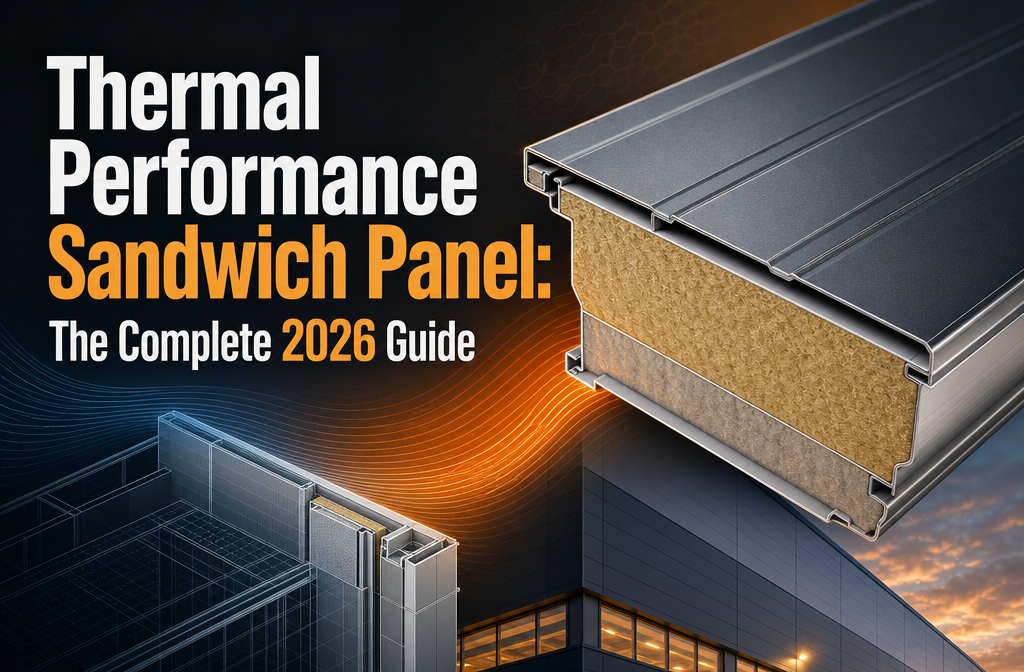
A thermal performance sandwich panel consists of three bonded layers: two outer metal face sheets (usually pre-painted galvanized steel or aluminum) and a continuous insulating core. The core material is what determines the panel's thermal resistance, measured as an R-value (thermal resistance) or U-value (thermal transmittance, where lower is better).
These panels are factory-manufactured, which means consistent quality and faster site installation compared to traditional brick-and-mortar or frame-and-insulation systems. They're used for walls, roofs, ceilings, and partitions across industrial, commercial, and specialized facilities.
Why it matters: In a country like Bangladesh, where outdoor temperatures regularly exceed 35°C and humidity is high, a building envelope with poor thermal performance forces HVAC systems to work harder, drives up energy bills, and creates uncomfortable or non-compliant working conditions. The right thermal insulation sandwich panel solves all three problems simultaneously.
How Is Thermal Performance Measured in Sandwich Panels?
Thermal performance is measured using two main metrics:
| Metric | What It Measures | Better Value |
|---|---|---|
| R-value | Resistance to heat flow (m²·K/W) | Higher is better |
| U-value | Rate of heat transfer (W/m²·K) | Lower is better |
| Lambda (λ) | Core material conductivity (W/m·K) | Lower is better |
The relationship is straightforward: R = thickness (m) ÷ lambda (λ). So a 100mm PU core with a lambda of 0.022 W/m·K gives an R-value of approximately 4.5 m²·K/W for the core alone. Face sheets and surface resistances add a small amount on top.
Common mistake: Many buyers compare panel prices without checking the core lambda value. Two panels labeled "100mm PU" can have meaningfully different thermal performance if one uses a lower-density foam with a higher lambda value. Always ask for the certified lambda value from the manufacturer.
Which Core Material Gives the Best Thermal Performance?
PU (polyurethane) foam delivers the highest thermal resistance per millimeter of any common sandwich panel core. EPS is a solid mid-range performer. Rockwool (mineral wool) has a higher lambda but compensates with excellent fire resistance.
Here's a practical comparison:
| Core Material | Typical Lambda (W/m·K) | R-value per 100mm | Fire Rating | Best For |
|---|---|---|---|---|
| PU / PIR | 0.022–0.028 | ~3.6–4.5 | Moderate (PIR better) | Cold rooms, food processing, clean rooms |
| EPS | 0.035–0.040 | ~2.5–2.9 | Low–Moderate | Warehouses, light industrial, general buildings |
| Rockwool | 0.033–0.040 | ~2.5–3.0 | Excellent (non-combustible) | Hospitals, pharma, high fire-risk industrial |
Choose PU if: maximum insulation in minimum thickness is the priority (cold rooms, refrigerated warehouses, pharmaceutical clean rooms).
Choose EPS if: budget is the main constraint and the application is a standard warehouse or factory building without extreme temperature control needs. See the EPS vs PU sandwich panel comparison for a detailed breakdown.
Choose rockwool if: fire safety regulations require non-combustible materials, or the facility handles flammable materials.
How Does Panel Thickness Affect Thermal Performance of a Sandwich Panel?
Thicker panels always provide higher thermal resistance, but the relationship is linear — not exponential. Doubling thickness doubles the R-value. The practical question is where the point of diminishing returns sits for a given application.
Common thickness ranges and their typical applications:
- 25–50mm: Partition walls, interior dividers, non-climate-controlled areas
- 50–75mm: General industrial walls and roofs in moderate climates
- 75–100mm: Standard commercial buildings, warehouses in hot climates like Bangladesh
- 100–150mm: Cold rooms, food processing plants, pharmaceutical facilities
- 150–200mm+: Deep-freeze cold storage, specialized low-temperature applications
For roof panels specifically, thermal performance requirements are generally higher than for walls because roofs face direct solar radiation. A roof panel in Bangladesh's climate typically needs at least 75–100mm of PU or 100mm of EPS to perform adequately. The sandwich panel thickness selection guide covers this in more detail.
Key point: Specifying a thicker panel than needed wastes money. Specifying too thin a panel wastes energy every day for the building's entire lifespan. Get the calculation right upfront.
What Applications Demand the Highest Thermal Performance Sandwich Panel Specifications?
Some applications are far more demanding than others. Here's where thermal performance is non-negotiable:
🧊 Cold rooms and refrigerated storage
Cold rooms require the tightest thermal envelope because even small heat gains translate directly into compressor runtime and energy cost. PU panels of 100–150mm are standard. Poor panel joints or thermal bridges at fixings can cause condensation, mold, and product spoilage. See the PU sandwich panel cold room guide for specification details.
🏭 Food processing and pharmaceutical facilities
These facilities need controlled temperature and humidity, plus hygienic wall surfaces. PU or PIR panels with smooth, cleanable face sheets are the standard. Clean room sandwich panel specifications add hygiene and air-tightness requirements on top of thermal performance.
🏗️ Industrial warehouses and factories
The thermal requirement here is less extreme, but still significant in Bangladesh's climate. EPS or 75mm PU panels typically suffice. The sandwich panel for factory buildings guide covers structural and thermal considerations together.
🏥 Hospitals and operating theaters
Hospital OT rooms and clean areas need both thermal control and fire safety, making rockwool or PIR panels the preferred choice.
What Are the Common Mistakes That Hurt Thermal Performance?
Even a correctly specified thermal performance sandwich panel can underperform if installation or design is poor. These are the most frequent problems:
-
Thermal bridging at fixings: Metal fasteners conduct heat directly through the panel. Using thermal break washers and minimizing exposed fixings reduces this significantly.
-
Poor joint sealing: Gaps between panels at joints, corners, and penetrations are the most common cause of heat gain in otherwise well-specified buildings. All joints should be sealed with compatible sealant and, where required, foam backing rod.
-
Incorrect panel orientation: Some panels are designed specifically for horizontal or vertical installation. Installing them the wrong way can affect drainage and joint performance.
-
Mismatched accessories: Using standard doors or windows in a thermally insulated panel wall creates weak points. Insulated frames and thermally broken accessories are essential.
-
Ignoring solar gain on roofs: Dark-colored roof panels absorb significantly more solar radiation than light-colored ones. In hot climates, panel color selection affects thermal performance meaningfully.
For ongoing performance, proper maintenance matters too. The sandwich panel maintenance guide covers how to keep panels performing as specified over their service life.
How Does Thermal Performance Sandwich Panel Compare to Traditional Construction?
| Feature | Sandwich Panel | Brick + Insulation | Concrete Block |
|---|---|---|---|
| Thermal resistance | High (factory-controlled) | Variable (workmanship-dependent) | Low without added insulation |
| Construction speed | Fast (prefabricated) | Slow | Moderate |
| Weight | Light | Heavy | Very heavy |
| Airtightness | Good (if joints sealed) | Variable | Moderate |
| Cost (upfront) | Moderate–High | Low–Moderate | Low |
| Lifetime energy saving | High | Moderate | Low |
The upfront cost of sandwich panels is higher than basic brick construction, but the energy savings over a 10–20 year building lifespan typically justify the investment, especially for air-conditioned or refrigerated facilities in hot climates.
What Should Buyers Check Before Purchasing a Thermal Performance Sandwich Panel?
Before placing an order, verify these specifications with the supplier:
- ✅ Core material and density (kg/m³) — higher density generally means better performance and durability
- ✅ Certified lambda value (W/m·K) from an accredited test laboratory
- ✅ Face sheet thickness and coating — standard is 0.4–0.6mm pre-painted galvanized steel
- ✅ Panel thickness matched to the calculated thermal requirement for the application
- ✅ Fire rating — especially critical for food, pharma, hospital, and high-occupancy buildings
- ✅ Joint system — tongue-and-groove, cam-lock, or ship-lap; cam-lock joints generally give better airtightness
- ✅ Manufacturer's warranty and track record
For buyers in Bangladesh, the insulated sandwich panel Bangladesh guide covers local availability, pricing, and supplier selection in detail.
FAQ: Thermal Performance Sandwich Panels
Q: What R-value should a sandwich panel have for a warehouse in Bangladesh?
A: For a standard warehouse in Bangladesh's hot, humid climate, aim for a minimum R-value of 2.5–3.5 m²·K/W for walls and 3.5–4.5 m²·K/W for roofs. This typically means 75–100mm EPS or 50–75mm PU panels.
Q: Is PU or EPS better for thermal performance?
A: PU (polyurethane) is better, delivering roughly 40–50% more thermal resistance per millimeter than EPS. For cold rooms and climate-controlled facilities, PU is the standard choice. EPS is adequate for general warehousing where budget is a priority.
Q: Does sandwich panel color affect thermal performance?
A: Yes, especially for roof panels. Light colors (white, light grey, light blue) reflect more solar radiation and reduce heat gain. In Bangladesh's climate, choosing a light-colored roof panel can meaningfully reduce cooling loads.
Q: How long do sandwich panels maintain their thermal performance?
A: Quality PU and EPS panels retain most of their thermal performance for 20–30 years if properly installed and maintained. PU foam can experience some long-term lambda drift (slight increase) over decades, but this is minor in well-manufactured panels.
Q: Can sandwich panels be used for both walls and roofs?
A: Yes, but wall and roof panels are typically different products. Roof panels are designed to handle structural loads, water drainage, and higher thermal requirements. Always specify roof-rated panels for roof applications.
Q: What is a U-value and what's a good target?
A: U-value measures how much heat passes through a panel per square meter per degree of temperature difference (W/m²·K). Lower is better. For climate-controlled buildings in Bangladesh, target U-values below 0.35 W/m²·K for walls and below 0.25 W/m²·K for roofs.
Q: Are sandwich panels airtight?
A: Factory-manufactured panels are inherently dense and low-permeability, but airtightness depends heavily on joint sealing during installation. Cam-lock joints with proper sealant application give the best results.
Q: How much does a thermal performance sandwich panel cost in Bangladesh?
A: Prices vary by core material, thickness, and supplier. For current pricing, the sandwich panel price guide for Bangladesh provides up-to-date market rates.
Q: Do sandwich panels need additional insulation?
A: Generally no — that's the point of the sandwich construction. However, in deep-freeze applications (below -20°C), additional insulation at joints and penetrations may be needed.
Q: What's the difference between PIR and PU panels?
A: PIR (polyisocyanurate) is a higher-specification variant of polyurethane foam with better fire resistance and a slightly lower lambda value. PIR panels cost more but are preferred for applications where both thermal performance and fire safety are critical.
Conclusion: Choosing the Right Thermal Performance Sandwich Panel
The thermal performance sandwich panel market in 2026 offers genuinely good options across every budget and application type. The decision framework is straightforward:
- Define the thermal requirement first — calculate the target U-value or R-value based on the application and climate.
- Select the core material — PU for maximum insulation, EPS for cost efficiency, rockwool for fire safety.
- Specify the correct thickness — don't over-specify (wasted cost) or under-specify (wasted energy for the building's entire life).
- Verify certified performance data — ask for lambda test certificates, not just marketing claims.
- Plan installation carefully — joint sealing and thermal bridging prevention are as important as the panel spec itself.
- Work with a reputable supplier — consistent manufacturing quality is what turns a good spec into a high-performing building envelope.
For buyers in Bangladesh, start with the sandwich panel buying guide to understand the local market, then match the spec to the application using the criteria above. Getting the thermal envelope right at the design stage is always cheaper than correcting it after construction.
References
- ASHRAE. (2021). ASHRAE Handbook — Fundamentals. American Society of Heating, Refrigerating and Air-Conditioning Engineers. https://www.ashrae.org
- European Insulation Manufacturers Association (EURIMA). (2020). Thermal Insulation and Energy Efficiency in Buildings. https://www.eurima.org
- International Organization for Standardization. (2017). ISO 6946: Building components and building elements — Thermal resistance and thermal transmittance — Calculation methods. https://www.iso.org/standard/65708.html
- Metal Construction Association (MCA). (2022). Insulated Metal Panels: Thermal Performance Guide. https://www.metalconstruction.org