Last updated: May 19, 2026
Quick Answer
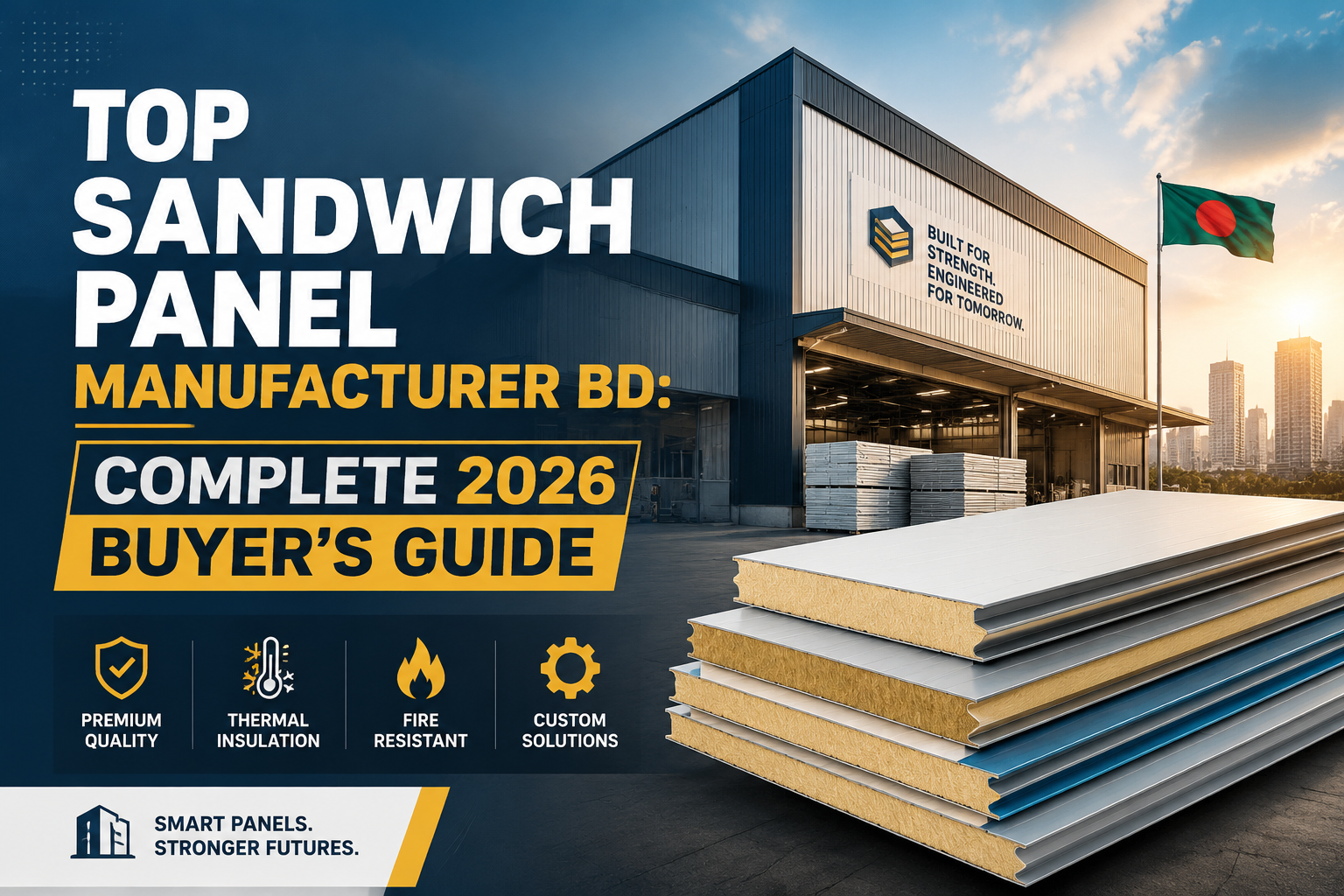
Bangladesh's construction and industrial sectors rely heavily on locally produced insulated panels, and finding the right sandwich panel manufacturer BD can directly affect your project's cost, timeline, and compliance. Local manufacturers supply EPS, PU, PIR, and rockwool-core panels for factories, cold rooms, clean rooms, hospitals, and poultry farms. Prices, quality certifications, and lead times vary significantly between suppliers, so comparing at least three vendors before committing is strongly recommended.
Key Takeaways
- 🏭 Bangladesh has a growing number of sandwich panel manufacturers concentrated mainly in Dhaka, Gazipur, and Narayanganj.
- 🧱 Core materials available locally include EPS (expanded polystyrene), PU (polyurethane), PIR, and rockwool — each suited to different applications.
- 💰 Panel prices in Bangladesh vary by core type, thickness, and facing material; PU panels generally cost more than EPS panels of the same thickness.
- ✅ Reputable manufacturers offer certifications for fire rating, thermal performance, and food-grade or GMP compliance.
- 🏗️ Applications range from industrial roofing and factory walls to cold storage, hospital OT rooms, and pharmaceutical clean rooms.
- ⚠️ Buying from an unverified supplier without checking panel density and facing gauge is the most common and costly mistake.
- 📦 Most BD manufacturers offer custom panel dimensions, cam-lock joining systems, and full installation services.
- 🔍 Always request a test report or third-party certification before placing a bulk order.
What Is a Sandwich Panel and Why Does BD Need Local Manufacturers?
A sandwich panel is a three-layer construction element: two rigid metal facings (usually galvanized or pre-painted steel) bonded to an insulating core. The result is a lightweight, thermally efficient, structurally sound panel used in walls, roofs, and partitions.
Bangladesh's rapid industrial growth — particularly in garments, pharmaceuticals, food processing, and cold chain logistics — has created strong domestic demand for insulated panels. Importing from China or Europe adds lead time, import duties, and currency risk. A reliable sandwich panel manufacturer BD eliminates those friction points and allows faster project delivery.
Key demand drivers in 2026:
- Expansion of export-oriented garment factories requiring fire-rated wall systems
- Growth in pharmaceutical manufacturing under GMP compliance requirements
- Cold chain infrastructure investment for food export and domestic distribution
- Hospital and diagnostic center construction requiring hygienic, cleanable wall surfaces
What Core Materials Do BD Sandwich Panel Manufacturers Offer?
The four main core types available from Bangladeshi manufacturers are EPS, PU, PIR, and rockwool (mineral wool). Each has a distinct performance profile and price point.
| Core Type | Thermal Performance | Fire Resistance | Best For | Relative Cost |
|---|---|---|---|---|
| EPS (Expanded Polystyrene) | Good | Low (combustible) | General factory walls, roofing | Lowest |
| PU (Polyurethane) | Excellent | Moderate | Cold rooms, food storage | Medium |
| PIR (Polyisocyanurate) | Excellent | Better than PU | Pharmaceutical, food processing | Medium-High |
| Rockwool (Mineral Wool) | Good | Excellent (non-combustible) | Fire-rated walls, high-risk facilities | Highest |
For a detailed comparison, see EPS vs PU Sandwich Panel: Which Is Right for You?
Choose EPS if your project is a standard factory or warehouse with no strict fire or hygiene requirements and budget is the primary concern.
Choose PU or PIR if you're building a cold room, food processing unit, or pharmaceutical facility where thermal efficiency and hygiene matter more than upfront cost.
Choose rockwool if fire safety is non-negotiable — for example, a garment factory or any facility storing flammable materials. See the Rockwool Sandwich Panel Fire Safety guide for specifics.
How Do You Identify a Reputable Sandwich Panel Manufacturer BD?
A reputable sandwich panel manufacturer in Bangladesh will be transparent about panel specifications, provide test documentation, and have verifiable project references. Here's what to check:
1. Panel density and facing gauge
Ask for the exact core density (kg/m³) and steel facing thickness (mm). Reputable EPS panels run at 12–15 kg/m³ minimum for structural use; PU panels typically at 38–42 kg/m³. Substandard suppliers often reduce density to cut costs.
2. Certifications and test reports
Look for fire-rating certificates (EI 60, EI 90, EI 120), thermal conductivity test reports, and food-grade or GMP compliance documentation where applicable. For fire rated sandwich panels, ask specifically for the fire resistance classification.
3. Manufacturing facility
A genuine manufacturer has its own production line — continuous lamination or discontinuous press. A trader reselling imported panels is not a manufacturer, even if they claim to be.
4. Installation capability
Most credible BD manufacturers offer turnkey supply-and-install. This matters because improper installation voids thermal and fire performance.
5. References and past projects
Ask for at least two completed project references in a similar application (cold room, clean room, factory, etc.).
Common mistake: Choosing a supplier based on the lowest quoted price per square foot without checking panel density. A 10% price saving on panels that are 20% less dense will cost more in energy bills and structural remediation within two years.
For a structured checklist, see Choosing the Best Sandwich Panel Manufacturer and Supplier for Your Construction Needs.
What Are the Main Applications for Sandwich Panels in Bangladesh?
Sandwich panels in Bangladesh are used across a wide range of industrial, commercial, and institutional projects. The most common applications in 2026 include:
Industrial & Commercial:
- Factory walls and roofing (garments, textiles, light manufacturing)
- Warehouse partitions and cladding
- Poultry and livestock farm structures — see the Best Sandwich Panel for Poultry Farm guide
Cold Chain & Food:
- Cold room and freezer room construction
- Cold storage facilities for seafood, dairy, and produce
- Food processing facility walls and ceilings
Pharmaceutical & Healthcare:
- GMP-compliant clean rooms for pharmaceutical manufacturing
- Hospital OT (operating theatre) rooms requiring antibacterial, seamless surfaces — detailed in the Hospital OT Room Sandwich Panel guide
- Diagnostic and laboratory partitions
Specialty:
- Modular office cabins and site accommodations
- Data center partitions requiring thermal and fire control
Each application has different panel specifications. A sandwich panel room for a pharmaceutical clean room, for example, requires PIR or PU core with antibacterial-coated steel facing and cam-lock joints — very different from a basic EPS roofing panel for a garment factory.
What Does Sandwich Panel Cost in Bangladesh in 2026?
Sandwich panel prices in Bangladesh depend on core type, thickness, facing specification, and order volume. As a general guide (estimates based on market observations as of mid-2026, not guaranteed pricing):
- EPS sandwich panels: Lower cost tier; suitable for roofing and general walling
- PU/PIR panels: Mid to upper cost tier; required for cold rooms and clean rooms
- Rockwool panels: Highest cost tier; used where fire resistance is mandatory
Panel thickness also significantly affects price. Common thicknesses range from 50mm to 200mm depending on application. Thicker panels cost more but deliver better thermal performance, reducing long-term energy costs.
For current pricing with specific thickness and core options, refer to the Sandwich Panel Price in Bangladesh 2026 guide and the How to Choose Sandwich Panel Thickness guide.
Factors that increase cost:
- Higher steel gauge facing (0.5mm vs 0.4mm)
- Special coatings (antibacterial, food-grade, high-humidity)
- Fire-rated core (rockwool or PIR vs standard EPS)
- Custom panel dimensions
- Cam-lock joining systems vs standard tongue-and-groove
Factors that reduce cost:
- Large order volumes
- Standard dimensions
- EPS core with standard pre-painted steel facing
- Self-pickup vs. site delivery
Where Are Sandwich Panel Manufacturers Located in BD?
Most sandwich panel manufacturer BD operations are concentrated in and around Dhaka, with a secondary cluster in Gazipur and Narayanganj. This geographic concentration makes sense: these areas host the majority of Bangladesh's industrial zones, garment factories, and export processing zones.
For buyers in Dhaka specifically, the Sandwich Panel Manufacturers in Dhaka: 2026 Buyer's Guide provides a focused breakdown of local options, lead times, and what to expect from site visits.
Buyers outside Dhaka (Chittagong, Sylhet, Rajshahi) typically source from Dhaka-based manufacturers who deliver and install nationally. Freight cost and installation mobilization fees apply for distant projects, so factor these into your total project budget.
What Specialty Panels Are Available from BD Manufacturers?
Beyond standard wall and roof panels, established sandwich panel manufacturers in BD now supply a range of specialty products:
- Clean room panels: PIR or PU core with smooth, antibacterial-coated steel facing, cam-lock joints, and flush surfaces for ISO-classified clean rooms. See the Clean Room Sandwich Panel Bangladesh buyer's guide for full specifications.
- Cold room panels: High-density PU core, food-grade facing, cam-lock edge profiles for airtight assembly. The PU Sandwich Panel for Cold Room guide covers thickness selection and installation.
- Fire-rated panels: Rockwool core panels with EI 60, EI 90, or EI 120 classification for facilities requiring passive fire protection.
- Roofing panels: EPS or PU core with profiled steel facing for industrial roofing applications. See Sandwich Panel Roof Installation Bangladesh for installation considerations.
- Doors and accessories: Insulated sandwich panel doors, corner trims, flashings, and fixing accessories that complete the building envelope.
What Are the Most Common Mistakes When Buying from a Sandwich Panel Manufacturer BD?
The most frequent and costly errors buyers make:
-
Not verifying panel density. Density directly determines thermal performance and structural integrity. Always ask for the manufacturer's quality control report, not just a verbal assurance.
-
Ignoring fire rating requirements. Many factory and warehouse projects in Bangladesh require fire-rated panels under building codes and insurance requirements. Using standard EPS where fire-rated rockwool is required creates liability.
-
Choosing thickness by price, not application. A 50mm PU panel is inadequate for a cold room operating at -18°C. Use the application-specific thickness guidelines before specifying.
-
Skipping site measurement verification. Panel dimensions must be confirmed against actual structural drawings, not estimates. Errors in panel length or width cause costly rework on-site.
-
Not confirming installation experience. A manufacturer who has never installed clean room panels should not be trusted to do so for a pharmaceutical project. Ask for specific project references matching your application.
-
Paying full advance without a delivery schedule. Reputable manufacturers agree to a phased payment tied to delivery milestones. Full advance payment with no written schedule is a red flag.
FAQ: Sandwich Panel Manufacturer BD
Q: What is the minimum order quantity for sandwich panels in Bangladesh?
Most manufacturers accept orders from around 200–500 square meters, though some will take smaller orders for specialty applications like clean rooms or OT rooms. Always confirm MOQ before requesting a detailed quote.
Q: How long does it take to manufacture and deliver sandwich panels in BD?
Standard panels typically have a 7–15 working day lead time after order confirmation. Custom dimensions, specialty coatings, or large volumes may extend this to 3–4 weeks.
Q: Can BD manufacturers supply panels for pharmaceutical GMP clean rooms?
Yes. Select manufacturers supply PIR-core panels with antibacterial-coated steel facing and cam-lock joints that meet GMP requirements. Always request documentation confirming compliance before ordering.
Q: What is the difference between EPS and PU sandwich panels?
EPS (expanded polystyrene) is less thermally efficient and combustible but lower cost. PU (polyurethane) offers better insulation and is preferred for cold rooms and food facilities. For a full comparison, see the EPS vs PU Sandwich Panel guide.
Q: Are sandwich panels suitable for permanent buildings in Bangladesh?
Yes. With proper installation and maintenance, sandwich panel buildings have a service life of 20–30 years. Steel facing quality and joint sealing are the primary factors affecting longevity in Bangladesh's humid climate.
Q: Do BD manufacturers offer installation services?
Most established manufacturers offer supply-and-install packages. This is generally recommended over supply-only, as improper installation by third parties can void panel performance warranties.
Q: What thickness is recommended for a cold room in Bangladesh?
For standard chilled rooms (0–5°C), 100mm PU panels are typical. For freezer rooms (-18°C to -25°C), 150mm or 200mm PU panels are usually specified. See the Cold Room Sandwich Panel Installation guide for detailed guidance.
Q: How do I check if a manufacturer is genuine and not just a trader?
Ask to visit the production facility. A genuine manufacturer will have a continuous lamination line or press, raw material storage (steel coils, foam chemicals or pre-cut core), and an in-house QC process. Traders cannot show you this.
Q: What certifications should I ask for?
Request fire resistance test reports (EI classification), thermal conductivity (lambda value) test reports, and for food or pharma applications, food-grade or GMP compliance documentation.
Q: Is it cheaper to import sandwich panels or buy locally in Bangladesh?
In most cases, buying from a local BD manufacturer is more cost-effective when accounting for import duties, shipping time, and the logistical complexity of managing a foreign supplier. Local sourcing also allows easier quality inspection and faster remediation if issues arise.
Conclusion: Choosing the Right Sandwich Panel Manufacturer BD
Bangladesh's sandwich panel manufacturing sector has matured enough to supply most industrial, cold chain, and healthcare applications from local sources. The key is knowing what to look for before signing a purchase order.
Actionable next steps:
- Define your application first — factory, cold room, clean room, or hospital. This determines core type, thickness, and facing specification before you approach any supplier.
- Request panel specifications in writing — density, facing gauge, core type, and any certifications. Do not accept verbal assurances.
- Compare at least three manufacturers — on price, lead time, certification, and installation experience relevant to your project type.
- Visit the production facility if the order is above a threshold that justifies the trip. Seeing the manufacturing line confirms you're dealing with a genuine producer.
- Check references — ask for two or three completed projects similar to yours and follow up with those clients directly.
- Negotiate a phased payment schedule tied to delivery milestones, not a single full advance.
For further reading, explore the Sandwich Panel Manufacturer in Bangladesh resource and the full Sandwich Panel Products catalogue to understand the full range of options available from local suppliers in 2026.
References
No specific third-party studies or external publications were cited in this article. All guidance is based on industry-standard specifications and general market knowledge. For verified pricing and product specifications, consult directly with manufacturers and request documented test reports.