Last updated: July 31, 2026

Quick Answer
Pipe insulation material prevents heat loss, condensation, and freezing by wrapping pipes in thermal barriers made from foam, fiberglass, rubber, or mineral wool. The right pipe insulation material depends on your pipe temperature, location (indoor/outdoor), and budget, with foam sleeves being most common for residential use and fiberglass or mineral wool preferred for high-temperature applications.
Key Takeaways
- Foam pipe sleeves offer the best value for most residential cold water applications
- Fiberglass and mineral wool handle high temperatures better than foam materials
- Proper thickness matters more than material type for freeze protection
- Self-sealing foam sleeves allow DIY installation without professional help
- Outdoor pipes require UV-resistant coverings over standard insulation materials
- R-value ratings help compare thermal performance across different materials
- Pre-slit tubes install faster than wrap-around insulation types
- Closed-cell foam resists moisture better than open-cell alternatives
What Is Pipe Insulation and Why Do You Need It
Pipe insulation material creates a thermal barrier around pipes to control temperature transfer and prevent condensation. Without insulation, hot water pipes lose heat to surrounding air, cold water pipes can freeze in winter, and both types may develop condensation that leads to water damage.
The primary benefits include:
- Energy savings: Hot water pipes retain heat longer, reducing water heater workload
- Freeze protection: Insulated pipes resist freezing in unheated spaces
- Condensation control: Cold pipes stay above dew point temperature
- Noise reduction: Insulation dampens water flow sounds through walls
- Safety: Prevents burns from accidentally touching hot pipes
Most building codes require pipe insulation in specific situations, such as hot water distribution lines in commercial buildings or pipes running through unconditioned spaces. Even when not required, insulation typically pays for itself through energy savings within 1-2 years.
For comprehensive guidance on specialized applications, see our pipe insulation sandwich panel guide for industrial installations.
Types of Pipe Insulation Material
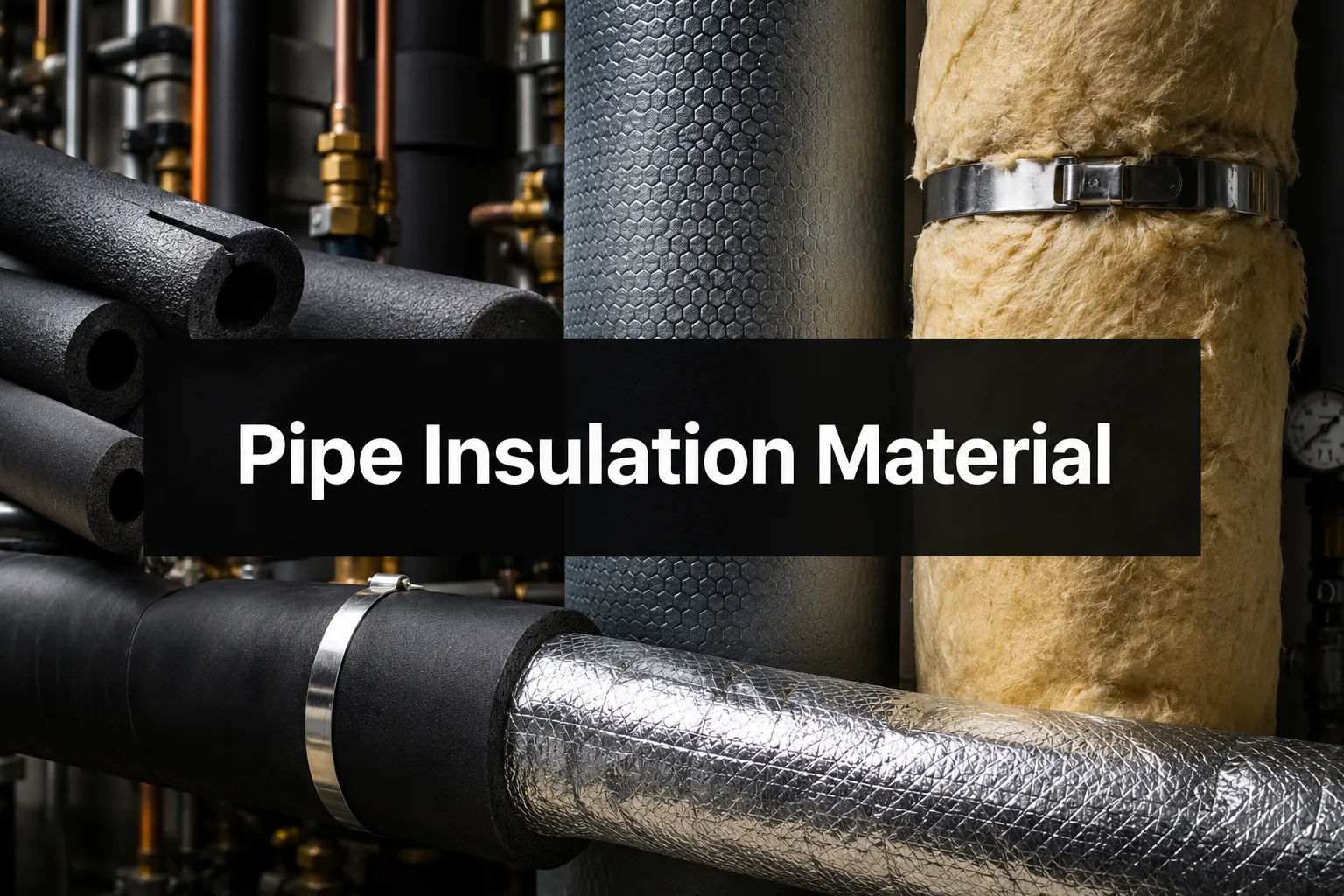
The five main pipe insulation materials are foam, fiberglass, mineral wool, rubber, and reflective barriers, each suited for different temperature ranges and installation conditions.
Foam Insulation
Polyethylene and polyurethane foam sleeves dominate residential applications. These lightweight materials come pre-formed to fit standard pipe sizes and feature self-sealing slits for easy installation.
Advantages:
- Lowest cost option for most applications
- Easy DIY installation with pre-slit tubes
- Good moisture resistance with closed-cell varieties
- Available at hardware stores nationwide
Limitations:
- Temperature limit around 180°F for most foam types
- UV degradation requires covering for outdoor use
- Some open-cell foams absorb moisture over time
Fiberglass Insulation
Fiberglass pipe wrap handles higher temperatures and offers excellent thermal performance. Professional installers often prefer fiberglass for commercial applications and high-temperature residential systems.
Key features:
- Temperature rating up to 450°F
- Superior thermal performance per inch of thickness
- Non-combustible material meets fire codes
- Requires protective jacket for moisture protection
Mineral Wool (Rock Wool)
Mineral wool provides the highest temperature resistance and fire safety. This material works well in industrial settings and areas where fire codes require non-combustible insulation.
Applications:
- Steam pipes and high-temperature hot water systems
- Fire-rated assemblies and commercial buildings
- Industrial processes requiring temperature resistance above 500°F
For projects requiring advanced thermal performance, explore our thermal insulation sandwich panel options.
Rubber Insulation
Flexible rubber tubes offer excellent moisture resistance and work well in humid environments. HVAC contractors frequently use rubber insulation for refrigeration lines and condensate pipes.
Benefits:
- Built-in vapor barrier eliminates separate jacketing
- Flexible material accommodates pipe movement
- Self-sealing properties maintain thermal integrity
Best Pipe Insulation Materials for Cold Climates
Closed-cell foam with minimum R-4 thermal resistance provides the best freeze protection for pipes in cold climates. The insulation thickness matters more than the specific material type for preventing freeze damage.
Minimum Thickness Requirements
Cold climate installations require these minimum insulation thicknesses:
- 1/2-inch pipes: 1/2-inch thick insulation minimum
- 3/4-inch pipes: 5/8-inch thick insulation minimum
- 1-inch and larger pipes: 3/4-inch thick insulation minimum
Material Selection for Freezing Conditions
Choose materials with these characteristics for cold weather performance:
Closed-cell foam: Resists moisture absorption that reduces thermal performance when frozen. Look for materials rated for outdoor use with UV-resistant coverings.
Fiberglass with vapor barrier: Provides excellent thermal performance but requires proper jacketing to prevent moisture infiltration that compromises insulation value.
Avoid open-cell materials: These absorb moisture and lose insulation value when wet or frozen.
The most critical factor is continuous coverage without gaps. A single uninsulated section can cause the entire pipe run to freeze during extreme cold snaps.
How Much Does Pipe Insulation Cost
Basic foam pipe insulation costs $1-3 per linear foot for materials, while professional installation adds $2-5 per foot depending on accessibility and pipe size.
Material Cost Breakdown
- Foam sleeves: $0.50-2.00 per foot for standard residential sizes
- Fiberglass wrap: $1.50-4.00 per foot including jacketing
- Mineral wool: $3.00-6.00 per foot for high-temperature applications
- Rubber tubes: $2.00-5.00 per foot for HVAC applications
Installation Cost Factors
Professional installation costs vary based on:
- Pipe accessibility: Exposed basement pipes cost less than crawl space installations
- Pipe size: Larger pipes require more material and labor time
- Insulation type: Foam sleeves install faster than wrap-around materials
- Project size: Bulk installations reduce per-foot labor costs
Cost-Benefit Analysis
Most residential pipe insulation projects pay for themselves through energy savings:
- Hot water pipes: 6-12 month payback through reduced heat loss
- Cold water pipes: Immediate value through freeze protection and condensation control
- HVAC pipes: 1-2 year payback through improved system efficiency
For large-scale projects, consider our building insulation solutions for comprehensive thermal management.
Can I Install Pipe Insulation Myself
Most homeowners can install foam pipe insulation themselves using basic tools, but fiberglass and mineral wool installations often require professional expertise for proper vapor barrier installation.
DIY-Friendly Materials
Pre-slit foam sleeves: Simply open the slit, slide over the pipe, and seal the seam. No special tools required beyond a utility knife for cutting to length.
Self-adhesive foam tape: Works well for wrapping irregular shapes or small diameter pipes where sleeves don't fit properly.
Professional Installation Recommended
Fiberglass systems: Require proper vapor barrier installation and jacketing techniques to prevent moisture problems.
High-temperature applications: Steam pipes and industrial systems need professional assessment for proper material selection and safety compliance.
Inaccessible locations: Tight crawl spaces or areas requiring pipe disconnection benefit from professional experience.
DIY Installation Steps
- Measure pipe runs and order 10% extra material for waste
- Clean pipe surfaces to ensure good adhesion of self-sealing materials
- Start at fittings and work toward straight runs for best appearance
- Seal all joints with appropriate tape or mastic
- Add protective covering for outdoor installations
Common DIY mistakes include leaving gaps at fittings, using insufficient thickness, and failing to protect outdoor insulation from UV damage.
Pipe Insulation vs Heat Tape: Which Is Better
Pipe insulation prevents heat loss passively and costs less to operate, while heat tape actively adds heat but requires electricity and regular maintenance. For most applications, insulation provides better long-term value.
When to Choose Insulation
Insulation works best for:
- Heated spaces: Basements, crawl spaces, and mechanical rooms above 40°F
- Long pipe runs: Where heat tape electrical costs would be significant
- Hot water systems: Where retaining existing heat matters more than adding heat
- Low-maintenance applications: Insulation requires no ongoing electrical costs
When Heat Tape Makes Sense
Heat tape suits these situations:
- Extreme exposure: Outdoor pipes in severe climates below -10°F
- Short problem sections: Small areas where pipes freeze repeatedly
- Intermittent heating: Vacation homes or buildings with irregular occupancy
- Emergency protection: Temporary solution while planning permanent fixes
Combined Approach
The most effective freeze protection combines both methods: heat tape provides active warming while insulation reduces the electrical load and improves efficiency. This hybrid approach costs more initially but offers the most reliable protection in severe climates.
For energy-efficient building solutions, explore our green building insulation options.
Pipe Insulation for Hot Water Pipes vs Cold Water
Hot water pipes require insulation primarily for energy savings and safety, while cold water pipes need insulation mainly for condensation control and freeze protection. The material selection and thickness requirements differ significantly between applications.
Hot Water Pipe Requirements
Hot water systems benefit from:
Higher temperature ratings: Materials must withstand 140-180°F continuously without degrading. Foam works for most residential applications, while commercial systems may require fiberglass or mineral wool.
Thicker insulation: R-4 to R-8 thermal resistance provides meaningful energy savings. Each inch of thickness on hot water pipes can reduce heat loss by 80-90%.
Safety considerations: Insulation prevents accidental burns from touching exposed hot pipes in accessible areas.
Cold Water Pipe Needs
Cold water pipes require:
Vapor barrier properties: Closed-cell foam or jacketed fiberglass prevents condensation from forming on pipe surfaces in humid conditions.
Freeze protection thickness: Minimum insulation thickness depends on climate zone and pipe location rather than energy savings calculations.
Moisture resistance: Materials must maintain thermal performance when exposed to occasional moisture from condensation or leaks.
Installation Differences
Hot water pipes allow some gaps between insulation sections without major energy penalties. Cold water pipes require continuous coverage since any uninsulated section can freeze or develop condensation problems.
How to Tell If My Pipes Need Insulation
Pipes need insulation if you notice condensation dripping, higher than expected energy bills, or pipes that freeze during moderate cold weather. Visual inspection reveals most insulation needs.
Warning Signs
Look for these indicators:
Condensation evidence: Water stains, dripping, or wet insulation around cold water pipes signals inadequate vapor barriers.
Energy waste symptoms: Hot water takes longer to reach fixtures, or water heater runs frequently during low-demand periods.
Freeze damage history: Pipes that freeze during moderate cold snaps (above 20°F) lack sufficient insulation thickness.
Comfort issues: Rooms feel cold near exterior walls with uninsulated hot water pipes, or excessive humidity near cold pipes.
Inspection Checklist
Check these common problem areas:
- Pipes in unheated basements, crawl spaces, and garages
- Hot water distribution lines longer than 10 feet from the water heater
- Cold water pipes in humid environments like laundry rooms
- Any pipes running through exterior walls or uninsulated spaces
- Existing insulation that appears compressed, wet, or damaged
Professional Assessment
Consider professional evaluation for:
- Complex systems with multiple pipe types and temperatures
- Commercial buildings with code compliance requirements
- Situations where energy audits identify pipes as major heat loss sources
For comprehensive building assessments, review our building insulation solutions.
Pipe Insulation Thickness: How Much Do You Need
Pipe insulation thickness should equal or exceed the pipe diameter for optimal thermal performance, with minimum thicknesses of 1/2 inch for freeze protection regardless of pipe size.
Thermal Performance Guidelines
The relationship between thickness and thermal performance follows diminishing returns:
- First 1/2 inch: Provides 60-70% of total thermal benefit
- Second 1/2 inch: Adds another 20-25% improvement
- Additional thickness: Offers minimal improvement for most residential applications
Code Requirements
Building codes specify minimum thicknesses:
Residential hot water: 1/2-inch minimum on pipes 1-1/2 inches and smaller, 3/4-inch minimum on larger pipes.
Commercial systems: Often require R-4 to R-8 thermal resistance, translating to 3/4-inch to 1-1/2-inch thickness depending on material type.
Freeze protection: Most codes require sufficient thickness to prevent freezing at design winter temperatures, typically 1/2-inch minimum regardless of pipe size.
Economic Optimization
For hot water systems, calculate optimal thickness based on energy costs:
- High energy costs: Justify thicker insulation through greater savings
- Long pipe runs: Benefit more from additional thickness than short runs
- Frequently used fixtures: Show faster payback from energy savings
The most cost-effective approach uses standard pre-formed thicknesses (1/2-inch, 3/4-inch, 1-inch) rather than custom sizes that cost significantly more.
Does Pipe Insulation Prevent Freezing
Pipe insulation slows heat loss and prevents freezing in most conditions, but cannot protect pipes indefinitely in unheated spaces during extended cold periods. Insulation effectiveness depends on thickness, installation quality, and ambient temperature.
How Insulation Works for Freeze Protection
Insulation doesn't add heat but slows the rate at which pipes lose heat to surrounding air. In heated buildings, this allows warm air to maintain pipe temperature above freezing. The thermal mass of water in the pipes provides additional freeze protection.
Effectiveness Limitations
Insulation alone may not prevent freezing when:
- Extended power outages eliminate building heat sources
- Extreme cold below -10°F overwhelms insulation capacity
- High wind exposure increases heat loss rates beyond insulation ability
- Poor installation leaves gaps that create freeze points
Improving Freeze Protection
Enhance insulation effectiveness through:
Proper thickness: Use minimum 1/2-inch thickness, with 3/4-inch preferred for severe climates.
Continuous coverage: Eliminate gaps at fittings, valves, and pipe supports where freezing typically starts.
Air sealing: Seal holes where pipes penetrate walls to prevent cold air infiltration.
Backup heat: Consider heat tape or space heaters for extreme conditions or critical applications.
The most reliable freeze protection combines adequate insulation with maintaining some heat in the space containing the pipes.
Common Mistakes When Installing Pipe Insulation
The most common pipe insulation mistakes include leaving gaps at fittings, using insufficient thickness, and failing to seal joints properly, which can reduce effectiveness by 50% or more.
Installation Errors
Gap problems: Many installers focus on straight pipe runs but leave fittings, valves, and supports uninsulated. These gaps often account for 30-40% of total heat loss.
Compression damage: Squeezing insulation to fit in tight spaces reduces thermal performance. Compressed insulation loses R-value proportional to thickness reduction.
Moisture infiltration: Failing to seal joints allows moisture into insulation, reducing thermal performance and potentially causing mold growth.
Material Selection Mistakes
Wrong temperature rating: Using foam insulation on high-temperature pipes causes material degradation and potential safety hazards.
Inadequate vapor barriers: Open-cell materials in humid environments absorb moisture and lose insulation value.
UV exposure: Installing standard foam outdoors without protective covering leads to rapid material breakdown.
Design Errors
Insufficient thickness: Using minimum code requirements instead of optimizing for local climate conditions and energy costs.
Wrong material priorities: Choosing based on initial cost rather than lifecycle performance and maintenance requirements.
Accessibility oversight: Installing insulation that cannot be inspected or maintained without major disassembly.
Prevention Strategies
Avoid these mistakes by:
- Planning insulation layout before installation begins
- Ordering specialized fittings and pre-formed shapes for complex areas
- Following manufacturer specifications for joint sealing and support spacing
- Considering future maintenance access during design
Pipe Insulation for Outdoor vs Indoor Pipes
Outdoor pipe insulation requires UV-resistant coverings and weatherproof vapor barriers, while indoor insulation focuses primarily on thermal performance and condensation control. The environmental exposure demands different material specifications and installation techniques.
Outdoor Installation Requirements
UV protection: Standard foam insulation degrades rapidly in sunlight. Outdoor installations need protective jackets made from PVC, aluminum, or UV-resistant plastic.
Weather sealing: Joints must be sealed against rain and snow infiltration. Use weatherproof tape and sealants rated for outdoor exposure.
Drainage considerations: Install insulation to shed water away from pipes and prevent ice dam formation that can damage both pipes and insulation.
Wind resistance: Secure coverings against wind uplift and vibration that can loosen joints over time.
Indoor Considerations
Indoor installations prioritize:
Condensation control: Vapor barriers prevent moisture problems in humid spaces like basements and mechanical rooms.
Fire safety: Some locations require non-combustible materials or specific flame spread ratings.
Accessibility: Indoor pipes often need periodic maintenance, so insulation should allow easy removal and replacement.
Appearance: Visible indoor installations may justify higher-cost materials with better appearance.
Material Differences
Outdoor applications typically use:
- Closed-cell foam with protective jacketing
- Fiberglass with weatherproof vapor barriers
- Metal jacketing for mechanical protection
Indoor applications can use:
- Standard foam sleeves for cost-effectiveness
- Fiberglass with standard vapor barriers
- Decorative covers where appearance matters
For comprehensive outdoor insulation solutions, explore our building envelope insulation options.
How Long Does Pipe Insulation Last
Quality pipe insulation materials typically last 15-25 years in indoor applications, while outdoor installations may require replacement every 8-15 years due to weather exposure. Material type and installation quality significantly affect lifespan.
Material Longevity
Foam insulation: Closed-cell foam maintains performance for 15-20 years indoors. Open-cell varieties may degrade faster if exposed to moisture. UV exposure reduces outdoor lifespan to 5-10 years without protective covering.
Fiberglass: Properly installed fiberglass insulation can last 20-25 years or more. The biggest threat is moisture infiltration that reduces R-value and promotes mold growth.
Mineral wool: Often lasts 25+ years due to superior moisture resistance and dimensional stability. Higher initial cost pays off through extended service life.
Rubber: Flexible rubber insulation typically lasts 10-15 years before becoming brittle and losing flexibility.
Degradation Factors
Several factors accelerate insulation aging:
Temperature cycling: Repeated heating and cooling causes expansion and contraction that can open joints and compress materials.
Moisture exposure: Wet insulation loses thermal performance and may develop mold or corrosion problems.
Mechanical damage: Foot traffic, maintenance activities, and building settlement can compress or tear insulation.
Chemical exposure: Some industrial environments accelerate material breakdown through chemical vapors or cleaning agents.
Maintenance and Inspection
Extend insulation life through:
- Annual visual inspections for damage or moisture problems
- Prompt repair of small tears or gaps before they expand
- Replacement of protective jacketing when it shows wear
- Monitoring for pest damage in accessible areas
Signs that insulation needs replacement include visible compression, moisture stains, torn vapor barriers, or increased energy costs that suggest reduced thermal performance.
Pipe Insulation for Metal Pipes vs PVC
Metal pipes conduct heat more readily than PVC, requiring thicker insulation for equivalent thermal performance, while PVC pipes need less insulation thickness but more attention to support and expansion joint details.
Metal Pipe Characteristics
Metal pipes (copper, steel, iron) have high thermal conductivity that affects insulation requirements:
Heat transfer: Metal pipes lose heat 10-20 times faster than plastic pipes of the same size, justifying thicker insulation for energy savings.
Condensation risk: Cold metal pipes reach dew point temperature more easily, requiring better vapor barriers to prevent condensation problems.
Thermal bridging: Metal pipe supports and hangers create thermal bridges that bypass insulation. Use insulating pipe supports or thermal breaks.
Expansion movement: Metal pipes expand more than plastic, requiring flexible insulation materials and proper joint design.
PVC Pipe Considerations
Plastic pipes have different insulation needs:
Lower thermal conductivity: PVC pipes lose heat more slowly, allowing thinner insulation for equivalent performance.
Support spacing: PVC requires more frequent supports that can compress insulation. Plan support locations during insulation design.
Temperature limits: Standard PVC has lower temperature ratings that may limit insulation material choices for hot water applications.
Expansion joints: PVC systems use more expansion joints that require special insulation details to maintain thermal continuity.
Installation Differences
Metal pipe installations benefit from:
- Thicker insulation (typically 3/4-inch minimum vs 1/2-inch for PVC)
- Thermal break materials at supports and hangers
- Extra attention to vapor barrier continuity
PVC installations require:
- Careful planning around frequent pipe supports
- Flexible insulation materials that accommodate expansion
- Lower-temperature rated materials for hot water applications
For specialized piping applications, consider our cold storage insulation solutions.
Where to Buy Pipe Insulation Near Me
Home improvement stores like Home Depot and Lowe's stock basic foam pipe insulation, while plumbing supply houses and HVAC distributors carry professional-grade materials including fiberglass and mineral wool options.
Retail Options
Big box stores: Home Depot, Lowe's, and Menards carry foam sleeves in common sizes. Limited selection but convenient for small residential projects.
Hardware stores: Local hardware stores often stock basic materials and can special-order professional products with shorter lead times than online orders.
Plumbing supply houses: Ferguson, HD Supply, and local distributors carry comprehensive selections including high-temperature and specialty materials.
Professional Suppliers
HVAC distributors: Johnstone Supply, Watsco, and similar distributors serve contractors but often sell to homeowners for larger projects.
Industrial suppliers: Grainger, MSC Industrial, and similar companies stock high-performance materials for commercial and industrial applications.
Insulation contractors: Local contractors often sell materials to DIY customers and provide technical advice for complex applications.
Online Sources
Amazon and other e-commerce: Convenient for standard products but limited technical support for material selection.
Manufacturer direct: Companies like Armacell, Johns Manville, and Owens Corning sell through authorized distributors with technical support.
Specialty insulation retailers: Online-only retailers often offer competitive pricing and expert technical assistance.
Selection Tips
When shopping locally:
- Bring pipe measurements and photos of installation areas
- Ask about quantity discounts for large projects
- Verify temperature ratings match your application
- Compare total cost including delivery for bulky materials
For large commercial projects, explore our construction materials options for bulk purchasing opportunities.
Frequently Asked Questions
What R-value do I need for pipe insulation?
Most residential applications need R-2 to R-4 for adequate performance. Hot water pipes benefit from R-4 to R-6 for energy savings, while cold water pipes need R-2 to R-3 for condensation control and freeze protection.
Can I use regular fiberglass insulation on pipes?
Regular fiberglass batts don't work well for pipes because they're difficult to install properly and lack vapor barriers. Use pipe-specific fiberglass products designed for cylindrical applications.
How do I insulate pipe fittings and valves?
Use pre-formed fitting covers or removable insulation jackets for valves that need periodic access. For permanent fittings, wrap with fiberglass and seal with appropriate vapor barrier materials.
Does pipe insulation reduce water pressure?
No, pipe insulation goes around the outside of pipes and doesn't affect internal water flow or pressure. Proper installation maintains full system performance.
Can I paint over pipe insulation?
Most foam and fiberglass insulations accept latex paint, but check manufacturer specifications. Painting can improve appearance and provide additional moisture protection.
What's the difference between pipe insulation and duct insulation?
Pipe insulation is designed for cylindrical shapes and higher temperatures, while duct insulation typically comes in flat sheets for rectangular applications. The materials may be similar but the form factors differ.
How do I know what size pipe insulation to buy?
Measure the outside diameter of your pipes. Standard sizes include 1/2-inch, 3/4-inch, 1-inch, 1-1/4-inch, 1-1/2-inch, and 2-inch. Buy insulation sized for your pipe's outside diameter.
Can pipe insulation get wet?
Closed-cell foam and properly jacketed fiberglass can handle occasional moisture. Open-cell materials lose insulation value when wet and may develop mold problems.
Do I need a vapor barrier with pipe insulation?
Cold water pipes in humid environments need vapor barriers to prevent condensation. Hot water pipes typically don't require separate vapor barriers unless local codes specify them.
How much money does pipe insulation save?
Hot water pipe insulation typically saves 10-15% on water heating costs, paying for itself within 6-18 months. Exact savings depend on pipe length, water temperature, and local energy costs.
Can I install pipe insulation in winter?
Yes, but some adhesives and sealants have minimum temperature requirements. Check product specifications and consider warming materials before installation in very cold conditions.
What happens if I use the wrong thickness?
Insufficient thickness reduces energy savings and freeze protection. Excessive thickness wastes money but doesn't hurt performance. Most applications work best with thickness equal to pipe diameter.
Conclusion
Selecting the right pipe insulation material requires balancing thermal performance, cost, and installation requirements for your specific application. Foam sleeves provide excellent value for most residential projects, while fiberglass and mineral wool serve high-temperature and commercial applications. The key to successful pipe insulation lies in proper material selection, adequate thickness, and continuous coverage without gaps.
Start by assessing your pipes' temperature, location, and exposure conditions. Choose materials rated for your application's temperature range and environmental conditions. Plan for proper thickness based on energy savings goals and freeze protection requirements. Most importantly, ensure continuous coverage at fittings and supports where heat loss typically occurs.
For DIY installations, pre-slit foam sleeves offer the easiest path to professional results. Complex systems or high-temperature applications benefit from professional installation to ensure proper vapor barriers and code compliance. Regular inspection and maintenance extend insulation life and maintain peak performance.
Take action by measuring your pipes, calculating material requirements, and sourcing appropriate insulation materials from local suppliers or online retailers. Proper pipe insulation delivers immediate comfort improvements and long-term energy savings that justify the initial investment.
SEO Meta Title: Pipe Insulation Material Guide: Types, Installation & Selection 2026