Last updated: May 19, 2026
Quick Answer
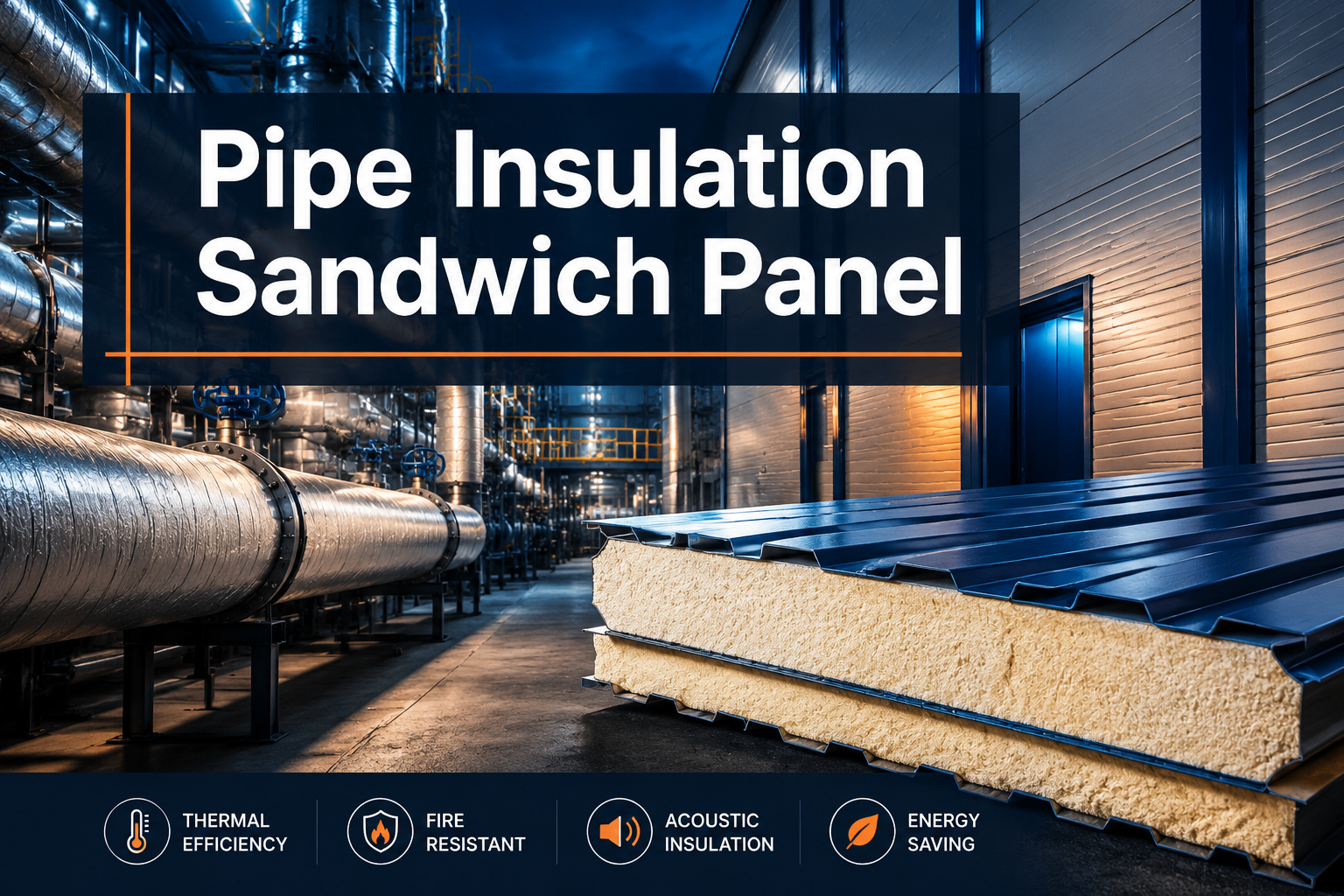
A pipe insulation sandwich panel is a prefabricated building panel with an insulating core (typically polyurethane, EPS, or mineral wool) bonded between two rigid face sheets, used to enclose, protect, and thermally isolate pipe systems in industrial, cold storage, and HVAC applications. These panels reduce heat transfer, prevent condensation on pipe runs, and speed up construction compared to traditional wrap-and-lag methods. They work best in environments where pipes carry fluids at temperatures significantly different from ambient conditions.
Key Takeaways 🔑
- Pipe insulation sandwich panels combine structural strength with high thermal resistance in a single prefabricated unit.
- Core materials (PU, EPS, rockwool) determine thermal performance, fire rating, and moisture resistance.
- Polyurethane (PU) cores offer the highest R-value per millimeter, making them ideal for cold rooms and chilled water pipe enclosures.
- Panel thickness directly controls heat loss — choosing the wrong thickness is the most common and costly mistake.
- These panels are suitable for cold storage facilities, pharmaceutical plants, food processing lines, and industrial HVAC duct/pipe enclosures.
- Installation is significantly faster than traditional pipe lagging because panels arrive pre-cut and pre-faced.
- Fire-rated cores (rockwool or PIR) are mandatory in many commercial and industrial building codes.
- Proper joint sealing between panels is critical — gaps cause condensation, mold, and energy loss.
- In Bangladesh and South Asia, PU-core sandwich panels dominate cold room pipe enclosure projects due to the humid climate.
- Always verify the panel's thermal conductivity (λ value) against your pipe operating temperature before specifying.
What Is a Pipe Insulation Sandwich Panel?
A pipe insulation sandwich panel is a three-layer composite panel designed to enclose pipe runs while providing continuous thermal insulation. The outer faces are typically pre-painted galvanized steel or aluminum, and the core is a rigid insulating foam or mineral wool bonded under pressure to both faces.
Unlike loose pipe lagging or foam tube insulation, sandwich panels create a sealed enclosure around entire pipe corridors or mechanical rooms. This means:
- No exposed pipe surfaces that collect condensation
- Structural rigidity that protects pipes from physical damage
- Clean, finished appearance suitable for food-grade or pharmaceutical environments
"A well-specified pipe insulation sandwich panel reduces both energy loss and maintenance costs over the building's lifetime — the upfront cost difference versus traditional lagging typically pays back within two to four years in cold storage applications."
How Does a Pipe Insulation Sandwich Panel Differ from Standard Wall Panels?
Standard sandwich panels are designed for walls, roofs, and ceilings. Pipe insulation sandwich panels serve the same thermal function but are specified and installed specifically around mechanical pipe runs, duct enclosures, and service corridors.
Key differences:
| Feature | Standard Wall Panel | Pipe Insulation Sandwich Panel |
|---|---|---|
| Primary function | Structural enclosure | Thermal pipe protection |
| Typical thickness | 50–150mm | 75–200mm |
| Core material | EPS, PU, rockwool | PU or PIR preferred |
| Face sheet | Steel/aluminum | Steel, aluminum, or stainless |
| Joint treatment | Standard cam-lock | Vapor-sealed, airtight joints |
| Installation context | Walls, roofs | Pipe corridors, mechanical rooms |
The core principle is the same — an insulating layer sandwiched between rigid faces — but the specification priorities shift toward vapor control and higher thermal resistance when pipes are involved.
For a broader understanding of how core materials affect performance, see this guide on EPS vs PU Sandwich Panel: Which Is Right for You?
Which Core Material Is Best for Pipe Insulation Sandwich Panels?
PU (polyurethane) foam core is the top choice for most pipe insulation applications because it delivers the lowest thermal conductivity (λ ≈ 0.022–0.025 W/m·K) of any common sandwich panel core, meaning thinner panels achieve the same insulation as thicker EPS alternatives.
Core material comparison:
- Polyurethane (PU/PIR): Best thermal performance, good moisture resistance, suitable for temperatures from -40°C to +100°C. Preferred for cold rooms, chilled water pipe enclosures, and pharmaceutical facilities. Learn more about Polyurethane Sandwich Panel Benefits.
- EPS (Expanded Polystyrene): Lower cost, adequate for ambient-temperature pipe enclosures, but absorbs moisture over time and has higher λ values (≈ 0.035–0.040 W/m·K). Not recommended for cold pipe runs below 5°C.
- Rockwool/Mineral Wool: Fire-resistant (non-combustible), suitable for hot pipe runs and areas with strict fire codes. Higher λ value than PU but excellent fire performance. See the Rockwool Sandwich Panel Fire Safety Guide for fire rating details.
Choose PU if: pipes carry chilled water, refrigerant, or any fluid below 10°C.
Choose rockwool if: pipes carry steam, hot water above 80°C, or if fire regulations require non-combustible materials.
Choose EPS if: budget is the primary constraint and pipes operate near ambient temperature.
What Thickness Should a Pipe Insulation Sandwich Panel Be?
Panel thickness is determined by the temperature difference between the pipe contents and the surrounding environment, plus the acceptable heat gain or loss rate. There is no universal answer — thickness must be calculated for each application.
General guidance (estimates based on standard PU core at λ = 0.023 W/m·K):
- Cold room pipe enclosures (0°C to -25°C): 100–150mm PU core
- Chilled water pipe runs (5°C–15°C): 75–100mm PU core
- Ambient temperature pipe protection: 50mm EPS or PU
- Hot water/steam enclosures: 75–100mm rockwool
For a detailed breakdown of how to match thickness to application, the How to Choose Sandwich Panel Thickness Guide covers the calculation method step by step.
Common mistake: Specifying wall panel thickness for pipe enclosures without accounting for the additional vapor pressure in cold applications. Cold pipe enclosures need both higher R-value and vapor-sealed joints — thickness alone is not enough.
Where Are Pipe Insulation Sandwich Panels Used?
These panels appear in any facility where pipes must be thermally isolated and protected. The most common applications in 2026 include:
Industrial and commercial applications:
- Cold storage facilities: Enclosing refrigerant suction lines, evaporator pipe runs, and condensate drain lines. See the Cold Room Sandwich Panel Installation Guide for installation specifics.
- Food processing plants: Pipe corridors carrying chilled water or brine, where hygiene and insulation must both be maintained.
- Pharmaceutical manufacturing: Clean room pipe enclosures where surfaces must be smooth, non-porous, and easy to sanitize.
- HVAC mechanical rooms: Enclosing chilled water headers, air handling unit connections, and duct runs.
- Poultry and livestock facilities: Ventilation pipe enclosures where temperature control directly affects animal welfare and production. The Best Sandwich Panel for Poultry Farm Guide covers this use case in detail.
- Hospital operating theaters: Sterile pipe enclosures for medical gas and chilled water lines.
How Are Pipe Insulation Sandwich Panels Installed?
Installation follows a logical sequence. The panels are prefabricated off-site and assembled around the pipe run on-site. Here is the standard process:
Step-by-step installation:
- Survey and measure the pipe run, noting diameter, bends, valves, and access points.
- Design the enclosure layout — panels are cut to create a rectangular or square enclosure around the pipe(s), with adequate clearance for maintenance access.
- Install support framework (steel or aluminum sub-frame) if the pipe run is overhead or requires structural support.
- Fix the base panel to the floor or support frame using appropriate fasteners.
- Erect side panels, engaging cam-lock or tongue-and-groove joints between panels.
- Seal all joints with compatible polyurethane sealant or vapor-barrier tape — this step is non-negotiable for cold applications.
- Install access doors or removable panels at valve locations and inspection points.
- Apply edge trim and corner pieces for a finished, weathertight result.
- Inspect for gaps using a thermal camera or smoke pencil before commissioning.
Critical edge case: At pipe penetrations through the panel face, use pre-formed foam collars or pipe boots to maintain the vapor seal. An unsealed pipe penetration will cause condensation inside the enclosure within weeks in a humid climate.
What Are the Key Benefits and Limitations of Pipe Insulation Sandwich Panels?
Benefits:
- ✅ Fast installation — prefabricated panels reduce on-site labor by 40–60% compared to traditional lagging (industry estimate based on contractor reports; actual savings vary by project complexity)
- ✅ Consistent thermal performance across the entire enclosure
- ✅ Clean, professional finish suitable for food-grade and pharmaceutical environments
- ✅ Durable steel faces resist mechanical damage, moisture, and pests
- ✅ Modular design allows future access and reconfiguration
- ✅ Available with fire-rated cores for code compliance
Limitations:
- ❌ Higher upfront material cost than foam tube lagging
- ❌ Requires accurate measurement and planning — errors in prefabrication are costly
- ❌ Access panels must be planned in advance; retrofitting access is difficult
- ❌ Heavy panels (especially thick rockwool types) require mechanical handling on large projects
- ❌ Not suitable for very small-diameter pipes where a simple foam sleeve is more practical
For a full picture of building insulation panels and their performance characteristics, the linked resource covers broader insulation panel types.
What Are the Most Common Mistakes When Specifying Pipe Insulation Sandwich Panels?
The biggest mistake is treating pipe insulation panels as identical to standard wall panels. They share the same construction but face different performance demands.
Top specification errors:
- Under-specifying thickness based on wall panel tables rather than pipe temperature differentials.
- Ignoring vapor diffusion — cold pipe enclosures need vapor-closed cores (PU/PIR), not open-cell materials.
- Skipping access panels at valves and unions, forcing destructive entry later.
- Using incompatible sealants that degrade at low temperatures or react with the panel face coating.
- Forgetting thermal bridges at steel sub-frame connections, which create condensation points.
- Selecting EPS core for below-ambient pipe runs because it's cheaper — EPS absorbs moisture and loses R-value over time in cold, humid conditions.
FAQ: Pipe Insulation Sandwich Panel
Q: Can pipe insulation sandwich panels be used outdoors?
Yes, provided the face sheets are pre-painted galvanized steel or aluminum rated for exterior exposure, and all joints are sealed with UV-stable sealant. Stainless steel faces offer the best outdoor durability.
Q: What is the typical lifespan of a pipe insulation sandwich panel enclosure?
A well-installed PU-core panel enclosure lasts 20–30 years in most industrial environments. Lifespan depends on face sheet quality, joint maintenance, and whether the core is ever exposed to water ingress.
Q: Are these panels suitable for steam pipe enclosures?
PU foam is not suitable for steam pipes above 100°C — it will degrade. Use rockwool or mineral wool core panels for steam pipe enclosures.
Q: How do I prevent condensation inside a cold pipe enclosure?
Use a vapor-closed core (PU or PIR), seal every joint with polyurethane sealant, and seal all pipe penetrations with foam collars. Condensation inside the enclosure almost always means a vapor leak.
Q: Can I cut pipe insulation sandwich panels on-site?
Yes, panels can be cut with a circular saw fitted with a fine-tooth blade. Always re-seal cut edges with compatible foam sealant to restore the vapor barrier.
Q: What face sheet material is best for food processing environments?
Stainless steel (304 or 316 grade) or food-grade coated steel faces are preferred in food processing. They resist cleaning chemicals and prevent bacterial harborage.
Q: Do pipe insulation sandwich panels require planning permission?
In most cases, enclosures around existing pipe runs within a building do not require planning permission. However, if the enclosure forms part of a fire compartment wall, fire-rated panels and building control approval are required.
Q: How do I choose between PU and PIR core for pipe insulation?
PIR (polyisocyanurate) offers slightly better fire performance than standard PU and is preferred where fire codes are strict. Thermal performance is similar. Choose PIR if your project requires a specific fire classification.
Q: What is the cost difference between sandwich panel pipe enclosures and traditional pipe lagging?
Sandwich panel enclosures typically cost more upfront per linear meter than foam tube lagging. However, they offer lower maintenance costs, longer service life, and faster installation on large pipe runs. The break-even point varies by project but is generally reached within two to five years in commercial applications.
Q: Are pipe insulation sandwich panels available in Bangladesh?
Yes. Several manufacturers in Dhaka supply PU and EPS sandwich panels suitable for pipe enclosure applications. See the Sandwich Panel Manufacturers in Dhaka Buyer's Guide for supplier information.
Conclusion: Actionable Next Steps
A pipe insulation sandwich panel is one of the most efficient ways to thermally protect pipe runs in cold storage, food processing, pharmaceutical, and industrial HVAC applications. The panel's layered construction delivers consistent insulation, structural protection, and a clean finish in a single prefabricated component.
To move forward effectively:
- Define your pipe operating temperature and the ambient conditions around it — this determines core type and thickness.
- Choose PU/PIR core for any pipe running below 10°C; choose rockwool for hot pipes or fire-critical zones.
- Plan access panels at every valve, union, and inspection point before fabrication begins.
- Specify vapor-sealed joints and pipe penetration collars as non-negotiable installation requirements.
- Get a thermal calculation from your supplier or engineer to confirm panel thickness before ordering.
- Request samples and verify the λ value and fire classification match your project specification.
For a complete overview of insulation panel options available in Bangladesh, the Insulated Sandwich Panel Bangladesh Complete Guide is a practical starting point for local procurement.
References
- ASHRAE Handbook — Fundamentals, Chapter 26: Heat, Air, and Moisture Control in Building Assemblies. American Society of Heating, Refrigerating and Air-Conditioning Engineers, 2021. https://www.ashrae.org
- EN 14509: Self-supporting double skin metal faced insulating panels — Factory made products — Specifications. European Committee for Standardization, 2013. https://www.cen.eu
- CIBSE Guide C: Reference Data, Section 3: Thermal Properties of Building Structures. Chartered Institution of Building Services Engineers, 2007. https://www.cibse.org
- NIBS (National Institute of Building Sciences): Whole Building Design Guide — Mechanical Insulation. 2020. https://www.wbdg.org/resources/mechanical-insulation