Last updated: May 20, 2026
Quick Answer
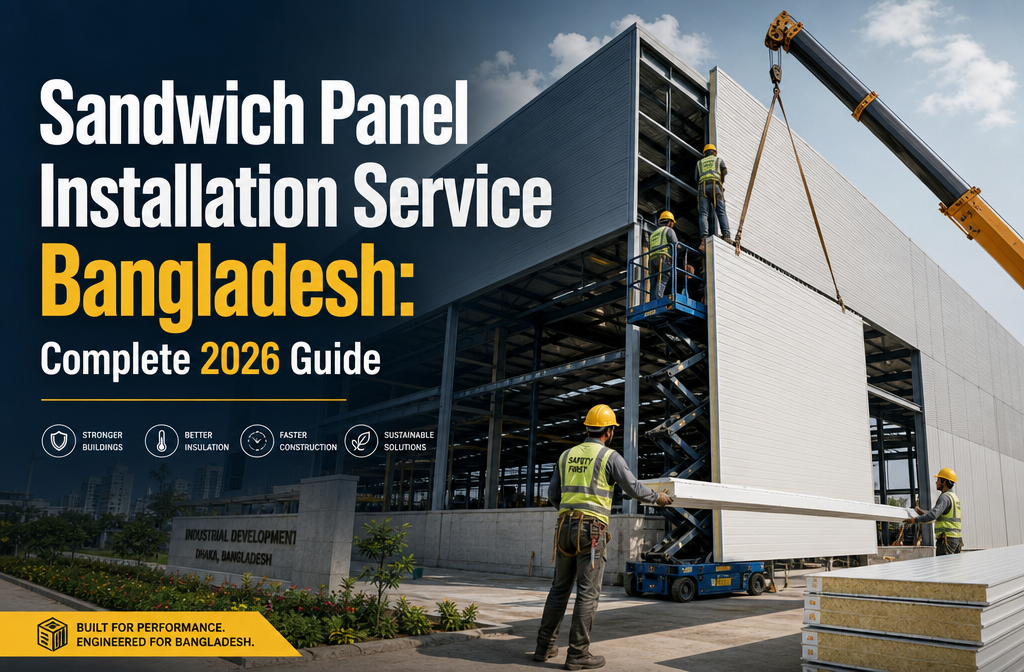
Sandwich panel installation service in Bangladesh covers supply, fabrication, and on-site fitting of insulated composite panels for industrial, commercial, and specialized buildings. Costs typically range from BDT 180 to BDT 650+ per square foot depending on panel type, thickness, and project complexity. Reputable contractors in Dhaka, Chittagong, and Gazipur can complete small-to-medium projects in 7 to 30 days.
Key Takeaways
- 🏗️ Sandwich panels are the dominant choice for factory, warehouse, cold room, and clean room construction in Bangladesh due to speed and thermal performance.
- 💰 Installation costs vary widely — EPS panels are the most affordable; rockwool and PIR panels cost more but offer better fire resistance and insulation.
- 🌡️ Bangladesh's tropical climate (high humidity, heavy monsoon rain, heat) makes proper panel selection and sealing critical for long-term performance.
- ⏱️ Typical project timelines range from 1 week for small partitions to 8+ weeks for large industrial facilities.
- ✅ Certified contractors should comply with Bangladesh National Building Code (BNBC) and ideally hold ISO quality certifications.
- 🏭 Key industries using sandwich panels include garments/RMG, pharmaceuticals, food processing, poultry farming, and cold storage.
- ⚠️ The most common installation mistakes are inadequate substructure preparation, poor joint sealing, and wrong panel thickness for the application.
- 🔧 Maintenance is low but not zero — annual joint inspections and surface cleaning extend panel life to 25–35 years.
- 🏠 Residential use is possible but less common; it suits prefab homes, server rooms, and home cold storage more than standard housing.
- 📋 Always verify contractor credentials, project portfolio, and warranty terms before signing any contract.
What Is Sandwich Panel Installation and Why Does It Matter in Bangladesh?
Sandwich panel installation is the process of mounting factory-made composite panels — each consisting of two metal face sheets bonded to an insulating core — onto a steel or concrete structural frame. In Bangladesh, demand for this service has grown sharply alongside the expansion of the RMG (ready-made garment) sector, pharmaceutical manufacturing, and modern cold chain logistics.
Traditional brick-and-mortar construction takes months and struggles to meet the precise temperature, hygiene, and fire-resistance requirements of modern industrial facilities. Sandwich panels solve this by combining structure, insulation, and cladding in one pre-engineered component, cutting build time by 40–60% compared to conventional methods (estimate based on typical contractor-reported project comparisons).
For anyone evaluating a sandwich panel installation service in Bangladesh, understanding the full scope — materials, costs, contractor qualifications, and climate suitability — is essential before committing to a project.
How Much Does Sandwich Panel Installation Cost in Bangladesh?
Installation cost in Bangladesh depends on panel type, core material, thickness, project size, and site accessibility. The table below shows typical 2026 price ranges:
| Panel Core Type | Typical Thickness | Approx. Cost (BDT/sq ft, supply + install) |
|---|---|---|
| EPS (Expanded Polystyrene) | 50–150 mm | BDT 180–320 |
| PIR (Polyisocyanurate) | 50–100 mm | BDT 280–450 |
| Rockwool (Mineral Wool) | 50–150 mm | BDT 320–550 |
| PUF (Polyurethane Foam) | 50–120 mm | BDT 260–420 |
| Special fire-rated / clean room | 75–200 mm | BDT 450–650+ |
Note: Prices are market estimates for 2026 and exclude VAT, structural steelwork, and civil works. Actual quotes will vary by contractor and location.
For a detailed breakdown, see the Sandwich Panel Installation Cost Bangladesh 2026 Guide and the Sandwich Panel Price Per Square Meter Bangladesh 2026 reference.
Key cost drivers:
- Roof panels cost more to install than wall panels due to access and safety requirements.
- Projects in Dhaka and Chittagong city centers may carry 10–20% surcharges for logistics.
- Larger projects (5,000+ sq ft) typically attract volume discounts of 8–15%.
What Materials Are Used in Sandwich Panel Installation?
A sandwich panel has three core components: two steel (or aluminum) face sheets and an insulating core. The face sheets are typically galvanized steel (PPGI or PPGL) with a polyester or PVDF coating for corrosion resistance.
Common core materials used in Bangladesh:
- EPS (Expanded Polystyrene): Lightweight, low cost, good thermal insulation. Most widely used for general industrial buildings. See the EPS Sandwich Panel Bangladesh guide for specifications.
- Rockwool (Mineral Wool): Fire-resistant, excellent acoustic performance. Preferred for pharmaceutical plants and buildings requiring fire ratings. Explore the Rockwool Sandwich Panel Bangladesh guide for more detail.
- PIR/PUF (Polyurethane/Polyisocyanurate): Superior thermal efficiency at lower thickness. Ideal for cold rooms and refrigerated warehouses.
- Accessories: Self-drilling screws, EPDM gaskets, aluminum flashings, ridge caps, and sealant tapes are all part of a complete installation.
Choosing the wrong core for the application is one of the most expensive mistakes a buyer can make. For example, using EPS in a cold room instead of PIR leads to inadequate insulation and higher energy costs.
Can Sandwich Panels Handle Bangladesh's Tropical Climate Conditions?
Yes — when correctly specified and installed, sandwich panels perform well in Bangladesh's climate. The key challenges are high humidity (annual average above 70%), monsoon-driven rain and wind loads, and sustained heat (temperatures regularly exceeding 35°C).
How to ensure climate resilience:
- Use PPGI or PPGL steel sheets with a minimum 275 g/m² zinc coating for corrosion resistance in humid conditions.
- Select PIR or rockwool cores for roofing in areas with direct sun exposure; these resist thermal bridging better than EPS under sustained heat.
- Seal all joints with EPDM gaskets and polyurethane sealant to prevent moisture ingress during monsoon. Unsealed joints are the leading cause of panel failure in Bangladesh.
- Ensure adequate roof pitch (minimum 5°) to allow rainwater runoff. Flat or near-flat roofs accumulate water and accelerate corrosion at panel joints.
- Apply UV-resistant coatings on exterior faces if the building is in a coastal or high-humidity zone (Chittagong, Cox's Bazar, Khulna).
For thermal insulation performance in Bangladesh's climate, the Thermal Insulation Sandwich Panel Bangladesh Guide covers panel selection by climate zone in detail.
Pros and Cons of Sandwich Panel Installation for Industrial Buildings
Pros:
- ✅ Fast construction — panels arrive pre-fabricated and can be installed in days, not months.
- ✅ Built-in insulation reduces HVAC energy consumption significantly.
- ✅ Clean, hygienic interior surfaces suit pharmaceutical, food, and clean room environments.
- ✅ Lightweight — reduces structural load and foundation costs.
- ✅ Modular and reconfigurable — panels can be removed and relocated if needed.
- ✅ Long service life (25–35 years with proper maintenance).
Cons:
- ❌ Higher upfront material cost than brick for basic structures.
- ❌ Requires skilled installation — poor workmanship causes leaks, thermal bridging, and structural issues.
- ❌ Fire performance varies by core type — EPS panels are not suitable where fire ratings are required.
- ❌ Susceptible to denting from impact; not ideal for areas with heavy forklift or machinery contact at wall level.
- ❌ Resale/salvage value is lower than brick construction in the local market.
Choose sandwich panels if: your project requires fast completion, controlled temperature, hygiene compliance, or modular flexibility. Stick with traditional construction if the building is a permanent multi-story structure with no special environmental requirements.
Which Industries Typically Use Sandwich Panel Construction in Bangladesh?
Sandwich panel construction is used across multiple sectors in Bangladesh, with industrial applications dominating. The following industries account for the majority of demand:
- Garment and textile factories (RMG): Pre-engineered factory buildings with sandwich panel walls and roofs are standard for new RMG facilities in EPZs and industrial parks.
- Pharmaceuticals: Clean rooms and sterile manufacturing areas require smooth, non-porous panel surfaces. See the Clean Room Sandwich Panel Bangladesh guide for compliance requirements.
- Cold storage and food processing: PIR and PUF panels are essential for maintaining refrigerated environments. The Cold Room Sandwich Panel Installation Guide covers this application thoroughly.
- Poultry and livestock farming: Controlled-environment poultry houses use EPS or PUF panels for temperature and biosecurity management.
- Hospitals and healthcare: OT rooms and ICUs use fire-rated, antimicrobial panels.
- Warehousing and logistics: Large distribution centers in Dhaka, Narayanganj, and Chittagong increasingly use sandwich panel construction for speed and insulation. See Sandwich Panel for Warehouse Bangladesh.
Are Sandwich Panels Good for Factory and Warehouse Construction?
Sandwich panels are among the best available solutions for factory and warehouse construction in Bangladesh. They allow large clear-span structures to be enclosed quickly, and the insulated panels keep interior temperatures manageable — critical for worker productivity and product quality in Bangladesh's heat.
For factories, rockwool panels are preferred where fire safety compliance is required under BNBC. For warehouses storing temperature-sensitive goods, PIR panels offer the best energy efficiency. The Sandwich Panel for Factory Building guide covers structural and compliance considerations in detail.
Difference Between Sandwich Panels and Traditional Building Materials
| Factor | Sandwich Panels | Brick/Concrete |
|---|---|---|
| Construction speed | 3–8 weeks (typical) | 6–18 months |
| Thermal insulation | Excellent (built-in) | Poor (requires separate insulation) |
| Weight | 10–15 kg/m² | 200–400 kg/m² |
| Fire resistance | Varies by core type | Generally good |
| Maintenance | Low (annual inspection) | Moderate (painting, waterproofing) |
| Relocatability | Yes (modular) | No |
| Initial cost | Moderate to high | Low to moderate |
| Lifespan | 25–35 years | 40–60+ years |
The key trade-off: sandwich panels win on speed, insulation, and flexibility; brick/concrete wins on longevity and fire resistance for multi-story structures.
What Certifications Should a Sandwich Panel Installation Service Have?
A credible sandwich panel installation service in Bangladesh should hold or comply with the following:
- BNBC (Bangladesh National Building Code) compliance: All structural and fire safety aspects of the installation must meet BNBC standards. Ask contractors to confirm this in writing.
- ISO 9001 (Quality Management): Indicates the contractor has documented quality processes.
- ISO 45001 (Occupational Health & Safety): Relevant for on-site safety during installation.
- Fire rating certification for panels: Panels used in pharmaceutical, food, or public buildings should carry BS 476 or EN 13501 fire test certificates from the manufacturer.
- RAJUK or relevant local authority approvals: For projects in Dhaka, contractor registration and building plan approval from RAJUK (Rajdhani Unnayan Kartripakkha) may be required.
Common mistake: Many buyers accept a contractor's verbal claim of compliance without requesting documentation. Always ask for copies of certifications and check panel test reports from the manufacturer.
Common Mistakes to Avoid During Sandwich Panel Installation
Even experienced project managers make errors that lead to leaks, thermal failures, or structural problems. The most frequent mistakes in Bangladesh projects include:
- Skipping substructure alignment checks — Panels installed on an uneven steel frame create gaps at joints, leading to water ingress.
- Using incorrect panel thickness — Undersizing for cold rooms or oversizing for simple wall partitions wastes money or causes performance failures. Use the guide to choosing sandwich panel thickness as a reference.
- Inadequate joint sealing — Sealant tape and EPDM gaskets must be applied at every longitudinal and transverse joint. Skipping this step is the single most common cause of roof leaks.
- Wrong fastener specification — Using standard screws instead of self-drilling, corrosion-resistant fasteners causes rust streaks and panel loosening within 2–3 monsoon seasons.
- No thermal break at steel connections — Steel purlins and columns that contact panel faces without a thermal break create condensation points inside the building.
- Ignoring panel storage on site — Panels stored flat on muddy ground or in direct sun before installation can warp or delaminate.
How Long Does a Typical Sandwich Panel Installation Take?
Project duration depends on scope, panel type, and site conditions. As a general guide:
- Small partitions or single rooms (up to 500 sq ft): 3–7 days
- Medium factory or warehouse section (500–5,000 sq ft): 2–4 weeks
- Large industrial facility (5,000–50,000 sq ft): 6–12 weeks
- Cold room or clean room (specialized fit-out): Add 1–3 weeks for sealing, testing, and commissioning
Delays are most common during monsoon season (June–September) when wet conditions slow steel erection and panel handling. Experienced contractors factor this into project schedules.
Is Sandwich Panel Installation Suitable for Residential Projects in Bangladesh?
Sandwich panels can work for residential applications, but they're not a mainstream choice for standard housing in Bangladesh. The economics and aesthetics of brick construction still dominate the residential market.
Where residential sandwich panel use makes sense:
- Prefabricated or temporary housing in remote or disaster-affected areas
- Home cold storage rooms or wine cellars
- Rooftop server rooms or home offices requiring climate control
- Guest houses or staff quarters on industrial campuses
Where it doesn't make sense: Standard urban apartments or multi-story residential buildings, where structural requirements, local aesthetics, and resale expectations favor reinforced concrete construction.
Maintenance Requirements for Sandwich Panel Buildings
Sandwich panel buildings require relatively little maintenance compared to brick structures, but annual checks are essential to protect the investment.
Annual maintenance checklist:
- Inspect all roof and wall joints for sealant cracking or separation; re-seal as needed.
- Check fasteners for corrosion or loosening; replace any compromised fixings.
- Clear debris from roof gutters and panel overlaps to prevent water pooling.
- Wash exterior panel surfaces with mild detergent to remove industrial dust, mold, or algae (common in Bangladesh's humid climate).
- Inspect cut edges and flashings for rust; apply touch-up paint or zinc primer where needed.
For a complete maintenance protocol, the Maintenance of Sandwich Panels guide provides a step-by-step annual schedule.
With proper maintenance, panels from reputable manufacturers last 25–35 years in Bangladesh's climate.
How to Find the Best Sandwich Panel Contractors Near You in Bangladesh
The best sandwich panel installation service in Bangladesh combines manufacturing capability, installation experience, and post-installation support. Here's how to evaluate contractors:
Step 1: Request a portfolio of completed projects in your industry (pharma, food, garments, cold storage). Ask for site visit access if possible.
Step 2: Verify that the contractor sources panels from a certified manufacturer. Buying from a reputable sandwich panel manufacturer in Bangladesh ensures consistent panel quality and available test certificates.
Step 3: Compare at least three quotations. The lowest price often reflects thinner panels, cheaper coatings, or fewer accessories (flashings, gaskets, fasteners).
Step 4: Confirm the warranty — reputable contractors offer 5–10 years on workmanship and pass through the manufacturer's panel warranty (typically 10–15 years on coatings).
Step 5: Check references from past clients, specifically asking about leak history, on-time delivery, and after-sales responsiveness.
Major contractor hubs are in Dhaka (Gazipur, Savar, Narayanganj), Chittagong, and Comilla EPZ. For supplier options, the Sandwich Panel Suppliers in Bangladesh guide lists verified suppliers with contact details.
FAQ
Q: What is the minimum order size for sandwich panel installation in Bangladesh?
Most contractors accept projects from 200 sq ft upward, though small projects may carry a minimum mobilization charge. Larger projects get better per-unit pricing.
Q: Do sandwich panels require a building permit in Bangladesh?
Yes. Any permanent structure requires plan approval from the relevant authority (RAJUK in Dhaka, CDA in Chittagong). Your contractor should assist with documentation.
Q: Which panel type is best for a garment factory in Bangladesh?
EPS panels with PPGI face sheets are the most common choice for RMG factories — they balance cost, thermal performance, and speed. Rockwool panels are required where fire ratings are mandated.
Q: Can sandwich panels be installed on an existing building?
Yes. Sandwich panels can be fitted as cladding or internal partitions on existing structures, provided the existing frame can carry the additional load. A structural assessment is recommended.
Q: How do sandwich panels perform during cyclones or high winds?
Panels designed to EN 14509 standards can withstand significant wind loads. In cyclone-prone coastal areas (Chittagong, Khulna, Barishal), specify panels with higher-gauge steel faces and ensure all fixing points are engineered for the local wind zone.
Q: What is the fire rating of sandwich panels available in Bangladesh?
EPS panels are generally not fire-rated. Rockwool panels can achieve Class A1 (non-combustible) ratings. PIR panels typically achieve Class B or C under European standards. Always request the fire test certificate from the manufacturer.
Q: Are there local manufacturers of sandwich panels in Bangladesh?
Yes. Several manufacturers operate in Dhaka and Chittagong, producing EPS, PUF, and rockwool panels. Sourcing locally reduces lead times and logistics costs compared to importing.
Q: How thick should a sandwich panel be for a cold room in Bangladesh?
For standard refrigeration (0–5°C), 100 mm PIR panels are typically sufficient. For freezer rooms (-18°C or below), 150–200 mm PIR panels are recommended to maintain energy efficiency.
Q: Can sandwich panels be painted or customized in color?
Yes. PPGI face sheets are available in a wide range of RAL colors. Custom colors may require a minimum order quantity from the manufacturer.
Q: What happens if a panel gets damaged? Can it be repaired?
Minor dents and scratches can be repaired with touch-up paint and sealant. Severely damaged panels can be individually replaced without dismantling the entire structure — a major advantage over brick construction.
Conclusion
Sandwich panel installation service in Bangladesh has become the go-to solution for industrial, commercial, and specialized construction — and for good reason. The combination of fast installation, built-in insulation, and adaptability to Bangladesh's tropical climate makes these panels a practical choice for factories, cold rooms, clean rooms, warehouses, and more.
Actionable next steps:
- Define your project requirements — panel type, thickness, fire rating, and hygiene standards before approaching any contractor.
- Get at least three quotes that itemize panels, accessories, labor, and warranty terms separately.
- Verify contractor credentials — ask for BNBC compliance confirmation, past project references, and manufacturer panel certificates.
- Plan around the monsoon season — schedule structural steel work and panel installation outside June–September if possible.
- Budget for maintenance — set aside a small annual amount for joint inspections and sealant replacement to protect your investment over the long term.
For a full buying framework, the Sandwich Panel Buying Guide Bangladesh 2026 is the recommended next read.
References
- Bangladesh National Building Code (BNBC) — Housing and Building Research Institute, 2020. https://bnbc.gov.bd
- EN 14509:2013 — Self-supporting double skin metal faced insulating panels. European Committee for Standardization, 2013.
- BS 476 — Fire tests on building materials and structures. British Standards Institution (various parts).
- EN 13501-1 — Fire classification of construction products and building elements. European Committee for Standardization, 2018.