Last updated: May 20, 2026
Quick Answer
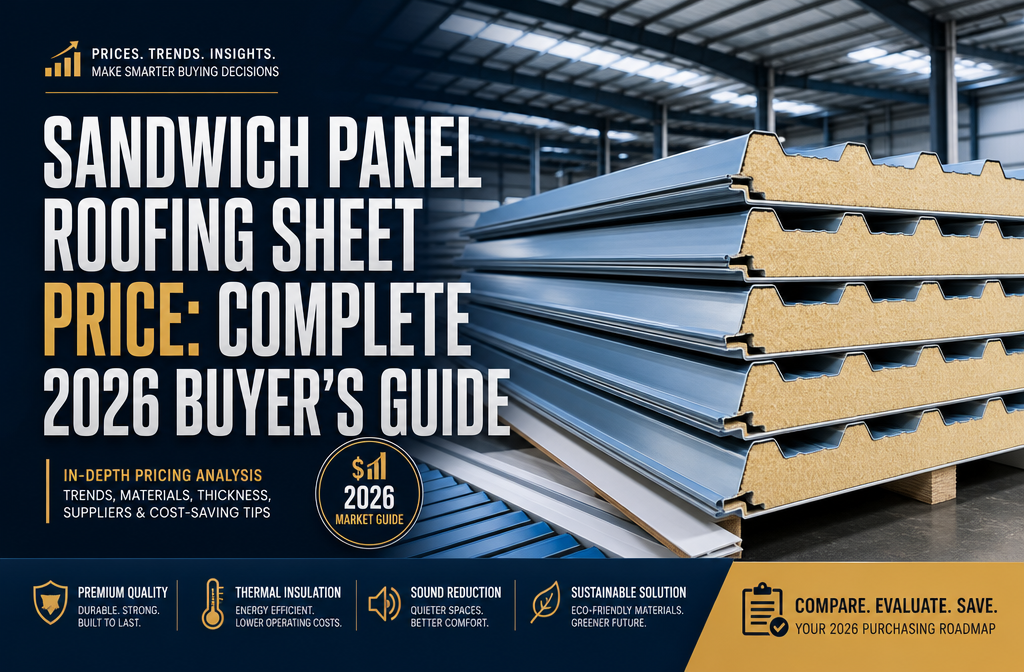
Sandwich panel roofing sheet price typically ranges from $8 to $35 per square meter depending on core material (EPS, PU, or rockwool), panel thickness, steel gauge, and supplier location. Budget projects use EPS-core panels at the lower end; cold storage or fire-rated industrial roofs use PU or rockwool panels at the higher end. Installation labor adds roughly 20–40% on top of material costs.
Key Takeaways 🏗️
- EPS sandwich panels are the most affordable roofing option, typically $8–$15/m²; PU panels run $14–$25/m²; rockwool panels cost $18–$35/m²
- Panel thickness for industrial roofs is usually 50mm to 100mm, with 75mm being the most common starting point
- Total installed cost (materials + labor) for a warehouse roof can be 30–50% lower than conventional concrete or brick construction
- Cheap panels often use thin steel facings (below 0.4mm) and low-density cores — both reduce lifespan significantly
- Standard sandwich panels last 20–30 years with proper maintenance; poor-quality panels may fail within 5–8 years
- EPS panels offer R-values around R-3.8 to R-4.4 per inch; PU panels deliver R-6 to R-7 per inch — a meaningful difference in hot or cold climates
- Always calculate total roof area + 10–15% waste factor before ordering
- Reliable brands publish certified steel thickness and core density specs — always ask for documentation
How Much Do Sandwich Panel Roofing Sheets Cost Per Square Meter?
Sandwich panel roofing sheet price varies primarily by core material, thickness, and steel facing quality. As a general estimate for 2026 market conditions:
| Core Type | Thickness | Estimated Price (per m²) | Best For |
|---|---|---|---|
| EPS (Expanded Polystyrene) | 50mm | $8–$12 | Light commercial, poultry farms |
| EPS | 75–100mm | $11–$15 | Warehouses, sheds |
| PU (Polyurethane) | 50mm | $14–$18 | Cold storage, food processing |
| PU | 75–100mm | $18–$25 | Industrial, high-insulation needs |
| Rockwool (Mineral Wool) | 50–100mm | $18–$35 | Fire-rated, high-temp environments |
Note: These are estimated market ranges based on regional supplier data as of 2026. Prices vary by country, order volume, and steel coil costs. Always get at least three quotes before committing.
Key price drivers:
- Steel facing thickness: 0.4mm vs. 0.5mm vs. 0.6mm steel makes a noticeable cost difference
- Core density: Higher-density EPS (18–20 kg/m³) costs more than low-density (12 kg/m³) but performs better
- Panel length: Custom lengths cost more than standard 6m or 12m cuts
- Surface coating: PVDF or polyester coatings add cost but extend lifespan in humid or coastal areas
For a detailed breakdown by region, see the Sandwich Panel Price Per Square Meter Bangladesh 2026 guide.
What Are the Different Types of Sandwich Panel Roofing Sheets?
Three core materials dominate the roofing sandwich panel market. Each suits different budgets and performance requirements.
1. EPS (Expanded Polystyrene) Panels
The most widely used and most affordable option. EPS panels work well for general warehouses, agricultural buildings, and light industrial sheds. They're not fire-resistant and absorb moisture over time if facings are damaged.
2. PU (Polyurethane) Panels
Higher insulation value per millimeter than EPS. PU panels are the go-to choice for cold rooms, food processing facilities, and any building where energy efficiency is a priority. They cost more upfront but reduce long-term HVAC costs. Read more in the EPS vs PU Sandwich Panel comparison guide.
3. Rockwool (Mineral Wool) Panels
The premium option for fire safety and acoustic performance. Rockwool panels are non-combustible and meet fire resistance standards required for pharmaceutical plants, hospitals, and high-risk industrial facilities. See the Rockwool Sandwich Panel Fire Safety guide for full details.
Choose EPS if: budget is the top priority and fire rating isn't required.
Choose PU if: insulation performance matters more than upfront cost.
Choose Rockwool if: fire resistance or acoustic insulation is a project requirement.
Are Metal Sandwich Panels Cheaper Than Other Roofing Materials?
Yes, in most cases. Metal sandwich panels offer a lower total installed cost compared to reinforced concrete slabs, clay tiles, or built-up roofing systems — especially for large-span industrial buildings.
Rough cost comparison (installed, per m²):
- Sandwich panel roofing: $12–$45
- Reinforced concrete roof slab: $40–$80+
- Clay/concrete tiles on timber frame: $25–$60
- Standing seam metal roofing (no insulation): $20–$50
The real advantage of sandwich panels isn't just material cost — it's speed of installation. A sandwich panel roof can be installed 3–5x faster than a concrete roof, which cuts labor costs and reduces project timelines significantly.
Where sandwich panels are NOT cheaper:
- Very small residential projects (under 50m²) where setup costs dominate
- Highly customized curved roof designs
- Areas with extreme wind loads requiring heavy structural reinforcement
What Thickness of Sandwich Panel Is Best for Industrial Buildings?
For most industrial buildings, 75mm to 100mm is the recommended roofing panel thickness. This range balances structural performance, thermal insulation, and cost.
- 50mm panels: Suitable for mild climates with low insulation demands; not recommended for warehouses storing temperature-sensitive goods
- 75mm panels: The most common choice for general-purpose industrial roofs; good thermal performance at a reasonable price
- 100mm panels: Best for cold storage facilities, food processing plants, or buildings in extreme climates
- 150mm+ panels: Specialized cold rooms and freezer storage; higher cost but necessary for maintaining sub-zero temperatures
For a full breakdown of thickness selection criteria, see the How Thick Sandwich Panel for Roof: 2026 Guide.
Common mistake: Choosing 50mm panels to save money on an industrial roof, then spending more on HVAC to compensate for poor insulation. The lifecycle math rarely works in favor of under-insulating.
How Do I Calculate the Total Cost for My Warehouse Roof?
Calculating the total sandwich panel roofing sheet price for a warehouse involves four steps:
Step 1: Measure total roof area
Length × width of the roof surface (not the floor plan — account for slope). A 1,000m² floor plan with a 15° pitch roof adds roughly 3–4% to the surface area.
Step 2: Add a waste factor
Add 10–15% to the measured area to account for cuts, overlaps, and waste.
Step 3: Multiply by panel price per m²
Use the table above to estimate material cost based on core type and thickness.
Step 4: Add installation and ancillary costs
- Labor: typically 20–40% of material cost
- Fasteners, flashings, ridge caps, gutters: budget an additional 8–12% of material cost
- Transport/delivery: varies by distance and order size
Example calculation (1,000m² warehouse, EPS 75mm panels at $13/m²):
- Panel material: 1,000m² × 1.12 (waste) × $13 = $14,560
- Labor (30%): $4,368
- Accessories (10%): $1,456
- Estimated total: ~$20,384
For region-specific pricing, the Sandwich Panel Installation Cost Bangladesh 2026 Guide provides detailed local benchmarks.
What Problems Can Happen with Cheap Sandwich Panel Roofing?
Cheap sandwich panels create predictable, expensive problems. The most common issues stem from substandard steel facings and low-density cores.
Problems to expect from low-quality panels:
- Delamination: The steel facing separates from the core, usually within 3–7 years in humid climates
- Corrosion at cut edges: Thin or poorly coated steel rusts quickly, especially at panel joints and fastener points
- Thermal bridging: Low-density cores develop cold/hot spots that reduce energy efficiency and cause condensation
- Sagging: Panels with inadequate core density sag between purlins over time, creating drainage problems
- Fire risk: Cheap EPS cores without flame retardant additives can accelerate fire spread
How to spot low-quality panels before buying:
- Ask for the steel facing thickness certificate (reject anything below 0.4mm for roofing)
- Request core density documentation (EPS below 15 kg/m³ is a red flag)
- Check for third-party test certifications, not just manufacturer claims
- Avoid suppliers who cannot provide a written product warranty of at least 10 years
Which Sandwich Panel Brands Are Most Reliable in Construction?
Globally recognized manufacturers include Kingspan (Ireland), Metecno (Italy), ArcelorMittal (Luxembourg), and Isopan (Italy). In South and Southeast Asia, regional manufacturers often supply comparable quality at lower prices, but due diligence is essential.
What makes a brand reliable:
- Published and independently verified steel thickness and core density specs
- ISO 9001 quality management certification
- Traceable raw material sourcing (steel coils from certified mills)
- Documented fire and thermal performance test results
- Active after-sales support and warranty fulfillment record
For buyers in Bangladesh and the surrounding region, the Sandwich Panel Manufacturer in Bangladesh page lists certified local suppliers with verifiable specifications.
Are Sandwich Panels Good for Hot or Cold Climate Regions?
Yes — but the right core material matters. Sandwich panels perform well in both hot and cold climates when specified correctly.
Hot climates (tropical, desert):
- PU panels with reflective steel facings (light-colored PVDF coating) reduce solar heat gain significantly
- 75mm PU panels can reduce cooling loads by an estimated 30–40% compared to uninsulated metal roofing (based on manufacturer thermal modeling data)
- Ventilated ridge details prevent heat buildup at the apex
Cold climates (temperate, sub-zero):
- 100mm+ PU or rockwool panels maintain interior temperatures efficiently
- Vapor barriers and proper joint sealing are critical to prevent condensation inside the panel
- EPS panels are less suitable for freezer or cold room applications due to lower R-value per mm
For energy efficiency guidance specific to tropical climates, see the Energy Efficient Sandwich Panel Bangladesh: 2026 Guide.
What Installation Mistakes Should I Avoid with Roof Panels?
Installation errors are the leading cause of premature sandwich panel failure. These mistakes are common and avoidable.
Top installation mistakes:
- Incorrect purlin spacing: Exceeding the manufacturer's recommended span causes panel deflection and joint stress
- Over-tightening fasteners: Compresses the panel facing and creates leak points; use torque-controlled tools
- Cutting without sealing cut edges: Exposed steel at cut edges corrodes rapidly; always apply edge sealant
- Ignoring thermal expansion: Panels expand and contract; fixed-point fastening without expansion allowance causes buckling
- Improper overlap direction: Installing panels with overlaps running against the prevailing wind direction causes water ingress
- Skipping vapor barriers in cold climates: Condensation inside the panel structure accelerates delamination
For a full step-by-step process, the Sandwich Panel Roof Installation Guide: Step-by-Step 2026 covers each phase in detail.
Do Sandwich Panels Work for Residential or Just Commercial Roofing?
Sandwich panels work for both, but they're most cost-effective for mid-to-large commercial and industrial projects. Residential use is growing but comes with trade-offs.
Residential applications where sandwich panels work well:
- Prefabricated homes and modular housing
- Garages, home workshops, and outbuildings
- Rooftop extensions and additions
- Rural or agricultural homesteads
Limitations for residential use:
- Aesthetic options are more limited than clay tiles or asphalt shingles
- Some building codes in urban areas restrict visible metal roofing profiles
- Resale value perception varies by market
For smaller residential structures, EPS panels at 50–75mm offer a practical, affordable solution. For premium residential builds, PU panels with high-quality PVDF-coated steel facings provide a cleaner finish and better insulation.
How Long Do Sandwich Panel Roofing Sheets Typically Last?
A well-specified, properly installed sandwich panel roof lasts 20–30 years. Some installations with premium coatings and regular maintenance exceed 35 years.
Factors that shorten lifespan:
- Steel facing below 0.4mm gauge
- Coastal or high-humidity environments without marine-grade coatings
- Neglected maintenance (blocked gutters, unrepaired fastener points)
- Chemical exposure (fertilizer dust, industrial fumes) without resistant coatings
Factors that extend lifespan:
- PVDF or HDP coatings on steel facings (rated for 25+ years by major coating manufacturers)
- Annual inspection and fastener re-torquing
- Prompt repair of any surface scratches or coating damage
For maintenance schedules and inspection checklists, see the Maintenance of Sandwich Panels: Complete 2026 Guide.
What Insulation R-Value Can I Expect from Standard Sandwich Panels?
The R-value of a sandwich panel depends on core material and thickness. PU panels deliver significantly better thermal resistance per millimeter than EPS.
| Core | Thickness | Approximate R-Value (m²·K/W) |
|---|---|---|
| EPS | 50mm | ~1.25 |
| EPS | 100mm | ~2.50 |
| PU | 50mm | ~2.50 |
| PU | 100mm | ~5.00 |
| Rockwool | 100mm | ~2.70 |
Note: R-values above are approximate and based on typical core densities. Actual performance depends on manufacturer specifications and installation quality. Always request certified thermal conductivity (λ) values from your supplier.
A 100mm PU panel delivers roughly twice the insulation of a 100mm EPS panel at the same thickness — which is why PU commands a higher sandwich panel roofing sheet price but often pays back through reduced energy costs within 3–7 years in climate-controlled buildings.
FAQ: Sandwich Panel Roofing Sheet Price
Q: What is the minimum order quantity for sandwich panel roofing sheets?
Most manufacturers set minimums at 100–200m² for standard panels. Custom sizes or colors typically require 500m² minimum. Smaller orders are possible through distributors at a price premium.
Q: Can sandwich panel prices be negotiated?
Yes. Orders above 500m² typically qualify for 5–15% volume discounts. Bundling roofing and wall panels in one order also improves pricing leverage.
Q: Is there a price difference between profiled and flat-face roofing panels?
Profiled (trapezoidal or sinusoidal) panels cost roughly the same as flat panels of equivalent specification. Profile choice affects structural span capability and drainage, not primarily price.
Q: How does steel coil price affect sandwich panel roofing sheet price?
Steel accounts for 40–60% of a panel's material cost. When global steel prices rise (as they did sharply in 2021–2022), panel prices follow within 1–3 months. Locking in prices with a supply contract during stable periods is advisable for large projects.
Q: Are fire-rated sandwich panels significantly more expensive?
Rockwool-core fire-rated panels typically cost 40–80% more than equivalent EPS panels. For buildings where fire rating is a code requirement, this cost is non-negotiable.
Q: What warranty should I expect on sandwich panel roofing sheets?
Reputable manufacturers offer 10–15 years on steel coating and 5–10 years on panel integrity. Warranties below 5 years are a quality warning sign.
Q: Do sandwich panels require a structural steel frame?
Yes. Sandwich panel roofing sheets are cladding elements, not structural. They require a supporting purlin-and-rafter steel frame. Frame cost adds significantly to total project budget.
Q: Can damaged sandwich panels be repaired rather than replaced?
Minor surface damage (scratches, small dents) can be repaired with touch-up coatings. Delaminated or structurally compromised panels must be replaced. See the Maintenance of Sandwich Panels guide for repair criteria.
Q: Are sandwich panels suitable for curved roofs?
Standard flat sandwich panels are not suitable for tight curves. Curved applications require specially manufactured curved panels or standing seam systems, which cost significantly more.
Q: How do I compare quotes from different suppliers?
Compare on: steel facing thickness (mm), core density (kg/m³), core material, coating type, panel length tolerance, and warranty terms — not just price per m². Two quotes at the same price per m² can represent very different quality levels.
Conclusion: Making the Right Decision on Sandwich Panel Roofing Sheet Price
Getting sandwich panel roofing sheet price right isn't just about finding the cheapest quote. The core decision is matching panel specification to project requirements — then finding the best price within that specification.
Actionable next steps:
- Define your performance requirements first: Does the project need fire rating, high insulation, or just basic weather protection? This determines core material before price shopping begins.
- Calculate your total roof area with a 12% waste factor and get quotes for the full package (panels + accessories + delivery).
- Request specification documentation from every supplier: steel thickness certificate, core density test report, and coating warranty.
- Compare at least three suppliers on identical specifications — not just headline price per m².
- Budget for installation properly: Under-budgeting labor is the most common reason projects overrun.
- Plan for maintenance: Factor in annual inspection costs to protect your investment over the full 20–30 year lifespan.
For buyers in South Asia, the Sandwich Panel Buying Guide Bangladesh 2026 and the Sandwich Panel Price List Bangladesh 2026 provide current local pricing and supplier comparisons to support your procurement process.
References
- Kingspan Group. (2023). Insulated Panel Technical Data Sheets. kingspan.com
- ArcelorMittal Construction. (2022). Insulated Panels Product Guide. arcelormittal.com
- International Organization for Standardization. (2021). ISO 6946: Building Components and Building Elements — Thermal Resistance and Thermal Transmittance. iso.org
- European Sandwich Panel Association (EPFA). (2022). Design Guide for Sandwich Panels. epfa.eu
- Steel Construction Institute (SCI). (2020). Design of Sandwich Panels for Buildings. steel-sci.com