Last updated: May 19, 2026
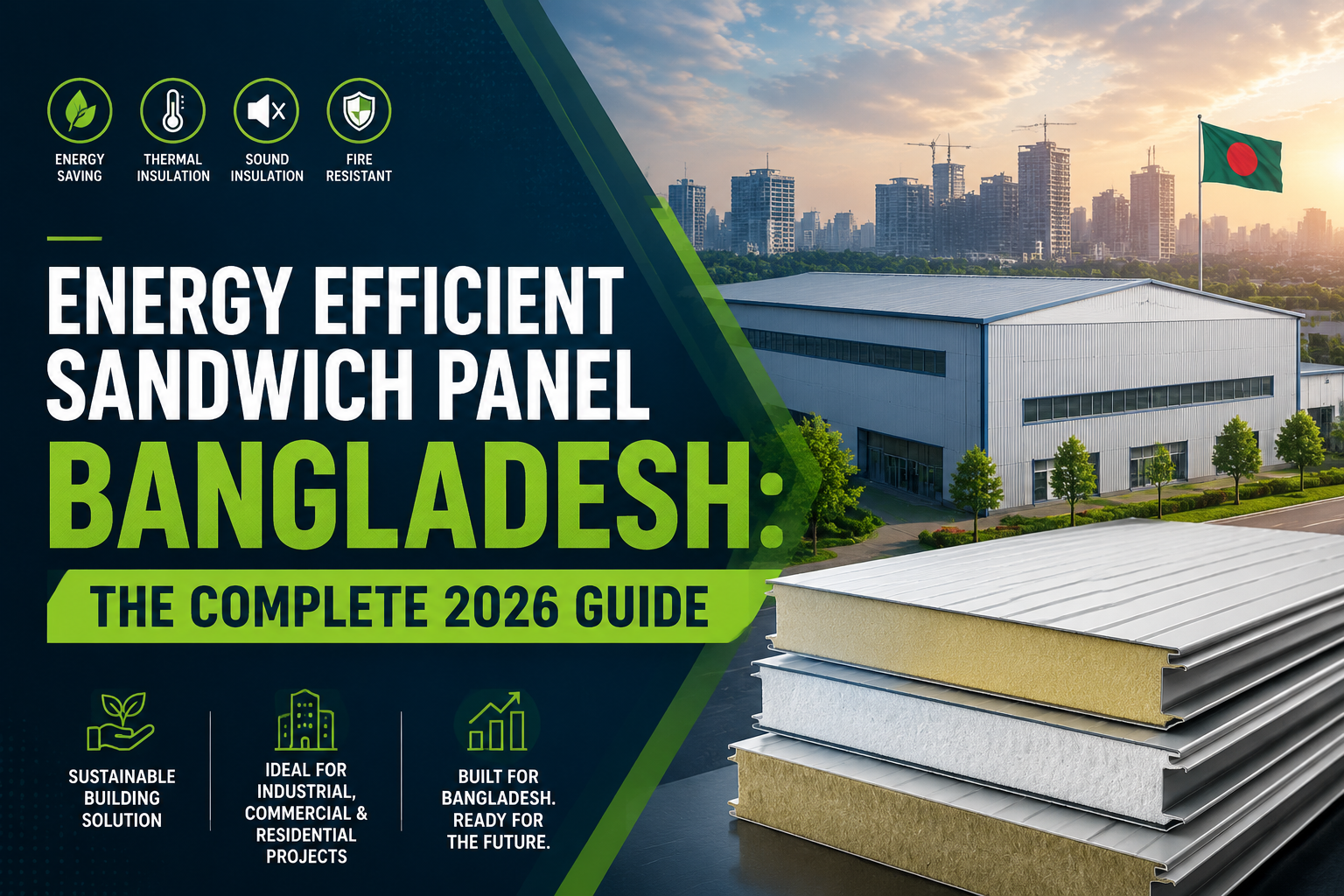
Quick Answer: Energy efficient sandwich panels in Bangladesh are prefabricated building panels with an insulating core (EPS, PU, PIR, or rockwool) bonded between two steel facings. They significantly reduce heat transfer, lower cooling and heating costs, and speed up construction. In Bangladesh's hot and humid climate, they are the most practical insulation solution for factories, cold rooms, clean rooms, and commercial buildings.
Key Takeaways
- 🏗️ Sandwich panels combine structural strength and thermal insulation in one product, cutting construction time by up to 40% compared to brick-and-mortar methods.
- 🌡️ Bangladesh's tropical climate makes thermal insulation critical — uninsulated industrial buildings can reach interior temperatures well above 40°C in summer.
- 💡 PU (polyurethane) and PIR panels offer the highest thermal resistance (lowest U-values) among core types available in Bangladesh.
- 💰 While upfront panel costs are higher than conventional materials, energy savings on air conditioning typically recover the investment within 3–5 years (industry estimate based on typical Bangladeshi industrial use).
- 🏭 Primary users include RMG factories, pharmaceutical plants, cold storage facilities, food processing units, and poultry farms.
- ✅ Panel thickness directly affects energy performance — 75mm to 150mm is the most common range for walls; 100mm to 200mm for roofs and cold rooms.
- 🔥 Rockwool-core panels add fire resistance alongside thermal insulation, making them suitable for high-risk environments.
- 📦 Several local manufacturers in Dhaka and Chittagong now produce panels domestically, reducing lead times and import costs.
What Is an Energy Efficient Sandwich Panel and Why Does It Matter in Bangladesh?
An energy efficient sandwich panel is a composite building element: two rigid steel face sheets bonded to a continuous insulating core. The core material — EPS foam, polyurethane (PU), polyisocyanurate (PIR), or mineral wool — blocks heat transfer through the wall or roof assembly.
In Bangladesh, this matters enormously. The country sits in a subtropical monsoon zone where outdoor temperatures regularly exceed 35°C from April through September. Industrial buildings without proper insulation force HVAC systems to work overtime, driving up electricity bills and reducing equipment lifespan. For garment factories, pharmaceutical facilities, and food processing plants, maintaining stable interior temperatures is also a compliance requirement, not just a comfort preference.
For a deeper look at how insulation properties vary by panel type, see this thermal insulation sandwich panel Bangladesh guide.
How Do Energy Efficient Sandwich Panels Work?
The insulating core is the key. Each core material resists heat flow differently, measured by thermal conductivity (λ, lambda) and the resulting U-value of the assembled panel.
Lower U-value = better insulation performance.
| Core Type | Typical λ (W/m·K) | Relative Energy Efficiency | Best Use Case |
|---|---|---|---|
| EPS (Expanded Polystyrene) | 0.035–0.040 | Good | Walls, general industrial |
| PU/PUR (Polyurethane) | 0.022–0.028 | Excellent | Cold rooms, AC buildings |
| PIR (Polyisocyanurate) | 0.020–0.025 | Excellent+ | High-performance walls/roofs |
| Rockwool/Mineral Wool | 0.033–0.040 | Good + fire rated | Fire-risk zones, factories |
For Bangladesh's climate, PU and PIR cores deliver the best return on energy savings. EPS is a cost-effective choice for general factory walls where extreme temperature control is not required. Read the full EPS vs PU sandwich panel comparison to decide which suits your project.
What Are the Main Applications of Energy Efficient Sandwich Panels in Bangladesh?
Energy efficient sandwich panels in Bangladesh serve a wide range of industries and building types. The right choice depends on the required temperature range, fire rating, hygiene standard, and budget.
Common applications:
- Garment and textile factories (RMG sector): Roof and wall panels reduce solar heat gain, keeping production floors cooler and cutting air conditioning loads.
- Cold storage and refrigeration: PU panels with 100–200mm thickness maintain low temperatures efficiently. See the insulated sandwich panel Bangladesh guide for cold storage specs.
- Pharmaceutical and clean rooms: Smooth-faced panels with antibacterial coatings meet GMP standards while maintaining thermal control.
- Food processing plants: Hygienic panel surfaces plus thermal insulation prevent condensation and contamination.
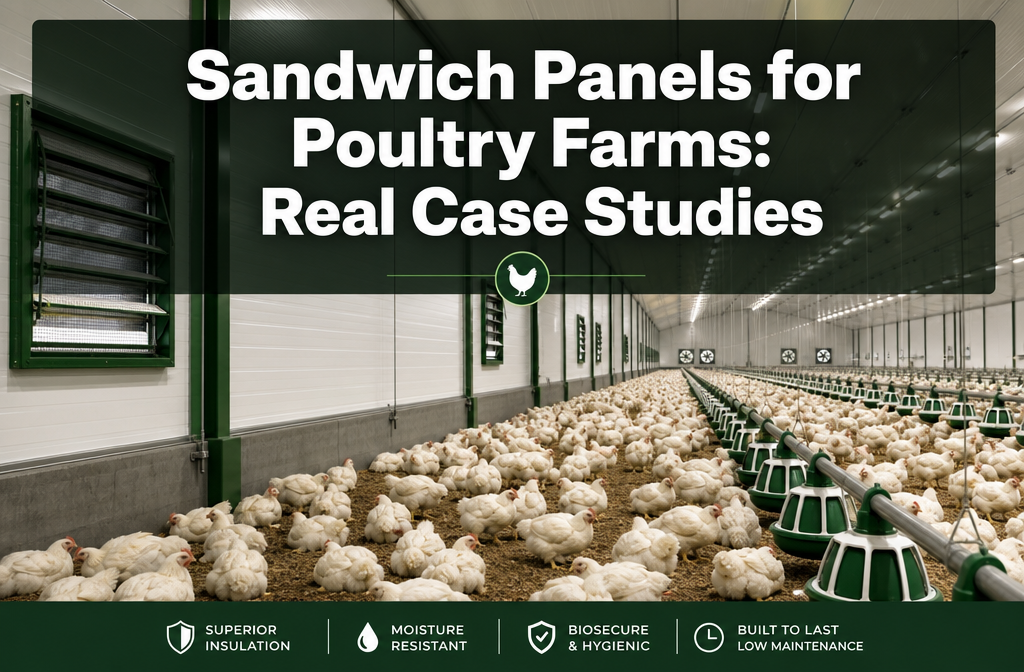
- Poultry farms: Panels regulate temperature and humidity, directly affecting bird health and feed conversion ratios. Learn more in the best sandwich panel for poultry farm guide.
- Commercial and office buildings: Lightweight panels speed up fit-outs and reduce structural load.
How Much Do Energy Efficient Sandwich Panels Cost in Bangladesh?
Panel cost depends on core type, thickness, steel gauge, surface finish, and order volume. Prices have shifted with raw material markets, so always get current quotes from local suppliers.
Approximate price ranges (2026 estimates, subject to market variation):
- EPS core panels (50–100mm): BDT 550–900 per sq ft
- PU core panels (50–100mm): BDT 750–1,200 per sq ft
- Rockwool core panels (50–100mm): BDT 900–1,400 per sq ft
- PIR core panels (75–150mm): BDT 1,000–1,600 per sq ft
For verified, up-to-date pricing, consult the sandwich panel price in Bangladesh 2026 guide.
Cost vs. savings logic: A factory spending BDT 5–8 lakh per month on industrial air conditioning can realistically reduce that bill by 20–35% with proper roof and wall insulation (estimate based on typical thermal load reduction for insulated vs. uninsulated steel buildings in tropical climates). Over a 3–5 year period, the energy savings offset the panel investment.
⚡ Decision rule: Choose PU panels if your building requires active cooling (AC, refrigeration). Choose EPS if the building is naturally ventilated and only needs basic heat reduction. Choose rockwool if fire resistance is a regulatory requirement.
Which Sandwich Panel Thickness Is Right for Energy Efficiency in Bangladesh?
Thickness is the single most controllable factor in panel energy performance. Doubling the core thickness roughly halves the U-value, meaning half the heat passes through.
Recommended thickness by application (Bangladesh context):
- General factory walls: 50–75mm EPS or PU
- Roof panels (high solar exposure): 100–150mm PU or PIR
- Cold rooms (+2°C to +8°C): 100–150mm PU
- Freezer rooms (-18°C to -25°C): 150–200mm PU
- Clean rooms / pharma: 75–100mm PU with smooth liner
- Fire-rated zones: 75–100mm rockwool
For a full breakdown of how to match thickness to your specific project, the sandwich panel thickness selection guide covers all variables including climate zone, HVAC load, and budget constraints.
Common mistake: Many buyers in Bangladesh underspecify roof panel thickness to save upfront cost. Roofs receive direct solar radiation and account for the majority of heat gain in single-storey industrial buildings. Skimping on roof insulation negates savings on wall panels.
Who Are the Leading Energy Efficient Sandwich Panel Manufacturers in Bangladesh?
Bangladesh now has a growing domestic manufacturing base for sandwich panels, concentrated mainly in Dhaka and its industrial periphery. Buying locally reduces lead times from weeks to days and avoids import duties.
When evaluating suppliers, check for:
- In-house continuous lamination line (ensures consistent bond quality)
- Panel thickness tolerance (should be ±1.5mm or better)
- Steel skin grade and coating (pre-painted galvanized steel, minimum G550 or equivalent)
- Core density certification (EPS: min 15 kg/m³; PU: min 38–42 kg/m³)
- After-sales support and installation guidance
For a vetted list of suppliers, see sandwich panel suppliers in Bangladesh: 2026 buyer's guide and the sandwich panel manufacturers in Dhaka guide.
What Are the Key Benefits and Limitations of Energy Efficient Sandwich Panels?
Benefits:
- ✅ Significant reduction in building heat gain and cooling costs
- ✅ Fast installation — panels arrive pre-fabricated and click or bolt together
- ✅ Lightweight compared to brick, reducing structural steel requirements
- ✅ Clean, professional appearance suitable for food, pharma, and export-oriented facilities
- ✅ Long service life (15–25 years with proper maintenance)
- ✅ Available in fire-rated versions (rockwool core) for compliance-sensitive projects
Limitations:
- ❌ Higher upfront material cost than conventional corrugated steel or brick
- ❌ Requires skilled installation — poor jointing creates thermal bridges and leaks
- ❌ EPS and PU cores are combustible; fire-rated alternatives (rockwool, PIR) cost more
- ❌ Panels can dent or deform if struck by forklifts or heavy equipment at low levels
- ❌ Repairs to damaged panels require matching stock; keep spare panels on-site
For fire safety specifics, the rockwool sandwich panel fire safety guide is worth reviewing before specifying panels for factories with flammable materials.
How Are Energy Efficient Sandwich Panels Installed in Bangladesh?
Correct installation is as important as panel selection. A well-specified panel installed poorly will underperform because of thermal bridging at joints, gaps, and penetrations.
Key installation steps for walls and roofs:
- Structural frame preparation: Ensure steel purlins or columns are plumb, level, and at the correct spacing for the panel span.
- Panel handling: Use panel lifters or suction cups — never clamp through the face skin, as dents compromise the insulation layer.
- Starting alignment: The first panel sets the line for the entire run. Take extra time here.
- Joint sealing: Apply manufacturer-supplied sealant tape at all longitudinal and transverse joints before locking panels together.
- Fastener placement: Use self-drilling screws at specified centres (typically 300–400mm for walls, 250mm for roofs). Over-tightening crushes the core.
- Penetration detailing: All pipe, cable, and duct penetrations need foam-filled sleeves and weatherproof collars to prevent heat bridges.
- Ridge and eave flashings: Critical for roof panels — water ingress at these points is the most common cause of premature panel failure in Bangladesh's monsoon conditions.
See the sandwich panel roof installation Bangladesh guide for a complete step-by-step walkthrough with Bangladesh-specific weather considerations.
How Do You Maintain Energy Efficient Sandwich Panels for Long-Term Performance?
Sandwich panels require minimal but consistent maintenance to preserve their energy efficiency over time.
Annual maintenance checklist:
- Inspect all joint sealants for cracking or separation — reseal with compatible sealant
- Check fastener heads for corrosion or loosening
- Clear debris from roof panel overlaps and gutters before monsoon season
- Wash panel surfaces with mild detergent to remove industrial grime (which can trap heat)
- Inspect for dents, cuts, or exposed core at low-level wall panels
- Verify that all penetration seals remain intact
Panels with surface damage that exposes the steel substrate will corrode in Bangladesh's humid environment. Touch up with zinc-rich primer and matching topcoat within the same season. For a full maintenance schedule, refer to the complete guide to maintenance of sandwich panels.
FAQ: Energy Efficient Sandwich Panel Bangladesh
Q: Are sandwich panels suitable for Bangladesh's monsoon climate?
Yes. Steel-faced sandwich panels with properly sealed joints and flashings are highly weather-resistant. The key is correct installation — especially at roof ridges, eaves, and wall-to-floor junctions where water can enter during heavy monsoon rain.
Q: Which core type gives the best energy efficiency in Bangladesh?
PU (polyurethane) and PIR cores offer the lowest thermal conductivity and best energy savings. For general factory use, EPS is a cost-effective alternative. Rockwool is the choice when fire rating is required alongside insulation.
Q: How long do sandwich panels last in Bangladesh?
With proper installation and annual maintenance, sandwich panels typically last 15–25 years in Bangladesh's climate. The steel skin's coating quality is the main factor — specify minimum 200g/m² galvanized coating with PVDF or polyester topcoat for best longevity.
Q: Can sandwich panels reduce electricity bills significantly?
Yes. In insulated industrial buildings, cooling load reductions of 20–40% are commonly reported compared to uninsulated corrugated steel structures (industry estimate for tropical climates). Actual savings depend on building size, occupancy, and HVAC system efficiency.
Q: Do sandwich panels meet Bangladesh building codes?
Bangladesh's National Building Code (BNBC) addresses fire resistance and structural requirements. Rockwool-core panels meet fire resistance requirements for many industrial occupancies. Always confirm specific compliance requirements with your local authority and structural engineer.
Q: What is the minimum order quantity for sandwich panels in Bangladesh?
Most local manufacturers have a minimum order of 500–1,000 sq ft, though this varies by supplier. Smaller quantities may attract a premium or require sourcing from distributors.
Q: Can sandwich panels be used for both walls and roofs?
Yes, but wall panels and roof panels have different profiles and load ratings. Roof panels have a trapezoidal or standing-seam profile to handle water runoff and higher span loads. Do not substitute wall panels for roof applications.
Q: Are there locally manufactured energy efficient sandwich panels in Bangladesh?
Yes. Several manufacturers in Dhaka now produce PU, EPS, and rockwool-core panels domestically. Local production reduces cost and lead time compared to imported panels.
Q: What thickness is recommended for cold storage in Bangladesh?
For standard cold rooms (+2°C to +8°C), 100–150mm PU panels are standard. For freezer rooms (-18°C and below), 150–200mm PU panels are required. Thicker panels reduce refrigeration compressor runtime and operating costs.
Q: How do I choose between EPS and PU panels for a factory in Bangladesh?
Choose EPS if the factory is naturally ventilated and budget is the primary concern. Choose PU if the building will be air-conditioned, as the superior insulation value of PU will recover the cost difference through energy savings within a few years.
Conclusion: Actionable Next Steps
Energy efficient sandwich panels are not a luxury for Bangladeshi builders — they are a practical response to rising energy costs, tightening compliance requirements, and the country's demanding climate. The right panel, correctly specified and installed, pays for itself through reduced cooling loads and faster construction timelines.
Here's what to do next:
- Define your application — cold room, factory, clean room, or commercial building — and identify the required temperature range and fire rating.
- Select the right core type — PU or PIR for maximum energy efficiency; rockwool where fire resistance is needed; EPS for cost-sensitive general applications.
- Specify the correct thickness — do not underspecify roof panels; they carry the highest solar heat load.
- Get quotes from at least two or three local manufacturers and ask for U-value data sheets, not just price per sq ft.
- Verify installation capability — confirm the contractor has experience with the specific panel system you've chosen.
- Plan for maintenance — budget for annual joint inspection and sealant replacement from year one.
For a comprehensive overview of available products and specifications from a local manufacturer, visit the sandwich panel manufacturer in Bangladesh page to start comparing options.
References
- Bangladesh National Building Code (BNBC), 2020 — Housing and Building Research Institute, Bangladesh
- European Sandwich Panel Association (EASP), Technical Guidelines for Sandwich Panels, 2019
- ASHRAE Handbook of Fundamentals, Chapter 26: Heat, Air, and Moisture Control in Building Assemblies, 2021
- International Energy Agency (IEA), "Tracking Buildings," 2023 — iea.org
- Bangladesh Power Development Board (BPDB), Annual Report, 2023 — bpdb.gov.bd