Last updated: July 31, 2026

Quick Answer
Sandwich panels for poultry farms are insulated building panels consisting of two metal sheets with a foam core that provide superior temperature control, moisture resistance, and energy efficiency compared to traditional construction methods. These panels typically cost $15-35 per square meter and can reduce heating costs by 30-50% while maintaining consistent internal temperatures crucial for bird health and productivity.
Key Takeaways
- Sandwich panels offer better insulation than traditional poultry farm construction with R-values of 4-8 per inch
- Polyurethane (PU) cores provide the best thermal performance while polystyrene (EPS) offers cost-effective solutions
- Proper thickness selection ranges from 50mm for moderate climates to 150mm for extreme temperature zones
- Installation costs are offset by 30-50% reduction in heating and cooling expenses over time
- Fire-rated panels meeting agricultural safety standards are essential for insurance and regulatory compliance
- Condensation control requires proper vapor barriers and ventilation system integration
- Professional installation prevents common mistakes that compromise thermal performance and structural integrity
- Panel lifespan exceeds 25 years with proper maintenance in agricultural environments
- Both retrofit and new construction applications are feasible with appropriate planning
What Are Sandwich Panels and How Do They Work in Poultry Farming
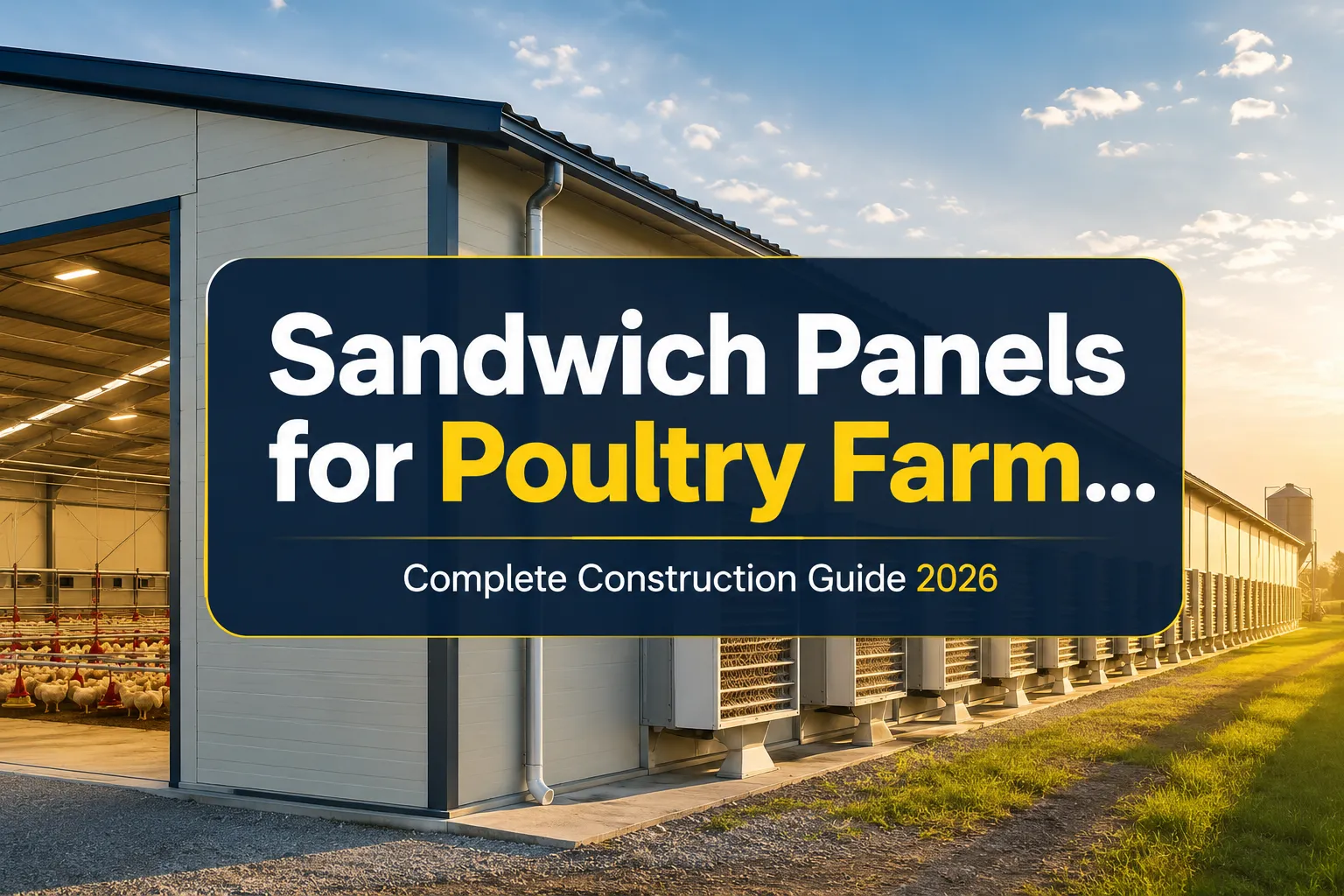
Sandwich panels are composite building materials consisting of two outer metal sheets bonded to an insulating foam core, creating a single structural unit that provides both strength and thermal insulation. In poultry farming applications, these panels form the walls and roofing of chicken houses, broiler barns, and egg production facilities.
The panels work by creating a continuous thermal barrier that prevents heat transfer between the interior and exterior environments. The metal faces, typically made from galvanized steel or aluminum, provide structural strength and weather protection. The insulating core material – usually polyurethane (PU), expanded polystyrene (EPS), or mineral wool – eliminates thermal bridging that occurs with traditional framed construction.
Key performance benefits for poultry operations include:
- Consistent internal temperatures reduce stress on birds and improve feed conversion rates
- Sealed panel joints minimize air infiltration and pest entry
- Smooth interior surfaces facilitate cleaning and disinfection protocols
- Rapid installation reduces construction time compared to conventional methods
Choose sandwich panels over traditional construction when maintaining precise environmental control is critical for your operation's success. The complete guide to poultry farm sandwich panels covers detailed specifications for different farming applications.
Sandwich Panels vs Traditional Poultry Farm Insulation: Which Is Better
Sandwich panels outperform traditional insulation methods in most poultry farming scenarios due to superior thermal performance, faster installation, and lower long-term maintenance requirements. Traditional construction using fiberglass batts or blown-in insulation typically achieves R-values of 11-19 for wall assemblies, while sandwich panels deliver R-values of 20-35 depending on thickness and core material.
Sandwich Panel Advantages:
- No thermal bridging through structural members
- Integrated vapor barrier eliminates moisture infiltration
- Factory-controlled quality ensures consistent performance
- Installation time reduced by 40-60% compared to stick-built construction
- Smooth surfaces prevent dust and contaminant accumulation
Traditional Insulation Drawbacks:
- Thermal bridging through wood or steel framing reduces effective R-value by 15-25%
- Separate vapor barrier installation creates potential failure points
- Settling and compression over time degrades thermal performance
- Difficult to achieve airtight construction with multiple components
Choose traditional construction only when initial budget constraints outweigh long-term operational costs, or when local building codes specifically require conventional framing methods. For most commercial poultry operations, sandwich panels provide better return on investment through reduced energy costs and improved bird performance.
How Much Do Sandwich Panels Cost for a Poultry Farm
Sandwich panel costs for poultry farms range from $15-35 per square meter for the panels themselves, with total installed costs including labor and accessories reaching $25-50 per square meter. Price varies based on panel thickness, core material, surface finish, and regional market conditions.
Cost breakdown by core material:
- EPS (Expanded Polystyrene): $15-22 per square meter
- PU (Polyurethane): $22-35 per square meter
- Mineral Wool: $25-40 per square meter
Additional cost factors include:
- Structural framework and foundations: $8-15 per square meter
- Professional installation labor: $5-12 per square meter
- Flashing, trim, and accessories: $3-8 per square meter
- Transportation and handling: $2-5 per square meter
For a typical 1,000 square meter broiler house, expect total material and installation costs of $35,000-65,000. While initial investment exceeds traditional construction by 15-25%, energy savings of $3,000-8,000 annually typically provide payback within 3-5 years. Our sandwich panel price guide offers detailed cost comparisons for different project sizes.
Best Sandwich Panel Thickness for Chicken Coops
Optimal sandwich panel thickness for chicken coops depends on your climate zone, with 75mm panels suitable for moderate climates and 100-150mm panels required for extreme temperature regions. The poultry farm panel thickness guide provides zone-specific recommendations.
Thickness recommendations by climate:
- Tropical/subtropical (minimal heating): 50-75mm
- Temperate zones (moderate heating/cooling): 75-100mm
- Cold climates (significant heating required): 100-150mm
- Extreme cold regions: 150mm+ with enhanced edge sealing
Performance by thickness:
- 50mm panels: R-value 12-15, suitable for temperature swings under 20°C
- 75mm panels: R-value 18-22, handles temperature differentials up to 30°C
- 100mm panels: R-value 24-28, effective for differentials up to 40°C
- 150mm panels: R-value 35-42, manages extreme conditions over 40°C differential
Choose thicker panels when energy costs are high, bird species require precise temperature control, or local climate experiences significant seasonal variation. Thinner panels work for operations in stable climates where initial cost savings outweigh modest energy efficiency gains.
Common thickness selection mistakes:
- Under-sizing for climate zone leads to poor temperature control and high energy costs
- Over-sizing wastes money without proportional performance gains
- Ignoring local wind loads that may require structural thickness upgrades
Sandwich Panels for Poultry Farms: Temperature Control Benefits
Sandwich panels provide superior temperature control in poultry operations by eliminating thermal bridging, reducing air infiltration, and maintaining consistent internal conditions that improve bird health and productivity. Studies show properly insulated poultry houses using sandwich panels maintain temperature variations within ±2°C compared to ±5°C or greater with traditional construction.
Temperature control advantages:
- Reduced energy consumption for heating and cooling by 30-50%
- Faster temperature recovery after door openings or equipment cycling
- More uniform temperature distribution eliminates hot and cold spots
- Better humidity control reduces condensation and respiratory issues
Impact on poultry performance:
- Improved feed conversion ratios due to reduced metabolic stress
- Higher egg production rates in layer operations
- Faster growth rates in broiler production
- Reduced mortality from temperature-related stress
The continuous insulation layer prevents thermal bridging that occurs at structural members in conventional construction. This eliminates cold spots where condensation forms and maintains surface temperatures closer to ambient air temperature. Proper panel selection and installation can maintain internal temperatures within optimal ranges using 40-60% less energy than traditional building methods.
Critical design considerations:
- Panel joints must be properly sealed to prevent air leakage
- Ventilation system integration requires coordination with panel layout
- Thermal mass considerations for different poultry production cycles
Sandwich Panels Poultry Farm Condensation Problems
Condensation problems in poultry farm sandwich panels typically result from improper vapor barrier installation, inadequate ventilation, or thermal bridging at panel joints rather than inherent panel defects. Properly installed panels with continuous vapor barriers and sealed joints eliminate most moisture issues.
Common condensation causes:
- Incomplete vapor barrier coverage at panel edges and penetrations
- Air leakage through poorly sealed joints allows warm, humid air to contact cold surfaces
- Insufficient ventilation creates excessive humidity levels inside the building
- Thermal bridging at structural connections creates cold spots where moisture condenses
Prevention strategies:
- Install continuous vapor barrier on warm side of insulation
- Seal all panel joints with appropriate gaskets and sealants
- Design ventilation system to maintain 60-70% relative humidity
- Use thermal breaks at structural connections to prevent bridging
Troubleshooting existing condensation:
- Identify leak sources using thermal imaging during temperature differentials
- Improve ventilation rates to reduce internal humidity levels
- Add supplemental vapor barriers at problem areas
- Repair damaged panel joints and sealant failures
Choose panels with factory-applied vapor barriers when possible, as field-applied barriers are more prone to installation defects. The sealed panel system, when properly installed, creates a more effective moisture barrier than traditional construction methods that rely on separate vapor barrier films.
Can Sandwich Panels Be Used for Existing Poultry Barns
Sandwich panels can be retrofitted to existing poultry barns as an exterior cladding system or interior liner, though structural evaluation is required to ensure adequate support for additional loads. Retrofit applications typically involve installing panels over existing walls while maintaining structural integrity and proper thermal performance.
Retrofit application methods:
- Exterior over-cladding: Panels installed over existing walls with new structural framework
- Interior liner system: Panels mounted inside existing structure to improve insulation
- Selective replacement: Remove deteriorated sections and install panels in specific areas
- Roof upgrade: Replace existing roofing with insulated panel systems
Structural considerations:
- Existing foundation and framing must support additional panel weight (15-25 kg/m²)
- Wind load calculations may require structural reinforcement
- Building height increases with exterior applications may affect zoning compliance
- Existing utilities and equipment may require relocation or modification
Cost-benefit analysis for retrofits:
- Retrofit costs typically 60-80% of new construction panel costs
- Energy savings begin immediately upon completion
- Improved building performance may extend overall structure lifespan
- Enhanced biosecurity through better sealing and cleanability
Choose retrofit applications when existing structures are sound but lack adequate insulation, or when expanding operations require improved environmental control. Avoid retrofits on buildings with significant structural defects or those nearing end of useful life.
Who Makes Quality Sandwich Panels for Agricultural Use
Quality sandwich panels for agricultural use are manufactured by specialized companies that understand the unique requirements of farming environments, including resistance to ammonia, humidity, temperature cycling, and cleaning chemicals. Leading manufacturers typically offer agricultural-specific panel designs with enhanced corrosion protection and appropriate fire ratings.
Key manufacturer qualifications:
- Agricultural panel experience with poultry-specific applications
- Quality certifications (ISO 9001, agricultural building standards)
- Local manufacturing or distribution for reduced shipping costs and lead times
- Technical support for design and installation guidance
- Warranty coverage appropriate for agricultural environments (10-25 years typical)
Panel specifications for agricultural use:
- Corrosion-resistant coatings designed for ammonia exposure
- Food-grade surface finishes for easy cleaning and disinfection
- Fire ratings meeting agricultural building codes and insurance requirements
- Structural performance ratings for local wind and snow loads
Evaluation criteria:
- Request sample panels for physical inspection and testing
- Verify manufacturer experience with similar poultry projects
- Check references from other agricultural installations
- Compare warranty terms and local service availability
- Evaluate technical support quality during design phase
Work with established sandwich panel suppliers who understand agricultural requirements and can provide ongoing support throughout your project lifecycle.
Sandwich Panel Installation Mistakes in Poultry Farms
Common sandwich panel installation mistakes in poultry farms include improper joint sealing, inadequate structural support, and poor integration with ventilation systems, leading to thermal bridging, air leakage, and reduced energy efficiency. Professional installation following manufacturer guidelines prevents most performance issues.
Critical installation errors:
- Incomplete sealant application at panel joints allows air infiltration
- Insufficient structural attachment creates wind uplift risks and panel failure
- Thermal bridging through structural connections reduces insulation effectiveness
- Poor flashing details allow water penetration and corrosion
- Inadequate vapor barrier continuity creates condensation problems
Quality control checkpoints:
- Verify panel alignment and proper joint engagement before final fastening
- Inspect sealant application for continuous coverage without gaps
- Check structural attachment spacing and fastener torque specifications
- Test panel system airtightness before interior finishing
- Coordinate with other trades to maintain thermal and air barriers
Professional installation benefits:
- Manufacturer warranty coverage typically requires certified installer
- Proper tools and equipment ensure quality joint sealing
- Experience prevents common mistakes that compromise performance
- Faster installation reduces weather exposure during construction
- Technical support available for problem resolution
Choose experienced installers with poultry farm project references rather than general construction contractors unfamiliar with agricultural panel requirements. The sandwich panel installation guide covers best practices for agricultural applications.
Do Sandwich Panels Reduce Heating Costs for Poultry Operations
Sandwich panels reduce heating costs for poultry operations by 30-50% compared to traditional construction through superior insulation performance, reduced air infiltration, and elimination of thermal bridging. The continuous insulation layer and sealed panel joints create a more effective thermal envelope than conventional framed construction.
Energy savings mechanisms:
- Higher effective R-values reduce heat loss through building envelope
- Sealed construction minimizes air leakage and infiltration losses
- Thermal mass of panels helps stabilize internal temperatures
- Faster warm-up times reduce equipment runtime during startup
Typical cost reductions:
- Heating fuel savings: 40-60% in cold climates
- Cooling costs: 20-30% reduction in hot climates
- Equipment sizing: 25-40% smaller HVAC systems required
- Maintenance costs: Reduced equipment wear from fewer cycles
Payback period factors:
- Energy cost levels in your region
- Climate severity and heating/cooling degree days
- Panel thickness and thermal performance selected
- Existing building insulation levels being replaced
- Financing costs and available incentives
Calculate potential savings using local energy rates and degree-day data for your location. Most poultry operations see payback periods of 3-7 years, with higher energy costs and more severe climates providing faster returns. The energy-efficient sandwich panel guide includes savings calculators for different scenarios.
Sandwich Panels Fire Rating Requirements for Poultry Farms
Fire rating requirements for sandwich panels in poultry farms vary by jurisdiction but typically mandate Class A or Class 1 fire resistance for agricultural buildings housing livestock. Most building codes require panels to meet specific flame spread and smoke development ratings to ensure occupant safety and insurance compliance.
Common fire rating standards:
- ASTM E84 (Steiner Tunnel Test): Class A rating (flame spread ≤25, smoke developed ≤450)
- FM 4880/4881: Factory Mutual approval for insulated panels
- UL listings for specific panel constructions and applications
- Local agricultural building codes may have additional requirements
Core material fire performance:
- Mineral wool cores: Inherently non-combustible, best fire resistance
- Polyurethane (PU): Fire-retardant formulations available, good performance
- Polystyrene (EPS): Requires fire-retardant additives, adequate for most applications
- Polyisocyanurate (PIR): Enhanced fire resistance compared to standard PU
Insurance and regulatory considerations:
- Insurance carriers may require specific fire ratings for coverage
- Agricultural lending may mandate fire-rated construction
- Local fire departments may have inspection requirements
- Building permits typically specify minimum fire resistance levels
Verify fire rating requirements with local building officials and insurance providers before panel selection. The fire-rated sandwich panel guide covers compliance requirements for agricultural applications.
Fire safety design elements:
- Proper fire stopping at panel penetrations
- Adequate egress planning for emergency evacuation
- Integration with fire suppression systems where required
- Separation distances from property lines and other structures
How Long Do Sandwich Panels Last in Farm Conditions
Sandwich panels typically last 25-30 years in farm conditions when properly selected and maintained, with some installations exceeding 40 years of service life. Panel longevity depends on core material selection, coating quality, installation practices, and exposure to agricultural chemicals and cleaning procedures.
Lifespan by core material:
- Mineral wool cores: 30-40+ years (non-degrading inorganic material)
- Polyurethane (PU): 25-35 years (excellent chemical resistance)
- Polystyrene (EPS): 20-30 years (adequate for most applications)
- Performance varies with UV exposure, temperature cycling, and chemical contact
Factors affecting panel life:
- Coating quality and corrosion resistance determine exterior durability
- Ammonia exposure from poultry waste accelerates metal corrosion without proper coatings
- Cleaning chemical compatibility affects surface finish longevity
- Thermal cycling from heating/cooling systems creates expansion stress
- Moisture infiltration through damaged joints degrades core materials
Maintenance requirements:
- Annual inspection of panel joints and sealants
- Cleaning with approved chemicals that don't damage coatings
- Prompt repair of damaged panels or flashing to prevent water entry
- Recoating or touch-up of scratched or worn surface finishes
- Replacement of weatherstripping and gaskets as needed
End-of-life indicators:
- Visible corrosion or coating failure on panel surfaces
- Loss of structural integrity or panel deflection
- Reduced thermal performance from core degradation
- Persistent moisture or condensation problems
Plan for panel replacement in 25-30 year cycles as part of facility lifecycle management. Proper maintenance extends service life and maintains performance throughout the operational period.
Sandwich Panels for Small vs Large Scale Poultry Farms
Sandwich panels benefit both small and large-scale poultry operations, though panel selection, installation methods, and cost considerations differ based on farm size and production requirements. Small farms often prioritize cost-effectiveness while large operations focus on performance optimization and operational efficiency.
Small farm considerations (under 5,000 birds):
- Standard panel thicknesses (75-100mm) provide adequate performance
- DIY installation possible with proper training and tools
- Focus on essential performance features rather than premium options
- Longer payback periods acceptable due to lower absolute energy costs
- Simpler building designs reduce installation complexity
Large farm considerations (over 20,000 birds):
- Premium panel specifications justify higher costs through operational savings
- Professional installation required for quality and warranty compliance
- Advanced features like integrated vapor barriers and enhanced fire ratings
- Shorter payback requirements due to higher energy costs
- Complex building systems require coordinated installation
Scaling factors:
- Bulk purchasing reduces per-unit panel costs for large projects
- Installation efficiency improves with larger, simpler building shapes
- Engineering and design costs spread over more square footage
- Financing options may differ based on project size and farm creditworthiness
Performance optimization by scale:
- Small farms: Focus on basic thermal performance and durability
- Medium farms: Balance performance upgrades with cost constraints
- Large farms: Specify premium features for maximum operational efficiency
Choose panel specifications appropriate for your operation size and growth plans. The best sandwich panels for poultry farms guide includes recommendations by farm size and production type.
Polyurethane vs Polystyrene Sandwich Panels for Poultry
Polyurethane (PU) sandwich panels outperform polystyrene (EPS) panels in thermal efficiency and moisture resistance, while EPS panels offer cost advantages for budget-conscious poultry operations. PU panels provide R-values of 6-8 per inch compared to 4-5 per inch for EPS, requiring less thickness to achieve equivalent thermal performance.
Polyurethane (PU) advantages:
- Superior thermal performance allows thinner panels for same R-value
- Better adhesion to metal faces creates stronger composite structure
- Excellent moisture resistance prevents core degradation
- Higher compressive strength supports structural loads
- Chemical resistance suitable for agricultural cleaning products
Polystyrene (EPS) advantages:
- Lower material cost reduces initial investment by 20-30%
- Easier to cut and modify during installation
- Lighter weight reduces structural support requirements
- Good thermal performance for most poultry applications
- Recyclable material supports sustainability goals
Performance comparison:
- Thermal efficiency: PU provides 25-30% better insulation per inch
- Moisture resistance: PU significantly outperforms EPS in humid conditions
- Structural strength: PU panels handle higher loads and wind forces
- Cost differential: EPS costs 20-30% less than equivalent PU panels
- Lifespan: Both materials provide 20-30 year service life when properly installed
Selection criteria:
- Choose PU for extreme climates, high moisture conditions, or premium applications
- Select EPS for moderate climates, budget projects, or retrofit applications
- Consider local availability and technical support when choosing suppliers
The rockwool panel guide covers mineral wool alternatives that offer fire resistance advantages over both PU and EPS cores.
Frequently Asked Questions
What thickness sandwich panel is best for a chicken coop?
75-100mm thickness works best for most chicken coops, providing adequate insulation while remaining cost-effective. Use 100mm+ in cold climates or 50-75mm in mild regions where heating requirements are minimal.
Can I install sandwich panels myself on a small poultry building?
Yes, small buildings under 500 square meters can be DIY projects with proper tools and training. However, professional installation ensures warranty coverage and optimal performance, especially for complex buildings or extreme climate conditions.
How do sandwich panels compare to traditional pole barn construction for poultry?
Sandwich panels provide superior insulation, air sealing, and temperature control compared to pole barns with traditional insulation. Initial costs are 20-40% higher but energy savings typically provide payback within 5-7 years.
What's the minimum fire rating required for poultry farm sandwich panels?
Most jurisdictions require Class A or Class 1 fire ratings (flame spread ≤25) for agricultural buildings. Check local building codes and insurance requirements, as standards vary by region and building occupancy.
Do sandwich panels work in high humidity poultry environments?
Yes, when properly installed with continuous vapor barriers and sealed joints. Choose panels with moisture-resistant cores like polyurethane or mineral wool for best performance in high-humidity applications.
How much can sandwich panels reduce my poultry farm heating costs?
Expect 30-50% reduction in heating costs compared to traditional construction. Actual savings depend on climate, energy costs, panel specifications, and existing building performance.
What's the lifespan of sandwich panels in agricultural applications?
Quality panels last 25-30 years with proper maintenance. Mineral wool cores may exceed 40 years while polystyrene cores typically provide 20-25 years of service in farm conditions.
Can sandwich panels be recycled at end of life?
Metal faces are fully recyclable, while core materials vary. EPS cores can be recycled, PU requires specialized processing, and mineral wool can be reused as aggregate. Plan for end-of-life disposal during initial selection.
What maintenance do sandwich panels require on poultry farms?
Annual inspection of joints and sealants, cleaning with approved chemicals, prompt repair of damage, and periodic recoating of scratched surfaces. Proper maintenance extends service life significantly.
Are there financing options available for sandwich panel poultry buildings?
Yes, agricultural lenders often provide construction loans for energy-efficient buildings. Some regions offer energy efficiency incentives or grants for qualifying projects. Consult agricultural lenders and local extension services for available programs.
Conclusion
Sandwich panels for poultry farms represent a proven building technology that delivers superior thermal performance, energy efficiency, and long-term durability compared to traditional construction methods. With proper selection based on climate requirements, core material properties, and operational needs, these panels provide 30-50% energy savings while maintaining optimal conditions for poultry health and productivity.
The key to successful implementation lies in choosing appropriate panel thickness for your climate zone, selecting quality manufacturers with agricultural experience, and ensuring professional installation that maintains thermal integrity. While initial costs exceed traditional construction by 15-25%, most operations achieve payback within 3-7 years through reduced energy expenses and improved bird performance.
Next steps for your poultry farm project:
- Assess your requirements – Determine building size, climate conditions, and performance goals
- Evaluate panel options – Compare core materials, thicknesses, and fire ratings for your application
- Get professional quotes – Contact experienced installers for detailed cost estimates and specifications
- Review financing options – Explore agricultural loans and energy efficiency incentives in your area
- Plan for long-term maintenance – Establish inspection and care procedures to maximize panel lifespan
For detailed specifications and supplier recommendations, consult our comprehensive poultry farm sandwich panel case studies to see real-world performance results from similar operations.
SEO Meta Title: Sandwich Panels for Poultry Farm: Complete 2026 Guide
SEO Meta Description: Complete guide to sandwich panels for poultry farms. Compare costs, thickness options, installation tips, and energy savings. Expert advice for 2026 projects.