Last updated: July 31, 2026

Quick Answer: EPS (Expanded Polystyrene) insulation typically has a thermal conductivity of 0.030-0.040 W/mK, providing R-values of 3.6-4.2 per inch. This foam insulation offers consistent thermal performance at a lower cost than alternatives like XPS or polyurethane, making it ideal for walls, roofs, and foundation applications where moisture exposure is controlled.
Key Takeaways
- EPS thermal conductivity ranges from 0.030-0.040 W/mK, delivering R-3.6 to R-4.2 per inch of thickness
- Density affects performance – higher density EPS (2.0 PCF) performs better than lower density (1.0 PCF) versions
- Moisture sensitivity is EPS insulation's main weakness, requiring proper vapor barriers and drainage
- Cost advantage makes EPS 20-40% cheaper than XPS while providing similar thermal performance
- Temperature stability allows EPS to maintain thermal properties from -100°F to 165°F
- Long-term performance remains stable for 50+ years when properly installed and protected from moisture
- Best applications include above-grade walls, roofing, and interior basement insulation
- Avoid in below-grade applications without waterproofing due to water absorption concerns
What Is Thermal Conductivity in EPS Insulation
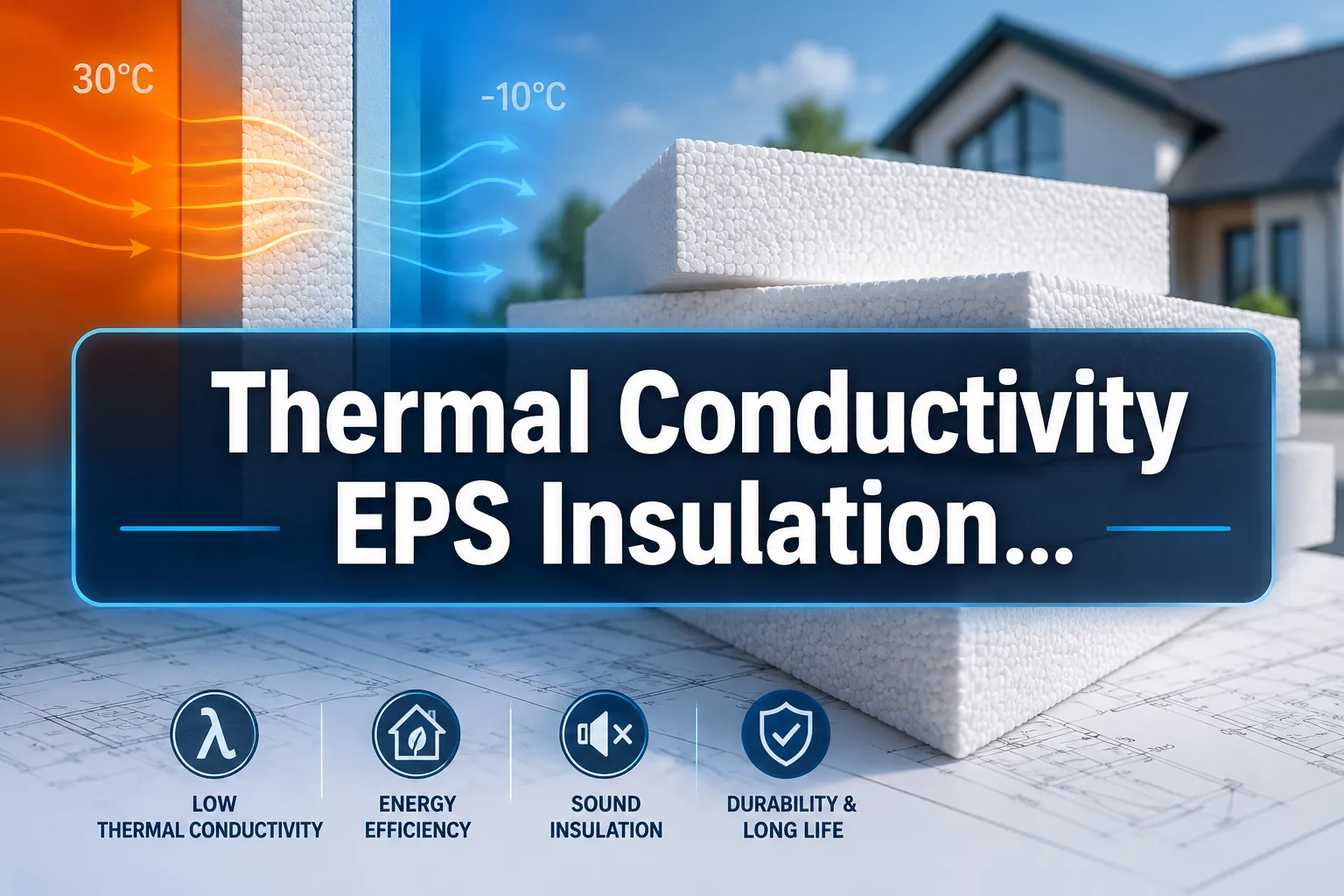
Thermal conductivity in EPS insulation measures how easily heat flows through the material, expressed in watts per meter-kelvin (W/mK). Lower values indicate better insulating performance, with EPS typically ranging from 0.030-0.040 W/mK depending on density and manufacturing quality.
The thermal conductivity of EPS insulation directly translates to its R-value – the material's resistance to heat flow. Standard EPS with 0.036 W/mK thermal conductivity provides approximately R-4.0 per inch of thickness. This relationship means that a 4-inch thick EPS panel delivers R-16 total insulation value.
Key factors affecting EPS thermal conductivity:
- Foam density – Higher density (1.5-2.0 PCF) reduces thermal conductivity
- Cell structure – Smaller, more uniform cells improve thermal performance
- Manufacturing process – Steam molding creates more consistent cell structure
- Aging – Minimal change in thermal properties over time unlike some foam types
Choose EPS insulation when you need predictable thermal performance at competitive pricing. The material works best in applications where moisture control is manageable through proper design and installation techniques.
How Does EPS Insulation Compare to Other Foam Insulation Types
EPS insulation offers moderate thermal performance between basic foam boards and premium closed-cell options. While XPS provides slightly better thermal conductivity (0.025-0.030 W/mK) and polyurethane delivers superior performance (0.020-0.025 W/mK), EPS balances cost and performance effectively.
Thermal Performance Comparison:
| Insulation Type | Thermal Conductivity (W/mK) | R-Value per Inch | Relative Cost |
|---|---|---|---|
| EPS Insulation | 0.030-0.040 | 3.6-4.2 | Low |
| XPS Insulation | 0.025-0.030 | 4.5-5.0 | Medium |
| Polyurethane Foam | 0.020-0.025 | 6.0-7.0 | High |
| Polyisocyanurate | 0.022-0.028 | 5.5-6.5 | High |
When to choose EPS over alternatives:
- Budget-conscious projects where cost savings matter more than maximum R-value
- Above-grade applications where moisture exposure is controlled
- Large-scale construction where material cost significantly impacts total project budget
- Retrofit projects where existing wall cavities accommodate standard thickness requirements
Avoid EPS when you need maximum thermal performance in limited space or face severe moisture exposure without adequate protection systems.
What R-Value Does EPS Insulation Have
EPS insulation delivers R-values between 3.6 and 4.2 per inch of thickness, with performance varying based on foam density and manufacturing quality. Standard Type I EPS (1.0 PCF density) provides R-3.6 per inch, while higher-density Type II EPS (1.5 PCF) achieves R-4.2 per inch.
EPS R-Value by Density Type:
- Type I EPS (1.0 PCF): R-3.6 per inch – most common for residential walls
- Type II EPS (1.5 PCF): R-4.0 per inch – standard commercial applications
- Type IX EPS (2.0 PCF): R-4.2 per inch – high-performance applications
The R-value calculation multiplies the per-inch rating by total thickness. A 4-inch Type II EPS panel provides R-16 total insulation value (4.0 × 4 = 16). This predictable relationship helps contractors and architects calculate exact insulation requirements for energy code compliance.
Common EPS thickness and total R-values:
- 2-inch EPS: R-7.2 to R-8.4 total
- 3-inch EPS: R-10.8 to R-12.6 total
- 4-inch EPS: R-14.4 to R-16.8 total
- 6-inch EPS: R-21.6 to R-25.2 total
Choose thicker EPS panels when building codes require higher R-values or when maximizing energy efficiency justifies the additional material cost. The linear relationship between thickness and R-value makes EPS sizing calculations straightforward compared to other insulation types with variable performance characteristics.
Why Is EPS Insulation Thermal Conductivity Important
EPS insulation thermal conductivity directly determines energy efficiency, heating and cooling costs, and building code compliance. Lower thermal conductivity values mean less heat transfer through walls and roofs, reducing HVAC system workload and utility bills throughout the building's lifespan.
Understanding thermal conductivity helps building professionals make informed decisions about insulation thickness and placement. A building requiring R-20 wall insulation needs 5 inches of standard EPS (R-4.0 per inch) versus only 3.3 inches of premium polyurethane foam (R-6.0 per inch). This calculation affects wall cavity design, construction costs, and interior space allocation.
Economic impact of thermal conductivity:
- Energy savings compound annually – better thermal performance reduces heating/cooling costs by 15-30%
- HVAC sizing allows smaller, less expensive equipment when insulation thermal performance is optimized
- Building code compliance requires specific R-values that thermal conductivity calculations help achieve
- Resale value benefits from superior energy efficiency ratings tied to insulation thermal performance
Long-term performance considerations:
EPS insulation maintains consistent thermal conductivity over decades, unlike some foam types that experience thermal drift. This stability means the R-value calculated during design remains accurate throughout the building's service life, providing predictable energy performance for building owners and occupants.
Consider thermal conductivity as an investment rather than just a construction cost. The difference between standard and high-performance EPS thermal conductivity can pay for itself through reduced energy bills within 5-10 years in most climate zones.
Can EPS Insulation Lose Its Thermal Properties Over Time
EPS insulation maintains stable thermal conductivity for 50+ years when properly installed and protected from moisture. Unlike polyurethane or polyisocyanurate foams that experience thermal drift as blowing agents migrate out of cells, EPS uses air as its insulating gas, eliminating performance degradation over time.
Laboratory aging tests demonstrate that EPS thermal conductivity remains within 2-3% of original values after decades of exposure to normal building conditions. This stability occurs because EPS manufacturing creates closed cells filled with air rather than specialty gases that can escape through cell walls over time.
Factors that can affect long-term EPS thermal performance:
- Moisture infiltration – Water absorption increases thermal conductivity significantly
- Physical damage – Compression or crushing reduces insulation effectiveness
- UV exposure – Direct sunlight degrades EPS surface but doesn't affect core thermal properties
- Extreme temperatures – Performance remains stable from -100°F to 165°F
Protecting EPS thermal performance:
Install proper vapor barriers on the warm side of EPS insulation to prevent moisture migration. Use protective coverings when EPS will be exposed to sunlight during construction. Ensure proper drainage around below-grade applications to prevent water accumulation against EPS surfaces.
The thermal stability of EPS insulation makes it suitable for applications where long-term performance predictability matters more than maximum initial R-value. This characteristic particularly benefits commercial buildings and infrastructure projects with 30-50 year design lives.
Is EPS Insulation Good for Cold Climates
EPS insulation performs well in cold climates when properly designed for moisture control and thermal bridging prevention. The material maintains consistent thermal conductivity at low temperatures and doesn't experience the R-value degradation that affects some other foam insulation types in extreme cold.
Cold climate applications benefit from EPS insulation's temperature stability. While polyisocyanurate foam can lose 20-30% of its R-value at temperatures below 25°F, EPS thermal performance remains constant down to -100°F. This consistency makes heating load calculations more predictable in northern climates.
EPS cold climate advantages:
- No thermal drift at low temperatures unlike some closed-cell foams
- Freeze-thaw stability prevents cracking and performance loss
- Cost effectiveness allows thicker installations to meet high R-value requirements
- Vapor permeability can be managed with proper barrier design
Critical cold climate considerations:
Install continuous exterior EPS insulation to minimize thermal bridging through structural members. Use minimum 2-inch thickness to maintain above-dewpoint temperatures on sheathing surfaces. Combine EPS with interior vapor barriers rated for cold climate conditions.
Successful cold climate applications:
- Exterior wall continuous insulation over wood or steel framing
- Roof insulation above structural decks with proper vapor control
- Foundation walls above grade with drainage protection
- Thermal insulation sandwich panels for commercial and industrial buildings
Avoid EPS in cold climates where moisture control cannot be assured or where space limitations prevent adequate thickness installation. Consider upgrading to higher-density EPS types for maximum thermal performance in extreme cold applications.
What's the Difference Between EPS and XPS Insulation Thermal Performance
XPS insulation provides 10-25% better thermal conductivity than EPS, with values of 0.025-0.030 W/mK versus EPS's 0.030-0.040 W/mK. This translates to XPS delivering R-5.0 per inch compared to EPS's R-3.6-4.2 per inch, but at significantly higher material cost.
The thermal performance difference stems from manufacturing processes and cell structure. XPS extrusion creates smaller, more uniform closed cells that trap insulating gas more effectively. EPS molding produces larger cells with some interconnection, allowing slightly more heat transfer through the material.
Key thermal performance differences:
• EPS: 0.030-0.040 W/mK (R-3.6 to R-4.2 per inch)
• XPS: 0.025-0.030 W/mK (R-4.5 to R-5.0 per inch)
• Performance gap: XPS provides 15-25% better insulation per inch
When thermal performance differences matter:
- Space-limited applications where maximum R-value per inch is critical
- Below-grade installation where XPS moisture resistance provides additional benefits
- High-performance building projects targeting passive house or net-zero standards
- Retrofit projects where existing wall cavities limit insulation thickness
When EPS thermal performance is sufficient:
Choose EPS when building codes allow adequate thickness installation and when project budgets prioritize cost savings over maximum thermal performance. The 15-25% thermal performance advantage of XPS often doesn't justify its 30-50% higher material cost in standard construction applications.
Consider thermal performance sandwich panels that combine EPS cores with structural facings for applications requiring both insulation and load-bearing capacity.
EPS Insulation Thermal Conductivity K-Value Explained
The K-value represents thermal conductivity measured in watts per meter-kelvin (W/mK), indicating how much heat flows through one meter of material with a one-degree temperature difference. For EPS insulation, K-values typically range from 0.030-0.040 W/mK, with lower numbers indicating better insulating performance.
K-value testing follows standardized procedures using guarded hot plate or heat flow meter methods. Test specimens are conditioned at specific temperature and humidity levels, then measured under controlled heat flow conditions. The resulting K-value provides the basis for calculating R-values and thermal resistance properties.
Understanding K-value measurements:
- Laboratory conditions: K-values are measured at 75°F mean temperature with specific moisture content
- Real-world variation: Actual thermal conductivity can vary ±5% from published K-values
- Density correlation: Higher-density EPS generally achieves lower K-values (better performance)
- Quality control: Reputable manufacturers test K-values on every production lot
Converting K-values to R-values:
The relationship between thermal conductivity (K-value) and thermal resistance (R-value) follows this formula: R-value = thickness (inches) ÷ (K-value × 6.93). For EPS with K-value 0.036 W/mK, one inch provides R-value of 1 ÷ (0.036 × 6.93) = R-4.0.
Practical K-value applications:
Use K-values when comparing different EPS products or calculating exact insulation requirements for energy modeling. Architects and engineers rely on K-values for building envelope design and thermal bridge analysis in high-performance construction projects.
Verify K-values through third-party testing reports rather than relying solely on manufacturer claims. Independent testing provides confidence in thermal performance calculations for code compliance and energy efficiency targets.
Does Moisture Affect EPS Insulation Thermal Conductivity
Moisture significantly degrades EPS insulation thermal conductivity, with water absorption increasing heat transfer by 5-15% per 1% moisture content by volume. Unlike closed-cell XPS, EPS has interconnected cells that can absorb and retain water, making moisture control critical for maintaining thermal performance.
Water conducts heat approximately 25 times more effectively than air, so even small amounts of moisture in EPS cells dramatically reduce insulation effectiveness. A 2% moisture content can reduce R-value by 10-30%, effectively negating the benefits of proper insulation installation.
Moisture impact on thermal performance:
- 1% moisture content: 5-10% reduction in thermal resistance
- 2% moisture content: 15-25% reduction in thermal resistance
- 5% moisture content: 40-60% reduction in thermal resistance
- Saturation: Near-complete loss of insulating properties
Moisture sources affecting EPS thermal conductivity:
- Vapor diffusion through inadequate vapor barriers
- Air leakage carrying moisture into wall cavities
- Bulk water from roof leaks or plumbing failures
- Ground moisture in below-grade applications without waterproofing
Protecting EPS from moisture:
Install continuous vapor barriers on the warm side of EPS insulation with sealed joints and penetrations. Use proper flashing and drainage systems to prevent bulk water contact. Consider building envelope insulation strategies that manage both air and moisture movement.
Moisture recovery characteristics:
EPS can dry out and recover thermal performance if moisture sources are eliminated and drying conditions are provided. This reversibility distinguishes EPS from some insulation types that suffer permanent damage from moisture exposure.
Choose EPS applications where moisture control systems can be properly designed and maintained throughout the building's service life.
When Shouldn't You Use EPS Insulation
Avoid EPS insulation in below-grade applications without waterproofing, areas with uncontrolled moisture exposure, or where space limitations require maximum R-value per inch. EPS moisture sensitivity and moderate thermal performance make it unsuitable for specific building applications despite its cost advantages.
Applications where EPS performs poorly:
- Below-grade foundation walls in wet soil conditions without drainage systems
- Crawl spaces with moisture problems or inadequate vapor control
- Roof applications where ponding water or ice dams create moisture exposure
- High-humidity environments like pool buildings or industrial facilities with steam
Performance limitations requiring alternatives:
Choose higher-performance insulation when building codes require R-values that would need impractically thick EPS installation. In retrofit applications where wall cavity depth is limited, XPS or polyurethane foam may provide necessary thermal performance in available space.
Structural and fire safety concerns:
- Load-bearing applications where EPS compressive strength is insufficient
- Fire-rated assemblies requiring specific insulation flame spread characteristics
- High-temperature exposure above 165°F where EPS may soften or deform
- Chemical exposure to petroleum products or organic solvents that dissolve EPS
Cost-benefit analysis failures:
Avoid EPS when the total installed cost including vapor barriers, drainage systems, and moisture protection exceeds alternatives that provide integrated moisture resistance. Consider cold storage insulation applications where moisture control and thermal performance requirements may favor other materials.
Better alternatives for problem applications:
- XPS insulation for below-grade and high-moisture applications
- Closed-cell spray foam for irregular cavities and air sealing
- Mineral wool for fire-rated assemblies and high-temperature exposure
- Vacuum insulated panels for extreme space-limited applications
How to Measure EPS Insulation Thermal Conductivity
EPS insulation thermal conductivity is measured using standardized test methods including ASTM C518 (Heat Flow Meter) or ASTM C177 (Guarded Hot Plate). These laboratory procedures determine precise K-values under controlled temperature and moisture conditions, providing the basis for R-value calculations and building code compliance.
The heat flow meter method places EPS specimens between heated and cooled plates, measuring the heat flux required to maintain specific temperature differences. Test conditions typically use 75°F mean temperature with specimens conditioned to equilibrium moisture content before testing.
Standard test procedures:
- Specimen preparation: Cut samples to exact dimensions, condition at test temperature and humidity
- Temperature differential: Maintain 36°F difference across specimen thickness
- Measurement duration: Continue until heat flow reaches steady-state conditions
- Multiple specimens: Test minimum three samples and average results
Field measurement considerations:
While laboratory testing provides precise K-values, field conditions can affect actual thermal performance. Use infrared thermography to identify thermal bridging or installation defects that compromise EPS insulation effectiveness in real buildings.
Quality control testing:
Reputable EPS manufacturers conduct thermal conductivity testing on every production lot, maintaining certificates of compliance with building code requirements. Request test reports showing K-values, density measurements, and compressive strength data for specific EPS products.
Third-party verification:
Independent testing laboratories provide unbiased thermal conductivity measurements for critical applications. Consider third-party testing when EPS thermal performance affects building energy code compliance or high-performance building certification requirements.
Practical measurement applications:
Use thermal conductivity data for energy modeling, building envelope design, and thermal bridge analysis. Combine K-values with installation details to calculate effective R-values for complete wall or roof assemblies including thermal bridging effects.
EPS Insulation Thermal Conductivity at Different Temperatures
EPS insulation maintains stable thermal conductivity across building-relevant temperature ranges, with minimal variation from -40°F to 160°F. This temperature stability distinguishes EPS from some foam insulation types that experience significant thermal performance changes in extreme conditions.
Laboratory testing demonstrates that EPS thermal conductivity increases slightly at higher temperatures but remains within acceptable performance ranges for building applications. The relationship is approximately linear, with thermal conductivity increasing about 0.0001 W/mK per degree Fahrenheit temperature rise.
Temperature effects on EPS thermal performance:
• 32°F: K-value decreases ~3% from standard conditions
• 75°F: Standard test condition (baseline K-value)
• 120°F: K-value increases ~5% from standard conditions
• 160°F: K-value increases ~8% from standard conditions
Practical implications for building design:
The modest temperature effects on EPS thermal conductivity rarely require design adjustments in normal building applications. Roof installations in hot climates may experience slightly reduced R-values during peak summer conditions, but the effect is typically less than 10% of total thermal resistance.
Extreme temperature considerations:
- Cold climates: EPS thermal performance improves slightly in winter conditions
- Hot roofs: Summer surface temperatures may reduce effective R-value by 5-8%
- Mechanical equipment: Avoid EPS near heat sources exceeding 165°F
- Fire safety: EPS begins to soften around 200°F, requiring protective barriers
Comparison with other foam insulation:
Unlike polyisocyanurate foam that can lose 20-30% of R-value in cold conditions, EPS maintains consistent thermal conductivity throughout normal building temperature ranges. This stability makes heating and cooling load calculations more predictable across seasonal temperature variations.
Consider temperature effects when designing thermal performance sandwich panels for extreme climate applications or industrial facilities with elevated operating temperatures.
Where to Buy EPS Insulation for Best Thermal Performance
Purchase EPS insulation from manufacturers or distributors that provide thermal conductivity test data and density specifications for each product grade. Quality suppliers offer Type I through Type IX EPS with documented K-values, compressive strength ratings, and compliance certificates for building code requirements.
Reputable EPS supplier characteristics:
- Third-party testing reports for thermal conductivity and physical properties
- Lot-specific data showing K-values and density for each production run
- Code compliance documentation for local building energy requirements
- Technical support for application-specific thermal performance questions
Evaluating EPS thermal performance quality:
Request K-value test reports following ASTM C518 or equivalent standards. Compare thermal conductivity data between suppliers, noting that lower K-values indicate better insulating performance. Verify that density specifications match thermal performance claims.
Regional supplier considerations:
Local EPS manufacturers often provide competitive pricing and technical support for regional building practices. National suppliers may offer more consistent quality control and broader product ranges including specialized high-performance grades.
Key supplier questions for thermal performance:
- What K-values do you guarantee for each EPS density grade?
- Can you provide lot-specific thermal conductivity test reports?
- What quality control procedures ensure consistent thermal performance?
- Do you offer technical support for thermal bridge analysis and installation details?
Specialty EPS products for enhanced thermal performance:
Some manufacturers produce EPS with graphite additives or modified cell structures that achieve lower thermal conductivity values. These premium products cost 15-30% more but provide R-5.0+ per inch performance approaching XPS levels.
Consider building insulation panels that integrate EPS cores with structural facings for applications requiring both thermal performance and load-bearing capacity.
Common Mistakes with EPS Insulation Installation Affecting Performance
The most critical EPS installation mistakes include inadequate vapor barrier installation, thermal bridging through fasteners, and gaps between insulation panels that compromise thermal performance. These errors can reduce effective R-values by 20-50% even when using high-quality EPS with proper thermal conductivity ratings.
Vapor barrier installation errors:
- Incomplete sealing at joints and penetrations allows moisture infiltration
- Wrong-side installation places vapor barriers on cold surfaces where condensation occurs
- Inadequate overlap creates pathways for air and moisture movement
- Penetration sealing failures around electrical and mechanical systems
Thermal bridging mistakes:
Metal fasteners and structural members create thermal bridges that bypass EPS insulation effectiveness. Use thermal break fasteners or continuous insulation strategies to minimize heat transfer through structural connections. Calculate effective R-values including thermal bridging effects rather than assuming nominal EPS thermal performance.
Installation gap problems:
Even small gaps between EPS panels significantly reduce thermal performance through air movement and thermal bridging. Use proper cutting techniques to achieve tight-fitting joints. Seal gaps with compatible foam sealants or tape systems designed for EPS applications.
Common installation errors affecting thermal conductivity:
- Compression during installation reduces EPS thickness and thermal resistance
- Moisture exposure during construction allows water absorption before protection systems are complete
- UV damage from prolonged sunlight exposure degrades EPS surfaces
- Chemical contact with petroleum-based products dissolves EPS foam
Quality control during installation:
Inspect EPS installation for proper fit, vapor barrier continuity, and protection from moisture sources. Use infrared thermography after installation to identify thermal bridges and installation defects that compromise thermal performance.
Best practices for thermal performance:
- Install EPS in multiple layers with staggered joints to minimize thermal bridging
- Use compatible adhesives and fasteners that don't compromise EPS thermal properties
- Protect EPS from moisture during construction with temporary coverings
- Verify vapor barrier integrity with blower door testing and thermal imaging
Consider insulated sandwich panel systems that integrate EPS cores with factory-controlled installation quality for consistent thermal performance.
Frequently Asked Questions
What is the typical thermal conductivity range for EPS insulation?
EPS insulation thermal conductivity ranges from 0.030 to 0.040 W/mK, depending on foam density and manufacturing quality. Higher-density EPS achieves lower thermal conductivity values and better insulating performance.
How does EPS thermal conductivity compare to fiberglass insulation?
EPS provides better thermal conductivity (0.030-0.040 W/mK) than fiberglass batts (0.040-0.050 W/mK), delivering higher R-values per inch of thickness with less air infiltration when properly installed.
Does EPS insulation thermal conductivity change with age?
EPS maintains stable thermal conductivity for 50+ years because it uses air rather than blowing agents that can migrate out of foam cells over time. Proper installation and moisture protection ensure long-term thermal performance.
Can moisture permanently damage EPS thermal conductivity?
Moisture reduces EPS thermal performance while present but doesn't cause permanent damage. EPS can dry out and recover original thermal conductivity if moisture sources are eliminated and drying conditions provided.
What EPS density provides the best thermal conductivity?
Type IX EPS at 2.0 PCF density provides the lowest thermal conductivity (around 0.030 W/mK) and highest R-value per inch (R-4.2), but costs significantly more than standard density grades.
How do you calculate R-value from EPS thermal conductivity?
Divide insulation thickness in inches by thermal conductivity in W/mK multiplied by 6.93. For example: 4-inch EPS with 0.036 W/mK provides R-value of 4 ÷ (0.036 × 6.93) = R-16.
Is EPS thermal conductivity affected by temperature cycling?
EPS thermal conductivity remains stable through normal building temperature cycles. Freeze-thaw cycling doesn't damage EPS cellular structure or affect thermal performance when moisture is properly controlled.
What's the minimum EPS thickness for effective thermal performance?
Minimum 2-inch EPS thickness provides meaningful thermal performance (R-7 to R-8) while maintaining structural integrity. Thinner EPS may not justify installation costs or provide adequate condensation control.
Does EPS insulation thermal conductivity meet building energy codes?
EPS thermal conductivity allows compliance with most building energy codes when adequate thickness is installed. Check local requirements for specific R-value mandates and thermal bridging limitations.
Can you improve EPS thermal conductivity after installation?
EPS thermal conductivity cannot be improved after installation, but effective R-values can be enhanced by adding continuous exterior insulation layers or improving air sealing around EPS panels.
How does EPS thermal conductivity perform in high-humidity climates?
EPS thermal conductivity degrades in high-humidity conditions without proper vapor control. Use enhanced vapor barriers and dehumidification systems in humid climates to maintain thermal performance.
What testing standards verify EPS thermal conductivity claims?
ASTM C518 (Heat Flow Meter Method) and ASTM C177 (Guarded Hot Plate Method) provide standardized testing for EPS thermal conductivity. Request test reports following these standards from EPS suppliers.
Conclusion
EPS insulation thermal conductivity of 0.030-0.040 W/mK provides reliable thermal performance for most building applications at competitive costs. While not achieving the premium performance of XPS or polyurethane foams, EPS offers excellent value when proper moisture control and installation techniques are employed.
The key to successful EPS thermal performance lies in understanding its limitations and designing systems that protect against moisture infiltration. When properly installed with continuous vapor barriers and adequate drainage, EPS maintains stable thermal conductivity for decades without the thermal drift experienced by some alternative foam insulations.
Take action on EPS thermal performance:
- Specify EPS density grades that match your thermal conductivity requirements
- Design comprehensive moisture control systems including vapor barriers and drainage
- Work with suppliers who provide thermal conductivity test data and technical support
- Implement quality control procedures during installation to maintain thermal performance
- Consider thermal performance sandwich panel systems for applications requiring integrated structural and thermal properties
Choose EPS insulation when your project prioritizes cost-effective thermal performance with predictable long-term stability, and when building design can accommodate proper moisture control systems.
SEO Meta Title: EPS Insulation Thermal Conductivity Guide: K-Values & Performance 2026