Last updated: July 31, 2026

Quick Answer: PIR insulation delivers superior thermal performance with conductivity values of 0.022-0.028 W/mK compared to EPS insulation at 0.030-0.040 W/mK. PIR provides better insulation per inch of thickness but costs 30-50% more than EPS, making material choice dependent on space constraints, budget, and performance requirements.
Key Takeaways
- PIR offers 20-40% better thermal conductivity than EPS insulation in most applications
- EPS costs significantly less but requires greater thickness to match PIR performance
- PIR excels in space-constrained applications where thin, high-performance insulation is critical
- EPS provides excellent value for projects with adequate space and budget constraints
- Moisture resistance differs significantly between the two materials, affecting long-term performance
- Fire ratings vary substantially, with PIR generally offering better fire resistance
- Installation requirements and techniques differ based on material properties and application
- Climate considerations influence which material performs better in specific environments
What Is the Difference Between PIR and EPS Insulation
PIR (Polyisocyanurate) and EPS (Expanded Polystyrene) are both closed-cell foam insulations but differ fundamentally in their chemical composition and manufacturing processes. PIR is a thermoset plastic created through a chemical reaction between polyol and isocyanate, while EPS is a thermoplastic made by expanding polystyrene beads with steam.
The manufacturing differences create distinct performance characteristics:
- Cell structure: PIR has smaller, more uniform cells compared to EPS's larger bead structure
- Density: PIR typically ranges from 30-40 kg/m³ while EPS ranges from 15-30 kg/m³
- Temperature stability: PIR maintains properties at higher temperatures than EPS
- Chemical resistance: PIR offers better resistance to solvents and chemicals
These fundamental differences directly impact thermal performance, with PIR's tighter cell structure contributing to its superior insulating properties. For projects requiring thermal insulation sandwich panels, understanding these material differences becomes crucial for optimal performance.
Which Insulation Has Better Thermal Conductivity PIR or EPS
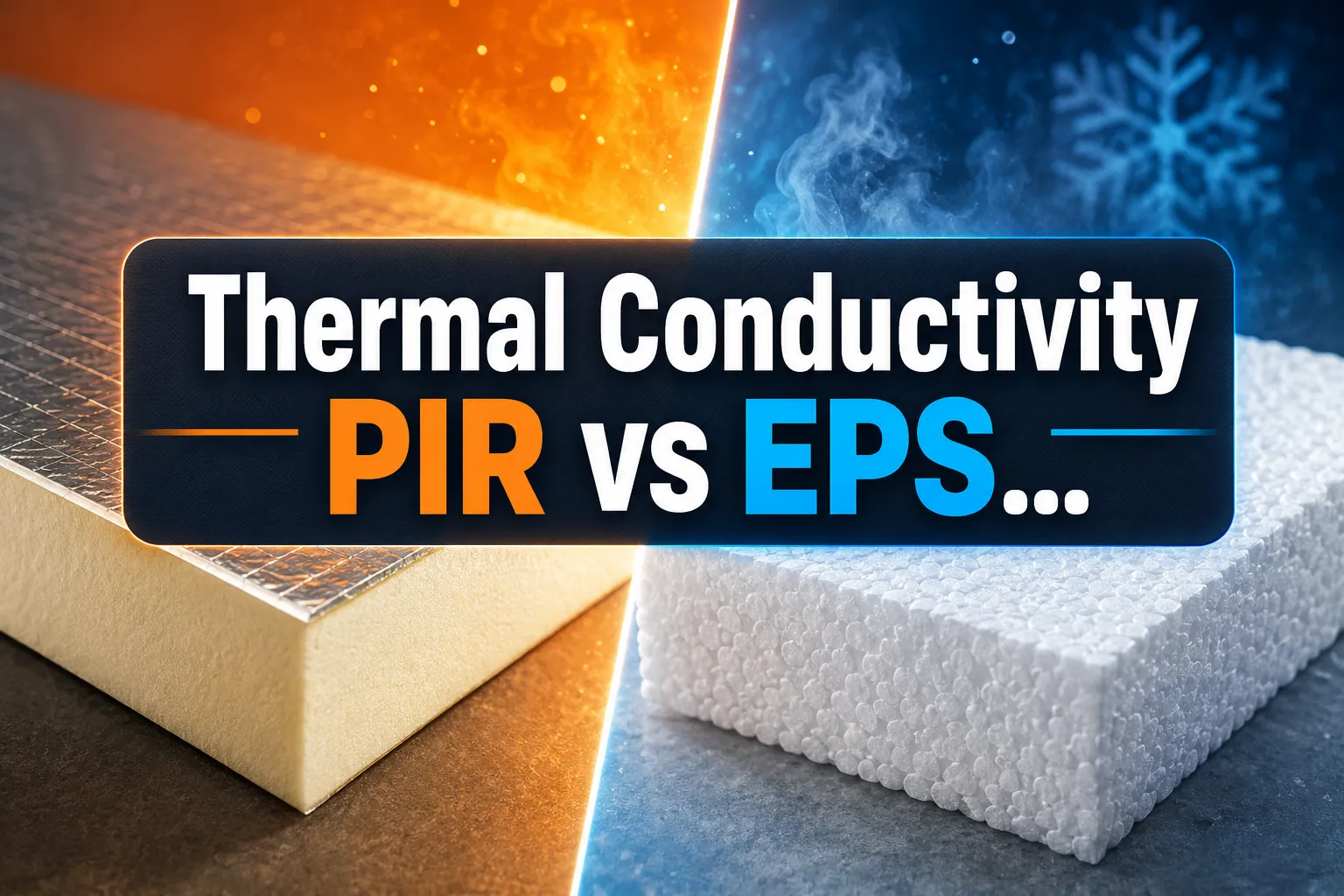
PIR insulation consistently outperforms EPS in thermal conductivity measurements. PIR achieves lambda values between 0.022-0.028 W/mK, while EPS typically ranges from 0.030-0.040 W/mK, representing a 20-40% performance advantage for PIR.
Thermal Performance Comparison:
| Material | Thermal Conductivity (W/mK) | R-Value per inch | Thickness for R-20 |
|---|---|---|---|
| PIR | 0.022-0.028 | R-5.0-6.5 | 3.1-4.0 inches |
| EPS | 0.030-0.040 | R-3.6-4.8 | 4.2-5.6 inches |
The superior performance stems from PIR's closed-cell structure and the thermal properties of the gas trapped within the cells. PIR initially contains pentane or other low-conductivity gases, though these gradually diffuse out over time. EPS contains air within its cells, which has higher thermal conductivity than the gases used in PIR.
Common mistake: Assuming all PIR or EPS products perform identically. Density, manufacturing quality, and aging significantly affect thermal conductivity values within each material category.
PIR Insulation Thermal Conductivity Rating
PIR insulation achieves its excellent thermal conductivity through advanced manufacturing processes and material science. Fresh PIR typically starts with thermal conductivity values as low as 0.020 W/mK, though this increases slightly over time as gases diffuse from the cells.
PIR Performance Factors:
- Initial conductivity: 0.020-0.022 W/mK when new
- Aged conductivity: 0.025-0.028 W/mK after 25 years
- Density impact: Higher density generally improves thermal performance
- Facer materials: Aluminum facers can reduce thermal bridging
The aging process occurs because the low-conductivity blowing agents gradually escape and are replaced by air. Most manufacturers provide aged thermal conductivity values for design purposes, ensuring long-term performance meets expectations.
Edge case: In extremely cold climates below -20°C, PIR thermal conductivity may increase more than EPS, potentially narrowing the performance gap in severe conditions.
EPS Insulation Thermal Conductivity Rating
EPS insulation thermal conductivity varies significantly based on density and manufacturing quality. Standard EPS achieves 0.035-0.040 W/mK, while high-performance variants can reach 0.030-0.032 W/mK through improved manufacturing and additives.
EPS Performance Categories:
- Standard EPS: 0.035-0.040 W/mK (15-20 kg/m³ density)
- Enhanced EPS: 0.030-0.035 W/mK (20-25 kg/m³ density)
- Graphite EPS: 0.030-0.032 W/mK (carbon additives improve performance)
- Aged performance: EPS thermal conductivity remains stable over time
Unlike PIR, EPS thermal conductivity doesn't significantly change with age since it contains air from manufacture. This stability makes EPS performance more predictable over building lifespans, though the initial performance remains lower than PIR.
Choose EPS when: Project budgets are constrained, adequate thickness is available, and moderate thermal performance meets building requirements.
Is PIR Insulation More Expensive Than EPS
PIR insulation costs 30-50% more than comparable EPS products, though the price gap varies by region, supplier, and specific product specifications. The higher cost reflects PIR's more complex manufacturing process and superior performance characteristics.
Cost Comparison Factors:
- Material cost: PIR typically $0.80-1.20 per board foot vs EPS $0.50-0.80
- Installation cost: Similar labor requirements for both materials
- Thickness requirements: PIR needs less thickness, potentially reducing overall system costs
- Long-term value: Better thermal performance may justify higher upfront costs
The total system cost comparison becomes more complex when considering required thickness. PIR's superior thermal performance means thinner installations can achieve the same R-values, potentially offsetting material cost differences through reduced structural requirements and space savings.
Decision rule: Choose PIR when space constraints justify the premium, or when energy-efficient building design requirements demand maximum performance per inch.
When Should I Use PIR Insulation vs EPS
Material selection depends on project-specific requirements including space constraints, performance targets, budget limitations, and environmental conditions. Each material excels in different applications based on these factors.
Use PIR insulation when:
- Space is limited and maximum R-value per inch is critical
- Building codes require high thermal performance
- Fire resistance is a priority concern
- Budget allows for premium performance materials
- Cold storage applications demand superior thermal control
Use EPS insulation when:
- Adequate thickness space is available
- Budget constraints are significant
- Moderate thermal performance meets requirements
- Large-area applications benefit from cost savings
- Structural loads favor lighter-weight materials
Common mistake: Selecting based solely on initial material cost without considering total system performance, thickness requirements, and long-term energy savings.
PIR Insulation Pros and Cons
PIR insulation offers excellent thermal performance but comes with specific advantages and limitations that affect project suitability.
PIR Advantages:
- Superior thermal conductivity (0.022-0.028 W/mK)
- Excellent fire resistance properties
- High compressive strength for structural applications
- Minimal thickness required for target R-values
- Good chemical resistance
- Suitable for high-temperature applications
PIR Disadvantages:
- Higher material costs (30-50% premium over EPS)
- Thermal performance degrades slightly over time
- More brittle than EPS, requiring careful handling
- Limited availability in some markets
- Potential for thermal bridging at joints without proper detailing
The performance advantages make PIR particularly valuable in space-constrained applications where thermal performance sandwich panels must deliver maximum efficiency.
EPS Insulation Pros and Cons
EPS insulation provides reliable thermal performance at competitive costs, making it suitable for many construction applications despite lower performance than PIR.
EPS Advantages:
- Lower material costs provide better budget flexibility
- Stable thermal performance over building lifetime
- Lightweight reduces structural loading requirements
- Easy to cut and install with standard tools
- Wide availability from multiple suppliers
- Good moisture resistance when properly installed
EPS Disadvantages:
- Lower thermal conductivity requires greater thickness
- Limited fire resistance compared to PIR
- Susceptible to damage from solvents and petroleum products
- Lower compressive strength than PIR
- Can shrink or deform under sustained loads
- Thermal bridging concerns with poor installation
Edge case: In applications requiring building acoustic insulation, EPS may provide better sound dampening due to its different cell structure, though this isn't its primary function.
Does PIR Insulation Absorb Water Like EPS Does
PIR insulation generally exhibits better moisture resistance than EPS, though both materials can experience moisture-related performance issues under certain conditions. PIR's closed-cell structure and manufacturing process create more uniform moisture barriers.
Moisture Resistance Comparison:
- PIR water absorption: Typically <2% by volume over 24 hours
- EPS water absorption: Usually 2-4% by volume over 24 hours
- Vapor permeability: Both materials have low vapor transmission rates
- Freeze-thaw resistance: PIR generally performs better in cycling conditions
The moisture absorption differences become significant in applications like cold room insulation where condensation and temperature cycling occur regularly. PIR's superior moisture resistance helps maintain thermal performance in these challenging conditions.
Installation consideration: Both materials require proper vapor barriers and installation techniques to prevent moisture infiltration, regardless of their inherent moisture resistance properties.
Can I Use EPS Instead of PIR Insulation
EPS can substitute for PIR in many applications, but requires increased thickness to achieve equivalent thermal performance and may not meet specific building code or performance requirements in all situations.
Substitution Requirements:
- Thickness adjustment: Increase EPS thickness by 25-40% to match PIR R-values
- Structural considerations: Verify framing can accommodate additional thickness
- Code compliance: Confirm EPS meets fire and thermal requirements
- Space constraints: Ensure adequate room for thicker insulation
Applications where substitution works well:
- Residential wall and roof insulation with adequate cavity depth
- Large commercial buildings where space isn't constrained
- Budget-sensitive projects prioritizing cost over maximum performance
Applications where PIR is preferred:
- Clean room construction requiring precise thermal control
- High-performance building envelopes with thickness limitations
- Applications requiring superior fire resistance ratings
PIR Insulation Common Mistakes Installation
PIR installation requires attention to specific details that differ from EPS handling and installation procedures. Understanding these requirements prevents performance issues and installation problems.
Critical Installation Mistakes:
- Inadequate joint sealing: PIR's rigidity makes gap sealing crucial for thermal bridging prevention
- Improper cutting techniques: Using wrong tools can damage cell structure and reduce performance
- Insufficient mechanical fastening: PIR's weight requires adequate structural attachment
- Ignoring thermal bridging: Metal fasteners and framing create significant thermal bridges without proper detailing
Best Installation Practices:
- Use sharp, fine-toothed saws for clean cuts
- Seal all joints with compatible tapes or sealants
- Install continuous insulation layers where possible
- Design fastening systems to minimize thermal bridging
- Protect from moisture during construction
Common mistake: Assuming PIR installs identically to EPS without accounting for material property differences and specific handling requirements.
Is EPS or PIR Better for Cold Climates
PIR generally performs better in cold climates due to superior thermal conductivity, though both materials face specific challenges in extreme temperature conditions that affect material selection.
Cold Climate Performance Factors:
- Thermal conductivity: PIR maintains better insulating properties at low temperatures
- Freeze-thaw cycling: PIR shows better dimensional stability through temperature cycles
- Moisture management: PIR's lower moisture absorption reduces freeze damage risks
- Installation conditions: Both materials can become brittle in extreme cold
PIR advantages in cold climates:
- Superior thermal performance reduces heating energy requirements
- Better moisture resistance prevents ice formation within insulation
- Maintains structural integrity through temperature cycling
- Reduced thickness requirements simplify cold-weather installation
EPS considerations for cold climates:
- Lower cost allows for increased thickness to improve performance
- Lighter weight reduces structural loading in snow-load regions
- Easier field modification in cold conditions
- Proven performance in many cold-climate applications
For critical applications like cold storage construction, PIR's performance advantages often justify the additional cost in cold climates.
How Long Does PIR Insulation Last vs EPS
Both PIR and EPS insulation offer excellent longevity when properly installed, though they age differently and face distinct long-term performance considerations.
PIR Lifespan Characteristics:
- Expected life: 25-30 years with gradual thermal performance decline
- Aging pattern: Thermal conductivity increases from 0.022 to 0.028 W/mK over time
- Performance stability: Maintains structural integrity throughout lifespan
- Degradation factors: UV exposure and extreme temperatures accelerate aging
EPS Lifespan Characteristics:
- Expected life: 30+ years with stable thermal performance
- Aging pattern: Minimal thermal conductivity changes over time
- Performance stability: Maintains consistent R-values throughout life
- Degradation factors: Physical damage and solvent exposure primary concerns
The key difference lies in performance predictability. EPS maintains consistent thermal properties throughout its life, while PIR experiences gradual performance reduction. However, aged PIR typically still outperforms new EPS in thermal conductivity.
Design consideration: Use aged thermal conductivity values for PIR in energy calculations, while EPS values remain constant for building lifespan calculations.
PIR Insulation Fire Rating Compared to EPS
Fire performance represents a significant differentiator between PIR and EPS insulation, with PIR generally achieving superior fire resistance ratings in standard building tests.
Fire Performance Comparison:
| Property | PIR | EPS |
|---|---|---|
| Ignition Temperature | 450-500°C | 300-350°C |
| Flame Spread Rating | Class A (0-25) | Class B-C (25-200) |
| Smoke Development | Low | Moderate |
| Self-Extinguishing | Yes | Limited |
PIR Fire Advantages:
- Higher ignition temperature provides better fire resistance
- Self-extinguishing properties limit fire spread
- Lower smoke production improves occupant safety
- Meets stricter building code requirements
EPS Fire Considerations:
- Requires fire barriers in many applications
- May need additional fire-resistant facings
- Limited use in high-fire-risk applications
- Cost-effective when fire barriers are acceptable
Code compliance: Many building codes mandate PIR or equivalent fire performance for specific applications, making material substitution impossible in fire-sensitive installations.
Frequently Asked Questions
What is the R-value difference between PIR and EPS per inch?
PIR provides R-5.0 to R-6.5 per inch compared to EPS at R-3.6 to R-4.8 per inch, representing a 25-40% performance advantage for PIR in equivalent thicknesses.
Can I mix PIR and EPS insulation in the same project?
Yes, but ensure proper thermal bridging control at transitions and verify that both materials meet project fire and performance requirements. Design thermal barriers appropriately for material changes.
Which insulation works better in high-humidity environments?
PIR generally performs better in high-humidity conditions due to lower moisture absorption rates and better resistance to condensation-related performance degradation.
Do PIR and EPS require different installation techniques?
PIR requires more careful handling due to brittleness and needs better joint sealing, while EPS is more forgiving but requires attention to compression and thermal bridging details.
How do I calculate the equivalent EPS thickness for PIR performance?
Multiply PIR thickness by 1.3-1.6 depending on specific product thermal conductivity values to determine equivalent EPS thickness for the same R-value.
Which material is more environmentally friendly?
Both materials offer long lifespans and energy savings that typically offset manufacturing impacts. EPS may have slightly lower embodied energy, while PIR provides better energy performance during use.
Can either material be used in below-grade applications?
Both can work below-grade with proper moisture protection, though PIR's superior moisture resistance makes it preferable for challenging below-grade conditions.
What happens to thermal performance in extreme temperatures?
PIR maintains better performance in moderate cold but both materials see reduced effectiveness in extreme conditions. EPS may perform relatively better in severe cold below -20°C.
Are there thickness limitations for either material?
Standard products range from 1-6 inches thickness. Custom thicknesses are available, though very thick sections may require special handling and installation considerations.
How do fastener requirements differ between materials?
PIR's higher density requires more robust fastening systems, while EPS needs careful compression control to prevent performance degradation from over-tightened fasteners.
Which material is better for retrofit applications?
EPS often works better for retrofits due to easier field modification and lower cost, unless space constraints make PIR's superior performance per inch necessary.
Do both materials work with radiant heating systems?
Both are compatible with radiant systems, though PIR's better thermal conductivity provides more responsive temperature control and better system efficiency.
Conclusion
The thermal conductivity comparison between PIR and EPS insulation reveals clear performance differences that should guide material selection based on project-specific requirements. PIR delivers superior thermal performance with 20-40% better conductivity values, making it ideal for space-constrained applications and high-performance building envelopes. However, EPS provides excellent value for projects with adequate thickness allowances and budget considerations.
Key selection factors include available space, budget constraints, fire resistance requirements, and long-term performance expectations. PIR excels when maximum thermal performance per inch is critical, while EPS offers reliable performance at lower costs for applications with sufficient installation depth.
Next Steps:
- Evaluate your project's space constraints and thermal performance requirements
- Compare total system costs including material, installation, and energy savings
- Verify building code compliance for fire resistance and thermal performance
- Consider long-term performance expectations and maintenance requirements
- Consult with insulation suppliers for project-specific product recommendations and technical support
For specialized applications requiring thermal insulation sandwich panels or energy-efficient building solutions, professional guidance ensures optimal material selection and installation success.
SEO Meta Title: PIR vs EPS Insulation Thermal Conductivity: 2026 Complete Guide