Last updated: May 20, 2026
Quick Answer
Bangladesh has a growing number of EPS panel manufacturers producing expanded polystyrene sandwich panels for construction, cold storage, industrial buildings, and clean rooms. Prices typically range from BDT 350 to BDT 900+ per square foot depending on thickness, facing material, and supplier. Choosing the right bangladesh eps panel manufacturer means verifying production capacity, core density, steel gauge, and after-sales support before signing any contract.
Key Takeaways
- EPS (expanded polystyrene) panels are lightweight, thermally efficient sandwich panels used in walls, roofs, cold storage, and prefabricated buildings.
- Bangladesh has multiple domestic manufacturers, reducing lead times and import costs compared to sourcing panels from China or India.
- Core density (typically 10–25 kg/m³) and steel skin thickness (0.4–0.6 mm) are the two most critical specs to verify.
- EPS panels perform well in Bangladesh's hot, humid climate but require proper sealing at joints to prevent moisture ingress.
- For earthquake-prone zones, EPS panels in a steel frame system perform better than traditional masonry because of their low weight.
- Typical lifespan is 25–40 years with proper installation and maintenance.
- EPS is recyclable, but fire resistance is lower than mineral wool or PU panels — check fire ratings for your application.
- Prices vary significantly by manufacturer; always request a detailed quotation with material certificates.
- Industries using EPS panels in Bangladesh include garments, pharmaceuticals, food processing, poultry farming, and cold chain logistics.
- Always confirm whether the quoted price includes delivery, installation, and accessories such as corner trims and fasteners.
What Exactly Are EPS Panels Used For?
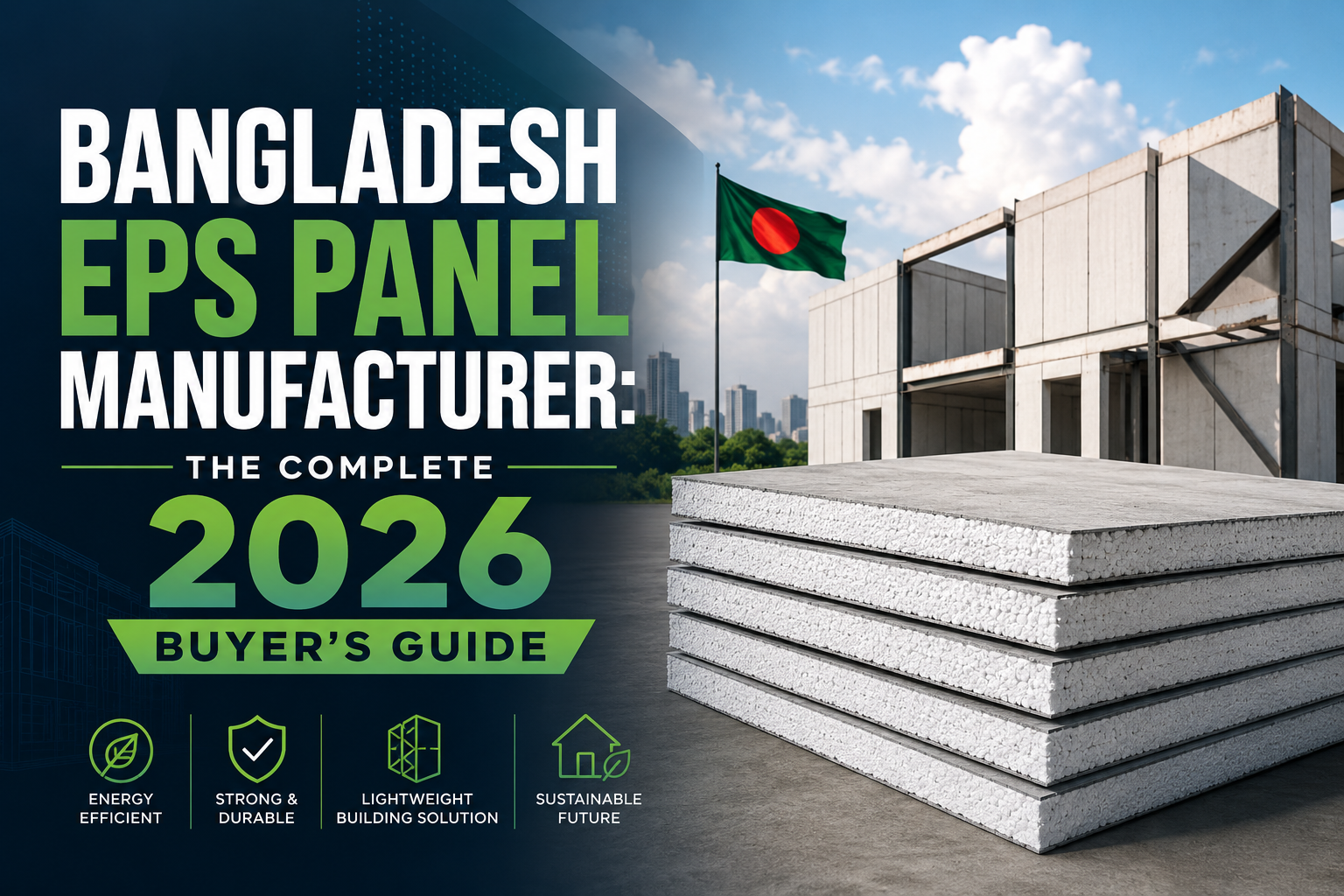
EPS panels — short for expanded polystyrene sandwich panels — are prefabricated building components made of a rigid polystyrene foam core bonded between two steel (or other material) facings. They serve as walls, roofs, partitions, and floor systems across a wide range of construction projects.
Common applications in Bangladesh include:
- 🏭 Industrial buildings: Factory walls and roofs where thermal control reduces cooling costs.
- ❄️ Cold storage and cold rooms: EPS core provides strong thermal resistance at a lower cost than PU panels for moderate temperature ranges (above -10°C).
- 🧪 Clean rooms and pharmaceutical facilities: Smooth steel facings are easy to clean and resist contamination.
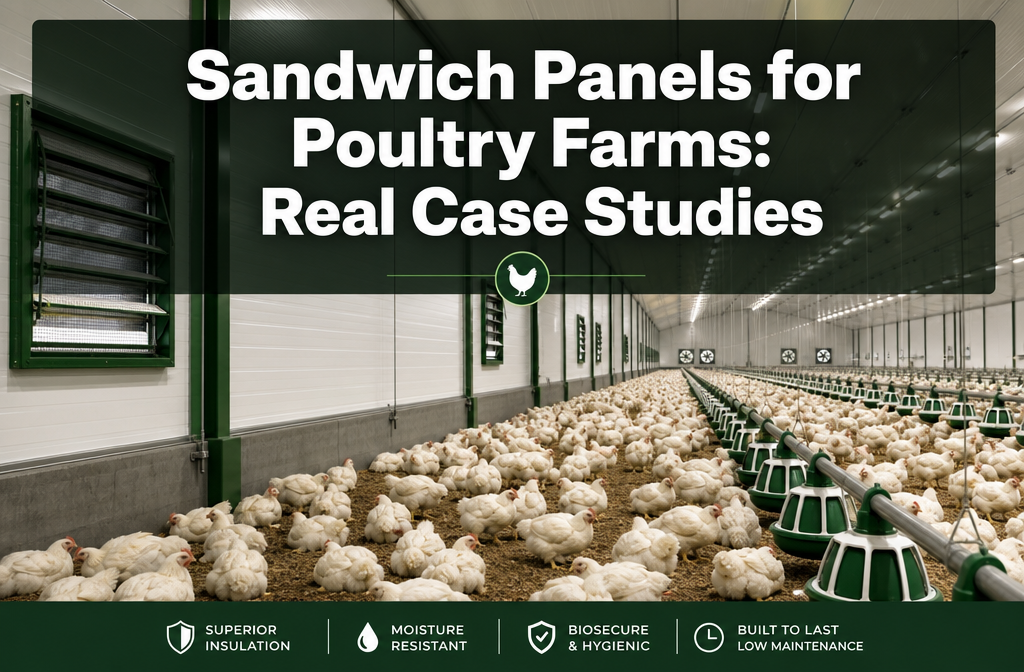
- 🐔 Poultry and livestock sheds: Lightweight panels reduce structural load and keep internal temperatures stable.
- 🏗️ Prefabricated offices and site cabins: Fast assembly makes EPS panels ideal for temporary or semi-permanent structures.
For a detailed breakdown of wall-specific applications, see the EPS Panel for Wall Bangladesh: 2026 Complete Buyer's Guide.
How Much Do EPS Panels Cost in Bangladesh?
EPS panel prices in Bangladesh generally range from BDT 350 to BDT 900 per square foot (as of 2026 estimates), depending on core thickness, steel gauge, and order volume. Thicker panels with heavier steel facings cost more but deliver better insulation and durability.
| Core Thickness | Typical Price Range (BDT/sq ft) | Best For |
|---|---|---|
| 50 mm | 350–480 | Partition walls, site offices |
| 75 mm | 450–580 | Factory walls, poultry sheds |
| 100 mm | 550–700 | Cold rooms (above -10°C), warehouses |
| 150 mm | 700–900+ | Deep cold storage, high-spec clean rooms |
Factors that shift the price:
- Steel skin thickness (0.4 mm vs. 0.5 mm vs. 0.6 mm)
- Surface finish (plain galvanized vs. pre-painted PPGI)
- Order quantity (bulk discounts are common above 500 m²)
- Delivery distance from the manufacturing plant
- Whether installation labor is included
For a broader look at market pricing, the Sandwich Panel Price in Bangladesh 2026 guide covers multiple panel types side by side.
Common mistake: Comparing only the per-square-foot rate without checking steel gauge. A panel quoted at BDT 380/sq ft with 0.35 mm steel will underperform a BDT 450/sq ft panel with 0.5 mm steel within two to three years.
Who Are the Top EPS Panel Manufacturers in Bangladesh?
Several established manufacturers produce EPS sandwich panels domestically, with most facilities concentrated in Dhaka, Gazipur, Narayanganj, and Chattogram. Rather than listing names that may change, the key criteria for identifying a reliable bangladesh eps panel manufacturer are:
- ISO certification or equivalent quality management system
- In-house EPS bead expansion and panel pressing (not just assembly)
- Traceable raw materials with mill certificates for steel coils
- Minimum 2–3 years of documented project references
- Technical support and warranty terms in writing
For a vetted list of suppliers, the Sandwich Panel Suppliers in Bangladesh: 2026 Buyer's Guide and the Best Insulated Panel Manufacturer BD: 2026 Buyer's Guide provide current, project-verified options.
Choose a local manufacturer if: your project is under 1,000 m², you need fast delivery, or you require on-site technical support.
Consider a larger regional supplier if: your project exceeds 5,000 m², requires fire-rated panels, or demands export-grade documentation.
What's the Difference Between EPS Panels and Other Insulation Materials?
EPS panels are one of three main sandwich panel core types used in Bangladesh. Each has distinct trade-offs.
| Property | EPS Panel | PU/PIR Panel | Rockwool Panel |
|---|---|---|---|
| Thermal conductivity | ~0.035–0.038 W/mK | ~0.022–0.025 W/mK | ~0.033–0.040 W/mK |
| Fire resistance | Low (melts, flammable) | Moderate (self-extinguishing grades) | High (non-combustible) |
| Cost | Lowest | Higher | Moderate–High |
| Moisture resistance | Good if sealed | Excellent | Moderate |
| Weight | Very light | Light | Heavier |
| Cold storage suitability | Good (above -10°C) | Excellent (down to -40°C) | Not ideal |
Bottom line: EPS panels are the most cost-effective choice for general construction, moderate-temperature cold rooms, and poultry buildings. For deep-freeze cold storage, PU panels are the better option. For fire-sensitive applications, rockwool panels are the safer choice.
See the Rockwool Sandwich Panel Bangladesh: 2026 Complete Guide for a detailed rockwool comparison.
Are EPS Panels Good for Residential or Commercial Construction?
EPS panels work well for commercial and light industrial construction in Bangladesh. For standard residential use, they are less common but gaining traction in prefabricated housing and rural construction.
Residential use: EPS panels are suitable for single-story homes, site offices, and low-cost housing projects. They reduce construction time significantly compared to brick and mortar. The main concern is fire safety — EPS is combustible, so fire-retardant grades and proper finishing are essential.
Commercial use: Garment factories, pharmaceutical warehouses, food processing plants, and logistics hubs in Bangladesh widely use EPS sandwich panels for their speed of installation and thermal performance.
Edge case: Multi-story commercial buildings above four floors typically require EPS panels as cladding or partition only, not as primary structural elements, because the panels themselves are not load-bearing in most standard configurations.
How Do EPS Panels Perform in Bangladesh's Hot and Humid Climate?
EPS panels perform reliably in Bangladesh's climate when installed correctly. The foam core resists moisture absorption better than mineral wool, and the steel facings protect the core from direct humidity exposure.
Key performance points:
- EPS core does not rot, warp, or support mold growth under normal conditions.
- Thermal resistance (R-value) remains stable over time, unlike some organic insulation materials.
- The critical vulnerability is joint sealing: gaps at panel connections allow humid air to condense inside the wall cavity, leading to corrosion of the steel facings over time.
- In coastal areas (Chattogram, Cox's Bazar), specify zinc-aluminum coated steel or PVDF-coated facings rather than standard galvanized steel for better corrosion resistance.
Practical tip: Ask your bangladesh eps panel manufacturer to demonstrate their joint sealing system (cam-lock, tongue-and-groove, or foam tape) before ordering. Poor joint design is the single biggest cause of early panel failure in humid climates.
Can EPS Panels Be Used in Earthquake-Prone Areas?
Yes, EPS sandwich panels are actually well-suited for seismically active zones when used within a proper structural frame. Bangladesh's eastern and southeastern regions (Sylhet, Chattogram) carry moderate to high seismic risk.
Why EPS panels perform well in earthquakes:
- Very low self-weight reduces seismic force on the structure (seismic load is proportional to mass).
- Panels flex slightly rather than cracking like brick masonry.
- Prefabricated steel-framed EPS buildings can be designed to meet seismic codes more predictably than traditional construction.
Important constraint: The panels themselves are non-structural infill in most designs. The steel or concrete frame carries the seismic load. Confirm with a structural engineer that the frame design meets BNBC (Bangladesh National Building Code) seismic provisions before finalizing panel specifications.
What Technical Specifications Should I Look for in an EPS Panel?
A reputable bangladesh eps panel manufacturer should provide a full technical data sheet. Here are the specifications that matter most:
Core specifications:
- EPS density: 15–20 kg/m³ for standard construction; 20–25 kg/m³ for cold storage
- Compressive strength: minimum 100 kPa at 10% deformation
- Thermal conductivity: ≤ 0.038 W/mK
Facing specifications:
- Steel grade: DX51D or equivalent (hot-dip galvanized)
- Coating: Z100 minimum (100 g/m² zinc) or PPGI with 25 μm polyester coating
- Thickness: 0.4–0.6 mm (0.5 mm is the practical minimum for industrial use)
Panel dimensions:
- Standard widths: 950 mm or 1,000 mm (effective coverage)
- Lengths: custom cut, typically up to 12 m
- Thickness: 50 mm to 200 mm depending on application
Certifications to request:
- Material test reports for EPS core (density, compressive strength)
- Mill certificates for steel coils
- Fire classification (if required by your project)
For a comprehensive technical comparison, the EPS Sandwich Panel Bangladesh: Complete 2026 Buyer's Guide covers specification selection in detail.
How Long Do EPS Panels Typically Last?
EPS sandwich panels from a quality bangladesh eps panel manufacturer have a service life of 25 to 40 years under normal conditions. The steel facings are the limiting factor, not the EPS core itself.
Factors that extend lifespan:
- Heavier zinc coating on steel (Z200 vs. Z100)
- Proper joint sealing at installation
- Regular inspection and resealing of cut edges
- Avoiding direct mechanical damage to panel surfaces
Factors that shorten lifespan:
- Coastal or highly corrosive industrial environments without upgraded coatings
- Poor drainage design that allows water to pool at panel bases
- Cutting panels on-site without sealing exposed EPS edges
Are EPS Panels Environmentally Friendly?
EPS panels have a mixed environmental profile. On the positive side, they reduce building energy consumption significantly, which lowers lifetime carbon emissions. EPS itself is technically recyclable, and several manufacturers in Bangladesh now accept off-cuts for reprocessing.
Environmental considerations:
- ✅ Low embodied energy compared to concrete and brick
- ✅ Reduces HVAC energy use by 20–40% (estimate based on standard thermal modeling assumptions for tropical climates)
- ✅ Recyclable EPS core at end of life
- ⚠️ Steel facings require energy-intensive production
- ⚠️ EPS is derived from petroleum (styrene monomer)
- ⚠️ Standard EPS is combustible — fire events release toxic gases
For projects with sustainability targets, consider asking your supplier about fire-retardant EPS grades or comparing with thermal insulation sandwich panel options that may better fit your environmental criteria.
What Industries Use EPS Panels in Bangladesh?
EPS panels serve a broad range of industries across Bangladesh in 2026. The construction boom driven by export-oriented manufacturing, cold chain expansion, and pharmaceutical sector growth has made EPS panels one of the most widely specified building products in the country.
Key industries:
- Garment and textile factories: Fast construction timelines and thermal comfort for workers.
- Pharmaceutical and biotech: Clean room partitions and temperature-controlled storage areas.
- Food processing and cold chain: Moderate-temperature cold rooms and hygienic wall surfaces.
- Poultry and aquaculture: Thermally stable sheds that improve feed conversion and reduce mortality.
- Logistics and warehousing: Large-span roofing and wall systems for distribution centers.
- Hospitals and healthcare: Partition systems and sterile area construction.
For warehouse-specific guidance, see Sandwich Panel for Warehouse Bangladesh: 2026 Guide, and for factory applications, the Factory Building Panel Bangladesh: 2026 Complete Guide covers structural and specification details.
Common Problems With EPS Panel Installation
Even high-quality panels from a trusted manufacturer can fail if installation is poor. These are the most frequently reported issues on Bangladesh construction sites:
- Improper joint sealing — Gaps at cam-lock joints allow moisture infiltration. Always apply manufacturer-specified foam tape or sealant before engaging joints.
- Cutting without edge sealing — Exposed EPS absorbs moisture and degrades steel bond at cut edges. Seal all cut edges with aluminum tape or edge trim.
- Incorrect fastener spacing — Over-spaced fasteners lead to panel deflection under wind load. Follow the manufacturer's fastener schedule, not a generic rule of thumb.
- Panel base contact with standing water — Panels installed without a raised base or proper drainage channel corrode at the bottom within two to three years.
- Mixing panel batches — Different production batches can have slight thickness variations that create alignment issues. Order full projects from a single production run where possible.
- Overloading during storage — Stacking panels more than 10–12 high on-site can compress the EPS core and reduce thermal performance permanently.
FAQ
Q: What is the minimum order quantity for EPS panels from a Bangladesh manufacturer?
Most manufacturers accept orders from 100 m² upward, but pricing becomes competitive above 300–500 m². Smaller orders may carry a setup surcharge.
Q: Can EPS panels be used for cold rooms that go below -20°C?
No. Standard EPS panels are not recommended below -10°C to -15°C. For deep-freeze applications, PU (polyurethane) panels with higher core density are the appropriate choice.
Q: How long does EPS panel installation take compared to brick construction?
A skilled installation team can erect 200–300 m² of EPS panel wall per day. Equivalent brick masonry typically takes five to ten times longer for the same area.
Q: Do Bangladesh EPS panel manufacturers offer custom panel lengths?
Yes. Most manufacturers cut panels to custom lengths up to 11–12 meters. Confirm maximum length capacity and whether custom cutting carries an additional charge.
Q: Are EPS panels approved under the Bangladesh National Building Code (BNBC)?
EPS sandwich panels are used widely in Bangladesh, but BNBC does not have a dedicated EPS panel standard as of 2026. Projects typically comply through structural engineering sign-off and reference to international standards (EN 14509, ASTM C578).
Q: What is the difference between EPS density 15 kg/m³ and 20 kg/m³?
Higher density EPS (20 kg/m³) has better compressive strength, slightly lower thermal conductivity, and greater dimensional stability. It costs roughly 10–15% more and is recommended for cold storage floors and high-traffic partition walls.
Q: Can I export EPS panels manufactured in Bangladesh?
Yes. Several Bangladeshi manufacturers export to neighboring countries. For export-related information, see the Bangladesh Sandwich Panel Exporter: 2026 Buyer's Guide.
Q: How do I verify a manufacturer's EPS core density claim?
Request a third-party lab test report. A simple field check: weigh a known volume of core material and calculate density (mass ÷ volume). A 1m × 1m × 0.1m sample should weigh 1.5–2.5 kg for 15–25 kg/m³ density.
Q: What warranty should I expect from a reputable EPS panel manufacturer in Bangladesh?
Reputable manufacturers offer 5–10 years on the panel system (excluding mechanical damage). Get the warranty terms in writing, including what voids coverage.
Q: Are fire-rated EPS panels available in Bangladesh?
Fire-retardant EPS grades are available but less common than standard EPS. For applications requiring fire ratings, consider fire rated sandwich panel options using mineral wool or PIR cores instead.
Conclusion
Selecting the right bangladesh eps panel manufacturer comes down to three practical steps: verify technical specifications (density, steel gauge, coating), check project references in your specific application sector, and get written documentation covering warranty, material certificates, and installation support.
Actionable next steps:
- Define your project requirements: application type, required thickness, fire rating, and climate exposure.
- Request quotations from at least three manufacturers, specifying the same core density and steel gauge so prices are genuinely comparable.
- Ask each supplier for a material test report and at least two reference projects you can visit or verify.
- Review the Sandwich Panel Buying Guide Bangladesh 2026 before finalizing your specification.
- Confirm installation responsibility, site supervision, and post-installation inspection terms in your contract.
Bangladesh's EPS panel manufacturing sector is mature enough to deliver quality products at competitive prices — but only if buyers apply consistent technical scrutiny rather than selecting on price alone.
References
- Bangladesh National Building Code (BNBC), 2020 edition. Government of Bangladesh, Housing and Building Research Institute.
- EN 14509:2013 — Self-supporting double skin metal faced insulating panels. European Committee for Standardization, 2013.
- ASTM C578-22 — Standard Specification for Rigid, Cellular Polystyrene Thermal Insulation. ASTM International, 2022.
- European Manufacturers of EPS (EUMEPS). EPS White Book: Thermal Insulation in Buildings. EUMEPS, 2021. https://www.eumeps.org
- Bangladesh Bureau of Statistics. Survey of Manufacturing Industries. BBS, 2022.