Last updated: July 31, 2026

Quick Answer: A sandwich panel for cold storage system consists of two metal facings bonded to an insulating core (typically polyurethane or EPS foam), providing superior thermal insulation, structural strength, and moisture resistance essential for maintaining consistent temperatures in commercial refrigeration facilities. These panels offer R-values of 6-8 per inch and can maintain temperature differentials of 60°F or more between interior and exterior environments.
Key Takeaways
- Sandwich panels combine structural strength with thermal insulation in a single component
- Polyurethane (PU) cores provide the best thermal performance for freezer applications below 0°F
- Panel thickness ranges from 2-8 inches depending on temperature requirements and climate zone
- Proper installation prevents thermal bridging and condensation issues that plague traditional construction
- Fire-rated panels are mandatory for commercial cold storage facilities in most jurisdictions
- Expected lifespan is 20-25 years with proper maintenance and quality installation
- Cost ranges from $8-15 per square foot depending on core material and thickness
- Interlocking joint systems eliminate air gaps and thermal bridges between panels
What Are Sandwich Panels and How Do They Work in Cold Storage
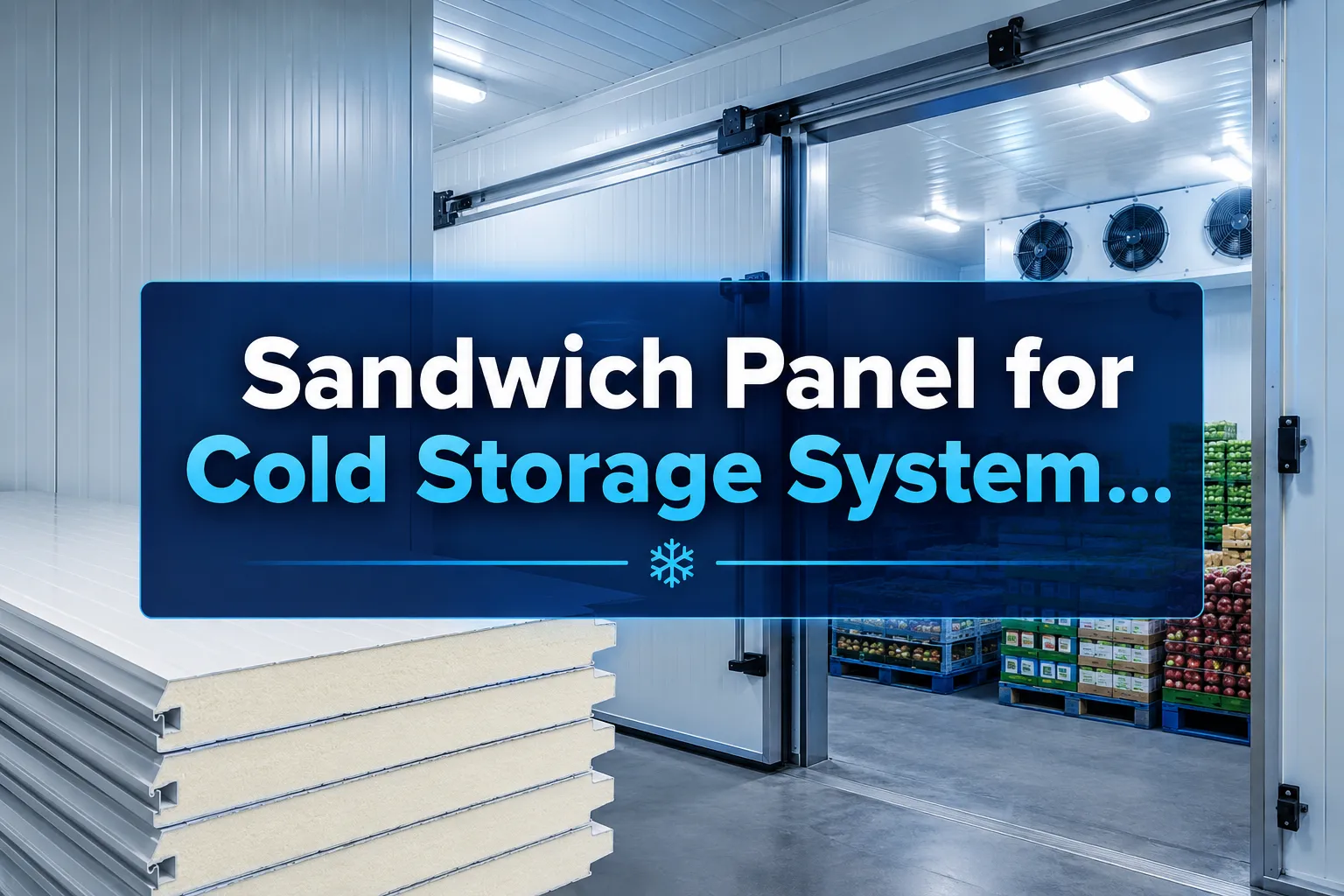
Sandwich panels are composite building materials consisting of two thin, strong facings bonded to a lightweight insulating core. In cold storage applications, these panels function as both the structural wall system and primary thermal barrier, eliminating the need for separate framing, insulation, and vapor barriers.
The outer facings are typically made from galvanized steel, stainless steel, or aluminum, providing structural integrity and weather resistance. The insulating core – usually expanded polystyrene (EPS), extruded polystyrene (XPS), or polyurethane (PU) foam – creates a continuous thermal barrier that prevents heat transfer.
Key performance advantages include:
- Continuous insulation without thermal bridging
- Integrated vapor barrier properties
- Self-supporting structural capability
- Factory-controlled quality and density
- Rapid installation compared to traditional methods
The panels connect through interlocking joint systems that maintain thermal continuity across the entire wall assembly. This eliminates the weak points common in traditional construction where studs, plates, and fasteners create thermal bridges.
Choose sandwich panels when you need consistent temperatures below 50°F, have limited construction time, or require easy future expansion capabilities.
Best Sandwich Panel Materials for Freezer Rooms
Polyurethane (PU) foam cores provide the highest thermal performance for freezer applications, with R-values of 7-8 per inch compared to 4-5 per inch for EPS alternatives. For facilities maintaining temperatures below 0°F, PU panels are typically the only viable option.
Core Material Comparison
| Core Type | R-Value per Inch | Best Application | Temperature Range |
|---|---|---|---|
| Polyurethane (PU) | 7-8 | Freezers, blast chillers | -20°F to 35°F |
| Expanded Polystyrene (EPS) | 4-5 | Coolers, moderate cold storage | 32°F to 50°F |
| Extruded Polystyrene (XPS) | 5-6 | High-moisture environments | 25°F to 45°F |
| Polyisocyanurate (PIR) | 6-7 | Fire-rated applications | -10°F to 40°F |
Facing material selection depends on environmental conditions:
- Stainless steel: Food processing areas requiring frequent washdown
- Galvanized steel with food-grade coating: Standard cold storage applications
- Aluminum: Corrosive environments or coastal locations
Common mistake: Using EPS panels in freezer applications below 20°F often results in inadequate insulation and condensation problems within the panel core.
For more details on specific PU panel applications, see our PU sandwich panel for cold room guide.
Sandwich Panel vs Traditional Insulation for Cold Storage
Sandwich panels outperform traditional stick-frame construction with batt insulation by eliminating thermal bridges and providing consistent R-values across the entire wall assembly. Traditional methods typically lose 20-30% of their theoretical insulation value due to framing thermal bridges and installation gaps.
Performance Comparison
Traditional Construction Challenges:
- Thermal bridging through metal studs reduces effective R-value
- Vapor barrier installation requires perfect sealing
- Multiple trade coordination increases error potential
- Field-installed insulation density varies significantly
Sandwich Panel Advantages:
- Factory-controlled insulation density and quality
- Integrated vapor barrier eliminates sealing concerns
- Single-component installation reduces coordination issues
- Continuous insulation maintains design R-values
Energy cost analysis shows sandwich panels typically reduce cooling energy consumption by 15-25% compared to traditional construction in commercial cold storage facilities.
Choose traditional construction when initial budget is severely constrained or when integrating with existing stick-frame structures. Choose sandwich panels when long-term energy costs, installation speed, or thermal performance are priorities.
How Much Does a Sandwich Panel Cost for Cold Storage
Sandwich panel costs for cold storage range from $8-15 per square foot installed, depending on core material, thickness, and project size. This represents a 20-40% premium over traditional insulated construction but typically pays back through energy savings within 3-5 years.
Cost Breakdown by Panel Type
- EPS Core Panels: $8-11 per sq ft (2-4 inch thickness)
- PU Core Panels: $12-15 per sq ft (3-6 inch thickness)
- Fire-Rated Panels: Add $2-4 per sq ft premium
- Stainless Steel Facing: Add $3-5 per sq ft premium
Additional cost factors:
- Corner and transition pieces: $25-50 per linear foot
- Installation labor: $2-4 per sq ft (varies by region)
- Structural support modifications: $500-2000 per project
Project size significantly impacts pricing – orders over 5,000 sq ft typically receive 10-15% volume discounts from manufacturers.
Budget for 20% contingency on first-time installations as learning curve and site conditions often require additional materials.
For current pricing in specific markets, check our sandwich panel price guide.
Sandwich Panel Installation Problems and Solutions
The most common installation problems are improper joint sealing and inadequate structural support, which can compromise both thermal performance and structural integrity. Professional installation training reduces these issues by 80% compared to untrained crews.
Critical Installation Issues
Joint Sealing Problems:
- Issue: Gaps at panel connections create thermal bridges
- Solution: Use manufacturer-specified sealants and gaskets at all joints
- Prevention: Pre-fit panels before final installation
Structural Support Inadequacy:
- Issue: Insufficient framing causes panel deflection and joint failure
- Solution: Engineer structural support for panel loads plus wind/seismic forces
- Prevention: Follow manufacturer's structural requirements exactly
Condensation Management:
- Issue: Improper vapor barrier continuity causes moisture buildup
- Solution: Seal all penetrations with compatible vapor barrier tape
- Prevention: Plan electrical and mechanical penetrations before installation
Common mistake: Attempting to cut costs by reducing structural support often results in panel failure and complete reinstallation within 2-3 years.
Installation timeline typically requires 3-5 days per 1,000 sq ft with experienced crews, compared to 7-10 days for traditional construction methods.
Sandwich Panel Alternatives for Cold Storage Systems
Primary alternatives to sandwich panels include spray foam insulation systems, structural insulated panels (SIPs), and traditional batt insulation with separate vapor barriers. Each alternative has specific applications where it may outperform sandwich panels.
Alternative Comparison
Spray Foam Systems:
- Best for: Irregular shapes, retrofit applications
- Thermal performance: R-6 to R-7 per inch
- Cost: $1.50-3.00 per sq ft per inch
- Drawback: Requires skilled application, weather-dependent installation
Structural Insulated Panels (SIPs):
- Best for: New construction, residential-scale projects
- Thermal performance: R-4 to R-6 per inch
- Cost: $6-10 per sq ft
- Drawback: Limited availability in commercial thicknesses
Traditional Batt + Vapor Barrier:
- Best for: Budget-constrained projects, small spaces
- Thermal performance: R-3 to R-4 effective (after thermal bridging)
- Cost: $3-6 per sq ft
- Drawback: Installation complexity, thermal bridging issues
Choose alternatives when project budgets are severely limited, irregular geometries make panel installation difficult, or when integrating with existing traditional construction.
Are Sandwich Panels Good for Industrial Freezers
Yes, sandwich panels are ideal for industrial freezers because they provide the continuous insulation and structural strength required for large-scale refrigeration systems operating at sub-zero temperatures. Industrial applications benefit most from the scalability and consistent performance of panel systems.
Industrial freezer requirements that favor sandwich panels:
- Large wall areas requiring consistent thermal performance
- Structural loads from racking systems and equipment
- Frequent temperature cycling without thermal stress
- Easy expansion capability for growing operations
- Minimal maintenance requirements in harsh environments
Performance in industrial settings shows sandwich panels maintain their R-value over 20+ years, while traditional insulation systems often degrade 15-25% within the first decade due to settling and moisture infiltration.
Typical industrial applications include:
- Food processing blast freezers (-20°F to -40°F)
- Pharmaceutical cold storage (2°F to 8°F)
- Ice cream manufacturing facilities (-10°F to 0°F)
- Frozen food distribution centers (0°F to 10°F)
Size considerations: Projects over 10,000 sq ft of wall area typically see 25-35% cost savings with sandwich panels compared to traditional construction due to reduced labor and faster installation.
For industrial applications, explore our cold storage panel types guide.
Sandwich Panel Thickness for Different Temperature Zones
Panel thickness requirements increase with greater temperature differentials, ranging from 2-3 inches for moderate cooling applications to 6-8 inches for blast freezer operations. Proper thickness selection prevents condensation within the panel core and ensures energy efficiency.
Thickness Guidelines by Application
Cooler Applications (35°F to 50°F):
- 2-3 inch panels: Adequate for most climates
- R-value needed: R-14 to R-21
- Typical core: EPS or PU
Freezer Applications (0°F to 32°F):
- 4-5 inch panels: Standard thickness
- R-value needed: R-28 to R-35
- Typical core: PU foam only
Blast Freezer Applications (-20°F to 0°F):
- 6-8 inch panels: Required thickness
- R-value needed: R-42 to R-56
- Typical core: High-density PU foam
Climate zone adjustments:
- Hot, humid climates: Add 1 inch to standard thickness
- Moderate climates: Use standard recommendations
- Cold climates: May reduce thickness by 0.5-1 inch
Engineering rule: Calculate required R-value based on design temperature differential, then add 20% safety margin to prevent condensation risk.
Common mistake: Under-sizing panel thickness to save initial costs typically results in 30-50% higher energy costs and potential condensation problems.
How Long Do Sandwich Panels Last in Cold Storage
High-quality sandwich panels typically last 20-25 years in cold storage applications when properly installed and maintained. Panel lifespan depends primarily on core material quality, facing protection, and maintenance practices.
Factors affecting panel longevity:
- Core material stability: PU foam maintains properties longer than EPS
- Facing corrosion protection: Proper coatings prevent premature failure
- Installation quality: Poor sealing reduces lifespan by 30-40%
- Maintenance frequency: Annual inspections extend service life significantly
Expected performance timeline:
- Years 1-10: Minimal degradation with proper installation
- Years 10-15: Minor sealant replacement may be needed
- Years 15-20: Facing maintenance becomes more frequent
- Years 20-25: Core insulation properties remain stable
Signs requiring panel replacement:
- Visible core material exposure or damage
- Persistent condensation or ice formation on panel surfaces
- Significant increase in cooling energy consumption
- Structural deflection or joint separation
Maintenance extends lifespan – facilities with annual inspection and maintenance programs typically achieve 25-30 year panel life compared to 15-20 years without maintenance.
Warranty considerations: Most manufacturers provide 10-15 year warranties on thermal performance and 20+ year warranties against manufacturing defects.
Sandwich Panel Fire Rating Requirements for Cold Storage
Commercial cold storage facilities typically require fire-rated sandwich panels with minimum 1-hour fire resistance ratings, though specific requirements vary by building size, occupancy type, and local codes. Fire-rated cores use mineral wool or specially formulated polyurethane that maintains structural integrity during fire exposure.
Fire rating classifications:
- Class A: Non-combustible, suitable for all applications
- Class B: Limited combustibility, acceptable for most cold storage
- Class C: Combustible but fire-retardant treated
Code requirements by facility type:
- Food processing plants: Typically require Class A rated panels
- Distribution warehouses: Class B often acceptable
- Retail cold storage: Varies by building size and occupancy load
Fire-rated core options:
- Mineral wool (rockwool): Non-combustible, excellent fire performance
- Fire-retardant PU: Maintains insulation properties with improved fire resistance
- Polyisocyanurate (PIR): Good thermal and fire performance combination
Cost impact: Fire-rated panels typically cost $2-4 per sq ft more than standard panels but may be required by insurance policies regardless of code requirements.
Installation considerations: Fire-rated panels require compatible fire-rated sealants and gaskets to maintain the fire rating of the complete assembly.
For fire safety details, see our fire-rated sandwich panel guide.
Can You Use Regular Sandwich Panels in Walk-In Coolers
Regular sandwich panels can be used in walk-in coolers, but they must be specifically designed for cold storage applications with appropriate core materials and vapor barrier properties. Standard building panels lack the thermal performance and moisture resistance needed for refrigerated environments.
Requirements for walk-in cooler panels:
- Minimum R-value: R-14 for cooler applications (35°F-50°F)
- Vapor barrier: Continuous barrier on warm side of insulation
- Core material: Closed-cell foam (EPS or PU) to prevent moisture absorption
- Joint design: Interlocking system to eliminate thermal bridges
Standard building panels vs. cold storage panels:
- Insulation thickness: Building panels often inadequate for temperature control
- Vapor barrier: May lack proper moisture protection
- Joint sealing: Standard panels may not provide airtight connections
- Facing materials: May not be food-grade or cleanable
Walk-in cooler specific considerations:
- Door integration: Panels must accommodate door frames and hardware
- Interior finish: Food-grade surfaces required for commercial applications
- Drainage: Floor-to-wall connections must prevent water infiltration
Cost comparison: Cold storage specific panels cost 15-25% more than standard building panels but prevent moisture and efficiency problems that require expensive remediation.
Choose cold storage panels when maintaining consistent temperatures below 50°F or when food safety regulations apply to the facility.
Sandwich Panel Condensation Issues in Cold Storage
Condensation problems in sandwich panels typically result from vapor barrier failures, thermal bridging, or inadequate panel thickness for the temperature differential. Proper design and installation eliminate 95% of condensation issues in cold storage applications.
Primary condensation causes:
- Vapor barrier discontinuity: Gaps allow warm, humid air into insulation
- Thermal bridging: Metal connections create cold spots where condensation forms
- Insufficient insulation: Under-sized panels allow surface temperatures below dew point
- Air leakage: Poor joint sealing permits humid air infiltration
Prevention strategies:
- Continuous vapor barrier: Seal all joints, penetrations, and connections
- Thermal break design: Isolate metal connections from cold surfaces
- Proper thickness: Calculate required R-value with safety margin
- Quality installation: Use trained installers familiar with cold storage requirements
Troubleshooting existing condensation:
- Surface condensation: Usually indicates insufficient insulation thickness
- Edge condensation: Typically caused by thermal bridging at connections
- Random condensation: Often results from air leaks or vapor barrier gaps
Repair solutions:
- Minor issues: Additional sealant application at problem areas
- Significant problems: Panel replacement with proper vapor barrier installation
- Systematic issues: Complete thermal analysis and redesign may be required
Prevention is critical – condensation damage to panel cores typically requires complete panel replacement at 3-5 times the cost of proper initial installation.
Best Brands for Cold Storage Sandwich Panels
Leading cold storage sandwich panel manufacturers include Kingspan, Metl-Span, MBCI, and Nucor, each offering specialized products for refrigeration applications. Brand selection should prioritize thermal performance, warranty coverage, and local technical support availability.
Top-tier manufacturers:
- Kingspan: Premium PU panels, excellent technical support
- Metl-Span: Wide range of core options, strong commercial focus
- MBCI: Cost-effective solutions, good availability
- Nucor: Structural strength focus, large project capability
Evaluation criteria for brand selection:
- Thermal performance: Verified R-values and long-term stability data
- Quality certifications: ISO 9001, UL listings, ICC-ES reports
- Warranty terms: Length and coverage of thermal performance guarantees
- Technical support: Engineering assistance and installation training
- Local availability: Regional distribution and service capabilities
Regional considerations:
- Coastal areas: Prioritize corrosion-resistant facing materials
- High-humidity climates: Focus on vapor barrier performance
- Seismic zones: Verify structural testing and approval
- Cold climates: Emphasize thermal cycling performance
Cost vs. quality balance: Premium brands typically cost 10-20% more but offer superior warranties and technical support that reduce long-term risk.
Due diligence steps: Request project references, review warranty terms, and verify local technical support availability before final selection.
For manufacturer options in specific regions, see our sandwich panel suppliers guide.
Sandwich Panel Maintenance and Cleaning Tips
Regular maintenance of sandwich panels in cold storage involves monthly visual inspections, annual sealant checks, and immediate repair of any damage to prevent moisture infiltration and thermal performance degradation. Proper maintenance extends panel life by 25-40% compared to neglected installations.
Monthly inspection checklist:
- Visual examination: Look for dents, scratches, or facing damage
- Joint inspection: Check for gaps, cracks, or sealant deterioration
- Condensation monitoring: Note any moisture formation patterns
- Temperature monitoring: Verify consistent cooling performance
Annual maintenance tasks:
- Sealant renewal: Replace deteriorated joint sealants
- Facing cleaning: Remove accumulated dirt and contaminants
- Fastener inspection: Check and tighten loose connections
- Thermal imaging: Identify potential insulation problems
Cleaning procedures for food-grade environments:
- Approved cleaners: Use food-safe, non-abrasive cleaning products
- Gentle techniques: Avoid high-pressure washing that can damage seals
- Drying requirements: Ensure complete drying to prevent moisture infiltration
- Frequency: Clean based on contamination levels and regulatory requirements
Damage repair protocols:
- Minor scratches: Touch-up paint to prevent corrosion
- Small dents: Monitor for sealant integrity, repair if needed
- Significant damage: Replace affected panels to maintain thermal performance
- Emergency repairs: Temporary sealing until permanent repairs possible
Documentation importance: Maintain maintenance records for warranty claims and regulatory compliance requirements.
Professional vs. in-house maintenance: Complex repairs and thermal performance issues typically require manufacturer-trained technicians, while routine cleaning and inspection can be handled by facility staff.
Frequently Asked Questions
What is the minimum thickness for freezer sandwich panels?
Freezer applications typically require 4-inch minimum thickness with PU foam core to achieve adequate R-values for temperatures below 32°F. Thinner panels risk condensation and inadequate thermal performance.
Can sandwich panels be cut on-site for custom fits?
Yes, panels can be field-cut using proper tools, but cut edges must be sealed with manufacturer-approved edge sealing compounds to maintain vapor barrier integrity and prevent core exposure.
How do sandwich panels connect to concrete floors?
Panels connect to floors using thermal break base tracks that prevent thermal bridging while providing structural attachment. The connection must include vapor barrier continuity to prevent moisture infiltration.
Are sandwich panels suitable for outdoor cold storage?
Yes, with proper facing materials and weather sealing. Outdoor applications require UV-resistant coatings and enhanced weather sealing at all joints and penetrations.
What happens if a sandwich panel gets damaged?
Minor damage can often be repaired with sealants and touch-up coatings. Significant damage that exposes the core typically requires panel replacement to maintain thermal performance and prevent moisture problems.
Do sandwich panels require special structural support?
Sandwich panels are self-supporting for typical spans but require proper structural framing designed for panel loads, wind forces, and seismic requirements per local building codes.
Can you install electrical systems through sandwich panels?
Electrical penetrations are possible but must be carefully sealed to maintain vapor barrier continuity. Pre-planning penetrations during design phase ensures proper sealing details.
How do sandwich panels perform in high-humidity environments?
Sandwich panels with proper vapor barriers perform well in humid conditions. The key is ensuring continuous vapor barrier installation without gaps or penetrations that allow moisture infiltration.
Are there environmental concerns with sandwich panel disposal?
Most sandwich panels are recyclable – metal facings can be recycled as scrap metal, while foam cores may require specialized recycling facilities depending on the core material type.
What warranty coverage is typical for cold storage sandwich panels?
Standard warranties include 10-15 years on thermal performance, 15-20 years on facing materials, and 20+ years against manufacturing defects, though terms vary by manufacturer.
Can sandwich panels be reused if a facility is relocated?
Panels can potentially be reused if carefully removed and undamaged, but reinstallation requires new sealants and gaskets. Cost analysis often favors new panels due to removal and reinstallation costs.
Do sandwich panels meet food safety requirements?
Food-grade sandwich panels with appropriate facings and sealants meet FDA and USDA requirements for food contact surfaces when properly specified and installed.
SEO Meta Title: Sandwich Panel Cold Storage Systems: Complete 2026 Guide