Last updated: May 20, 2026
Quick Answer
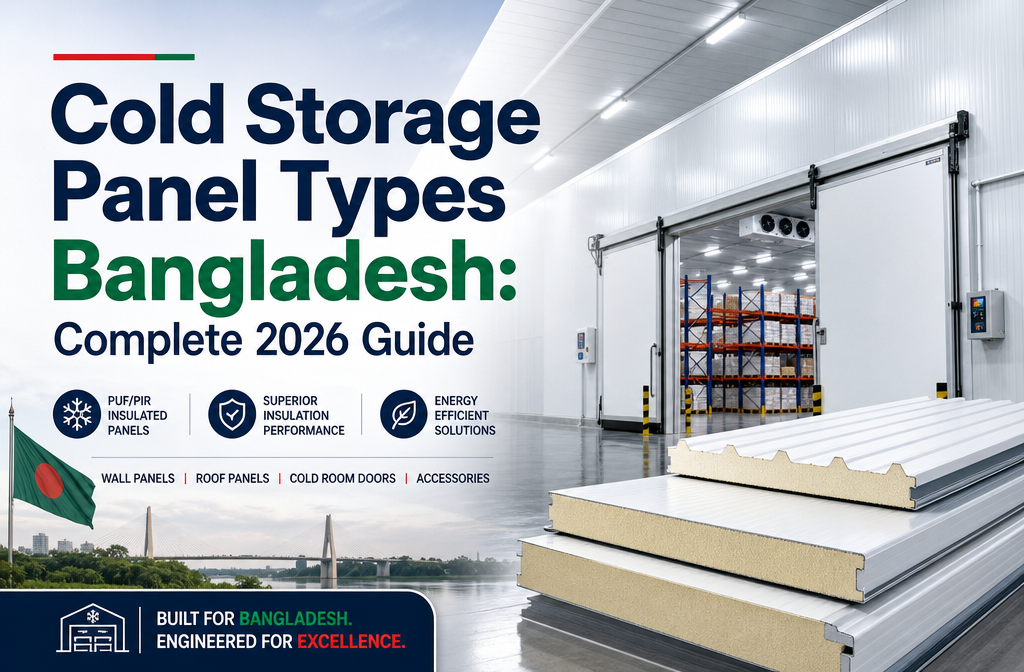
Bangladesh has three primary cold storage panel types in active commercial use: polyurethane (PU) panels, expanded polystyrene (EPS) panels, and polyisocyanurate (PIR) panels. PU panels dominate the market because they offer the best thermal performance per millimeter of thickness, which matters in Bangladesh's hot, humid climate. For most agricultural and food-sector cold rooms, 100mm to 150mm PU panels are the standard starting point.
Key Takeaways
- PU (polyurethane) panels are the most widely used cold storage panel type in Bangladesh due to superior insulation and moisture resistance.
- EPS panels cost less upfront but require greater thickness to match PU's thermal performance, making them better suited for low-budget or ambient-temperature storage.
- PIR panels offer better fire resistance than PU and slightly higher R-values, but they cost more and are less commonly stocked locally.
- Panel thickness for agricultural cold storage typically ranges from 100mm to 200mm depending on the target temperature and product type.
- Fish and seafood storage requires panels rated for -18°C to -25°C, which means thicker PU panels (150mm–200mm) and food-grade steel facings.
- Humid monsoon conditions demand camlock or tongue-and-groove joints sealed with polyurethane foam to prevent moisture infiltration.
- Local Bangladeshi manufacturers now produce panels competitive with many imports in quality, and they offer faster delivery and lower logistics costs.
- Energy costs in Bangladesh make insulation efficiency a direct financial concern — a poorly chosen panel type can increase electricity bills by 30–40% (industry estimate).
- Regular joint inspection and re-sealing every 12–18 months is critical in tropical environments to maintain panel integrity.
What Are the Most Common Cold Storage Panel Materials Used in Bangladesh?
The three core insulation materials used in cold storage panels across Bangladesh are polyurethane foam (PU), expanded polystyrene (EPS), and polyisocyanurate (PIR). PU panels hold the largest market share because they combine high thermal resistance with structural rigidity and moisture resistance — all critical in a tropical climate.
PU (Polyurethane) Panels
- Thermal conductivity: approximately 0.022–0.025 W/m·K
- Density: typically 40–45 kg/m³ for cold room applications
- Most common facing: pre-painted galvanized steel or stainless steel
- Best for: blast freezers, pharmaceutical storage, fish processing, and vegetable cold rooms
EPS (Expanded Polystyrene) Panels
- Thermal conductivity: approximately 0.033–0.038 W/m·K
- Lower density than PU, making panels lighter but less rigid
- More affordable, widely available from local suppliers
- Best for: ambient-temperature controlled storage, low-budget installations, short-term produce storage
PIR (Polyisocyanurate) Panels
- Thermal conductivity: approximately 0.020–0.023 W/m·K
- Better fire resistance than PU (higher limiting oxygen index)
- Slightly more expensive and less commonly stocked in Dhaka markets
- Best for: facilities requiring fire-rated insulation or pharmaceutical-grade cold rooms
For a broader comparison of panel materials available in Bangladesh, see this complete sandwich panel types comparison guide.
How Much Does a Typical Cold Storage Panel Cost in Dhaka?
Cold storage panel pricing in Dhaka in 2026 varies by material, thickness, and facing type. As a general market estimate (based on supplier quotes from the Bangladeshi market), PU panels for cold storage range from BDT 900 to BDT 1,800 per square meter depending on thickness and steel grade. EPS panels run roughly 20–35% cheaper per square meter but require greater thickness to achieve equivalent insulation.
Estimated price ranges (2026 Dhaka market):
| Panel Type | Thickness | Approx. Price (BDT/sqm) |
|---|---|---|
| EPS sandwich panel | 75mm | 600–900 |
| EPS sandwich panel | 100mm | 750–1,050 |
| PU sandwich panel | 100mm | 950–1,300 |
| PU sandwich panel | 150mm | 1,200–1,600 |
| PU sandwich panel | 200mm | 1,500–1,900 |
| PIR sandwich panel | 100mm | 1,100–1,500 |
| PIR sandwich panel | 150mm | 1,400–1,800 |
Note: These are market estimates. Actual prices vary by supplier, order volume, and steel facing grade. Always request a formal quote.
For a detailed breakdown of current pricing, see the cold storage panel price Bangladesh buyer's guide.
Common mistake: Buyers often compare only panel cost per square meter without accounting for thickness. A 75mm EPS panel at BDT 800/sqm may seem cheaper than a 100mm PU panel at BDT 1,100/sqm, but the EPS panel may need to be 150mm thick to achieve the same R-value — making it more expensive overall.
Polyurethane vs. Polyisocyanurate Panels: Which Is Better for Bangladesh's Climate?
For most cold storage applications in Bangladesh, PU panels are the more practical choice due to wider local availability, lower cost, and sufficient performance for temperatures down to -25°C. PIR panels offer a modest thermal advantage and better fire resistance, but the price premium is rarely justified unless fire ratings are mandated.
Head-to-head comparison for Bangladesh conditions:
| Factor | PU Panel | PIR Panel |
|---|---|---|
| Thermal performance | Excellent | Slightly better |
| Fire resistance | Moderate | Better (Class B or better) |
| Moisture resistance | High | High |
| Local availability | Widely available | Limited local stock |
| Cost | Lower | 15–25% higher |
| Best use case | General cold storage | Pharma, fire-rated facilities |
Choose PIR if: Your facility requires fire-rated construction, you're storing pharmaceuticals, or you're meeting international GMP standards.
Choose PU if: You're building agricultural cold storage, fish processing rooms, or general food cold rooms where fire ratings aren't mandated.
Bangladesh's monsoon humidity (often exceeding 85% relative humidity from June through September) doesn't significantly affect either material's core insulation performance when panels are properly sealed. The joint quality matters far more than the core material choice.
What Panel Thickness Do You Need for Small Agricultural Cold Storage?
Panel thickness depends on the target storage temperature and the ambient conditions outside the cold room. For small agricultural cold storage in Bangladesh, 100mm PU panels are the minimum recommended thickness for above-freezing produce storage (+2°C to +10°C). For frozen storage, 150mm is the standard, and blast freezers require 200mm or more.
Thickness guide for common agricultural products:
| Product | Target Temp | Recommended PU Thickness |
|---|---|---|
| Potatoes, onions | +4°C to +10°C | 100mm |
| Leafy vegetables, flowers | +2°C to +4°C | 100–125mm |
| Fish (chilled) | 0°C to +2°C | 125–150mm |
| Fish (frozen) | -18°C to -22°C | 150–200mm |
| Meat (frozen) | -18°C to -25°C | 150–200mm |
| Ice cream, blast freeze | -25°C to -35°C | 200mm+ |
For a deeper look at how thickness affects performance, the sandwich panel thickness selection guide covers the full calculation methodology.
Edge case: Small cold rooms under 20 square meters lose proportionally more heat through corners and joints than large rooms. For very small rooms, increase panel thickness by one step above the table recommendation to compensate.
Which Cold Storage Panel Type Works Best for Fish and Seafood Storage?
PU panels with stainless steel or food-grade pre-painted steel facings are the standard choice for fish and seafood cold storage in Bangladesh. Fish storage requires panels that can handle high moisture levels, frequent wash-downs, and temperatures between -18°C and -25°C. Standard galvanized steel facings corrode quickly in these conditions.
Key requirements for fish storage panels:
- Core: 150mm to 200mm PU foam (closed-cell, 40–45 kg/m³ density)
- Facing: 304-grade stainless steel or food-grade pre-painted steel (minimum 0.5mm thickness)
- Joints: Camlock or hook-type connections sealed with PU foam
- Floor panels: Rated for forklift loads if applicable (reinforced facings)
Bangladesh's fish and seafood export sector — centered in Khulna, Chittagong, and Cox's Bazar — relies heavily on blast freezing facilities. For these, 200mm PU panels are the industry norm. See the PU panel cold storage Bangladesh guide for detailed specifications.
Common Mistakes When Installing Cold Storage Panels in Humid Conditions
Bangladesh's high ambient humidity is the single biggest threat to cold storage panel performance during and after installation. The most common mistake is leaving panel joints unsealed or under-sealed, which allows warm, moist air to infiltrate the cold room envelope and condense inside the panel structure.
Top installation mistakes to avoid:
- Skipping joint sealant — Every camlock joint must be filled with two-component PU foam or butyl tape before closing. No exceptions.
- Installing panels in rain or high humidity — Panel facings and joint surfaces must be dry before assembly. Moisture trapped in joints causes long-term delamination.
- Ignoring the vapor barrier at the floor-wall junction — This is where most moisture infiltration starts in Bangladeshi cold rooms.
- Using the wrong anchor bolts — Galvanized bolts corrode in high-humidity environments. Use stainless steel fasteners for all cold room connections.
- Not allowing for thermal expansion — Panels expand and contract with temperature cycling. Leave manufacturer-specified gaps at structural connections.
- Rushing the installation timeline — Panel installation in humid conditions requires more time for sealants to cure. Rushing leads to premature joint failure.
For a step-by-step installation reference, the cold room sandwich panel installation guide covers the process in detail.
Are Imported Cold Storage Panels Better Than Local Bangladeshi Manufacturers?
Not necessarily — and for most standard applications, local Bangladeshi manufacturers now produce panels that meet the same performance benchmarks as mid-range imports. The quality gap that existed a decade ago has narrowed significantly. Local manufacturers offer shorter lead times, lower shipping costs, and easier after-sales support.
Where imports still have an edge:
- Ultra-high-density cores (50+ kg/m³) for specialized blast freezers
- Certified fire-rated PIR panels (FM Approved or EN 14509 certified)
- Pharmaceutical-grade panels with documented traceability
Where local manufacturers compete well:
- Standard PU panels for agricultural and food cold storage
- EPS panels for ambient-temperature controlled storage
- Custom sizing and rapid delivery within Bangladesh
When evaluating suppliers, ask for: foam density test reports, thermal conductivity certificates, and facing steel grade documentation. A reputable sandwich panel manufacturer in Bangladesh should provide all three without hesitation.
How Do Insulated Panels Handle Monsoon Season Temperature Variations?
Well-installed PU or PIR panels handle monsoon temperature swings without performance loss, provided joints are properly sealed before the monsoon season begins. The risk isn't the panels themselves — it's the joints and penetrations where warm, humid monsoon air can enter.
During Bangladesh's monsoon season (June–September), ambient temperatures typically range from 28°C to 35°C with relative humidity above 80%. The temperature differential between the outside environment and a -18°C cold room can exceed 50°C. This drives significant moisture pressure toward the cold room envelope.
Monsoon preparation checklist:
- Inspect all panel joints for cracking or sealant shrinkage before June
- Re-apply PU foam or butyl sealant at any gaps
- Check door gaskets and replace if compressed or cracked
- Ensure drainage channels around the cold room base are clear
- Verify the refrigeration system can handle the higher ambient load
For more on panel maintenance in tropical conditions, see the complete sandwich panel maintenance guide.
What Panel R-Value Do You Need for Different Agricultural Products?
R-value (thermal resistance) determines how well a panel resists heat transfer. Higher R-values are needed for lower storage temperatures. In Bangladesh, where ambient temperatures regularly exceed 35°C, R-value requirements are higher than in temperate climates for the same product.
Approximate R-value requirements by product (Bangladesh ambient conditions):
| Product Category | Storage Temp | Minimum R-value (m²·K/W) | Typical PU Thickness |
|---|---|---|---|
| Root vegetables | +8°C to +12°C | R-2.5 to R-3.5 | 75–100mm |
| Fruits, leafy veg | +2°C to +6°C | R-3.5 to R-4.5 | 100mm |
| Dairy products | 0°C to +4°C | R-4.0 to R-5.0 | 100–125mm |
| Chilled fish/meat | 0°C to +2°C | R-4.5 to R-5.5 | 125–150mm |
| Frozen fish/meat | -18°C to -22°C | R-6.0 to R-8.0 | 150–200mm |
| Blast freezer | -30°C to -40°C | R-9.0+ | 200mm+ |
R-values calculated assuming PU core with λ = 0.023 W/m·K. Actual values depend on foam density and aging.
Energy Efficiency Comparison of Different Cold Storage Panel Types
PU and PIR panels are significantly more energy-efficient than EPS panels of equivalent thickness, because their lower thermal conductivity means less heat enters the cold room per hour. In Bangladesh, where electricity costs and load-shedding are ongoing concerns, panel choice has a direct impact on operating costs.
Energy efficiency ranking (best to worst for cold storage):
- PIR panels — Lowest thermal conductivity, best long-term energy performance
- PU panels — Very close to PIR, widely available, most cost-effective overall
- EPS panels — Adequate for ambient storage but requires 40–60% more thickness to match PU performance
Industry estimates suggest that upgrading from EPS to PU panels in a 100 sqm cold room can reduce compressor run-time by 15–25%, translating to meaningful electricity savings over a 10-year panel lifespan. For a detailed look at energy performance, the energy efficient sandwich panel Bangladesh guide provides further analysis.
Which Industries in Bangladesh Use Cold Storage Panels Most Frequently?
The fish and seafood export industry is the single largest user of cold storage panels in Bangladesh, followed by the pharmaceutical sector, agricultural produce storage, and the poultry and meat processing industry.
Industry breakdown:
- 🐟 Fish & seafood export: Largest segment; concentrated in Chittagong, Khulna, Cox's Bazar. Requires -18°C to -25°C blast freezing.
- 🌾 Agricultural produce: Potato, onion, and vegetable cold storage across Rajshahi, Bogura, and Comilla districts. Typically +2°C to +10°C.
- 💊 Pharmaceuticals: Dhaka-based manufacturers require +2°C to +8°C controlled storage with strict humidity management.
- 🐔 Poultry and meat processing: Growing segment; requires -18°C to -22°C frozen storage. See the poultry farm cold room panel guide for specifications.
- 🥛 Dairy: Smaller but growing; typically +2°C to +4°C storage.
- 🏥 Hospitals and blood banks: Specialized cold rooms requiring precise temperature control.
Cold Storage Panel Maintenance Tips for Tropical Environments
In Bangladesh's tropical climate, cold storage panels require inspection every 6–12 months and joint re-sealing every 12–18 months to maintain performance. The combination of high humidity, temperature cycling, and biological activity (mold, bacteria) accelerates panel degradation if maintenance is neglected.
Essential maintenance schedule:
| Task | Frequency |
|---|---|
| Visual inspection of all joints and facings | Every 6 months |
| Joint sealant inspection and re-application | Every 12–18 months |
| Door gasket inspection and replacement | Annually |
| Panel facing cleaning (mild detergent) | Every 3 months |
| Drainage channel inspection | Before monsoon season |
| Refrigeration coil defrost check | Monthly |
Signs a panel needs immediate attention:
- Visible condensation on the exterior panel surface (indicates joint failure)
- Soft spots or delamination when pressed on the facing
- Discoloration or rust streaks around fasteners
- Ice formation inside the panel at joints
FAQ: Cold Storage Panel Types Bangladesh
Q: What is the most popular cold storage panel type in Bangladesh?
PU (polyurethane) sandwich panels are the most widely used. They offer the best balance of thermal performance, moisture resistance, and cost for Bangladesh's climate and cold storage requirements.
Q: Can EPS panels be used for frozen fish storage in Bangladesh?
EPS panels are not recommended for frozen fish storage at -18°C or below. The required thickness would be impractical (200mm+), and EPS has higher moisture absorption than PU, which is a serious problem in fish processing environments.
Q: How long do cold storage panels last in Bangladesh?
With proper installation and maintenance, PU cold storage panels typically last 15–25 years. Poor joint sealing or neglected maintenance in humid conditions can reduce this to 8–12 years.
Q: What panel thickness is standard for a potato cold storage in Bangladesh?
100mm PU panels are the standard for potato cold storage targeting +4°C to +8°C. In regions with very high ambient temperatures, 125mm provides a useful buffer.
Q: Do I need special panels for a pharmaceutical cold room?
Yes. Pharmaceutical cold rooms typically require PIR or high-density PU panels with food-grade or medical-grade steel facings, documented foam density, and thermal conductivity certificates for regulatory compliance.
Q: Is it cheaper to buy panels locally or import them?
For standard PU and EPS panels, buying locally in Bangladesh is almost always cheaper when logistics costs are included. Imports make sense only for specialized panels with certifications not available locally.
Q: What facing material should I use for a fish processing cold room?
304-grade stainless steel facing is the recommended choice for fish processing cold rooms. It resists corrosion from salt, moisture, and cleaning chemicals far better than standard galvanized steel.
Q: How do I calculate how many panels I need for a cold room?
Calculate the total surface area of walls, ceiling, and floor (in sqm), then add 10–15% for waste and cuts. Your panel supplier can assist with a detailed material list once you provide room dimensions.
Q: What is a camlock joint and why does it matter?
A camlock is a locking mechanism built into the panel edge that connects adjacent panels tightly. It's the industry standard for cold storage panels because it creates a consistent, airtight joint that can be sealed effectively — critical for preventing moisture infiltration.
Q: Are there fire-rated cold storage panels available in Bangladesh?
Yes. PIR panels with fire-rated facings are available from select suppliers. For most agricultural cold storage, fire ratings aren't mandated, but pharmaceutical and food processing facilities may require them.
Conclusion
Choosing the right cold storage panel type in Bangladesh comes down to three factors: target storage temperature, budget, and the specific product being stored. PU panels are the default choice for most applications — they perform well in Bangladesh's humid climate, are widely available from local manufacturers, and offer the best thermal efficiency per taka spent. EPS panels work for low-temperature-differential storage on tighter budgets. PIR panels are worth the premium only when fire ratings or pharmaceutical certifications are required.
Actionable next steps:
- Define your target temperature before contacting any supplier — this single factor determines your minimum panel thickness and core material.
- Request foam density and thermal conductivity certificates from any supplier you're considering. Reputable manufacturers provide these without being asked twice.
- Get at least three quotes comparing total installed cost (panels + installation + accessories), not just panel price per sqm.
- Inspect joints and door gaskets on any existing cold room before the monsoon season begins — this is the highest-return maintenance task in Bangladesh's climate.
- Consider local manufacturers first — quality has improved significantly, and the logistics savings and faster support are real advantages.
For a complete overview of building a cold room from the ground up, the how to build a cold room in Bangladesh guide is a practical next read.
References
- Bangladesh Cold Storage Association (BCSA). Industry overview reports. Dhaka.
- Food and Agriculture Organization (FAO). Post-harvest losses and cold chain development in South Asia. 2019. https://www.fao.org
- EN 14509:2013 — Self-supporting double skin metal faced insulating panels. European Committee for Standardization.
- Bangladesh Bureau of Statistics (BBS). Agricultural and fisheries production data. 2022. https://www.bbs.gov.bd