Last updated: July 31, 2026

Quick Answer
Sandwich panels for cold storage systems typically cost between $15-45 per square meter in 2026, depending on core material, thickness, and temperature requirements. Polyurethane (PU) panels cost $25-45/sqm for freezer applications, while polystyrene (EPS) panels range from $15-30/sqm for standard cold rooms. Installation adds another $8-15/sqm to the total project cost.
Key Takeaways
- PU sandwich panels cost $25-45/sqm and work best for freezer rooms below -18°C
- EPS sandwich panels cost $15-30/sqm and suit standard cold storage above 0°C
- Panel thickness ranges from 75mm-200mm, with thicker panels costing 20-40% more
- Installation costs add $8-15/sqm depending on project complexity and location
- Total project costs including doors and accessories range from $35-80/sqm
- Quality panels last 15-25 years with proper maintenance in cold storage environments
- Self-installation can save 30-50% on labor but requires technical expertise
- Bulk orders over 500 sqm typically receive 10-15% volume discounts
What Is a Sandwich Panel for Cold Storage
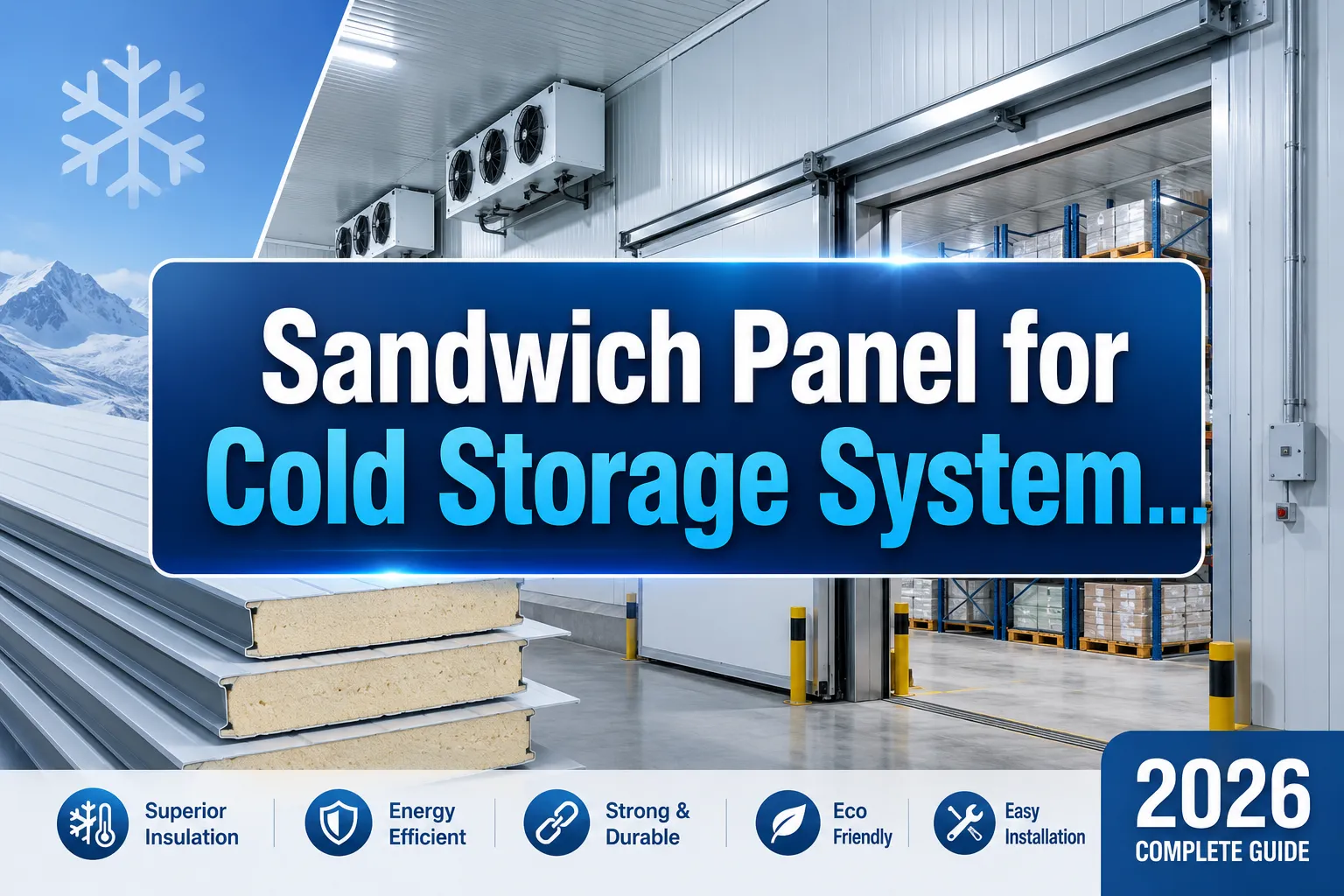
Sandwich panels for cold storage are composite building materials consisting of two metal sheets bonded to an insulating core material. These panels provide thermal insulation, structural strength, and moisture resistance essential for maintaining consistent temperatures in refrigerated environments.
The outer metal sheets are typically made from galvanized steel, stainless steel, or aluminum with protective coatings. The insulating core uses materials like polyurethane (PU), polystyrene (EPS), or polyisocyanurate (PIR) foam. This construction creates an effective thermal barrier while maintaining structural integrity.
Key components include:
- External metal facings (0.4-0.8mm thick)
- Insulating foam core (50-200mm thick)
- Interlocking edge profiles for seamless joints
- Vapor barriers to prevent moisture infiltration
- Fire-resistant additives in premium grades
Cold storage panels differ from standard building panels through enhanced moisture resistance, food-grade surface treatments, and superior thermal performance ratings. They're engineered to handle temperature differentials from +15°C to -40°C while preventing thermal bridging and condensation issues.
How Much Does a Sandwich Panel for Cold Storage Cost
Cold storage sandwich panel prices vary significantly based on core material, thickness, and performance specifications. Basic EPS panels start at $15/sqm for 75mm thickness, while premium PU panels can reach $45/sqm for 150mm applications.
Price breakdown by core material:
- EPS (Polystyrene) panels: $15-30/sqm
- PU (Polyurethane) panels: $25-45/sqm
- PIR (Polyisocyanurate) panels: $30-50/sqm
- Rockwool panels: $35-55/sqm
Thickness significantly impacts pricing:
- 75mm panels: Base price
- 100mm panels: +15-20% premium
- 125mm panels: +25-35% premium
- 150mm panels: +40-50% premium
- 200mm panels: +60-80% premium
Additional cost factors include surface treatments (stainless steel adds $5-10/sqm), custom colors ($2-5/sqm premium), and fire ratings (Class A adds $8-15/sqm). Current sandwich panel prices in Bangladesh reflect these material and specification variables.
Sandwich Panel vs Traditional Insulation for Cold Rooms
Sandwich panels outperform traditional insulation methods in cold storage applications through superior thermal efficiency, faster installation, and better moisture control. Traditional systems using separate insulation, vapor barriers, and cladding cost 15-25% less initially but require 40-60% more installation time.
Sandwich panel advantages:
- Thermal performance: Continuous insulation eliminates thermal bridging
- Installation speed: 3-4x faster than traditional build-up systems
- Moisture control: Integrated vapor barriers prevent condensation
- Structural integrity: Self-supporting design reduces framework needs
- Quality consistency: Factory-controlled manufacturing ensures uniform performance
Traditional insulation drawbacks:
- Multiple installation phases increase labor costs
- Thermal bridging through structural elements reduces efficiency
- Separate vapor barrier installation creates failure points
- Field-applied insulation varies in density and performance
- Higher long-term maintenance requirements
Cost comparison over 10 years:
- Sandwich panels: Higher initial cost, lower maintenance
- Traditional systems: Lower upfront cost, 20-30% higher operational expenses
The complete guide to PU panels for cold storage details specific performance advantages in Bangladeshi climate conditions.
Best Sandwich Panels for Freezer Rooms
Polyurethane (PU) sandwich panels provide the best performance for freezer rooms operating below -18°C due to superior thermal resistance and structural stability at extreme temperatures. PU foam maintains its insulating properties down to -40°C while resisting moisture absorption and thermal cycling stress.
Top freezer panel specifications:
- Core material: Polyurethane (PU) foam density 40-45 kg/m³
- Thickness: 150-200mm for temperatures below -20°C
- Facings: Stainless steel or plastisol-coated galvanized steel
- Thermal conductivity: 0.022-0.025 W/mK
- Compressive strength: Minimum 150 kPa
Performance requirements for different temperatures:
- 0°C to -5°C: 100-125mm EPS or PU panels acceptable
- -5°C to -18°C: 125-150mm PU panels recommended
- -18°C to -25°C: 150-175mm PU panels required
- Below -25°C: 175-200mm PU panels with enhanced vapor barriers
Premium features for freezer applications:
- Enhanced edge sealing systems
- Integrated heating cables for door frames
- Anti-condensation surface treatments
- Reinforced panel connections for thermal cycling
Choose panels with certified performance data for your specific temperature range. The specialized guide to cold storage panel types covers detailed selection criteria for various freezer applications.
Where to Buy Sandwich Panels for Cold Storage
Cold storage sandwich panels are available through specialized manufacturers, building material distributors, and refrigeration equipment suppliers. Direct manufacturer purchases typically offer 10-20% cost savings on orders over 500 sqm compared to distributor pricing.
Primary purchase channels:
- Manufacturers: Best prices for large orders, custom specifications available
- Distributors: Smaller quantities, local inventory, faster delivery
- Refrigeration contractors: Turnkey solutions including installation
- Import suppliers: International brands, premium specifications
Key supplier evaluation criteria:
- Product certifications (ISO, ASTM standards)
- Manufacturing quality controls
- Technical support and design assistance
- Warranty terms (typically 10-15 years)
- Local installation network
- Delivery capabilities and lead times
Questions to ask suppliers:
- What core densities and thermal ratings are available?
- Do you provide installation services or certified contractors?
- What warranty covers thermal performance vs. manufacturing defects?
- Can you supply matching accessories (doors, corners, penetrations)?
Research top sandwich panel suppliers in Bangladesh for local sourcing options and compare multiple quotes before committing to large orders.
How Thick Should Sandwich Panels Be for Cold Storage
Cold storage sandwich panel thickness depends on operating temperature, energy efficiency requirements, and local building codes. Standard thickness ranges from 75mm for mild refrigeration to 200mm for deep freeze applications below -25°C.
Thickness selection guide:
- 75-100mm: Temperatures 0°C to +10°C (produce storage, wine cellars)
- 100-125mm: Temperatures -5°C to 0°C (dairy, meat processing)
- 125-150mm: Temperatures -18°C to -5°C (frozen food storage)
- 150-175mm: Temperatures -25°C to -18°C (ice cream, pharmaceuticals)
- 175-200mm: Temperatures below -25°C (blast freezing, research facilities)
Factors affecting thickness selection:
- Climate conditions: Hot, humid climates require thicker panels
- Energy costs: Thicker panels reduce operational expenses
- Building codes: Some regions mandate minimum R-values
- Structural loads: Thicker panels provide greater strength
- Budget constraints: Each 25mm adds 15-20% to panel cost
Thermal performance by thickness (PU panels):
- 100mm: R-value 4.0-4.5 m²K/W
- 125mm: R-value 5.0-5.5 m²K/W
- 150mm: R-value 6.0-6.5 m²K/W
- 200mm: R-value 8.0-8.5 m²K/W
Use thermal modeling software or consult refrigeration engineers for precise thickness calculations. The guide to choosing sandwich panel thickness provides detailed calculation methods.
Sandwich Panel Installation Cost for Cold Storage
Professional sandwich panel installation for cold storage systems costs $8-15 per square meter depending on project complexity, site conditions, and regional labor rates. Complex installations with multiple penetrations, custom angles, or difficult access can increase costs to $18-25/sqm.
Installation cost factors:
- Project size: Larger projects achieve $2-4/sqm economies of scale
- Site accessibility: Ground-level installation vs. multi-story construction
- Panel complexity: Standard rectangles vs. custom cuts and angles
- Penetrations: Each door, window, or utility penetration adds $50-200
- Structural requirements: Additional framework increases labor time
Typical installation timeline:
- Site preparation: 1-2 days for framework and utilities
- Panel installation: 50-100 sqm per day with 3-person crew
- Sealing and finishing: 1-2 days for joints and penetrations
- Quality inspection: 0.5-1 day for thermal and moisture testing
Installation includes:
- Panel lifting and positioning
- Edge sealing with polyurethane sealant
- Penetration cutting and sealing
- Corner and junction details
- Basic electrical coordination
Additional services (quoted separately):
- Structural framework ($5-12/sqm)
- Refrigeration equipment connections ($200-500 per unit)
- Electrical rough-in ($3-8/sqm)
- Final commissioning and testing ($500-2000 per room)
Consider professional installation services to ensure proper thermal performance and warranty compliance.
Do Sandwich Panels Work for Minus 20 Degree Storage
Yes, properly specified sandwich panels work effectively for -20°C storage when using polyurethane (PU) core material with minimum 150mm thickness and enhanced vapor barrier systems. PU foam maintains thermal performance down to -40°C while providing structural stability under thermal cycling stress.
Critical specifications for -20°C operation:
- Core material: Polyurethane foam, density 40+ kg/m³
- Minimum thickness: 150mm (175mm recommended for energy efficiency)
- Thermal conductivity: Maximum 0.025 W/mK
- Vapor barrier: Continuous aluminum foil or equivalent
- Edge sealing: Polyurethane or silicone sealants rated for low temperatures
Performance considerations:
- Thermal bridging: Use thermal break connections at structural attachments
- Condensation control: Interior vapor barriers prevent moisture infiltration
- Expansion joints: Allow for thermal movement in large installations
- Door integration: Heated door frames prevent ice formation
Common installation mistakes at -20°C:
- Using EPS panels (lose performance below -15°C)
- Insufficient edge sealing allowing air infiltration
- Missing thermal breaks at structural connections
- Inadequate vapor barrier continuity
Energy efficiency impact:
- 150mm PU panels: 15-20% energy savings vs. 125mm
- 175mm PU panels: 25-30% energy savings vs. 125mm
- Proper installation: 10-15% efficiency gain vs. poor workmanship
The comprehensive PU sandwich panel guide covers detailed specifications for sub-zero applications.
Sandwich Panel Price Per Square Meter
Sandwich panel pricing per square meter varies from $15-55 depending on core material, thickness, surface treatments, and order quantity. Volume discounts typically begin at 500 sqm orders with 10-15% savings, while orders over 2000 sqm can achieve 20-25% reductions from list prices.
Current price ranges by specification:
| Panel Type | Thickness | Price Range ($/sqm) | Best Application |
|---|---|---|---|
| EPS Standard | 75-125mm | $15-25 | Cold rooms 0°C to -5°C |
| EPS Premium | 100-150mm | $20-30 | Medium-temp storage |
| PU Standard | 75-125mm | $25-35 | Freezers -5°C to -18°C |
| PU Premium | 125-200mm | $35-45 | Deep freeze below -18°C |
| PIR/Rockwool | 100-150mm | $35-55 | Fire-rated applications |
Price modifiers:
- Stainless steel facings: +$5-10/sqm
- Custom colors: +$2-5/sqm
- Fire ratings: +$8-15/sqm
- Enhanced vapor barriers: +$3-8/sqm
- Micro-ribbed surfaces: +$2-4/sqm
Regional price variations:
- Urban areas: 5-15% premium for delivery and logistics
- Remote locations: 10-25% premium for transportation
- Port cities: 5-10% discount for imported panels
- Manufacturing hubs: 5-15% discount near production facilities
Check detailed sandwich panel price lists for current regional pricing and available specifications.
How Long Do Sandwich Panels Last in Cold Storage
Quality sandwich panels last 15-25 years in cold storage environments with proper installation and maintenance. Premium PU panels with stainless steel facings can exceed 25 years, while budget EPS panels typically require replacement after 12-18 years due to thermal cycling fatigue and moisture infiltration.
Lifespan factors:
- Core material quality: High-density PU foam resists degradation better than EPS
- Facing protection: Stainless steel or premium coatings prevent corrosion
- Installation quality: Proper sealing prevents moisture infiltration and thermal bridging
- Operating conditions: Stable temperatures extend panel life vs. frequent cycling
- Maintenance practices: Regular inspection and seal replacement prevents failures
Common failure modes:
- Edge seal deterioration: 8-12 years for standard sealants
- Facing corrosion: 10-15 years in high-humidity environments
- Core degradation: 15-20 years for quality materials
- Thermal bridging: Develops gradually over 10-15 years
Maintenance requirements:
- Annual inspections: Check seals, facings, and thermal performance
- Seal replacement: Every 8-12 years for perimeter and penetrations
- Surface cleaning: Monthly cleaning prevents contamination buildup
- Damage repair: Immediate repair of dents or punctures
Warranty coverage:
- Manufacturing defects: 10-15 years standard
- Thermal performance: 5-10 years guaranteed R-value
- Facing materials: 15-25 years against corrosion
- Installation workmanship: 2-5 years typical
Regular maintenance and quality installation significantly extend panel lifespan. The sandwich panel warranty guide details specific coverage terms and maintenance requirements.
Common Problems with Sandwich Panels in Freezers
The most frequent sandwich panel problems in freezer applications include condensation buildup, thermal bridging at connections, and edge seal failures that compromise thermal performance. Poor installation accounts for 60-70% of panel failures within the first five years of operation.
Top 5 freezer panel problems:
-
Condensation and ice formation
- Cause: Inadequate vapor barriers or air infiltration
- Solution: Enhanced edge sealing and continuous vapor barriers
- Prevention: Proper installation and regular seal inspection
-
Thermal bridging at connections
- Cause: Metal-to-metal contact bypassing insulation
- Solution: Thermal break gaskets and proper connection details
- Prevention: Use manufacturer-specified connection systems
-
Edge seal deterioration
- Cause: Thermal cycling stress and UV exposure
- Solution: Premium polyurethane or silicone sealants
- Prevention: Regular inspection and preventive replacement
-
Panel deflection and joint opening
- Cause: Inadequate structural support or thermal expansion
- Solution: Proper structural design and expansion joints
- Prevention: Follow manufacturer's structural requirements
-
Surface contamination and cleaning damage
- Cause: Harsh cleaning chemicals or abrasive cleaning methods
- Solution: Food-grade surface treatments and proper cleaning protocols
- Prevention: Use approved cleaning products and techniques
Warning signs to monitor:
- Frost or ice formation on interior surfaces
- Visible gaps at panel joints
- Increased energy consumption
- Temperature fluctuations in storage areas
- Moisture stains on exterior surfaces
Preventive measures:
- Specify premium edge sealing systems
- Use thermal break connections at all structural attachments
- Install panels according to manufacturer specifications
- Implement regular maintenance schedules
- Train staff on proper cleaning procedures
Address problems immediately to prevent cascade failures. The cold storage panel maintenance guide provides detailed troubleshooting procedures.
Are Sandwich Panels Worth It for Small Cold Rooms
Sandwich panels provide excellent value for small cold rooms (under 100 sqm) due to faster installation, superior thermal performance, and lower total project costs compared to traditional construction methods. Small projects benefit most from the simplified installation process and reduced labor requirements.
Cost-benefit analysis for small cold rooms:
Advantages for small installations:
- Faster installation: 2-3 days vs. 1-2 weeks for traditional construction
- Lower labor costs: Single-trade installation vs. multiple contractors
- Better thermal performance: Continuous insulation eliminates thermal bridging
- Immediate operation: No curing time required for adhesives or sealants
- Consistent quality: Factory-controlled manufacturing ensures performance
Economic breakeven points:
- 20-50 sqm: 15-25% cost savings vs. traditional construction
- 50-100 sqm: 20-30% cost savings including faster occupancy
- Under 20 sqm: Marginal savings due to minimum order quantities
Considerations for small projects:
- Minimum orders: Some suppliers require 100+ sqm minimums
- Custom cutting: Small projects may need more custom panel sizes
- Delivery costs: Fixed delivery charges impact small order economics
- Installation efficiency: Setup costs spread over smaller areas
Best applications for small cold rooms:
- Restaurant walk-in coolers and freezers
- Pharmaceutical storage rooms
- Laboratory sample storage
- Retail frozen food displays
- Farm product cooling rooms
When traditional construction makes sense:
- Extremely small rooms (under 10 sqm)
- Irregular shapes requiring extensive custom cutting
- Temporary installations (under 2 years)
- Severe budget constraints prioritizing lowest upfront cost
For most small cold room applications, sandwich panels provide superior long-term value through energy savings and reduced maintenance requirements.
Polyurethane vs Polystyrene Sandwich Panels Cold Storage
Polyurethane (PU) sandwich panels outperform polystyrene (EPS) panels in cold storage applications below -5°C due to superior thermal resistance, moisture resistance, and structural stability at low temperatures. EPS panels work adequately for mild refrigeration above 0°C but lose thermal performance and become brittle in freezer conditions.
Performance comparison:
| Characteristic | Polyurethane (PU) | Polystyrene (EPS) |
|---|---|---|
| Thermal Conductivity | 0.022-0.025 W/mK | 0.035-0.040 W/mK |
| Temperature Range | +50°C to -40°C | +70°C to -15°C |
| Moisture Absorption | Less than 2% | 3-5% |
| Compressive Strength | 150-250 kPa | 100-150 kPa |
| Cost per sqm | $25-45 | $15-30 |
When to choose PU panels:
- Freezer storage below -5°C
- High-humidity environments
- Premium energy efficiency requirements
- Long-term installations (15+ years)
- Food processing facilities requiring washdown capability
When EPS panels are acceptable:
- Cold storage above 0°C (produce, wine, pharmaceuticals)
- Budget-constrained projects
- Temporary installations (under 10 years)
- Dry storage environments
- Non-critical temperature control applications
Energy efficiency comparison:
- PU 125mm provides equivalent thermal performance to EPS 175mm
- PU panels reduce energy consumption by 20-30% vs. equivalent EPS thickness
- Thinner PU panels save interior space while maintaining performance
Long-term cost analysis:
- PU panels: Higher upfront cost, lower operational expenses
- EPS panels: Lower initial investment, 15-25% higher energy costs
- Breakeven point: Typically 3-5 years for freezer applications
The detailed comparison of PU vs EPS panels helps determine the optimal choice for specific applications and budgets.
Can You Install Sandwich Panels Yourself
DIY sandwich panel installation is possible for experienced builders with proper tools and technical knowledge, but professional installation is recommended for cold storage applications due to critical thermal performance requirements. Self-installation can save 30-50% on labor costs but risks warranty voidance and performance issues if done incorrectly.
Required skills and tools:
- Construction experience: Framing, insulation, and weatherproofing knowledge
- Specialized tools: Panel lifts, thermal break fasteners, professional sealants
- Safety equipment: Fall protection, lifting equipment for panels over 25kg
- Measuring precision: Laser levels, thermal imaging for quality verification
Installation complexity factors:
- Panel size and weight: Large panels require 2-3 person teams and lifting equipment
- Height requirements: Multi-story installations need scaffolding and safety systems
- Penetrations: Doors, windows, and utilities require precise cutting and sealing
- Structural integration: Proper connection to building framework and foundations
Critical installation steps:
- Framework preparation: Ensure level, square, and properly sized openings
- Panel positioning: Use manufacturer-specified lifting points and support methods
- Edge sealing: Apply continuous sealant beads at all panel joints
- Penetration sealing: Properly seal all utility and door penetrations
- Quality verification: Check thermal continuity and air tightness
Common DIY mistakes:
- Inadequate edge sealing allowing air infiltration
- Thermal bridging through improper fastener selection
- Panel damage during handling and installation
- Incorrect panel orientation or joint alignment
- Missing vapor barrier continuity
When to hire professionals:
- Cold storage below -10°C (critical thermal performance)
- Commercial food storage (health code requirements)
- Large installations over 200 sqm
- Multi-story construction
- Warranty requirements specify professional installation
DIY-friendly applications:
- Small farm cold rooms (under 50 sqm)
- Single-story construction at ground level
- Non-critical temperature storage
- Experienced builders with proper equipment
Consider the comprehensive installation guide and manufacturer training before attempting DIY installation on cold storage projects.
Frequently Asked Questions
What is the cheapest sandwich panel for cold storage?
EPS (polystyrene) sandwich panels are the most affordable option at $15-25/sqm for basic cold storage above 0°C. However, PU panels provide better long-term value for freezer applications due to superior thermal performance and durability.
How do I calculate how many sandwich panels I need?
Measure wall and ceiling areas in square meters, add 10% for waste and cutting, then subtract door and window openings. Include corner panels and accessories in your calculation. Most suppliers provide takeoff services for complex projects.
Do sandwich panels need a structural frame?
Sandwich panels are self-supporting for spans up to 6-8 meters but require perimeter framing and structural connections. The framework provides attachment points and distributes loads to the building foundation.
Can sandwich panels be repaired if damaged?
Minor damage can be repaired with specialized sealants and patches. Major damage typically requires panel replacement. Prompt repair prevents moisture infiltration and thermal performance loss.
What maintenance do cold storage sandwich panels require?
Annual inspection of seals and joints, cleaning with approved products, and immediate repair of damage. Edge seals typically need replacement every 8-12 years depending on conditions.
Are sandwich panels food safe for cold storage?
Yes, panels with food-grade surface treatments meet FDA and USDA requirements for food contact surfaces. Specify food-grade coatings and proper cleaning protocols for food storage applications.
How much weight can sandwich panels support?
Load capacity depends on panel thickness, span, and core material. Typical panels support 150-300 kg/sqm distributed loads. Consult structural engineers for point loads like equipment or shelving.
Do sandwich panels require building permits?
Most cold storage installations require building permits and inspections. Check local codes for insulation, structural, and refrigeration requirements before starting construction.
Can I mix different panel types in one cold room?
Mixing panel types is not recommended due to different thermal expansion rates and connection details. Use consistent panel specifications throughout each temperature zone.
What happens if panels get wet during installation?
PU panels resist moisture absorption, but EPS panels can be damaged by water infiltration. Protect panels during installation and allow wet panels to dry completely before sealing.
How do I connect utilities through sandwich panels?
Use manufacturer-supplied penetration sleeves and sealing systems. Maintain thermal continuity around pipes and electrical penetrations with appropriate insulation and vapor barriers.
Are there fire safety concerns with sandwich panels?
Standard panels use flame-retardant materials but may not meet all fire codes. Specify fire-rated panels for commercial applications or where required by local codes.
Conclusion
Sandwich panel pricing for cold storage systems in 2026 ranges from $15-45 per square meter depending on core material, thickness, and performance requirements. PU panels at $25-45/sqm provide the best performance for freezer applications, while EPS panels at $15-30/sqm work well for standard cold storage above 0°C.
Key decision factors include:
- Operating temperature requirements determine core material selection
- Panel thickness affects both cost and energy efficiency
- Professional installation adds $8-15/sqm but ensures optimal performance
- Quality panels last 15-25 years with proper maintenance
Next steps for your cold storage project:
- Define requirements: Determine temperature range, room size, and performance needs
- Get multiple quotes: Compare panel specifications and total project costs from 3-5 suppliers
- Verify certifications: Ensure panels meet local building codes and food safety requirements
- Plan installation: Decide between professional installation vs. DIY based on project complexity
- Consider long-term costs: Factor energy savings and maintenance into your decision
For current pricing and technical specifications, consult with qualified sandwich panel suppliers who can provide detailed quotes based on your specific requirements and local conditions.
SEO Meta Title: Sandwich Panel Cold Storage System Price Guide 2026 | Complete Cost Analysis