Last updated: May 20, 2026
Quick Answer
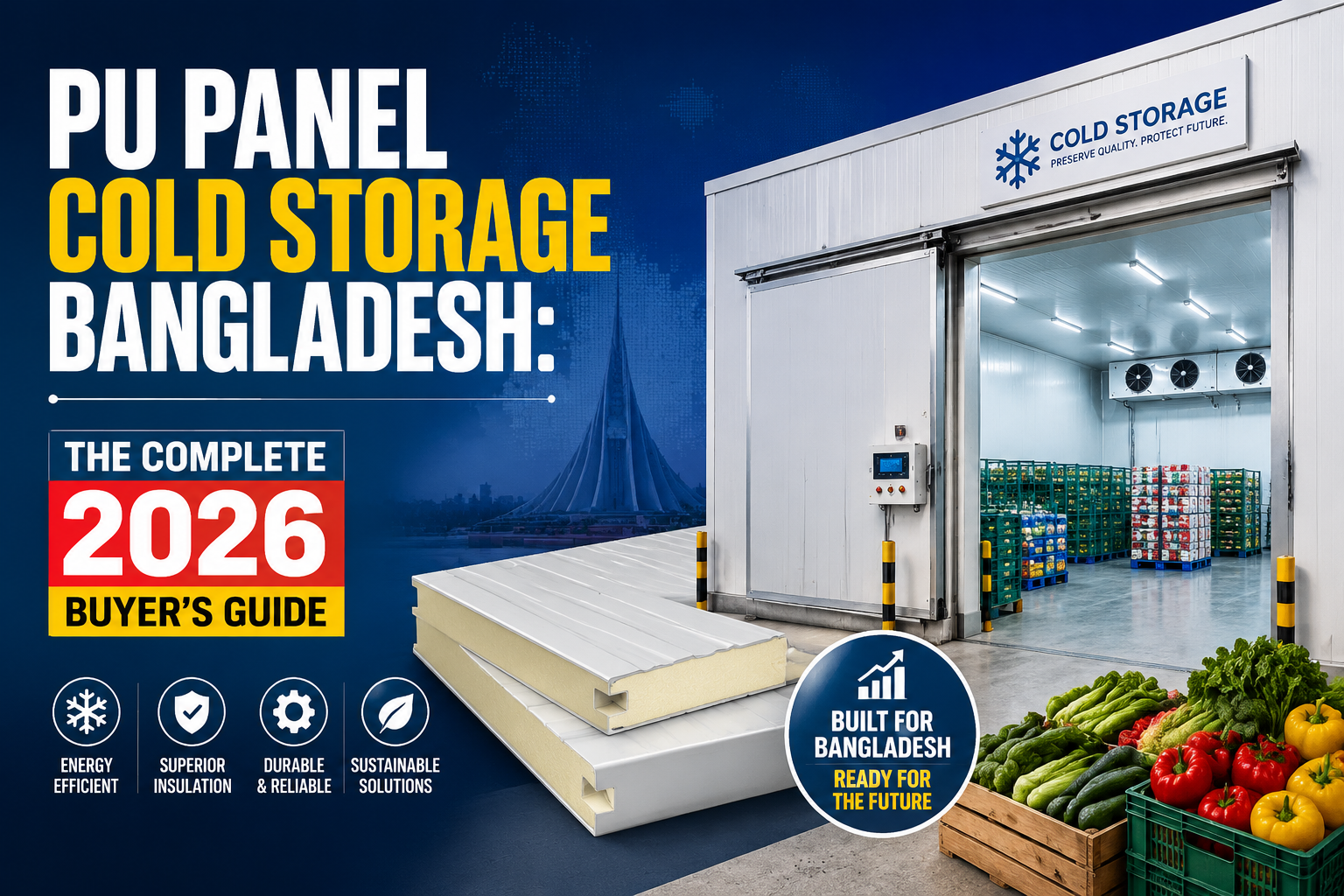
Polyurethane (PU) panels are the top choice for cold storage construction in Bangladesh because they deliver the lowest thermal conductivity of any common insulation core, keeping energy bills down in a climate where ambient temperatures regularly exceed 35°C. A properly specified PU panel cold storage system in Bangladesh typically uses panels ranging from 75 mm to 150 mm thick, depending on the target temperature zone. Costs vary by size and specification, but buyers can expect to pay more upfront than for EPS alternatives while saving significantly on long-term electricity costs.
Key Takeaways
- PU panels outperform EPS panels on thermal efficiency, making them the preferred core material for cold rooms and freezer storage in Bangladesh's hot, humid climate.
- Panel thickness matters: 75 mm suits chiller rooms (+2°C to +8°C); 100–150 mm is standard for blast freezers (-18°C to -25°C).
- Both wall and ceiling panels are needed for a complete cold storage enclosure; floor insulation requirements depend on the storage temperature.
- Bangladesh's food sector — fish, poultry, dairy, pharmaceuticals, and fresh produce — drives the majority of cold storage demand.
- Installation quality is as important as panel quality; poor jointing causes thermal bridging and condensation problems.
- Local manufacturers now produce food-grade PU sandwich panels domestically, reducing lead times and import costs compared to five years ago.
- Energy savings from high-density PU foam cores can reduce refrigeration running costs by an estimated 20–35% versus poorly insulated brick-and-mortar cold rooms (based on industry estimates from panel manufacturers; actual savings depend on room size, door frequency, and refrigeration system efficiency).
- Fire rating should be checked: standard PU foam is combustible; fire-retardant (FR) grades are available and recommended for larger facilities.
What Is a PU Panel and Why Does It Matter for Cold Storage in Bangladesh?
A PU (polyurethane) sandwich panel consists of two steel face sheets bonded to a rigid polyurethane foam core. The foam is injected and cured under pressure, creating a dense, closed-cell structure with very low thermal conductivity — typically around 0.022–0.024 W/m·K. That number matters because lower conductivity means less heat enters the cold room, and the refrigeration system works less to maintain temperature.
In Bangladesh, where summer temperatures in Dhaka and Chittagong regularly climb above 35°C with high humidity, this insulation performance is not a luxury — it's operationally critical. A cold storage facility built with substandard insulation will either fail to hold temperature or run refrigeration compressors continuously, driving up electricity costs dramatically.
Why PU over EPS (expanded polystyrene)? EPS panels cost less per square meter, but their thermal conductivity (around 0.035–0.040 W/m·K) is notably higher than PU. For ambient-temperature warehouses or light-duty cool rooms, EPS may be adequate. For freezer storage below -10°C, PU is the practical standard. See the EPS vs PU Sandwich Panel comparison guide for a detailed breakdown.
How Is PU Panel Cold Storage Used in Bangladesh? 🏭
PU panel cold storage in Bangladesh serves five main industries: fish and seafood processing, poultry and meat, fresh produce and horticulture, dairy and beverages, and pharmaceutical storage.
Bangladesh exports over USD 500 million worth of frozen fish and seafood annually (Export Promotion Bureau, Bangladesh, 2023), and virtually all export-grade processing facilities require certified cold chain infrastructure. PU-insulated cold rooms are the backbone of that infrastructure.
Common applications include:
- Blast freezers (-18°C to -30°C) for seafood and meat processing plants in Chittagong and Khulna
- Chiller rooms (+2°C to +8°C) for fresh produce, dairy, and pharmaceutical storage
- Controlled atmosphere rooms for fruit and vegetable exporters
- Pharmaceutical cold rooms maintaining +2°C to +8°C for vaccines and biologics
- Poultry farm cold rooms for broiler and layer operations — see the poultry farm cold room panel guide for sector-specific advice
What Thickness of PU Panel Should You Choose for Cold Storage in Bangladesh?
Panel thickness is the single most important specification decision. Choosing too thin means the room struggles to hold temperature; choosing unnecessarily thick adds cost without meaningful benefit.
| Storage Temperature | Recommended PU Panel Thickness | Typical Application |
|---|---|---|
| +2°C to +8°C (chiller) | 75 mm | Pharmaceuticals, dairy, fresh produce |
| -5°C to -15°C (medium freeze) | 100 mm | Fish, poultry short-term storage |
| -18°C to -25°C (deep freeze) | 120–150 mm | Export seafood, long-term meat storage |
| -30°C and below (blast freeze) | 150–200 mm | Industrial blast freezing |
Decision rule: If your target temperature is above -10°C, 75–100 mm PU panels are generally sufficient for Bangladesh's climate. For -18°C and below, use at least 120 mm. Add 25 mm to the standard recommendation if the facility has high door traffic or is located in a west-facing building with direct afternoon sun.
Common mistake: Buyers sometimes specify wall panel thickness correctly but underspecify ceiling panels. Ceiling panels should be at least the same thickness as walls — and one grade thicker in facilities where the roof absorbs direct sunlight, which is common in Bangladesh.
For a full breakdown of panel specifications and pricing, the cold storage panel price Bangladesh buyer's guide covers current market rates and thickness options.
What Does PU Panel Cold Storage Cost in Bangladesh in 2026?
Cold storage construction costs in Bangladesh depend on room size, panel thickness, refrigeration system, and whether you're building a standalone cold room or fitting out an existing structure.
Rough cost estimates for PU panel cold storage in Bangladesh (2026):
- PU sandwich panels (supply only): BDT 1,800–3,500 per square meter, depending on thickness (75 mm to 150 mm) and face sheet specification. These are market estimates based on local supplier data; get at least three quotes before committing.
- Full cold room installation (panels + refrigeration + accessories): Small rooms (up to 50 m³) typically range from BDT 8–15 lakh; medium rooms (50–200 m³) from BDT 15–40 lakh; large industrial cold stores are priced on project scope.
- Installation labor: BDT 150–300 per square meter for panel fixing, depending on complexity and location.
For current panel pricing, see the sandwich panel price per square meter Bangladesh 2026 guide.
What drives cost up:
- Thicker panels (120 mm+)
- Stainless steel or food-grade face sheets
- Fire-retardant (FR) PU core
- Remote locations with high transport costs
- Complex room geometries requiring custom cutting
What keeps cost down:
- Standard panel sizes (1,000 mm or 1,150 mm wide modules)
- Local sourcing from Bangladeshi manufacturers
- Simple rectangular room layouts
How Is PU Panel Cold Storage Installed in Bangladesh?
Installation quality determines whether a cold storage room performs as specified. Even premium PU panels will underperform if joints are poorly sealed or panels are incorrectly supported.
Step-by-step installation overview:
- Site preparation: Level the floor slab; apply a vapor barrier if the floor will be insulated. Ensure the structural frame or wall is plumb and load-bearing.
- Floor insulation (if required): For freezer rooms below -10°C, install floor PU panels or rigid foam boards before laying the final floor surface.
- Wall panel installation: Start from a corner. Interlock panels using the cam-lock or tongue-and-groove joint system. Apply food-grade sealant at all joints.
- Ceiling panel installation: Hang ceiling panels from the structural frame using approved hangers. Seal all ceiling-to-wall junctions carefully — this is the most common thermal bridge point.
- Door frame installation: Cold room doors require insulated frames and magnetic gaskets. The door is typically the weakest thermal link in the assembly.
- Refrigeration penetrations: All pipe and cable penetrations must be sealed with closed-cell foam and vapor-barrier tape to prevent condensation inside the panel structure.
- Final inspection: Check all joints with a thermal camera or by monitoring room pull-down time before commissioning.
For a detailed installation walkthrough, see the cold room sandwich panel installation guide.
Edge case: In coastal areas like Chittagong and Cox's Bazar, salt-laden air accelerates corrosion on standard galvanized steel face sheets. Specify pre-painted galvalume or PVDF-coated face sheets for facilities within 5 km of the coast.
PU Panel vs. EPS Panel for Cold Storage in Bangladesh: Which Should You Choose?
Both PU and EPS sandwich panels are available from Bangladeshi manufacturers, and both have legitimate use cases. The choice comes down to temperature requirements, budget, and project lifespan.
| Factor | PU Panel | EPS Panel |
|---|---|---|
| Thermal conductivity | ~0.022–0.024 W/m·K | ~0.035–0.040 W/m·K |
| Best for | Freezers, deep cold rooms | Chiller rooms, cool stores |
| Upfront cost | Higher | Lower |
| Long-term energy cost | Lower | Higher |
| Moisture resistance | Excellent (closed cell) | Moderate (open cell structure) |
| Fire performance | Standard PU is combustible; FR grades available | Similar; FR grades available |
| Panel lifespan | 15–25 years (well maintained) | 10–20 years |
Choose PU if: Your storage temperature is below -5°C, you're building for export-grade food processing, or you need pharmaceutical-grade temperature control.
Choose EPS if: You're building a basic chiller room above 0°C, budget is the primary constraint, and the facility is for short-term or low-value storage.
For a comprehensive comparison, the EPS sandwich panel Bangladesh guide covers EPS specifications in detail.
What Are the Key Quality Standards for PU Panel Cold Storage in Bangladesh?
Bangladesh does not yet have a standalone national standard specifically for cold room PU panels, but reputable buyers and specifiers reference international benchmarks.
Standards and certifications to look for:
- ISO 9001 certification from the panel manufacturer (quality management system)
- BSTI approval (Bangladesh Standards and Testing Institution) for building materials
- HACCP compliance for food-grade cold storage facilities — this affects face sheet material (food-safe coatings) and joint sealant selection
- FM Global or UL fire ratings for FR-grade PU panels used in larger facilities
- Core density: Minimum 40 kg/m³ for cold storage PU foam; 42–45 kg/m³ for freezer applications. Lower-density foam costs less but compresses over time, reducing insulation value.
Common mistake: Accepting a supplier's verbal claim of "40 kg/m³ density" without requesting a third-party test certificate. Density directly affects thermal performance and structural rigidity. Always ask for the test report.
For fire safety considerations, the fire-rated sandwich panel Bangladesh guide explains FR panel options and when they're required.
Who Are the Main Suppliers of PU Panels for Cold Storage in Bangladesh?
The Bangladeshi sandwich panel market has grown significantly since 2018, with several domestic manufacturers now producing PU panels locally. This reduces lead times from the 8–12 weeks typical of imported panels to 2–4 weeks for locally produced stock sizes.
What to look for in a supplier:
- Proven cold storage project references (ask for site visits)
- In-house foam injection equipment (not just panel assembly from imported foam blocks)
- Technical support for specification and installation
- Warranty terms (minimum 10 years on panel integrity is reasonable to request)
- Stock of standard accessories: cam-locks, corner profiles, door frames, sealants
For a vetted list of suppliers, see the sandwich panel suppliers in Bangladesh 2026 buyer's guide and the Dhaka sandwich panel supplier guide.
Pull quote: "The difference between a cold room that holds -18°C reliably and one that struggles to reach -12°C often comes down to panel density and joint sealing — not the refrigeration system."
Frequently Asked Questions
Q: What is the minimum PU panel thickness for a cold storage room in Bangladesh?
A: For chiller rooms (+2°C to +8°C), 75 mm is the practical minimum. For freezer rooms (-18°C), use at least 120 mm. Bangladesh's hot climate means thinner panels work harder and cost more to run.
Q: Can PU panels be used for both walls and ceilings in a cold room?
A: Yes. The same PU sandwich panel system covers walls, ceilings, and (in some designs) floors. Ceiling panels often need additional structural support hangers, especially for spans over 3 meters.
Q: How long do PU cold storage panels last in Bangladesh's climate?
A: With proper installation and maintenance, 15–25 years is a realistic lifespan. Coastal humidity and poor joint sealing are the main causes of premature failure.
Q: Are locally made PU panels in Bangladesh as good as imported panels?
A: Quality varies by manufacturer. The best Bangladeshi producers use imported polyol and isocyanate chemicals with in-house foam injection, producing panels that meet international density and conductivity standards. Always request test certificates.
Q: What face sheet material is best for food-grade cold storage in Bangladesh?
A: Pre-painted galvanized steel with a food-safe polyester or PVDF coating is standard. For wet processing areas (fish, meat), stainless steel face sheets on the interior surface are recommended despite higher cost.
Q: Do PU panels require a building permit in Bangladesh?
A: Cold storage construction generally falls under industrial building regulations. Consult your local Rajuk (Dhaka) or relevant municipal authority. Large facilities (over 500 m²) typically require structural drawings and permits.
Q: How do I prevent condensation on PU panel joints?
A: Use closed-cell sealant at all panel joints, ensure vapor barriers are continuous, and avoid thermal bridges at structural supports. Condensation at joints almost always indicates an unsealed gap or a thermal bridge.
Q: What refrigeration system pairs best with PU panel cold storage in Bangladesh?
A: The panel specification and refrigeration system must be matched. A qualified refrigeration engineer should calculate the heat load based on room volume, panel U-value, door frequency, and product load. PU panels' low U-value means the refrigeration system can be sized smaller, reducing capital cost.
Q: Can PU cold storage panels be used for pharmaceutical storage in Bangladesh?
A: Yes. PU panels are widely used for pharmaceutical cold rooms. Ensure panels meet WHO Good Storage Practice guidelines and that the face sheet coating is non-toxic and easy to clean.
Q: Is PU panel cold storage suitable for small fish traders in rural Bangladesh?
A: Small-scale modular cold rooms (5–20 m³) using PU panels are increasingly available from Dhaka-based suppliers and can be transported and assembled on-site. These are viable for rural fish landing stations and small traders.
Conclusion: Actionable Next Steps for PU Panel Cold Storage in Bangladesh
PU panel cold storage in Bangladesh is no longer a niche industrial product — it's a practical, accessible solution for food processors, pharmaceutical companies, poultry operators, and agricultural exporters of all sizes. The combination of Bangladesh's tropical climate and growing cold chain demand makes getting the panel specification right more important than ever.
Here's what to do next:
- Define your temperature zone before contacting any supplier. Know whether you need a chiller (+2°C to +8°C) or a freezer (-18°C or below) — this determines panel thickness and core density requirements.
- Request test certificates for foam density and thermal conductivity from at least three suppliers. Do not accept verbal specifications.
- Get itemized quotes covering panels, accessories, installation labor, and door systems separately so you can compare like for like.
- Specify face sheet coating based on your product type — food-grade coatings for food storage, standard polyester for pharmaceutical or general use.
- Hire an experienced cold room installer, not a general contractor. Joint sealing and thermal bridge prevention require specialized knowledge.
- Plan for maintenance: schedule annual joint inspections and re-sealing as needed. A small investment in maintenance extends panel life by years.
For a full picture of panel types and pricing available in Bangladesh, explore the PU sandwich panel for cold room complete guide and the sandwich panel price list Bangladesh 2026 to benchmark your quotes.
References
- Export Promotion Bureau, Bangladesh. Annual Export Statistics Report. 2023. www.epb.gov.bd
- Bangladesh Standards and Testing Institution (BSTI). Building Materials Standards Overview. 2022. www.bsti.gov.bd
- WHO. Good Storage and Distribution Practices for Medical Products. 2010. www.who.int