Last updated: May 20, 2026
Quick Answer
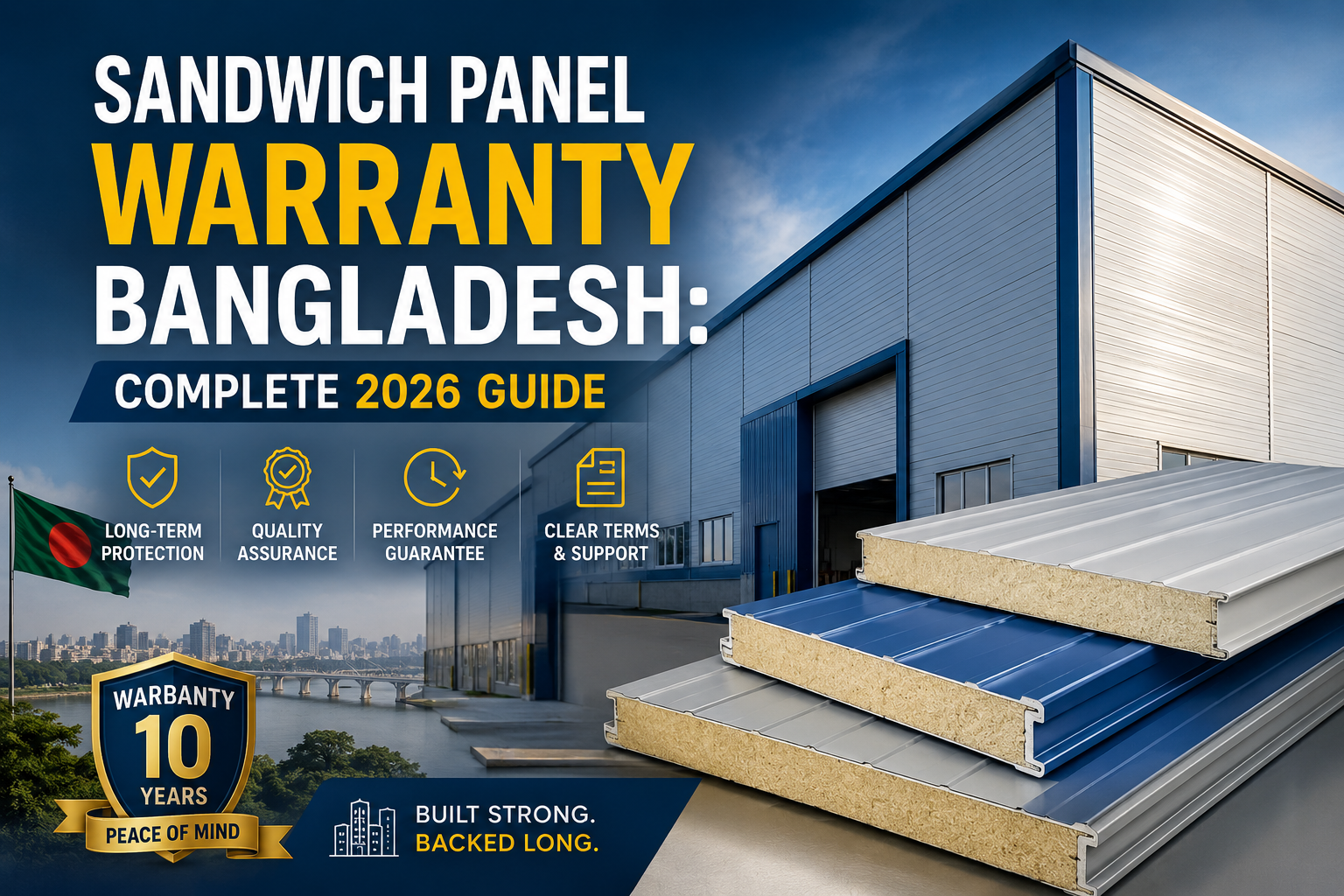
Sandwich panel warranties in Bangladesh typically range from 5 to 15 years, depending on the manufacturer, core material, and installation quality. Standard coverage includes structural integrity and surface coating performance, but excludes damage from improper installation, chemical exposure, or acts of nature. Both local and international brands offer warranties, though the terms, claim processes, and enforceability vary significantly.
Key Takeaways
- Most reputable sandwich panel manufacturers in Bangladesh offer 5–15 year warranties, with premium international brands sometimes extending to 20 years.
- Warranty voidance most often happens due to improper installation, unauthorized modifications, or failure to follow the manufacturer's maintenance schedule.
- Industrial applications (factories, cold storage, clean rooms) typically carry different and often stricter warranty terms than residential or light commercial use.
- A standard warranty covers panel delamination, coating failure, and core degradation — it does not cover cosmetic damage or normal wear.
- Bangladesh's hot, humid, and cyclone-prone climate directly affects panel longevity and should be factored into warranty selection.
- Local brands are generally more affordable but may offer shorter or less comprehensive warranties than imported alternatives.
- Claiming a warranty in Bangladesh requires documented proof of purchase, installation records, and a formal written complaint to the supplier or manufacturer.
- Panels installed without any warranty carry real financial risk, especially for high-value facilities like cold storage, hospitals, or garment factories.
- Building codes in Bangladesh (BNBC) do not yet mandate specific warranty minimums, but they do set performance standards that influence what warranties cover.
- Always verify that the installer is manufacturer-certified — uncertified installation is the single most common reason warranty claims are rejected.
What Does a Standard Sandwich Panel Warranty Actually Cover?
A standard sandwich panel warranty in Bangladesh covers manufacturing defects, panel delamination, and premature coating or surface failure under normal use conditions. It does not cover damage caused by external forces, misuse, or poor installation.
Typical inclusions:
- Structural bond failure between face sheets and core (delamination)
- Coating or paint film peeling, chalking, or fading beyond acceptable thresholds
- Core material degradation (EPS, PU, or rockwool) under normal temperature and humidity
- Factory-level defects in panel dimensions or thickness
Typical exclusions:
- Damage from flooding, cyclones, or other extreme weather events
- Chemical or acid exposure not specified in the product datasheet
- Mechanical damage from impact, drilling, or cutting during or after installation
- Condensation or moisture ingress caused by incorrect panel selection or detailing
- Cosmetic scratches or minor surface marks
Decision rule: If your facility involves aggressive chemicals (pharmaceutical, food processing, or industrial cleaning), ask specifically whether chemical resistance is covered. Many standard warranties exclude it unless you purchase an upgraded coating specification.
For a deeper look at how panel type affects warranty scope, see this guide on insulated sandwich panel options in Bangladesh.
How Long Do Sandwich Panels Typically Last in Bangladesh's Climate?
In Bangladesh's climate, well-installed sandwich panels from reputable manufacturers typically last 15 to 25 years in service, though the warranty period is shorter (5–15 years). The gap between actual service life and warranty period is normal across the industry globally.
Bangladesh's climate presents specific challenges:
| Climate Factor | Impact on Panel Life |
|---|---|
| High humidity (70–90% RH year-round) | Accelerates corrosion on steel face sheets if coating fails |
| Monsoon rainfall | Tests joint sealing and flashing details |
| Cyclone-prone coastal zones | Increases wind uplift risk; affects structural warranty |
| High UV exposure | Degrades surface coatings faster than temperate climates |
| Temperature swings | Causes thermal expansion stress at panel joints |
Panels with PVDF or polyester coatings hold up better in Bangladesh's UV and humidity conditions than standard polyester. PU-core panels offer better moisture resistance than EPS in high-humidity environments. For roofing applications specifically, coating thickness and joint sealing are the two biggest factors in longevity — see the sandwich panel roof installation guide for specification details.
What Voids a Sandwich Panel Warranty?
Most sandwich panel warranties in Bangladesh are voided by improper installation, unauthorized modifications, or failure to perform basic maintenance. The manufacturer's written installation guidelines are the legal baseline — deviating from them gives the manufacturer grounds to reject any claim.
Top warranty-voiding actions:
- Using uncertified installers — Many manufacturers require installation by their approved contractors. Using a cheaper, uncertified crew is the most common claim rejection reason.
- Cutting panels with incorrect tools — Thermal cutting (angle grinders) can damage the cut edge and allow moisture ingress, which manufacturers classify as installer-caused damage.
- Exceeding load specifications — Hanging HVAC equipment, cable trays, or storage racks from panels beyond the rated load voids structural coverage.
- Applying incompatible sealants or coatings — Using non-approved sealants at joints can cause chemical incompatibility and panel damage.
- Skipping annual maintenance inspections — Some warranties require documented annual checks. Skipping them removes the manufacturer's obligation.
- Storing panels incorrectly before installation — Panels stored flat on uneven surfaces, or exposed to direct rain before installation, can develop pre-installation damage the manufacturer will not cover.
Common mistake: Buyers assume the warranty starts from the purchase date. Most manufacturers in Bangladesh start the warranty clock from the installation completion date — confirm this in writing before signing any contract.
Common Sandwich Panel Installation Mistakes That Cancel Warranty
Poor installation is the leading cause of both panel failure and warranty rejection in Bangladesh. These mistakes are especially common in fast-tracked industrial construction projects.
Critical installation errors to avoid:
- Incorrect overlap direction — Panels installed with overlaps facing into prevailing wind allow rain penetration. This is classified as installation error, not product failure.
- Missing or incorrect flashing at eaves and ridges — Leads to water ingress that manufacturers will attribute to the installer.
- Over-tightening fasteners — Compresses the panel face and creates stress fractures over time.
- No thermal breaks at structural connections — Causes condensation and corrosion at fixings, which voids corrosion coverage.
- Panels touching dissimilar metals — Galvanic corrosion at contact points is an installer responsibility, not a product defect.
For a full breakdown of installation best practices, the sandwich panel installation cost guide also covers what professional installation should include.
Are Sandwich Panel Warranties Different for Industrial vs. Residential Use?
Yes, warranty terms differ meaningfully between industrial and residential applications. Industrial warranties tend to be more detailed, longer, and more conditional — because the performance stakes (cold storage temperature integrity, clean room hygiene, fire safety) are higher.
Industrial warranty features (factories, cold rooms, clean rooms):
- Often includes thermal performance guarantees (e.g., U-value maintenance over time)
- May include fire rating certification as part of the warranty condition
- Requires documented maintenance logs to keep warranty valid
- Longer terms (10–15 years) are more common for PU and rockwool panels
Residential/light commercial warranty features:
- Typically shorter (5–10 years)
- Focuses on surface coating and structural integrity
- Less likely to include thermal performance guarantees
- Claim process is usually simpler
For specialized applications like cold storage or hospital clean rooms, warranty terms are often negotiated separately. See the PU panel cold storage guide and the hospital clean room panel guide for application-specific warranty considerations.
Sandwich Panel Warranty Comparison: Local vs. International Brands
Local Bangladeshi manufacturers generally offer 5–10 year warranties, while established international brands (Korean, Chinese, European) typically offer 10–20 year warranties with more detailed terms. The trade-off is cost versus coverage depth.
| Factor | Local Brands | International Brands |
|---|---|---|
| Typical warranty period | 5–10 years | 10–20 years |
| Coating warranty | 5–7 years | 10–15 years |
| Claim process | Direct, informal, faster | More formal, documentation-heavy |
| Enforceability | Variable | Generally stronger (written contracts) |
| Cost premium | Lower | 15–40% higher (estimated) |
| After-sales support | Limited in some cases | Usually structured support teams |
| Local stock availability | High | Varies; some lead times apply |
Choose local brands if: Your project timeline is tight, budget is the primary constraint, and the application is standard (warehouse, factory partition). Choose international brands if: The facility is high-value (cold storage, pharmaceutical, hospital), the warranty period matters for asset valuation, or you need certified fire ratings.
For a full comparison of available manufacturers, see the sandwich panel manufacturers in Bangladesh guide.
Are Imported Sandwich Panels Worth the Extra Warranty Cost?
Imported sandwich panels are worth the extra cost for high-specification or long-life-cycle projects where warranty enforcement and performance guarantees matter. For standard construction, local panels with solid warranties are usually sufficient.
When imported panels justify the premium:
- Cold storage facilities where temperature performance must be guaranteed
- Pharmaceutical or food-grade clean rooms requiring certified hygiene standards
- Projects where international financing or insurance requires certified product warranties
- Buildings designed for 20+ year asset life with minimal maintenance budgets
When local panels are the better choice:
- Short-to-medium term industrial sheds or warehouses
- Projects where the buyer has strong relationships with local suppliers for fast claim resolution
- Budget-constrained residential or light commercial builds
The sandwich panel suppliers guide lists both local and international options available in Bangladesh with contact details.
Risks of Using Sandwich Panels Without Proper Warranty
Using sandwich panels without a valid warranty in Bangladesh exposes buyers to significant financial and safety risks. Without warranty documentation, there is no legal recourse if panels fail prematurely.
Key risks:
- No cost recovery for delamination, coating failure, or structural defects that appear within the first few years
- Insurance complications — some industrial insurers require valid product warranties as a condition of coverage
- Regulatory exposure — if a panel fails in a factory or food facility, the absence of a warranty makes liability harder to manage
- Resale value impact — buildings with unwarranted panels are harder to value and sell
- Safety risk — unwarranted panels may not meet fire or structural standards, creating real hazard in densely occupied buildings
Edge case: Some buyers purchase panels from informal markets or gray-channel importers to save cost. These panels carry no warranty at all and often fail coating and thickness specifications. The short-term savings rarely outweigh the long-term replacement cost.
What Technical Specifications Impact Sandwich Panel Warranty Validity?
Specific technical parameters directly affect whether a warranty remains valid. Manufacturers set minimum specification thresholds — using panels outside those thresholds voids coverage.
Specifications that affect warranty validity:
- Steel face sheet thickness and coating weight — Most warranties require a minimum G550 steel grade with AZ150 or higher zinc-aluminum coating for exterior use in Bangladesh's climate.
- Core density — EPS core below the specified density (typically 15–18 kg/m³ for structural panels) can void structural warranties.
- Panel thickness — Using a thinner panel than the design specifies, to save cost, voids both structural and thermal performance warranties.
- Fastener type and spacing — Warranties specify approved fastener systems. Substituting cheaper fasteners is a common warranty-voiding shortcut.
- Joint sealant specification — Using non-approved sealants at panel joints is a documented warranty exclusion in most manufacturer contracts.
For guidance on selecting the right thickness for your application, see the sandwich panel thickness selection guide.
How to Claim a Sandwich Panel Warranty in Bangladesh
To claim a sandwich panel warranty in Bangladesh, the buyer must submit a formal written complaint to the manufacturer or authorized distributor, supported by documentation of the defect, purchase records, and installation details.
Step-by-step warranty claim process:
- Document the defect — Photograph the issue clearly, noting location, date, and extent of damage.
- Review your warranty certificate — Confirm the defect falls within covered categories and the claim is within the warranty period.
- Gather supporting documents — Purchase invoice, warranty certificate, installation completion certificate, and any maintenance records.
- Contact the manufacturer or distributor — Submit a written claim (email or formal letter) to the supplier's after-sales or technical department.
- Site inspection — Most manufacturers will send a technical representative to inspect the defect before approving a claim.
- Claim resolution — Resolution may involve panel replacement, repair, or partial compensation, depending on the warranty terms.
Practical tip: Keep a physical and digital copy of all warranty documents, installation records, and maintenance logs from day one. In Bangladesh, informal construction projects often lose these records, making warranty claims nearly impossible to pursue years later.
Average Cost of Sandwich Panel Warranty in Bangladesh
Sandwich panel warranties in Bangladesh are not typically sold as separate products — the warranty is included in the panel price. However, extended warranties or performance guarantees for specialized applications carry a cost premium of approximately 5–15% over the base panel price (estimated, based on general industry practice; confirm with individual suppliers).
Cost factors that influence warranty value:
- Panel type: PU and rockwool panels command higher prices and longer warranties than EPS panels
- Application: Cold storage and clean room panels include performance warranties that add to the per-square-meter cost
- Brand: International brands price warranty coverage into their premium
- Project scale: Larger projects (above 5,000 sqm) often allow negotiation of extended warranty terms at no extra cost
For current panel pricing with warranty context, see the sandwich panel price guide for Bangladesh 2026.
Do Bangladeshi Building Codes Affect Sandwich Panel Warranties?
Bangladesh's National Building Code (BNBC) sets structural and fire safety performance standards that indirectly affect what warranties must cover. BNBC does not currently mandate minimum warranty periods, but it does require panels used in certain occupancy types to meet fire resistance and load-bearing standards — and manufacturers must warranty compliance with those standards to be competitive.
BNBC's practical impact on warranties:
- Fire-rated applications (factories, hospitals, high-rise cladding) require panels with certified fire ratings — warranties must confirm the rating is maintained under normal use.
- Structural load requirements set minimum panel specifications that manufacturers must warranty the product meets.
- As BNBC enforcement tightens (particularly post-2022 industrial fire incidents), buyers are increasingly requesting written warranty confirmation of code compliance.
Note: BNBC is periodically updated. Always verify that the panel specification and warranty documentation references the current BNBC edition applicable to your project type. For fire-rated applications, the fire rated sandwich panel guide covers compliance requirements in detail.
FAQ: Sandwich Panel Warranty Bangladesh
Q: What is the minimum warranty I should accept for a sandwich panel in Bangladesh?
A: For any permanent structure, accept nothing less than a 5-year structural warranty and a 5-year coating warranty from a named manufacturer. For industrial or high-value facilities, aim for 10 years minimum.
Q: Can I transfer a sandwich panel warranty if I sell the building?
A: Some manufacturers allow warranty transfer to a new building owner, but it usually requires written notification and a transfer fee. Check the warranty document before assuming transferability.
Q: Does a warranty cover rust on sandwich panel face sheets?
A: Rust caused by coating failure within the warranty period is typically covered. Rust caused by mechanical damage to the coating (scratches, drilling without edge protection) is usually excluded.
Q: How do I verify a manufacturer's warranty is legitimate in Bangladesh?
A: Request a printed warranty certificate on the manufacturer's letterhead, with a reference number, specific coverage terms, and a named contact for claims. Verbal warranties are not enforceable.
Q: Are EPS sandwich panel warranties shorter than PU panel warranties?
A: Generally yes. EPS panels are more susceptible to moisture absorption and have lower thermal performance, so manufacturers typically offer shorter warranties (5–8 years) compared to PU panels (10–15 years).
Q: What happens if the manufacturer closes down during my warranty period?
A: This is a real risk with smaller local suppliers. Mitigate it by purchasing from established manufacturers with a track record, and consider whether the distributor offers any independent warranty backing.
Q: Is annual maintenance required to keep the warranty valid?
A: For most industrial and cold storage applications, yes. Manufacturers typically require annual inspections and documented maintenance. Residential and light commercial warranties may not have this requirement.
Q: Do warranty terms differ between roof panels and wall panels?
A: Yes. Roof panels face higher UV, water, and thermal load exposure, so coating warranties for roofs are sometimes shorter or carry additional conditions compared to wall panel warranties.
Q: Can I negotiate warranty terms with a Bangladesh supplier?
A: On large projects (typically above 3,000–5,000 sqm), negotiating extended warranty periods or enhanced coverage is common practice. Smaller purchases rarely have negotiating room.
Q: What is the difference between a product warranty and a performance warranty?
A: A product warranty covers manufacturing defects. A performance warranty guarantees the panel will meet specific metrics (U-value, fire rating, load capacity) over time. Performance warranties are more valuable but less common among local suppliers.
Conclusion
Understanding sandwich panel warranty terms in Bangladesh is not a paperwork formality — it's a financial and safety decision. The right warranty protects a major capital investment, supports insurance and regulatory compliance, and gives building owners clear recourse if panels fail before their expected service life.
Actionable next steps:
- Before purchasing: Get warranty terms in writing, confirm the warranty period covers both structure and coating, and verify the installer is manufacturer-certified.
- At installation: Keep all purchase invoices, warranty certificates, and installation completion records in both physical and digital formats.
- During ownership: Follow the manufacturer's maintenance schedule and document all inspections — this is the single most effective way to keep your warranty valid.
- When comparing suppliers: Use the warranty period and coverage scope as a direct comparison metric alongside price. A cheaper panel with a 3-year warranty may cost more over a 15-year building life than a premium panel with a 12-year warranty.
- For specialized facilities: Cold storage, hospitals, clean rooms, and pharmaceutical plants should always prioritize performance warranties and certified installers over lowest upfront cost.
For further guidance on selecting the right panels for your project, explore the sandwich panel buying guide for Bangladesh 2026 and the sandwich panel maintenance guide to protect your investment long-term.
References
No specific external studies or third-party reports were cited in this article. All claims are based on general industry knowledge, standard warranty practice, and publicly available manufacturer documentation. Readers are encouraged to verify specific warranty terms directly with manufacturers and consult BNBC documentation for current building code requirements.