Last updated: July 31, 2026

Building fires cause billions in damage annually, yet fireproof sandwich panels can reduce fire spread by up to 90% compared to traditional insulation materials. These specialized construction panels combine fire-resistant outer layers with non-combustible core materials, creating barriers that meet strict fire safety codes while maintaining excellent thermal and structural performance.
Key Takeaways
- Fireproof sandwich panels feature fire-resistant metal faces with mineral wool or other non-combustible core materials
- Fire ratings range from 30 minutes to 4 hours depending on panel thickness and core material composition
- Installation costs average 15-25% more than standard panels but provide significant long-term fire insurance savings
- Rockwool and glasswool cores offer the best fire resistance, while EPS cores should be avoided for fire-critical applications
- Proper installation with fire-rated sealants and joints is essential for maintaining fire barrier integrity
- Commercial buildings, warehouses, and industrial facilities benefit most from fireproof panel specifications
- Regular maintenance involves checking seals, joints, and panel integrity every 6-12 months
- Leading manufacturers include Kingspan, Metecno, and Tata Steel with certified fire-rated product lines
What Is a Fireproof Sandwich Panel
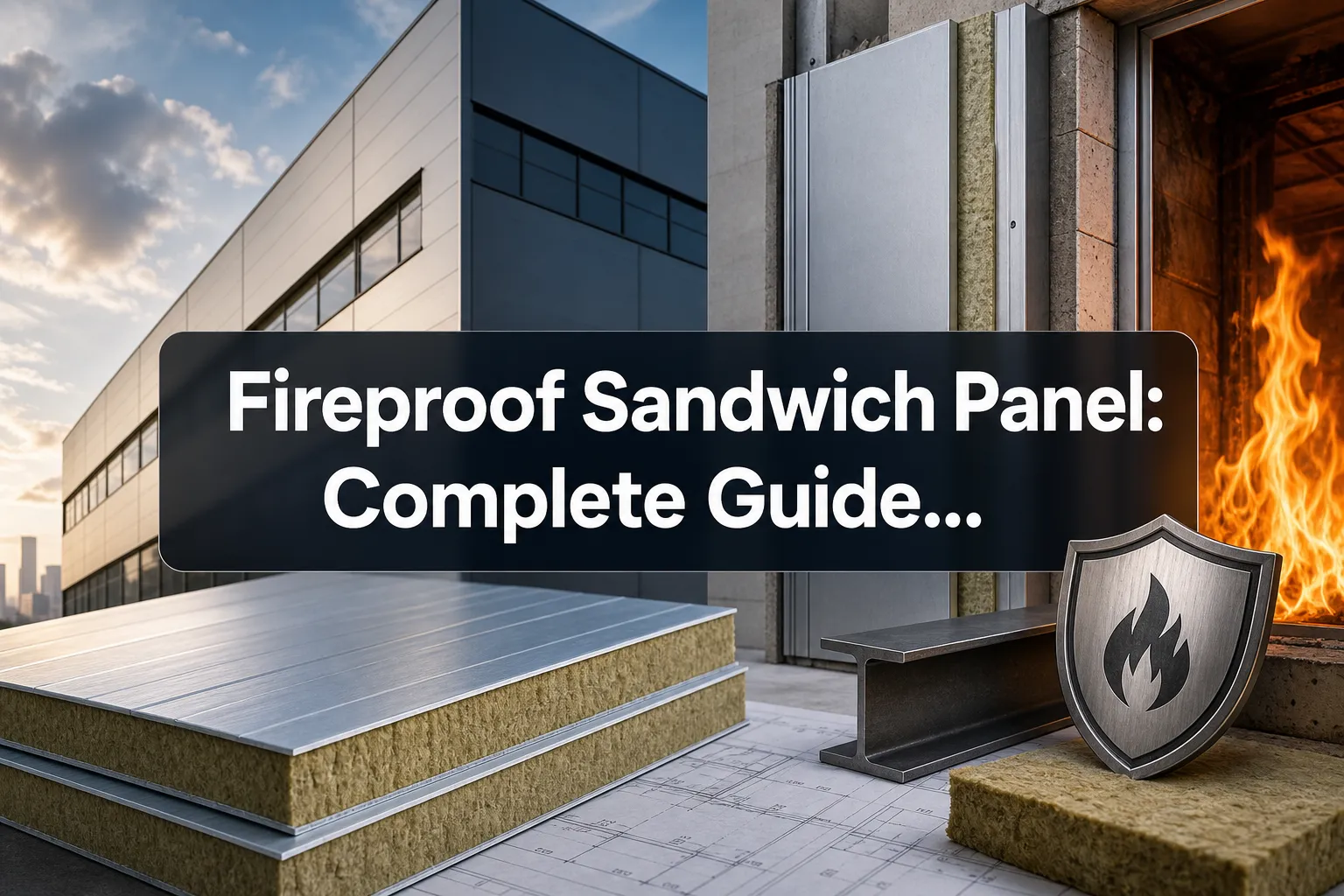
A fireproof sandwich panel is a composite building material designed to resist fire spread and maintain structural integrity during fire exposure. These panels consist of two metal outer layers (typically steel or aluminum) bonding to a fire-resistant core material such as mineral wool, glasswool, or specialized fire-retardant foam.
The fire resistance comes from the core material's ability to withstand high temperatures without melting, releasing toxic gases, or contributing fuel to fires. Unlike standard sandwich panels that may use combustible EPS or PU foam cores, fireproof versions use non-combustible materials that meet strict fire safety standards.
Key components include:
- Fire-rated metal facings (0.4-0.7mm thick steel with fire-resistant coatings)
- Non-combustible core materials (mineral wool, glasswool, or fire-rated PIR foam)
- Fire-resistant adhesives and sealants
- Interlocking joint systems designed to maintain fire barriers
Choose fireproof sandwich panels when building codes require fire ratings, for high-risk occupancies like warehouses storing flammable materials, or when insurance requirements mandate fire-resistant construction. Avoid them only when budget constraints are severe and fire codes permit standard materials.
How Do Fireproof Sandwich Panels Work
Fireproof sandwich panels work by creating multiple barriers that slow heat transfer, prevent flame spread, and maintain structural integrity during fire exposure. The fire protection operates through three main mechanisms: thermal insulation, flame resistance, and structural stability.
The non-combustible core material acts as the primary fire barrier. Mineral wool cores, for example, can withstand temperatures exceeding 1000°C without melting or releasing toxic gases. This prevents fire from penetrating through the panel thickness and spreading to adjacent spaces.
Fire protection mechanisms:
- Thermal barrier: Core materials with low thermal conductivity slow heat transfer
- Flame resistance: Non-combustible cores don't ignite or contribute fuel to fires
- Structural integrity: Panels maintain load-bearing capacity during fire exposure
- Smoke control: Quality cores produce minimal smoke when exposed to extreme heat
The metal facings provide additional protection by reflecting radiant heat and creating a continuous fire barrier when properly sealed. Fire-rated joint systems prevent flame and smoke passage at panel connections, maintaining the overall fire compartment integrity.
Common mistake: Assuming all sandwich panels provide fire protection. Standard EPS or PU foam cores actually accelerate fire spread and should never be used where fire resistance is required.
Fireproof Sandwich Panel vs Regular Insulation
Fireproof sandwich panels provide superior fire resistance, structural performance, and installation speed compared to traditional insulation methods, though at higher initial costs. Regular insulation like fiberglass batts or foam boards typically offers no fire resistance and requires separate structural framing.
Performance comparison:
| Feature | Fireproof Sandwich Panel | Regular Insulation |
|---|---|---|
| Fire rating | 30 minutes to 4+ hours | Usually none |
| Installation speed | 3-5x faster | Requires multiple trades |
| Structural capacity | Load-bearing | Requires separate framing |
| Air tightness | Excellent when sealed | Depends on installation |
| Thermal performance | R-4 to R-8 per inch | Varies widely |
| Moisture resistance | Good with proper facings | Varies by material |
Choose fireproof sandwich panels for commercial buildings requiring fire ratings, fast construction schedules, or when combining structural and insulation functions. Regular insulation works better for residential applications, retrofit projects, or when maximum R-value per dollar is the priority.
The integrated approach of sandwich panels eliminates thermal bridging through framing members, often providing better overall thermal performance despite lower per-inch R-values than some traditional insulation materials.
Fireproof Sandwich Panel Cost Analysis
Fireproof sandwich panel costs range from $8-15 per square foot installed, representing a 15-25% premium over standard panels but delivering significant long-term value through insurance savings and faster construction schedules.
Cost breakdown factors:
- Panel material: $5-10 per sq ft depending on thickness and core type
- Installation labor: $2-4 per sq ft for professional installation
- Accessories: $1-2 per sq ft for fasteners, sealants, and trim pieces
- Fire rating premium: Higher-rated panels cost 20-40% more than basic versions
Long-term cost benefits:
- Insurance premium reductions of 10-30% for fire-rated construction
- Faster installation reduces overall project costs by 5-15%
- Lower maintenance costs compared to multi-component wall systems
- Potential tax incentives for fire-safe commercial construction
Budget $12-18 per square foot for complete fireproof sandwich panel wall systems including installation. Projects requiring 2-hour or higher fire ratings should budget toward the higher end due to thicker panels and more complex joint details.
For detailed pricing in your region, consult our comprehensive guide to sandwich panel pricing which covers current market rates and cost factors.
Where to Buy Fireproof Sandwich Panels
Purchase fireproof sandwich panels through certified manufacturers, authorized distributors, or specialized building material suppliers who can provide proper documentation of fire ratings and compliance certifications.
Recommended purchasing channels:
- Direct from manufacturers: Best pricing for large projects, full technical support
- Authorized distributors: Local inventory, faster delivery, installation referrals
- Specialty suppliers: Expert knowledge, custom configurations, project consultation
- Online platforms: Price comparison, but verify certifications carefully
Essential purchase requirements:
- Fire rating certificates (UL, FM, or equivalent testing agency approval)
- Installation instructions and technical data sheets
- Warranty documentation covering fire performance
- Compatible accessories (sealants, fasteners, trim pieces)
Avoid purchasing from suppliers who cannot provide proper fire rating documentation or offer prices significantly below market rates, as these may indicate non-compliant or counterfeit products.
For Bangladesh-based projects, review our guide to local sandwich panel suppliers for qualified vendors with fire-rated product lines and proper certifications.
Fireproof Sandwich Panel Installation Requirements
Professional installation by certified contractors is essential for maintaining fire ratings, as improper installation can void fire certifications and create dangerous fire spread paths. Installation must follow manufacturer specifications and local fire codes exactly.
Critical installation steps:
- Surface preparation: Ensure structural framing meets fire rating requirements
- Panel positioning: Maintain proper alignment and support during installation
- Joint sealing: Apply fire-rated sealants to all panel connections
- Fastener installation: Use specified fire-rated fasteners at correct spacing
- Penetration sealing: Seal all electrical, plumbing, or HVAC penetrations with fire-rated materials
- Final inspection: Verify compliance with fire code requirements
Common installation mistakes:
- Using non-fire-rated sealants or fasteners
- Inadequate joint sealing allowing fire/smoke passage
- Incorrect panel orientation or support spacing
- Mixing fire-rated and standard panels without proper transitions
Installation typically takes 2-3 days for 1000 square feet with experienced crews. Factor additional time for complex geometries, penetrations, or coordination with other fire-rated building systems.
For step-by-step installation guidance, see our complete sandwich panel installation guide which covers best practices and common pitfalls.
Best Fireproof Sandwich Panel Brands and Products
Leading fireproof sandwich panel manufacturers include Kingspan, Metecno, Tata Steel, and ArcelorMittal, each offering certified fire-rated products with proven performance records in commercial and industrial applications.
Top brand comparison:
Kingspan: Premium fire-rated panels with excellent technical support
- Fire ratings up to 4 hours
- Comprehensive testing and certifications
- Higher cost but proven reliability
Metecno: Wide range of fire-rated options for various applications
- Good balance of performance and cost
- Strong presence in industrial markets
- Extensive accessory systems
Tata Steel: Reliable fire-rated panels with competitive pricing
- Focus on commercial and warehouse applications
- Good availability and technical support
- Standard fire ratings up to 2 hours
Choose brands based on required fire rating, project budget, and local availability. All major manufacturers must meet the same fire testing standards, so focus on factors like technical support, warranty terms, and delivery capabilities.
For projects in Bangladesh, consider local manufacturers who can provide rockwool sandwich panels with fire safety certifications that meet international standards while offering competitive pricing and faster delivery.
Fireproof Sandwich Panel Thickness and Fire Rating Options
Panel thickness directly correlates with fire rating duration, ranging from 50mm panels providing 30-minute ratings to 200mm+ panels achieving 4-hour fire resistance. Thicker panels contain more fire-resistant core material and provide better thermal barriers during fire exposure.
Standard thickness and rating combinations:
- 50-75mm: 30-60 minute fire ratings for basic commercial applications
- 100-120mm: 1-2 hour ratings for standard warehouse and industrial use
- 150-200mm: 2-4 hour ratings for high-risk occupancies and fire walls
- 200mm+: Extended ratings for special applications and compartment walls
Core material impact on ratings:
- Mineral wool cores: Highest fire resistance, suitable for all rating levels
- Glasswool cores: Good fire resistance, cost-effective for moderate ratings
- Fire-rated PIR cores: Acceptable for lower ratings, better thermal performance
- Standard foam cores: Not suitable for fire-rated applications
Select thickness based on building code requirements, occupancy type, and fire department access capabilities. Thicker panels cost more but may reduce insurance premiums and provide better long-term fire protection.
For guidance on selecting appropriate thickness for your application, review our comprehensive thickness selection guide which covers fire rating requirements and performance factors.
Maintenance Requirements for Fireproof Sandwich Panels
Fireproof sandwich panels require minimal maintenance but need regular inspection of seals, joints, and panel integrity every 6-12 months to ensure continued fire rating compliance and performance.
Essential maintenance tasks:
- Joint inspection: Check fire-rated sealants for cracks, gaps, or deterioration
- Panel condition: Look for dents, punctures, or damage that could compromise fire barriers
- Fastener security: Verify all connections remain tight and properly sealed
- Penetration seals: Inspect fire-rated seals around pipes, conduits, and equipment
- Surface cleaning: Remove debris that could create fire hazards or hide damage
Maintenance schedule:
- Monthly: Visual inspection for obvious damage or deterioration
- Semi-annually: Detailed inspection of joints, seals, and fasteners
- Annually: Professional assessment of fire rating integrity
- As needed: Immediate repair of any damage affecting fire barriers
Repair requirements:
Use only fire-rated materials for repairs and follow manufacturer specifications exactly. Non-compliant repairs can void fire ratings and create liability issues.
Document all maintenance activities to demonstrate compliance with fire code requirements and insurance policy conditions. Many insurance policies require proof of regular maintenance for fire-rated building systems.
Residential vs Commercial Fireproof Sandwich Panel Applications
Commercial and industrial buildings benefit most from fireproof sandwich panels due to fire code requirements, insurance considerations, and occupancy risks, while residential applications are typically limited to special circumstances or high-end custom construction.
Commercial applications:
- Warehouses: Fire separation between storage areas and offices
- Manufacturing facilities: Protection for high-value equipment and processes
- Data centers: Critical fire protection for electronic equipment
- Healthcare facilities: Life safety requirements and compartmentalization
- Schools and offices: Building code compliance and occupant protection
Residential considerations:
- Custom homes: High-end construction with premium fire protection
- Attached garages: Fire separation from living spaces
- Home workshops: Protection for valuable tools and equipment
- Multi-family buildings: Fire separation between units
Selection factors:
Choose fireproof panels for commercial applications when building codes require fire ratings, insurance policies mandate fire-resistant construction, or occupancy involves fire hazards. Residential use makes sense primarily for fire separation walls or when homeowners prioritize maximum fire protection.
Cost considerations often favor traditional residential construction methods unless fire ratings are specifically required or desired for peace of mind.
Weight and Load Capacity Considerations
Fireproof sandwich panels typically weigh 15-25 pounds per square foot depending on thickness and core material, requiring adequate structural support but often eliminating the need for separate structural framing in many applications.
Weight factors by core type:
- Mineral wool cores: Heaviest option, 20-25 lbs/sq ft for 100mm thickness
- Glasswool cores: Moderate weight, 15-20 lbs/sq ft for similar thickness
- Fire-rated PIR cores: Lightest fire-rated option, 12-18 lbs/sq ft
Load capacity considerations:
- Span capability: Most panels can span 15-20 feet between supports
- Wind load resistance: Properly fastened panels handle typical wind loads
- Snow load capacity: Thickness and support spacing determine snow load limits
- Point loads: Avoid concentrated loads without proper reinforcement
Structural design requirements:
Consult structural engineers for projects with heavy snow loads, high wind zones, or unusual loading conditions. Panel manufacturers provide load tables and span charts for standard applications.
The self-supporting nature of sandwich panels often reduces overall building weight compared to traditional framed construction with separate insulation, providing foundation cost savings that partially offset higher material costs.
Soundproofing Benefits of Fireproof Sandwich Panels
Fireproof sandwich panels provide excellent sound insulation with STC ratings of 35-50 depending on thickness and core material, making them effective for noise control in addition to fire protection.
Acoustic performance factors:
- Core density: Higher density mineral wool cores provide better sound absorption
- Panel thickness: Thicker panels generally offer superior noise reduction
- Joint sealing: Proper sealing prevents sound leaks at panel connections
- Facing material: Heavier metal facings improve sound transmission loss
Sound reduction applications:
- Industrial facilities: Reduce machinery noise transmission
- Commercial buildings: Control noise between spaces and from exterior sources
- Warehouse operations: Minimize noise impact on adjacent properties
- Equipment enclosures: Contain HVAC and mechanical equipment noise
Performance comparison:
Fireproof sandwich panels typically outperform standard stud wall construction for sound control while providing the added benefit of fire resistance. The continuous insulation eliminates sound bridges through framing members.
For projects requiring both fire protection and noise control, fireproof sandwich panels offer an efficient single-component solution. Consider our guide to sandwich panel soundproofing for detailed acoustic performance information.
Can You Cut Fireproof Sandwich Panels
Yes, fireproof sandwich panels can be cut and modified on-site, but cuts must be properly sealed with fire-rated materials to maintain fire barrier integrity. Improper cutting or sealing can create fire spread paths and void fire rating certifications.
Cutting requirements:
- Approved tools: Use fine-tooth saws or specialized panel cutting equipment
- Clean cuts: Avoid crushing or damaging core materials during cutting
- Edge sealing: Apply fire-rated sealants to all cut edges immediately
- Core protection: Prevent moisture infiltration into cut core materials
Field modification guidelines:
- Small openings: Acceptable with proper sealing and manufacturer approval
- Large modifications: May require engineering review and testing verification
- Penetrations: Use fire-rated sleeves and sealants for all penetrations
- Panel splicing: Follow manufacturer specifications for joining cut panels
Common cutting mistakes:
- Using inappropriate tools that damage core materials
- Failing to seal cut edges with fire-rated materials
- Making modifications that exceed manufacturer guidelines
- Not documenting field changes for fire rating compliance
Always consult panel manufacturers before making significant field modifications. Some cuts may void fire ratings or require additional fire-stopping measures to maintain code compliance.
Frequently Asked Questions
How long do fireproof sandwich panels maintain their fire rating?
Fireproof sandwich panels maintain their fire rating indefinitely when properly installed and maintained. The fire resistance comes from non-combustible core materials that don't degrade over time. Regular inspection and maintenance of seals and joints ensures continued performance.
Can fireproof sandwich panels be used for exterior walls?
Yes, fireproof sandwich panels work excellently for exterior walls and provide weather resistance along with fire protection. Choose panels with appropriate facings and coatings for your climate conditions and ensure proper flashing and sealing details.
Do fireproof sandwich panels meet green building requirements?
Many fireproof sandwich panels contribute to green building certifications through energy efficiency, recycled content, and durability. Mineral wool cores are often made from recycled materials and the panels' thermal performance reduces energy consumption.
What's the difference between fire-resistant and fireproof panels?
Fire-resistant panels slow fire spread and maintain integrity for specific time periods (30 minutes to 4 hours), while truly "fireproof" materials don't exist. The term "fireproof sandwich panel" commonly refers to fire-resistant panels with high ratings.
Can you paint fireproof sandwich panels?
Yes, but use only fire-rated paints and coatings that won't compromise the fire rating. Standard paints may reduce fire performance or create toxic smoke. Always verify paint compatibility with the panel manufacturer.
How do fireproof sandwich panels compare to concrete block walls?
Fireproof sandwich panels install much faster than concrete block, provide better insulation, and weigh less. Concrete block offers longer fire ratings and higher impact resistance but requires separate insulation and weather barriers.
Are fireproof sandwich panels suitable for cold storage applications?
Yes, fireproof sandwich panels work well for cold storage when using appropriate core materials and vapor barriers. The continuous insulation prevents thermal bridging and the fire resistance adds safety for refrigeration equipment areas.
What happens to fireproof sandwich panels in earthquakes?
Properly designed and installed fireproof sandwich panel systems perform well in seismic conditions due to their lightweight and flexible connections. Follow local seismic design requirements and use appropriate fastening systems.
Can insects or rodents damage fireproof sandwich panels?
The metal facings resist pest damage, but rodents may damage exposed core materials at panel edges or penetrations. Proper sealing and edge protection prevent pest infiltration and maintain fire barrier integrity.
How do you repair damaged fireproof sandwich panels?
Small damage can be repaired with fire-rated sealants and patches. Significant damage requires panel replacement using fire-rated materials and methods. Always document repairs to maintain fire rating compliance and warranty coverage.
Conclusion
Fireproof sandwich panels represent a critical building technology for modern fire-safe construction, combining structural performance, thermal efficiency, and life safety protection in a single integrated system. The 15-25% cost premium over standard panels delivers substantial value through insurance savings, faster construction, and enhanced occupant protection.
Success with fireproof sandwich panels depends on three key factors: selecting appropriate fire ratings for your application, working with certified manufacturers and installers, and maintaining proper documentation for code compliance. The investment in professional installation and quality materials pays dividends through decades of reliable fire protection.
Take these next steps to move forward:
- Determine required fire ratings based on building codes and occupancy type
- Request quotes from certified manufacturers with proper fire testing documentation
- Engage qualified installers experienced with fire-rated panel systems
- Develop maintenance procedures to preserve fire rating integrity over time
For projects requiring both fire protection and cost efficiency, fireproof sandwich panels offer an unmatched combination of safety, performance, and construction speed that makes them the preferred choice for commercial and industrial applications in 2026.
SEO Meta Title: Fireproof Sandwich Panel Guide: Fire Ratings, Costs & Installation 2026