Last updated: July 31, 2026

Quick Answer
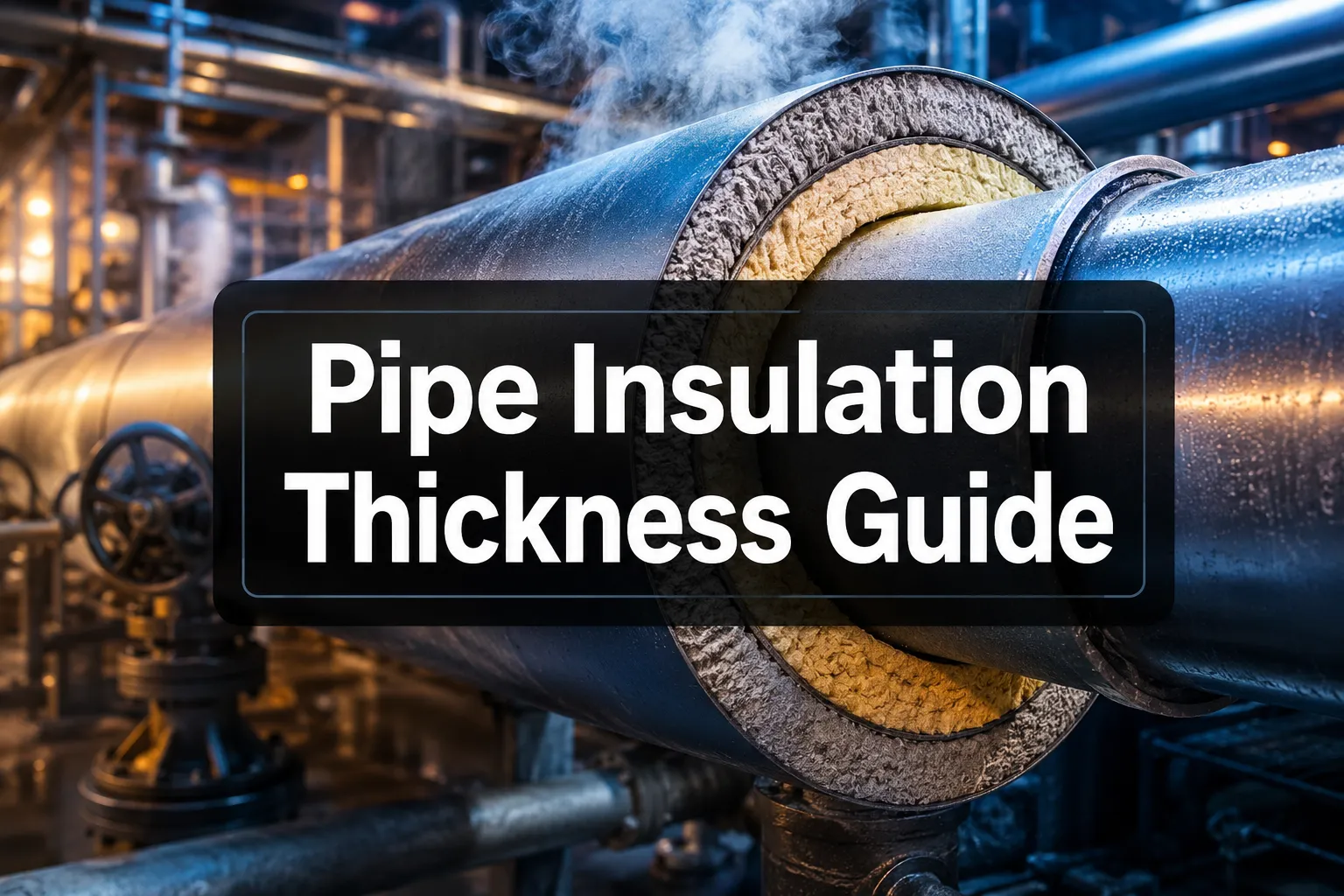
Pipe thermal insulation thickness calculation involves determining the optimal insulation layer depth based on pipe diameter, operating temperature, ambient conditions, and desired heat loss reduction. Standard calculations use the thermal resistance method, considering the pipe's outer diameter, insulation thermal conductivity (k-value), and target surface temperature to minimize energy loss while meeting code requirements.
Key Takeaways
- Standard pipe insulation thickness ranges from 1 to 4 inches for most residential and commercial applications
- Hot water pipes typically require 1-2 inches of insulation, while steam pipes need 2-4 inches
- Thermal conductivity (k-value) and R-value are inversely related – lower k-values mean better insulation performance
- Outdoor pipes in cold climates need 25-50% thicker insulation than indoor installations
- Over-insulating can waste money without significant energy savings beyond the optimal thickness
- Building codes specify minimum insulation requirements that vary by pipe size and application
- Professional calculations consider heat loss rates, surface temperatures, and economic thickness optimization
- Wrong insulation thickness can lead to condensation, freeze damage, or excessive energy costs
What Is the Standard Thickness for Pipe Insulation
Standard pipe insulation thickness varies from 0.5 to 6 inches depending on pipe diameter, fluid temperature, and application requirements. Most residential hot water pipes use 1-inch thick insulation, while commercial steam systems typically require 2-4 inches.
Common thickness standards by application:
- Residential hot water (120-140°F): 1-2 inches
- Commercial hot water (140-180°F): 1.5-2.5 inches
- Steam pipes (212°F+): 2-4 inches
- Chilled water (40-55°F): 1-2 inches
- Refrigeration lines (-20 to 35°F): 1.5-3 inches
The International Energy Conservation Code (IECC) mandates minimum insulation thickness based on pipe size and operating temperature. For example, pipes 1.5 inches and smaller carrying fluids above 105°F require at least 1-inch insulation thickness.
Pipe diameter considerations: Larger pipes need proportionally thicker insulation because they have more surface area for heat loss. A 6-inch steam pipe might need 4-inch insulation, while a 1-inch hot water line only needs 1-inch coverage.
For specialized applications like pipe insulation sandwich panels, thickness requirements may differ based on the integrated panel design and thermal performance targets.
How to Calculate the Right Insulation Thickness for Your Pipes
Calculating optimal pipe thermal insulation thickness requires determining heat loss rates, surface temperatures, and economic factors. The basic thermal resistance method compares insulation costs against energy savings over the system's lifespan.
Step 1: Gather pipe specifications
- Pipe outer diameter
- Operating fluid temperature
- Ambient air temperature
- Insulation material k-value (thermal conductivity)
Step 2: Apply the thermal resistance formula
The heat loss per linear foot formula is:
Q = (T₁ – T₂) / R_total
Where:
- Q = heat loss rate (BTU/hr/ft)
- T₁ = pipe surface temperature
- T₂ = ambient temperature
- R_total = total thermal resistance
Step 3: Calculate insulation thermal resistance
R_insulation = ln(r₂/r₁) / (2π × k × L)
Where:
- r₁ = pipe outer radius
- r₂ = insulation outer radius
- k = insulation thermal conductivity
- L = pipe length
Step 4: Determine economic thickness
Compare annual energy costs for different thicknesses against insulation material and installation costs. The optimal thickness minimizes total lifecycle costs, typically where additional insulation investment equals energy savings over 3-5 years.
Common mistake: Using only initial cost comparisons instead of lifecycle analysis. A thicker insulation specification that costs 20% more upfront might save 40% in energy costs annually.
Pipe Insulation Thickness Calculator Tools and Methods
Online pipe insulation thickness calculators streamline the complex thermal analysis process by automating heat transfer calculations and economic optimization. Professional tools like the 3E Plus program from the North American Insulation Manufacturers Association provide industry-standard calculations.
Popular calculator features:
- Heat loss rate calculations
- Surface temperature predictions
- Economic thickness optimization
- Condensation prevention analysis
- Greenhouse gas emission reductions
Manual calculation method:
For quick estimates, use the rule of thumb that insulation thickness should equal 10-25% of the pipe diameter for moderate temperature applications. A 4-inch pipe would need approximately 0.5 to 1-inch insulation thickness.
Professional software options:
- 3E Plus (free industry standard)
- Pipe Flow Expert
- HTRI Xist
- Engineering equation solvers
Input parameters for accurate results:
- Pipe material and size
- Insulation type and properties
- Operating and ambient temperatures
- Wind speed (for outdoor installations)
- Energy costs and insulation pricing
Validation step: Compare calculator results with manufacturer recommendations and local code requirements. Some jurisdictions specify minimum thicknesses that override economic calculations.
The thermal performance sandwich panel approach integrates insulation calculations with structural requirements for comprehensive system design.
Does Pipe Insulation Thickness Affect Heat Loss
Pipe insulation thickness directly impacts heat loss rates, with thicker insulation providing exponentially diminishing returns beyond optimal levels. Doubling insulation thickness typically reduces heat loss by 40-60%, but tripling thickness might only achieve an additional 15-20% reduction.
Heat loss relationship:
Heat transfer through cylindrical insulation follows logarithmic patterns, meaning initial thickness increases provide the greatest benefits. The first inch of insulation might reduce heat loss by 85%, while the second inch adds only 10% more efficiency.
Practical thickness limits:
- Under-insulated: Heat loss exceeds 15 BTU/hr/ft
- Properly insulated: Heat loss between 5-15 BTU/hr/ft
- Over-insulated: Heat loss below 5 BTU/hr/ft with minimal additional savings
Temperature drop analysis:
A bare 2-inch steam pipe at 250°F might drop to 200°F over 100 feet. With 2-inch insulation, the same pipe maintains 245°F, while 4-inch insulation only improves to 247°F.
Economic threshold: Most applications reach optimal thickness when additional insulation costs exceed energy savings within 3-5 years. Beyond this point, thicker insulation wastes money without meaningful performance gains.
Surface temperature impact: Proper thickness keeps outer surface temperatures within 10-20°F of ambient conditions, preventing burns while minimizing heat loss. Insufficient thickness creates hot surfaces that waste energy and pose safety risks.
R-Value vs Thickness Differences for Pipe Insulation
R-value measures total thermal resistance while thickness indicates physical insulation depth – these values relate inversely to thermal conductivity but aren't directly proportional. Higher R-values provide better insulation performance, but achieving target R-values requires different thicknesses depending on material properties.
R-value calculation for pipes:
R = thickness / k-value × correction factor
The correction factor accounts for cylindrical geometry, which differs from flat-wall insulation calculations. Pipe insulation R-values are typically 10-15% lower than equivalent flat applications.
Material comparison examples:
- Fiberglass: R-3.2 per inch, 2-inch thickness = R-6.4
- Polyurethane foam: R-6.0 per inch, 1-inch thickness = R-6.0
- Mineral wool: R-3.7 per inch, 1.75-inch thickness = R-6.5
Thickness vs performance trade-offs:
High-performance materials like aerogel achieve R-10 per inch but cost 5-10 times more than standard fiberglass. For most applications, moderate-performance materials at greater thickness provide better value.
Code compliance considerations:
Building codes specify either minimum R-values or minimum thickness requirements. Some jurisdictions require R-8 insulation regardless of thickness, while others mandate specific thickness minimums like 1.5 inches for hot water pipes.
Installation factors: Thicker insulation requires larger clearances and may need additional support structures. Dense, high-R materials often install easier in tight spaces compared to thick, low-density alternatives.
Understanding these relationships helps optimize thermal insulation sandwich panel specifications for specific performance targets.
Hot Water Pipe Insulation Thickness Requirements
Hot water pipe insulation thickness should be 1-2 inches for residential systems and 1.5-3 inches for commercial applications, depending on pipe diameter and water temperature. Systems operating at 120-140°F typically need 1-inch minimum thickness, while 160-180°F systems require 1.5-2 inches.
Residential hot water standards:
- 3/4-inch pipes: 1-inch insulation minimum
- 1-inch pipes: 1-1.5 inches insulation
- 1.5-inch+ pipes: 1.5-2 inches insulation
Commercial system requirements:
Large commercial buildings with recirculation systems need thicker insulation to maintain water temperatures over long distribution runs. Hotels and hospitals often specify 2-3 inch thickness for main distribution lines.
Temperature-based guidelines:
- 120-140°F: 1-inch standard thickness
- 140-160°F: 1.5-inch recommended thickness
- 160-180°F: 2-inch minimum thickness
- 180°F+: 2.5-3 inches for safety and efficiency
Return line considerations: Hot water return lines need equal insulation thickness as supply lines to prevent heat loss that forces the water heater to work harder. Many installations incorrectly under-insulate return piping.
Installation details: Ensure continuous insulation coverage at fittings, valves, and pipe supports. Gaps in insulation create thermal bridges that dramatically reduce overall system efficiency.
Energy savings: Properly insulated hot water pipes reduce standby losses by 60-80% and can cut water heating costs by 10-15% in typical residential applications.
Can Pipe Insulation Be Too Thick
Pipe insulation can be too thick when additional thickness costs more than energy savings over the system lifespan, creates installation problems, or exceeds structural support capabilities. Most applications reach optimal thickness at 2-4 inches, with minimal benefits beyond these levels.
Economic over-insulation indicators:
- Payback period exceeds 7-10 years
- Additional thickness costs 50%+ more with less than 10% energy savings
- Installation complexity doubles labor costs
Physical constraints:
Excessive thickness can interfere with:
- Ceiling clearances in mechanical rooms
- Pipe hanger and support systems
- Access for maintenance and repairs
- Fire sprinkler head coverage patterns
Diminishing returns analysis:
A 4-inch steam pipe with 2-inch insulation might lose 12 BTU/hr/ft. Adding another 2 inches reduces loss to 8 BTU/hr/ft – a 33% improvement. The next 2 inches only improve to 6 BTU/hr/ft, just 25% better performance.
Optimal thickness determination:
Most commercial applications optimize between 1.5-3 inches thickness. Industrial high-temperature processes might justify 4-6 inches, but residential systems rarely benefit from more than 2 inches.
Code maximums: Some building codes specify maximum insulation thickness to ensure proper clearances and fire safety access. Check local requirements before specifying extra-thick insulation systems.
Alternative strategies: Instead of excessive thickness, consider higher-performance insulation materials or addressing system design issues like oversized piping or poor layout planning.
Pipe Insulation Thickness for Cold Water vs Hot Water
Cold water pipe insulation focuses on condensation prevention rather than energy conservation, typically requiring 0.5-1.5 inches compared to 1-3 inches for hot water systems. The thickness calculation prioritizes keeping surface temperatures above dew point rather than minimizing heat loss.
Cold water thickness guidelines:
- Chilled water (45-55°F): 1-2 inches
- Domestic cold water: 0.5-1 inch (condensation control only)
- Refrigeration lines (0-35°F): 1.5-3 inches
- Sub-freezing systems: 2-4 inches minimum
Condensation prevention calculations:
Surface temperature must stay above ambient dew point temperature. In humid conditions (70°F, 60% RH), dew point is 57°F. Chilled water pipes at 45°F need sufficient insulation to maintain 60°F+ surface temperature.
Hot water comparison:
Hot water insulation prevents heat loss and maintains temperature, requiring thickness based on economic optimization. Cold water insulation prevents moisture problems and potential freeze damage, making adequate thickness mandatory rather than optional.
Material considerations:
Cold water applications need vapor barrier jackets to prevent moisture infiltration into insulation. Closed-cell foam materials work well because they resist moisture absorption and provide integrated vapor barriers.
Climate factors:
Humid climates require thicker cold water insulation than dry regions. Coastal areas or buildings with pools need extra thickness to handle higher ambient humidity levels.
Installation details: Cold water insulation joints need careful sealing to prevent vapor infiltration. Any gaps allow humid air to reach cold surfaces and cause condensation within the insulation system.
Modern building insulation panels integrate both hot and cold water considerations in comprehensive system designs.
What Happens If You Use Wrong Insulation Thickness
Using incorrect pipe thermal insulation thickness leads to energy waste, system damage, safety hazards, and code violations. Under-insulation causes excessive heat loss and high surface temperatures, while over-insulation wastes money without proportional benefits.
Under-insulation consequences:
- Energy waste: 20-50% higher operating costs
- Temperature loss: Hot water arrives 10-30°F cooler at fixtures
- Safety risks: Surface temperatures above 120°F cause burns
- Freeze damage: Insufficient protection in cold conditions
- Code violations: Failing to meet minimum thickness requirements
Over-insulation problems:
- Wasted investment: Payback periods exceed 10-15 years
- Installation issues: Clearance problems and support complications
- Maintenance difficulties: Harder access for repairs and modifications
Condensation issues with cold water:
Insufficient thickness on chilled water lines causes surface condensation, leading to:
- Mold and mildew growth
- Ceiling damage from dripping
- Insulation degradation and loss of effectiveness
- Structural damage from persistent moisture
Performance degradation:
Wrong thickness specifications reduce system efficiency by 15-40% compared to properly calculated installations. A steam system with 1-inch insulation instead of optimal 2.5-inch thickness might waste $2,000-5,000 annually in a commercial building.
Correction costs: Retrofitting incorrect insulation thickness costs 2-3 times more than initial proper installation due to removal, disposal, and reinstallation labor.
System sizing impacts: Under-insulated distribution systems require larger boilers, chillers, and pumps to compensate for thermal losses, increasing both capital and operating costs.
Common Mistakes When Choosing Pipe Insulation Thickness
The most frequent pipe thermal insulation thickness calculation errors include using residential standards for commercial applications, ignoring local climate conditions, and selecting thickness based solely on initial cost rather than lifecycle economics. These mistakes can increase energy costs by 25-50% over the system's lifespan.
Mistake 1: One-size-fits-all approach
Using standard 1-inch thickness for all applications ignores temperature, pipe size, and environmental differences. A 6-inch steam line needs 3-4 inches, not the same 1-inch used on domestic hot water.
Mistake 2: Ignoring economic thickness calculations
Choosing the cheapest upfront option often costs more long-term. Spending an extra $500 on thicker insulation might save $200 annually in energy costs, paying for itself in 2.5 years.
Mistake 3: Overlooking outdoor conditions
Indoor calculations don't account for wind, precipitation, and extreme temperatures. Outdoor pipes need 25-50% thicker insulation than indoor installations in the same climate zone.
Mistake 4: Neglecting vapor barriers on cold systems
Cold water and refrigeration lines without proper vapor barriers allow moisture infiltration that destroys insulation effectiveness within 1-2 years.
Mistake 5: Inadequate fitting coverage
Leaving valves, flanges, and fittings uninsulated creates thermal bridges that can account for 20-30% of total system heat loss despite representing only 5-10% of surface area.
Mistake 6: Using damaged thickness tables
Relying on outdated codes or manufacturer tables that don't reflect current energy costs and insulation technology leads to sub-optimal specifications.
Prevention strategy: Always perform site-specific calculations considering local climate, energy costs, and system operating conditions rather than using generic recommendations.
Pipe Insulation Thickness Requirements by Code
Building codes specify minimum pipe insulation thickness requirements that vary by jurisdiction, pipe size, fluid temperature, and building type. The International Energy Conservation Code (IECC) provides baseline requirements that many local codes adopt or modify for regional conditions.
IECC 2021 minimum thickness requirements:
- Pipes ≤1 inch diameter: 1-inch insulation for fluids >105°F
- Pipes 1-2 inches diameter: 1.5-inch insulation for fluids >105°F
- Pipes >2 inches diameter: 2-inch insulation for fluids >105°F
- Steam pipes: Additional 0.5-inch thickness above hot water requirements
Commercial building codes:
ASHRAE Standard 90.1 requires thicker insulation than residential codes:
- Hot water pipes: 1-2.5 inches based on diameter
- Steam pipes: 2-4 inches minimum thickness
- Chilled water: 1-2 inches with vapor barrier
Local code variations:
Cold climate jurisdictions often exceed IECC minimums:
- Minnesota: Requires 25% thicker insulation than IECC
- Alaska: Mandates 50% additional thickness for outdoor installations
- California Title 24: Specifies higher performance requirements for commercial buildings
Code compliance verification:
Inspectors check insulation thickness using non-destructive methods or core samples. Installations below minimum thickness require correction before occupancy permits.
Exemptions and alternatives:
Some codes allow performance-based compliance where higher-efficiency insulation materials at reduced thickness meet equivalent thermal performance standards.
Understanding code requirements helps ensure clean room panel thickness and other specialized applications meet regulatory standards.
How to Measure Existing Pipe Insulation Thickness
Measuring existing pipe insulation thickness requires careful assessment techniques to determine actual installed thickness without damaging the insulation system. Accurate measurements help evaluate compliance, plan upgrades, and diagnose performance issues.
Non-destructive measurement methods:
Caliper technique: Use large calipers or measuring tape to determine total diameter, then subtract known pipe diameter and divide by two. This works best on round, uniform insulation.
Ultrasonic thickness gauges: Professional tools can measure insulation thickness through metal jacketing without removal, providing accuracy within ±0.1 inches.
Visual inspection indicators:
- Manufacturer markings often indicate thickness
- Color coding systems used by some installers
- Comparison with new insulation samples
Destructive sampling method:
When precise measurements are critical, carefully cut small inspection holes in inconspicuous locations. Measure thickness with rulers, then patch holes with matching insulation and vapor barrier.
Documentation requirements:
Record measurements at multiple locations since thickness can vary due to:
- Installation inconsistencies
- Settling or compression over time
- Moisture damage reducing effective thickness
- Partial removal during maintenance
Common measurement errors:
- Not accounting for irregular pipe shapes
- Measuring compressed areas that don't represent average thickness
- Confusing vapor barrier thickness with insulation thickness
- Taking measurements at fittings where thickness differs
Professional assessment: For large systems or critical applications, hire insulation contractors with specialized measuring equipment to provide certified thickness reports for code compliance or energy audits.
Best Insulation Thickness for Outdoor Pipes in Cold Climate
Outdoor pipes in cold climates need 25-50% thicker insulation than indoor installations, with minimum thickness of 2-4 inches depending on pipe size and lowest expected temperatures. Wind exposure, precipitation, and freeze protection requirements drive thickness calculations beyond simple heat loss considerations.
Cold climate thickness guidelines:
- Zone 6-7 (0 to -10°F): Add 25% to standard thickness
- Zone 8 (-10 to -20°F): Add 50% to standard thickness
- Extreme cold (-20°F+): Double standard thickness minimums
Freeze protection calculations:
Pipes must maintain above-freezing temperatures during design winter conditions. A 2-inch hot water pipe in -20°F conditions needs 3-4 inches of insulation to prevent freezing during short-term heating system outages.
Wind exposure factors:
Exposed installations need additional thickness to compensate for convective heat loss:
- Sheltered locations: Standard cold climate thickness
- Moderate wind exposure: Add 0.5 inches
- High wind exposure: Add 1-1.5 inches
Material selection impact:
Closed-cell foam insulation performs better in cold, wet conditions than fiberglass or mineral wool. Higher-performance materials may allow reduced thickness while maintaining protection levels.
Installation considerations:
- Continuous vapor barriers prevent moisture infiltration
- Weather-resistant jacketing protects insulation integrity
- Expansion joints accommodate thermal movement
- Support systems prevent compression and thermal bridging
Maintenance requirements: Cold climate installations need annual inspection for damage, moisture infiltration, and jacket integrity. Failed insulation in extreme cold can cause freeze damage within hours.
Proper specifications for cold storage insulation applications provide guidance for extreme cold protection strategies.
Pipe Insulation Thickness for Industrial Applications
Industrial pipe insulation thickness calculations must account for higher operating temperatures, safety requirements, process control needs, and economic optimization over 15-20 year system lifespans. Thickness typically ranges from 2-8 inches depending on temperature, pipe size, and process requirements.
High-temperature applications:
- 400-600°F: 3-5 inches minimum thickness
- 600-800°F: 4-6 inches standard thickness
- 800-1000°F+: 6-8 inches with specialized materials
Process control considerations:
Some industrial processes require tight temperature control, necessitating thicker insulation than pure economic optimization would suggest. Pharmaceutical manufacturing might specify extra thickness to maintain ±2°F temperature control.
Safety and personnel protection:
OSHA requires surface temperatures below 140°F in areas with personnel access. High-temperature steam lines might need 4-6 inches of insulation primarily for safety rather than energy savings.
Economic thickness optimization:
Industrial facilities often justify thicker insulation due to:
- High energy costs and continuous operation
- Long system lifespans (20+ years)
- Process efficiency requirements
- Environmental regulations and carbon reduction goals
Specialized applications:
- Petrochemical: 4-8 inches with fire-resistant materials
- Power generation: 6-12 inches on main steam lines
- Food processing: 2-4 inches with sanitary jacketing
- Pharmaceutical: 3-6 inches with validation requirements
Installation complexity: Industrial thickness often requires engineered support systems, removable sections for maintenance access, and specialized installation techniques that affect total project costs.
Quality control: Industrial applications typically require thickness verification, thermal performance testing, and documentation for regulatory compliance and insurance requirements.
Frequently Asked Questions
What is the minimum insulation thickness required by code?
Most building codes require 1-inch minimum thickness for pipes carrying fluids above 105°F, with thicker requirements for larger pipes and higher temperatures. Commercial buildings often need 1.5-2.5 inches minimum depending on pipe diameter and application.
How do I calculate insulation thickness for steam pipes?
Steam pipe insulation thickness calculation uses the thermal resistance method considering steam temperature (typically 212-400°F), pipe diameter, ambient conditions, and desired surface temperature. Most steam applications require 2-4 inches thickness, with larger pipes needing proportionally more insulation.
Can I use the same thickness for hot and cold water pipes?
No, hot and cold water pipes have different thickness requirements. Hot water pipes need thickness based on energy conservation (1-3 inches), while cold water pipes need thickness for condensation prevention (0.5-2 inches depending on temperature and humidity conditions).
What happens if insulation gets wet?
Wet insulation loses 50-90% of its thermal effectiveness and can cause corrosion, mold growth, and system damage. Moisture-damaged insulation must be removed and replaced, highlighting the importance of proper vapor barriers and weather protection.
How often should I check insulation thickness?
Inspect insulation annually for damage, compression, or moisture infiltration. Commercial and industrial systems may need quarterly inspections. Any visible damage, unusual surface temperatures, or energy cost increases warrant immediate thickness verification.
Is thicker insulation always better?
No, insulation thickness has an economic optimum point where additional thickness costs more than energy savings. Most applications reach optimal performance at 2-4 inches thickness, with minimal benefits beyond these levels in typical commercial buildings.
Can I install insulation myself or need a professional?
Simple residential hot water pipe insulation can be DIY, but commercial systems, steam pipes, and complex industrial applications require professional installation to ensure proper thickness, vapor barriers, and code compliance.
How do I measure insulation thickness without removing it?
Use calipers to measure total diameter, subtract pipe diameter, and divide by two. For jacketed systems, ultrasonic thickness gauges provide accurate measurements without damage. Professional assessment may be needed for critical applications.
What's the difference between R-value and thickness?
Thickness is the physical depth of insulation material, while R-value measures thermal resistance. Different materials achieve the same R-value at different thicknesses – high-performance materials need less thickness for equivalent thermal performance.
How does climate affect required thickness?
Cold climates need 25-50% thicker insulation than standard calculations, while hot, humid climates may need thicker cold water insulation for condensation control. Outdoor installations always require additional thickness compared to indoor systems.
What's the typical payback period for proper insulation thickness?
Well-calculated insulation thickness typically pays for itself in 2-5 years through energy savings. Residential applications often see 3-7 year paybacks, while commercial and industrial systems may justify payback periods up to 10 years for optimal thickness.
Can building codes override economic thickness calculations?
Yes, building codes specify minimum thickness requirements that must be met regardless of economic calculations. Some jurisdictions require thicker insulation than economic optimization would suggest, particularly in energy-efficient building programs.
Conclusion
Proper pipe thermal insulation thickness calculation balances energy efficiency, code compliance, and economic optimization to deliver long-term system performance. The process requires careful consideration of operating temperatures, pipe sizes, environmental conditions, and lifecycle costs rather than simple rule-of-thumb approaches.
Key factors for successful thickness determination include understanding the logarithmic relationship between thickness and heat loss, recognizing that optimal thickness varies significantly between applications, and accounting for local climate conditions and code requirements. Most residential systems optimize at 1-2 inches thickness, while commercial and industrial applications often justify 2-4 inches or more.
Next steps for implementation:
- Gather complete system specifications including pipe sizes, temperatures, and operating conditions
- Use professional calculation tools or consult with insulation contractors for complex systems
- Verify local code requirements and climate factors that may override economic calculations
- Consider lifecycle costs and energy savings over 10-20 year periods rather than initial installation costs
- Plan for proper installation techniques including vapor barriers, weather protection, and maintenance access
Whether upgrading existing systems or designing new installations, investing time in proper thickness calculations pays dividends through reduced energy costs, improved system reliability, and regulatory compliance throughout the system's operational life.
SEO Meta Title: Pipe Thermal Insulation Thickness Calculation Guide 2026