Last updated: May 20, 2026
Quick Answer: Bangladesh's sandwich panel market is growing fast, driven by industrial expansion, stricter energy codes, cold chain infrastructure investment, and a shift toward fire-rated and eco-friendly core materials. By 2026, demand is concentrated in the RMG (ready-made garment) sector, pharmaceuticals, food processing, and cold storage — and that demand is pushing manufacturers toward higher-performance panels, faster installation systems, and export-grade quality standards.
Key Takeaways
- 🏗️ Bangladesh's construction boom is the primary engine behind rising sandwich panel demand, especially in Dhaka, Chittagong, and export processing zones.
- 🔥 Fire-rated panels (rockwool and PIR core) are replacing basic EPS panels in factories and pharmaceutical facilities due to stricter safety enforcement.
- ❄️ Cold chain and food processing sectors are the fastest-growing end-users of PU/PIR insulated panels in 2026.
- 🌱 Green building certifications (LEED, EDGE) are pushing buyers toward energy-efficient panel systems with lower thermal conductivity.
- 🏭 Local manufacturers are investing in automated production lines to compete with imported panels on quality and price.
- 📦 Bangladesh is emerging as a regional sandwich panel exporter, supplying panels to Myanmar, Nepal, and parts of Southeast Asia.
- ⚙️ Modular and prefabricated construction is gaining ground, with sandwich panels at the center of this shift.
- 💡 Smart panel integration (embedded sensors, reflective coatings) is an early-stage but real trend among premium buyers.
Why Are Sandwich Panel Future Trends in Bangladesh Accelerating Now?
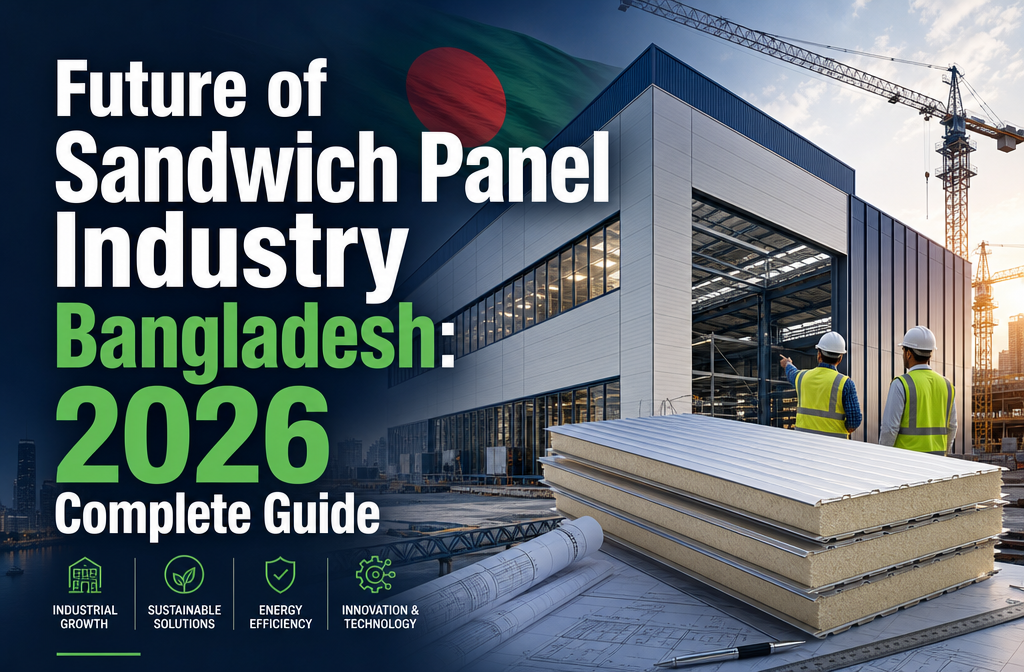
Bangladesh's construction and industrial sectors are not just growing — they are restructuring. The country added over 1,000 new industrial units in export processing zones between 2022 and 2025 (Bangladesh Export Processing Zones Authority, 2025), and nearly all of them require fast-build, thermally efficient enclosures. Sandwich panels fit that requirement better than brick-and-mortar for most industrial applications.
Three forces are compressing the timeline for adoption:
- Industrial policy: The government's "Smart Bangladesh" vision targets a $100 billion export economy by 2041, which means more factories, warehouses, and cold storage facilities built quickly.
- Energy costs: Rising electricity prices make thermal insulation a financial decision, not just a comfort one. A well-insulated panel building can cut cooling loads by 30–40% compared to a conventional tin-shed structure (estimate based on standard thermal performance data for 75mm PU panels vs. uninsulated corrugated steel).
- Safety enforcement: Post-Rana Plaza, Bangladesh's industrial safety standards have tightened significantly. Fire-rated materials are now a procurement requirement for many buyers and international brands sourcing from Bangladesh.
For a full overview of what's available locally, see the complete guide to insulated sandwich panels in Bangladesh.
What Core Material Trends Are Reshaping the Market?
The core material inside a sandwich panel determines its fire rating, thermal performance, and cost — and the market is shifting away from basic EPS toward PIR, rockwool, and PU cores.
Here's how the core material landscape looks in 2026:
| Core Material | Key Strength | Primary Use in Bangladesh | Fire Rating |
|---|---|---|---|
| EPS (Expanded Polystyrene) | Low cost, lightweight | General warehouses, poultry farms | Low (Class E–D) |
| PU (Polyurethane) | Excellent thermal insulation | Cold storage, food processing | Medium (Class C) |
| PIR (Polyisocyanurate) | Better fire resistance than PU | Pharmaceuticals, clean rooms | Medium-High (Class B) |
| Rockwool (Mineral Wool) | Non-combustible, acoustic | Factories, RMG units, hospitals | High (Class A) |
The shift to watch: EPS still dominates by volume because it's cheap, but rockwool and PIR panels are growing faster in percentage terms. Buyers in the pharmaceutical and food sectors are specifying fire-rated panels as a baseline, not an upgrade.
For buyers comparing options, the rockwool sandwich panel guide for Bangladesh and the fire-rated sandwich panel buyer's guide are useful starting points.
Common mistake: Choosing EPS panels for a facility that will later need fire insurance or international buyer audits. Retrofitting fire-rated panels is expensive. Specify correctly from the start.
How Is the Cold Chain Boom Driving Sandwich Panel Demand?
Cold storage and food processing are the single fastest-growing application segments for sandwich panels in Bangladesh right now. The government's push to reduce post-harvest losses — estimated at 20–40% for perishable crops (FAO, 2019) — has triggered significant investment in refrigerated warehouses and processing plants.
PU and PIR panels are the standard choice for cold rooms because their low thermal conductivity (typically 0.022–0.028 W/m·K for PU) minimizes refrigeration load. In Bangladesh's hot and humid climate, this matters enormously for operating costs.
Key drivers in this segment:
- Expansion of pharmaceutical cold chains (vaccine storage, temperature-sensitive medicines)
- Growth in frozen seafood and shrimp processing for export
- Supermarket and retail cold storage in Dhaka and Chittagong
- Government-funded agricultural cold storage under various rural development programs
For specifics on panel selection for refrigerated applications, see the PU sandwich panel for cold room guide and the cold storage panel pricing guide for Bangladesh.
What Role Does Green Building Play in Sandwich Panel Future Trends in Bangladesh?
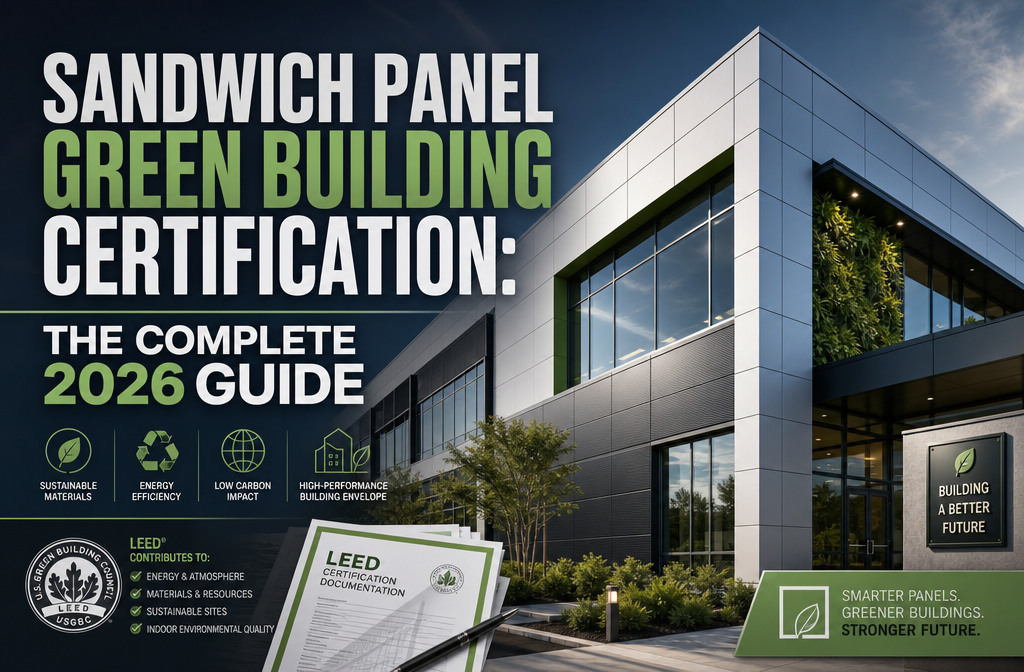
Green building is moving from aspiration to procurement requirement for a growing share of Bangladesh's industrial clients. International brands sourcing garments and goods from Bangladesh increasingly require their supplier factories to hold LEED or EDGE certification — and building envelope performance is a significant part of those scores.
Sandwich panels contribute directly to green building credits through:
- Thermal performance: Reducing HVAC energy consumption
- Reduced construction waste: Prefabricated panels generate far less site waste than conventional masonry
- Faster build times: Shorter construction schedules reduce embodied carbon from site operations
- Recyclable steel facings: Both GI and prepainted steel skins are recyclable at end of life
"Energy-efficient building envelopes are no longer a premium feature in Bangladesh's industrial construction — they are becoming a baseline requirement for export-oriented facilities."
The energy-efficient sandwich panel guide for Bangladesh covers thermal performance benchmarks and how to match panel specifications to local climate zones.
Choose energy-efficient panels if: Your facility needs LEED, EDGE, or similar certification, or if your international buyers conduct factory audits that include building performance criteria.
Is Bangladesh Becoming a Sandwich Panel Exporter?
Yes — and this is one of the more significant sandwich panel future trends in Bangladesh that gets less attention than domestic demand. Several local manufacturers have invested in continuous production lines capable of producing export-grade panels, and Bangladesh is now supplying panels to neighboring markets.
Why Bangladesh has export potential:
- Lower labor costs compared to India, China, and Southeast Asian competitors
- Improving raw material supply chains (steel coils, chemical foam systems)
- Strategic location for supplying Myanmar, Nepal, Bhutan, and parts of Southeast Asia
- Growing technical capability among local engineers and production staff
The challenge is consistency. Export buyers require tight tolerances on panel thickness, density, and facing adhesion — areas where some local producers still need improvement. Manufacturers investing in automated lines and third-party quality certification are best positioned to capture this opportunity.
For more on the export landscape, see the Bangladesh sandwich panel exporter guide.
What Technology Trends Are Emerging in Panel Manufacturing?
The most significant manufacturing trend is automation. Manual or semi-manual production lines produce panels with variable density and inconsistent bonding — problems that matter more as buyers become more sophisticated.
Emerging technology trends in Bangladesh's panel manufacturing sector:
- Continuous lamination lines: Replace batch production with automated, consistent output
- Digital thickness control: Sensors monitor foam injection in real time, reducing defects
- Improved facing coatings: PVDF and HDP coatings for better UV and corrosion resistance in coastal areas like Chittagong
- Interlocking joint systems: Tongue-and-groove and cam-lock joints that speed installation and improve airtightness
- Embedded reflective layers: Aluminum foil facings or radiant barrier coatings that reduce solar heat gain in roofing applications
Early-stage but worth watching: Some premium buyers are asking about panels with embedded temperature or humidity sensors for cold chain monitoring. This is not mainstream in Bangladesh yet, but it's a direction the global market is moving.
For panel types and technical comparisons, the sandwich panel types comparison guide for Bangladesh is a useful reference.
What Are the Key Application Sectors Driving Future Demand?
Beyond cold storage, several sectors are expanding their use of sandwich panels in Bangladesh:
1. Pharmaceuticals and clean rooms
Bangladesh's pharmaceutical industry is growing rapidly and exporting to regulated markets. Clean room construction requires hygienic, non-porous, easy-to-clean wall and ceiling panels — a specification that sandwich panels meet well. See the clean room sandwich panel buyer's guide for details.
2. Poultry and livestock farming
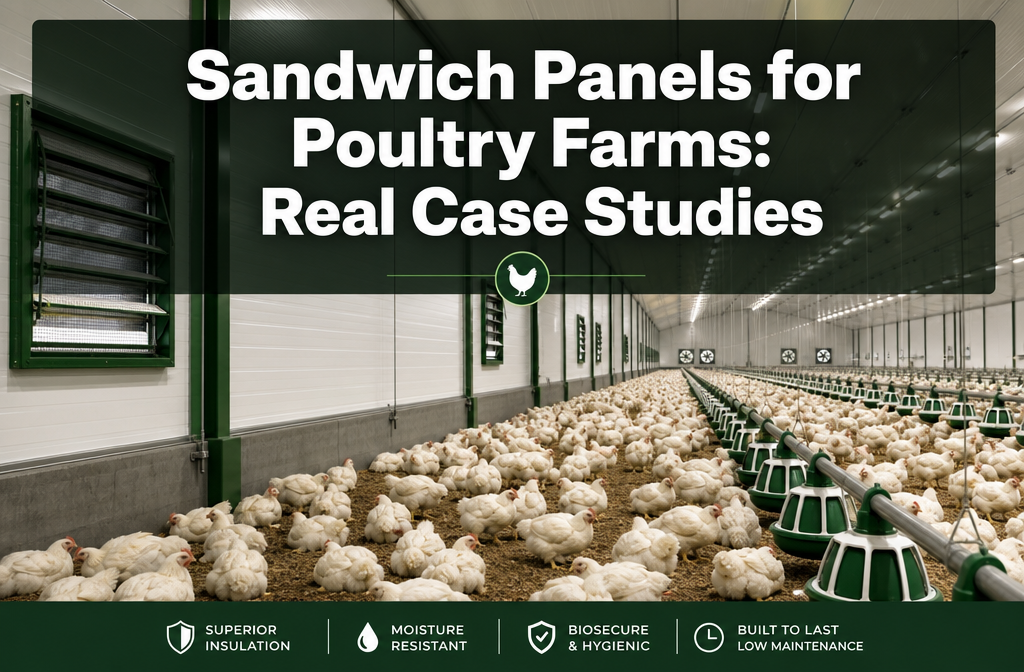
Commercial poultry farming is expanding, and insulated panels help maintain optimal temperatures while reducing disease risk. The best sandwich panel for poultry farm guide covers this application.
3. Industrial warehouses and factory buildings
This remains the largest single application. Fast construction timelines and lower lifecycle costs compared to brick construction make panels the default choice for new industrial sheds.
4. Hospitals and healthcare facilities
Infection control requirements are driving demand for hygienic wall panels in new hospital construction, particularly in private healthcare.
5. Data centers
A small but growing segment. Insulated panels help maintain controlled environments and reduce HVAC load.
What Challenges Could Slow These Trends?
Not every trend runs smoothly. Several factors could constrain growth:
- Raw material price volatility: Steel and chemical foam prices fluctuate with global commodity markets. Sharp increases squeeze margins and can delay projects.
- Skills gap in installation: Poor installation erases the performance benefits of good panels. There's a shortage of trained installers in Bangladesh, particularly outside Dhaka and Chittagong.
- Lack of standardized testing: Bangladesh does not yet have a comprehensive national standard for sandwich panel performance testing. Buyers rely on manufacturer claims or imported certifications, which creates quality uncertainty.
- Financing constraints: Many SME buyers struggle to access financing for prefabricated construction, defaulting to cheaper (but lower-performing) conventional methods.
- Counterfeit and substandard products: The market includes panels with understated core density or thinner-than-labeled facings. Buyers should request third-party test reports and work with established suppliers.
FAQ: Sandwich Panel Future Trends in Bangladesh
Q: What is the fastest-growing sandwich panel application in Bangladesh right now?
Cold storage and pharmaceutical clean rooms are growing fastest in 2026, driven by food export expansion and pharmaceutical industry growth.
Q: Are fire-rated panels now mandatory in Bangladesh?
Not universally, but they are required by many international buyers and are increasingly specified in pharmaceutical, food processing, and multi-story industrial facilities. Enforcement is tightening.
Q: How do Bangladesh-made panels compare to imported panels?
Quality has improved significantly. Leading local manufacturers now produce panels comparable to regional imports for most industrial applications. For highly specialized uses (pharmaceutical clean rooms, regulated cold chains), buyers should verify certifications regardless of origin.
Q: What panel core is best for Bangladesh's hot and humid climate?
PU or PIR for applications requiring strong thermal insulation (cold storage, air-conditioned factories). Rockwool for fire-rated applications. EPS remains acceptable for basic warehouses where thermal performance is secondary.
Q: Is sandwich panel construction cheaper than brick in Bangladesh?
For industrial buildings, yes — typically 20–35% faster to build and often lower in total cost when lifecycle operating savings are included. For residential construction, the comparison is less clear-cut.
Q: What thickness should I specify for a factory roof in Bangladesh?
50–75mm PU or EPS panels are common for factory roofs. For cold rooms, 100–150mm is standard. See the how thick sandwich panel for roof guide for detailed guidance.
Q: Are Bangladesh sandwich panel manufacturers exporting successfully?
Yes, to Myanmar, Nepal, and parts of Southeast Asia. Export volumes are growing but quality consistency remains the key differentiator between successful and unsuccessful exporters.
Q: What certifications should I look for when buying panels in Bangladesh?
Look for ISO 9001 (quality management), fire test reports (BS 476 or EN 13501-1), and thermal conductivity test certificates. For clean rooms, ISO 14644 compliance is relevant.
Q: How long do sandwich panels last in Bangladesh's climate?
With proper installation and maintenance, 20–30 years is achievable. Coastal areas (Chittagong, Cox's Bazar) require panels with enhanced corrosion-resistant coatings due to salt air exposure.
Q: Where can I compare current sandwich panel prices in Bangladesh?
The sandwich panel price guide for Bangladesh provides current pricing by panel type and thickness.
Conclusion: What to Do With These Trends
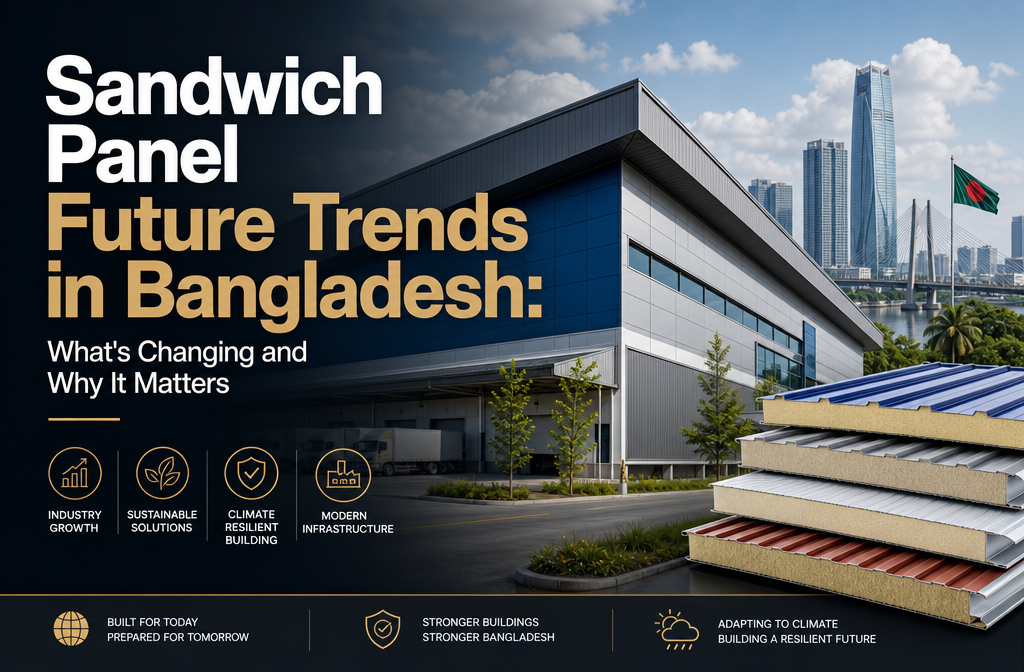
The sandwich panel future trends in Bangladesh point clearly in one direction: higher performance, greater specialization, and stronger quality standards. The market is maturing, and buyers who specify carefully will get significantly better outcomes than those who default to the cheapest option.
Actionable next steps:
- Identify your performance requirements first — fire rating, thermal performance, hygiene, acoustic insulation — before comparing prices. The sandwich panel buying guide for Bangladesh walks through this process.
- Request test certificates, not just manufacturer specifications. Ask for third-party fire and thermal test reports.
- Budget for installation quality. A premium panel installed poorly performs worse than a standard panel installed correctly.
- Consider lifecycle cost, not just purchase price. Energy savings from better insulation often pay back the cost premium within 3–5 years.
- Work with established manufacturers who have invested in automated production and can demonstrate consistent quality. See the sandwich panel manufacturers in Bangladesh directory for a starting point.
- Stay ahead of regulatory changes. Fire safety and energy efficiency standards are tightening. Specifying to future standards now avoids costly retrofits later.
The direction is clear. Bangladesh's sandwich panel sector in 2026 is not the same market it was five years ago — and five years from now, it will be different again. Buyers, specifiers, and manufacturers who understand where it's heading will be better positioned than those who don't.
References
- Bangladesh Export Processing Zones Authority (BEPZA). (2025). Annual Report 2024–2025. https://www.bepza.gov.bd
- Food and Agriculture Organization of the United Nations (FAO). (2019). The State of Food and Agriculture 2019: Moving Forward on Food Loss and Waste Reduction. https://www.fao.org/publications/sofa/2019/en/