Last updated: May 20, 2026
Quick Answer
Sandwich panel transport in Bangladesh involves moving prefabricated insulated panels — typically with EPS, PU, or rockwool cores — from manufacturers or suppliers to construction, cold storage, food processing, or industrial sites across the country. The biggest challenges are panel size, road conditions, and Bangladesh's high humidity climate. Choosing the right panel type, securing proper transport packaging, and working with experienced local suppliers dramatically reduces damage and cost.
Key Takeaways
- Sandwich panels used in transport vehicles and transport-related construction weigh 60–80% less than traditional concrete or brick alternatives, reducing fuel and logistics costs.
- PU (polyurethane) core panels are the top choice for food-grade and cold chain transport applications in Bangladesh due to superior moisture resistance.
- Dhaka, Gazipur, and Narayanganj are the primary manufacturing and supply hubs for sandwich panels in Bangladesh.
- Bangladesh's tropical climate — averaging 80%+ relative humidity — makes vapor-sealed panel joints critical for long-term performance.
- EPS panels are the most affordable option (estimated BDT 350–600 per sq ft installed), while PU panels run higher but outperform in temperature-sensitive applications.
- Common transport damage includes edge chipping, face sheet delamination, and joint contamination — all preventable with proper packaging.
- The pharmaceutical, food processing, garment, and cold storage industries are the heaviest users of sandwich panel transport solutions in Bangladesh.
- Aluminum-faced panels handle Bangladesh's road vibration better than fiberglass-faced alternatives in most heavy-duty transport scenarios.
What Exactly Are Sandwich Panels Used for in Transportation?
Sandwich panels serve two distinct roles in the transport sector in Bangladesh: as structural components of refrigerated trucks and transport containers, and as building panels delivered to industrial or commercial sites via road transport.
In transport vehicle construction, sandwich panels form the walls, floors, and ceilings of:
- Refrigerated trucks (reefer vans) carrying food, medicine, and dairy
- Mobile cold rooms and portable storage units
- Pharmaceutical transport containers requiring strict temperature control
- Poultry and fish transport vehicles
In construction logistics, sandwich panels are manufactured in large sheets (commonly 1,000–1,200mm wide, up to 12,000mm long) and transported to:
- Garment factory buildings
- Cold storage facilities
- Hospital clean rooms
- Industrial warehouses
For a full breakdown of panel types and their applications, see the Sandwich Panel Types Bangladesh: Full 2026 Comparison guide.
Which Industries in Bangladesh Use Sandwich Panel Transport Most?
The food processing, pharmaceutical, and garment sectors drive the majority of sandwich panel transport demand in Bangladesh. Cold chain logistics is the fastest-growing segment as of 2026.
Top industries by volume:
| Industry | Primary Panel Type | Key Use Case |
|---|---|---|
| Food processing | PU core | Cold storage rooms, processing walls |
| Pharmaceuticals | PU / clean room | Temperature-controlled warehouses |
| Garment / RMG | EPS core | Factory walls, roofing |
| Poultry & aquaculture | PU core | Cold chain transport vehicles |
| Healthcare | Clean room panels | Hospital OT rooms, labs |
| Cold storage | PU / PIR | Walk-in freezers, blast chillers |
Bangladesh's garment sector alone accounts for a significant share of industrial panel demand, given the scale of factory construction in Gazipur, Ashulia, and Chittagong Export Processing Zone. The Sandwich Panel for Warehouse Bangladesh: 2026 Guide covers warehouse-specific applications in detail.
How Much Do Sandwich Panels Cost in Bangladesh?
Sandwich panel prices in Bangladesh vary by core material, thickness, and facing type. As an estimate based on current market conditions in 2026, EPS panels start around BDT 350–500 per square foot installed, while PU panels range from BDT 500–900 per square foot depending on thickness and specification.
Key cost factors:
- Core material: EPS is cheapest; PIR (polyisocyanurate) is most expensive
- Thickness: 50mm panels cost less than 100mm or 150mm versions
- Facing: Galvanized steel is standard; aluminum or stainless steel adds cost
- Transport distance: Panels shipped from Dhaka to Chittagong or Sylhet incur additional freight charges
- Order volume: Bulk orders of 500+ sq meters typically attract 10–15% discounts (estimate based on supplier norms)
For current pricing, the Sandwich Panel Price in Bangladesh 2026 | Full Guide provides a detailed breakdown by panel type and thickness.
Decision rule: Choose EPS panels if budget is the primary constraint and temperature control is not critical. Choose PU panels if the application involves cold storage, food safety, or pharmaceutical compliance.
Where Can You Buy Sandwich Panels for Transport Vehicles in Dhaka?
Dhaka and its surrounding industrial zones — particularly Gazipur, Savar, and Narayanganj — are the main procurement hubs for sandwich panels in Bangladesh. Most reputable manufacturers offer direct supply with delivery to project sites nationwide.
What to look for in a Dhaka-based supplier:
- ISO certification or documented quality control process
- In-house manufacturing (not just trading/reselling)
- Ability to custom-cut panels to transport vehicle dimensions
- Experience supplying to cold chain or food-grade projects
- Clear warranty terms on delamination and joint sealing
The Sandwich Panel Manufacturers in Dhaka: 2026 Buyer's Guide lists verified manufacturers with contact details and product ranges. For a broader national view, the Sandwich Panel Suppliers in Bangladesh: 2026 Buyer's Guide covers suppliers outside Dhaka as well.
Common mistake: Buying from traders who don't manufacture in-house. This often means longer lead times, inconsistent panel quality, and no recourse for defects.
Are Sandwich Panels Better Than Traditional Transport Container Materials?
For most transport and cold chain applications in Bangladesh, sandwich panels outperform traditional materials like wood, galvanized sheet metal, or brick construction on nearly every practical measure.
Comparison: Sandwich panels vs. traditional materials
| Factor | Sandwich Panel | Traditional (Wood/Metal) |
|---|---|---|
| Weight | 8–12 kg/m² (typical) | 20–40 kg/m² |
| Thermal insulation | R-value 3–7+ (varies by core) | Poor to moderate |
| Moisture resistance | High (with sealed joints) | Low to moderate |
| Installation speed | Fast (prefabricated) | Slow |
| Maintenance | Low | Moderate to high |
| Cost (upfront) | Moderate to high | Low to moderate |
| Lifespan | 15–25 years (estimated) | 5–15 years |
For refrigerated trucks specifically, the weight advantage is critical. A lighter vehicle body means better fuel efficiency and higher payload capacity — both important for Bangladesh's competitive transport sector.
What Are the Weight Advantages of Sandwich Panels for Trucks?
Sandwich panels reduce truck body weight by an estimated 40–60% compared to traditional insulated wood-and-metal construction. This directly translates to higher cargo capacity and lower fuel costs per delivery.
For a standard 20-foot refrigerated truck body:
- Traditional insulated construction: approximately 2,500–3,500 kg body weight
- Sandwich panel construction: approximately 900–1,400 kg body weight (estimate based on typical 75mm PU panel specs)
Why this matters in Bangladesh:
- Overloaded trucks face fines and axle weight restrictions on national highways
- Fuel costs are a major operating expense for transport operators
- Lighter bodies allow operators to legally carry more product per trip
The weight benefit is most pronounced with aluminum-faced PU panels, which combine low density with high structural rigidity.
How Do Sandwich Panels Handle Moisture and Humidity?
PU and PIR core sandwich panels with properly sealed joints handle Bangladesh's high humidity well. EPS panels are more vulnerable to moisture ingress if joint sealing is neglected or damaged during transport.
Bangladesh's climate presents a real challenge: average relative humidity runs above 80% for much of the year, and monsoon season brings sustained moisture exposure. For transport applications, this means:
- Joint sealing is non-negotiable. Every panel joint must be sealed with food-grade or industrial-grade sealant appropriate to the application.
- Vapor barriers on the warm side of cold room panels prevent condensation buildup inside the panel core.
- Aluminum or pre-painted steel facings resist surface corrosion better than bare galvanized steel in coastal areas like Chittagong.
- EPS core panels absorb more moisture than PU panels over time if joints fail — leading to reduced insulation performance and potential mold growth.
For applications where moisture resistance is critical, the Insulated Sandwich Panel Bangladesh: Complete 2026 Guide covers core material selection in detail.
Are Sandwich Panels Safe for Food Transport in Bangladesh?
Yes — PU core sandwich panels with food-grade facings (stainless steel or food-safe coated steel) are widely used and considered safe for food transport in Bangladesh when correctly specified and maintained.
Key requirements for food-safe transport panels:
- Non-toxic core material (food-grade PU foam, not recycled or off-spec material)
- Smooth, cleanable interior facing (stainless steel or hygienic coated steel)
- No exposed joints or gaps where bacteria can accumulate
- Compliance with BSTI (Bangladesh Standards and Testing Institution) guidelines where applicable
- Regular cleaning with approved sanitizers that won't degrade the facing
⚠️ Edge case: Some low-cost panels use recycled or blended foam cores that may off-gas at elevated temperatures. Always request a material safety data sheet (MSDS) from the supplier before using panels in direct food contact environments.
The Clean Room Sandwich Panel Bangladesh: Full Buyer's Guide covers hygienic panel specifications relevant to food and pharmaceutical transport.
Common Problems With Sandwich Panel Transport in Bangladeshi Climate
The three most common problems are edge damage during road transport, joint failure from humidity exposure, and delamination caused by heat cycling. All three are preventable.
Problem 1: Edge and corner damage
Bangladesh's road network includes significant sections of rough, potholed, or unpaved road — especially in industrial zones and rural areas. Panels loaded without edge protection routinely arrive with chipped or crushed edges.
Fix: Use foam edge protectors and secure panels with ratchet straps, not wire ties. Stack panels face-to-face with protective film intact.
Problem 2: Joint failure from humidity
Improperly sealed joints allow moisture to enter the panel core during Bangladesh's monsoon season, degrading insulation performance over time.
Fix: Use closed-cell sealant tape at all joints during installation. Inspect and reseal annually.
Problem 3: Delamination from heat cycling
Panels stored outdoors in direct sun before installation can experience thermal stress, especially if the adhesive bond between core and facing was weak to begin with.
Fix: Store panels in shade, covered with breathable tarpaulin. Avoid stacking more than 6 panels high in hot weather.
Problem 4: Can sandwich panels withstand Bangladeshi road conditions?
Yes, with proper loading technique. The structural facing (steel or aluminum) handles vibration well. The main risk is point-load damage from improper tie-down or contact with sharp edges on the truck bed.
Difference Between Aluminum and Fiberglass Sandwich Panels for Transport
Aluminum-faced panels are generally better for transport vehicle construction in Bangladesh; fiberglass-faced panels suit specific applications where corrosion resistance or electrical insulation is required.
| Property | Aluminum-Faced | Fiberglass-Faced |
|---|---|---|
| Weight | Light | Slightly heavier |
| Corrosion resistance | Good (anodized) | Excellent |
| Impact resistance | Moderate | High |
| Repairability | Easy | Moderate |
| Cost | Moderate | Higher |
| Best for | Reefer trucks, cold rooms | Marine, chemical transport |
For most Bangladeshi operators building refrigerated truck bodies or cold storage rooms, aluminum-faced PU panels offer the best balance of weight, cost, and durability.
Which Bangladeshi Manufacturers Make High-Quality Sandwich Panels?
Several manufacturers in Dhaka and Gazipur produce sandwich panels to consistent quality standards. When evaluating a manufacturer, check for in-house production, documented QC processes, and a track record with industrial or food-grade projects.
Key criteria for selecting a manufacturer:
- In-house continuous lamination line (not batch production)
- Core density verification — PU panels should specify foam density (typically 38–42 kg/m³ for cold room use)
- Facing thickness — minimum 0.4mm pre-painted steel for transport applications
- References from cold chain, pharmaceutical, or food processing clients
The Best Sandwich Panel Manufacturer BD: 2026 Buyer's Guide provides a vetted list of manufacturers with product specifications.
Installation Mistakes to Avoid With Sandwich Panel Transport
The most costly mistakes happen during unloading and installation, not during manufacturing. Panels damaged on-site are rarely covered under warranty.
Top mistakes to avoid:
- Lifting panels by the facing alone — always use spreader bars or panel clamps to distribute load
- Cutting panels with angle grinders — heat from grinding damages the core; use jigsaws or panel saws
- Installing panels in rain — moisture trapped in joints before sealing causes long-term problems
- Skipping the vapor barrier on cold room applications — condensation inside the panel destroys insulation value within 2–3 years
- Using incompatible sealants — some silicone sealants degrade PU foam; always confirm chemical compatibility
- Over-tightening fasteners — compresses the panel facing and creates thermal bridges
For step-by-step installation guidance, the Sandwich Panel Installation Cost Bangladesh 2026 Guide covers both cost and process details.
FAQ
Q: What is the standard size of sandwich panels used in transport vehicles in Bangladesh?
A: Most transport vehicle panels are cut to order. Common widths are 1,000mm or 1,150mm; lengths are customized to vehicle dimensions. Standard sheet lengths from manufacturers run up to 12,000mm.
Q: How long do sandwich panels last in a refrigerated truck in Bangladesh?
A: With proper installation and maintenance, PU core sandwich panels in refrigerated trucks typically last 12–20 years (estimated). Lifespan shortens significantly if joints are not resealed and the vehicle is not cleaned regularly.
Q: Can I import sandwich panels to Bangladesh instead of buying locally?
A: Yes, panels can be imported — primarily from China, India, or South Korea. However, import duties, lead times, and the inability to inspect before purchase make local sourcing preferable for most buyers. See the Bangladesh Sandwich Panel Exporter: 2026 Buyer's Guide for export/import context.
Q: What thickness of sandwich panel is best for a refrigerated truck body?
A: 75mm PU panels are the most common choice for truck bodies in Bangladesh's climate. 100mm panels are used for blast-freeze applications or where the truck operates in direct sun for extended periods.
Q: Are sandwich panels fire-safe for transport use?
A: Standard EPS and PU panels are combustible. For applications requiring fire resistance, PIR or rockwool core panels should be specified. See the Fire Rated Sandwich Panel Bangladesh: 2026 Buyer's Guide for fire-rated options.
Q: How are sandwich panels secured during road transport in Bangladesh?
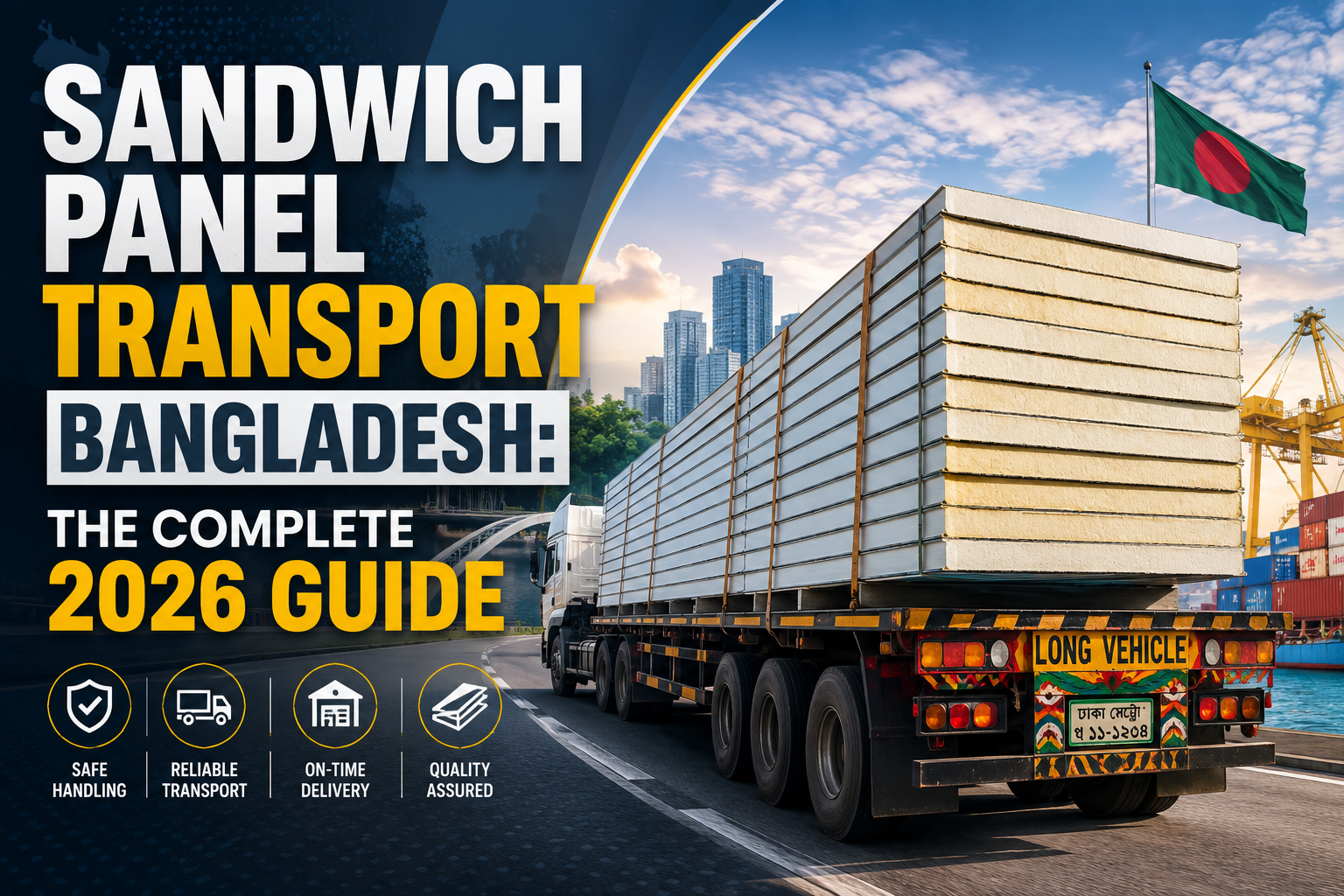
A: Panels should be loaded horizontally on a flat truck bed, face-to-face with protective film intact, secured with ratchet straps over padded contact points. Vertical loading is only appropriate for very short distances with rigid side supports.
Q: What is the minimum order quantity for sandwich panels from Dhaka manufacturers?
A: Most manufacturers have a minimum order of 50–100 square meters, though this varies. Smaller quantities are sometimes available from distributors at a higher per-unit cost.
Q: Do sandwich panels require special permits for transport on Bangladeshi highways?
A: Panels exceeding 12 meters in length may require an oversized load permit from the Bangladesh Road Transport Authority (BRTA). Standard panels under 12m typically do not require special permits.
Conclusion
Sandwich panel transport in Bangladesh is a practical, cost-effective solution for cold chain logistics, food processing, pharmaceutical storage, and industrial construction — but only when the right panel type is specified, properly transported, and correctly installed.
Actionable next steps:
- Define your application first — cold storage, transport vehicle, or construction — before approaching suppliers. Each use case has different core material and facing requirements.
- Get at least three quotes from Dhaka-based manufacturers, and ask each for a core density specification and sample MSDS.
- Specify PU panels for any food or pharmaceutical application in Bangladesh's climate. EPS is acceptable for dry construction but not for temperature-controlled environments.
- Plan your transport logistics before panels are manufactured — confirm truck bed dimensions, route conditions, and unloading equipment availability.
- Budget for proper installation including sealants, vapor barriers, and edge protection. Cutting corners here is the leading cause of premature panel failure.
For a complete purchasing framework, the Sandwich Panel Buying Guide Bangladesh 2026 is the recommended next read.
References
- Bangladesh Standards and Testing Institution (BSTI). Industrial Standards for Construction Materials. Dhaka: BSTI. (No specific publication year available for public citation — consult BSTI directly for current standards.)
- Bangladesh Road Transport Authority (BRTA). Oversize Load Permit Guidelines. brta.gov.bd. (Consult official BRTA portal for current regulations.)
- European Sandwich Panel Association (EASPA). Sandwich Panel Design and Application Guidelines. 2019. easpa.eu.
- International Institute of Refrigeration (IIR). Cold Chain in Developing Countries. 2021. iifiir.org.