Last updated: May 20, 2026
Quick Answer: Sandwich panel wall cladding in Bangladesh consists of two metal face sheets bonded to an insulating core (EPS, PU, or rockwool), forming a lightweight, thermally efficient wall system. In 2026, it is the preferred cladding choice for factories, warehouses, cold storage facilities, and increasingly for commercial buildings across Dhaka, Chittagong, and Gazipur. Installed costs typically range from BDT 550 to BDT 1,800 per square foot depending on panel type and thickness.
Key Takeaways
- Sandwich panels combine structural facing and insulation into one system, cutting construction time by 40–60% compared to traditional brick walls (estimate based on typical contractor reports in the Bangladesh market).
- Three core types dominate the Bangladesh market: EPS (most affordable), polyurethane/PU (best thermal performance), and rockwool (best fire resistance).
- Dhaka's high humidity and monsoon climate require panels with pre-coated galvanized steel faces and sealed joints to prevent corrosion.
- Rockwool-core panels carry fire ratings up to 2 hours, making them compliant with Bangladesh National Building Code (BNBC) fire safety requirements for industrial structures.
- Leading local manufacturers and suppliers include Tata BlueScope, BSRM-linked distributors, and several Dhaka-based fabricators who produce panels domestically.
- Sandwich panels are not ideal for load-bearing walls in multi-story residential buildings without additional structural framing.
- With proper maintenance, sandwich panel wall cladding in Bangladesh lasts 20–30 years in industrial environments.
- Common installation mistakes include skipping vapor barriers, improper joint sealing, and using undersized fasteners in high-wind zones.
What Are Sandwich Panels Used for in Construction?
Sandwich panels are prefabricated building elements used as walls, roofs, and partitions. Each panel consists of two rigid metal skins (usually pre-painted galvanized or Galvalume steel) bonded to a continuous insulating core. The result is a single component that handles structure, insulation, and weather protection simultaneously.
Primary applications in Bangladesh:
- Factory and warehouse walls — the single largest use case, especially in export processing zones (EPZs) in Dhaka, Narayanganj, and Chittagong
- Cold storage and food processing facilities — where thermal control is critical
- Pharmaceutical and clean room partitions — requiring hygienic, smooth surfaces (see our Clean Room Sandwich Panel Bangladesh guide for specifics)
- Commercial and retail fit-outs — interior partitions and mezzanine walls
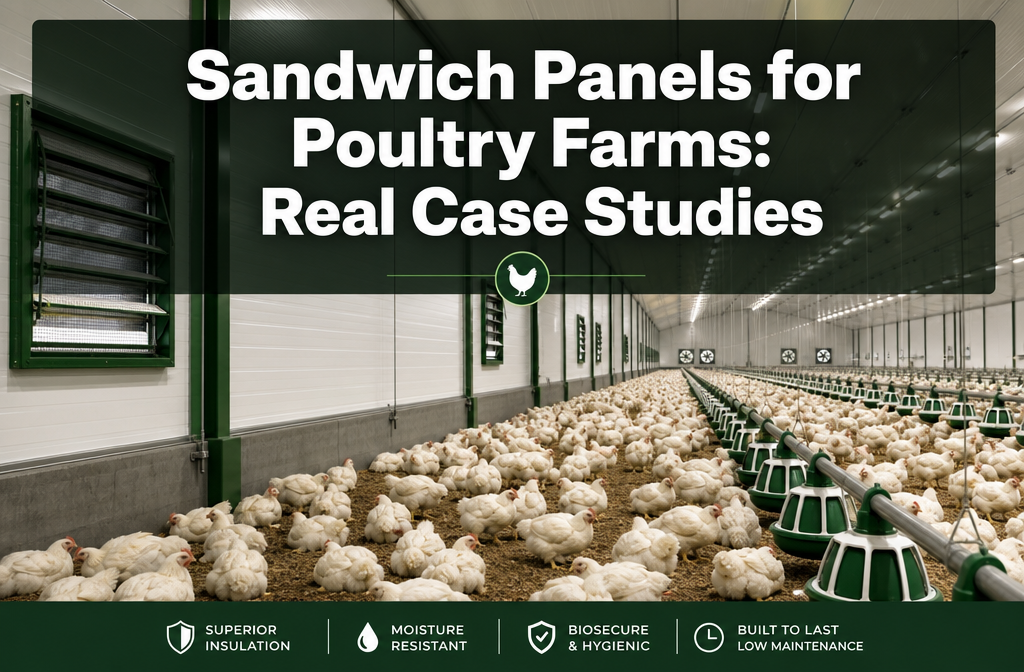
- Poultry farms and agricultural buildings — for temperature and humidity control
"A sandwich panel is not just a wall material — it is a complete building envelope system that replaces brick, plaster, insulation, and cladding in a single installation step."
For a broader look at how these panels are used across building types, the Benefits of Sandwich Panels in Construction guide covers the full scope.
How Much Do Sandwich Panels Cost in Bangladesh?
Sandwich panel wall cladding in Bangladesh costs between BDT 550 and BDT 1,800 per square foot for supply and installation, depending on core material, panel thickness, and steel gauge. EPS panels are the most affordable; PU panels sit in the mid-range; rockwool panels carry a premium due to fire-resistance properties.
| Panel Type | Core Material | Typical Price Range (BDT/sq ft) | Best For |
|---|---|---|---|
| EPS Sandwich Panel | Expanded Polystyrene | 550 – 850 | General warehouses, partitions |
| PU Sandwich Panel | Polyurethane Foam | 750 – 1,200 | Cold storage, food processing |
| Rockwool Sandwich Panel | Mineral Wool | 950 – 1,800 | Fire-rated industrial walls |
| PIR Sandwich Panel | Polyisocyanurate | 900 – 1,500 | High-temp industrial use |
Prices are market estimates for 2026 based on Dhaka supplier data. Actual quotes vary by order volume, steel thickness (0.4 mm vs. 0.5 mm), and delivery location.
For a detailed breakdown, see the Sandwich Panel Price in Bangladesh 2026 guide and the Sandwich Panel Price Per Square Meter Bangladesh page.
Cost drivers to watch:
- Steel coil prices (imported, USD-denominated) directly affect panel pricing
- Panel thickness (50 mm vs. 100 mm vs. 150 mm) adds 15–30% to material cost per step
- Custom colors or special coatings add 5–10% to base price
- Remote delivery outside Dhaka/Chittagong adds logistics surcharges
Pros and Cons of Sandwich Panel Wall Cladding
Sandwich panel wall cladding in Bangladesh offers clear advantages for industrial and commercial projects, but it also has real limitations worth understanding before committing.
✅ Pros:
- Speed of installation — panels arrive pre-fabricated and click or bolt into place, cutting wall construction time dramatically
- Thermal insulation — PU-core panels achieve U-values as low as 0.20 W/m²K, reducing air conditioning loads in Bangladesh's hot climate
- Lightweight — typically 10–15 kg/m², reducing structural load and foundation costs
- Consistent quality — factory-made panels have uniform thickness and density, unlike site-mixed masonry
- Recyclable steel faces — the metal skins can be recovered at end of life
- Wide color and finish options — pre-painted PVDF or polyester coatings in any RAL color
❌ Cons:
- Not load-bearing by default — panels need a steel or concrete frame to carry vertical loads
- Vulnerable to impact damage — thin steel faces dent more easily than brick walls
- Joint maintenance required — sealants at panel joints degrade over time and need periodic inspection
- Higher upfront cost vs. brick — material cost per square foot is higher than basic brick masonry, though total project cost is often comparable once labor and time savings are factored in
- Fire risk with EPS core — standard EPS panels are not fire-rated and should not be used where BNBC fire codes require rated assemblies
Rockwool vs. Polyurethane Sandwich Panels: Which Core Is Right for Bangladesh?
Rockwool (mineral wool) and polyurethane (PU) are the two premium core options for sandwich panel wall cladding in Bangladesh, and they serve different priorities. Choose rockwool if fire resistance is the primary requirement. Choose PU if thermal performance and cost efficiency matter most.
| Property | Rockwool Core | PU/PIR Core |
|---|---|---|
| Fire resistance | Up to 2-hour rating | Limited (melts above ~200°C) |
| Thermal conductivity | ~0.040 W/mK | ~0.022 W/mK |
| Water absorption | Low-moderate | Very low |
| Weight | Heavier (~12–18 kg/m²) | Lighter (~10–13 kg/m²) |
| Relative cost | Higher | Mid-range |
| Best application | Fire-rated industrial walls, pharma | Cold storage, food processing |
For pharmaceutical facilities, clean rooms, and any space requiring fire-rated walls, rockwool is the clear choice. See the Rockwool Sandwich Panel Bangladesh guide for full specifications.
For cold storage and temperature-controlled warehouses, PU panels deliver superior insulation at lower weight. The Polyurethane Sandwich Panel Benefits guide explains the thermal calculations in detail.
EPS panels are a third option — affordable and widely available, but not suitable for fire-rated or high-humidity applications without additional treatment. Full comparison available at Sandwich Panel Types Bangladesh.
Are Sandwich Panels Good for Industrial Buildings in Bangladesh?
Yes — sandwich panel wall cladding is the dominant choice for new industrial construction in Bangladesh in 2026. Factories, garment units, pharmaceutical plants, and logistics hubs across the country's EPZs and industrial zones now specify sandwich panels as the default wall and roof system.
Why industrial buildings benefit most:
- Large, repetitive wall areas make prefabricated panels highly cost-effective
- Insulated walls reduce cooling loads in production areas, cutting energy bills
- Smooth interior surfaces meet hygiene standards for food and pharma sectors
- Fast construction timelines align with lease or production deadlines
For factory-specific guidance, the Factory Building Panel Bangladesh guide covers structural integration, panel selection, and cost planning in detail.
Can Sandwich Panels Be Used in Residential Construction?
Sandwich panels can be used in residential construction in Bangladesh, but with important caveats. They work well for single-story homes, staff quarters, and modular housing projects. They are not suitable as load-bearing walls in multi-story apartments without a separate structural frame.
Residential use cases where panels work well:
- Single-story prefab homes and worker housing in industrial zones
- Boundary walls and compound structures
- Roof panels for residential extensions
- Interior partition walls in apartments
Where to be cautious:
- Multi-story buildings require a reinforced concrete or steel frame; panels serve only as infill cladding
- Aesthetic expectations in urban residential markets may not align with the industrial look of standard panels
- Building permits in Dhaka City Corporation areas may require architectural review for non-standard cladding
Installation Challenges with Sandwich Panels in Dhaka's Climate
Bangladesh's climate — high humidity (averaging 70–80% year-round), monsoon rainfall, and temperatures regularly exceeding 35°C — creates specific installation challenges for sandwich panel wall cladding. Ignoring these conditions is the most common reason panels fail prematurely.
Key climate-related challenges:
- Condensation and moisture ingress — in high-humidity environments, improperly sealed joints allow moisture to enter the panel core, causing delamination and corrosion of the steel faces
- Thermal expansion — steel faces expand and contract with temperature swings; fastener patterns and joint gaps must account for this
- Cyclone wind loads — coastal and southern Bangladesh requires panels rated for higher wind uplift; standard fastener spacing may be insufficient
- UV degradation — standard polyester coatings on steel faces degrade faster in Bangladesh's UV intensity; PVDF coatings last significantly longer
Common installation mistakes to avoid:
- Skipping the vapor barrier between panel and structural frame
- Using standard silicone sealant instead of polyurethane-based joint sealant (which handles movement better)
- Installing panels without checking for plumb and level on the primary frame — errors compound across large wall areas
- Using undersized or incorrect fasteners for the steel gauge and wind zone
- Leaving cut panel edges unsealed, exposing the core to moisture
For a step-by-step installation process, the Sandwich Panel Roof Installation Bangladesh guide includes fastener schedules and joint detail drawings applicable to wall installations as well.
Are Sandwich Panels Fire Resistant?
Fire resistance in sandwich panels depends entirely on the core material. Rockwool-core panels are fire-rated; EPS and standard PU panels are not. For any building where Bangladesh National Building Code (BNBC) requires fire-rated wall assemblies, only rockwool or PIR-core panels should be specified.
- Rockwool panels: Non-combustible mineral wool core; can achieve 60–120 minute fire ratings depending on panel thickness and facing configuration
- PIR panels: Improved fire performance vs. standard PU, but still combustible; typically used where moderate fire performance is needed without full fire rating
- EPS panels: Combustible; should not be used in fire-rated assemblies; require intumescent strips at joints if used in areas with fire code requirements
- Standard PU panels: Combustible; not suitable for fire-rated applications
The Fire Rated Sandwich Panel Bangladesh buyer's guide covers BNBC compliance, testing standards, and how to specify fire-rated panels correctly.
How Long Do Sandwich Panels Last in Bangladeshi Weather?
With proper installation and maintenance, sandwich panel wall cladding in Bangladesh lasts 20–30 years in industrial environments. The steel face coating is the primary determinant of longevity. PVDF-coated panels outperform polyester-coated panels in Bangladesh's UV and humidity conditions.
Factors that extend panel life:
- PVDF or HDP coating on steel faces (vs. standard polyester)
- 0.5 mm steel gauge (vs. 0.4 mm) for exterior walls
- Sealed joints re-inspected and re-caulked every 3–5 years
- Prompt repair of any dents or scratches that expose bare steel
- Annual cleaning to remove dust, mold, and salt deposits (especially in coastal areas)
Factors that shorten panel life:
- Unsealed cut edges at panel ends
- Standing water at panel base due to poor drainage design
- Mechanical damage from forklifts or equipment in warehouses
Which Brands and Suppliers Make the Best Sandwich Panels in Bangladesh?
Several manufacturers and suppliers offer sandwich panel wall cladding in Bangladesh in 2026. Quality varies significantly, so specifying panel thickness, steel grade, coating type, and core density in writing before ordering is essential.
What to look for in a supplier:
- In-house manufacturing vs. trading (manufacturers offer better quality control)
- Ability to provide test certificates for fire rating, thermal performance, and steel coating
- Track record with industrial projects in Bangladesh
- Availability of technical support for installation
For a vetted list of suppliers, see the Sandwich Panel Suppliers in Bangladesh buyer's guide and the Best Sandwich Panel Manufacturer BD guide.
How Do Sandwich Panels Compare to Traditional Brick Walls?
Sandwich panel wall cladding in Bangladesh is faster, lighter, and better insulated than traditional brick construction, but brick walls offer superior impact resistance, load-bearing capacity, and local familiarity among builders.
| Criteria | Sandwich Panel Wall | Brick/Masonry Wall |
|---|---|---|
| Construction speed | Fast (days) | Slow (weeks to months) |
| Thermal insulation | Excellent | Poor without added insulation |
| Weight | 10–15 kg/m² | 200–400 kg/m² |
| Load-bearing capacity | Frame-dependent | Inherent (for single story) |
| Fire resistance | Core-dependent | Good (brick is non-combustible) |
| Maintenance | Joint sealing every 3–5 years | Minimal if well-built |
| Upfront material cost | Moderate-high | Low-moderate |
| Skilled labor required | Yes (panel installation) | Yes (masonry) |
| Lifespan | 20–30 years | 40–60+ years |
Decision rule: Choose sandwich panels for industrial, commercial, or time-sensitive projects where insulation and speed matter. Choose brick for multi-story residential construction, perimeter security walls, or where long-term maintenance budgets are limited.
FAQ: Sandwich Panel Wall Cladding Bangladesh
Q: What thickness of sandwich panel is best for exterior walls in Bangladesh?
A: 50 mm is the minimum for exterior walls; 75–100 mm is recommended for air-conditioned industrial spaces in Bangladesh's climate. Thicker panels improve thermal performance and reduce air conditioning costs.
Q: Can sandwich panels be painted after installation?
A: Yes, but only with compatible metal-surface paints. Standard wall paint will not adhere properly to pre-coated steel. Consult the panel manufacturer for approved coating systems before repainting.
Q: Do sandwich panels require a building permit in Bangladesh?
A: Yes. Any permanent structure using sandwich panels as exterior walls requires a building permit from the relevant city corporation or municipality. BNBC compliance documentation is typically required.
Q: How are sandwich panels fixed to a steel frame?
A: Panels are fixed using self-drilling screws or concealed clip systems depending on the panel profile. Fastener spacing follows the manufacturer's load tables, which account for wind zone and panel span.
Q: Are sandwich panels suitable for use near the sea in Cox's Bazar or Chittagong?
A: Yes, but only with marine-grade coatings (PVDF or equivalent) and stainless steel or hot-dip galvanized fasteners. Standard polyester-coated panels corrode rapidly in salt-air environments.
Q: What is the minimum order quantity for sandwich panels in Bangladesh?
A: Most local manufacturers set minimum orders at 500–1,000 square meters. Smaller quantities are available from distributors at a higher per-unit cost.
Q: How do I verify a supplier's panel quality before ordering?
A: Request third-party test certificates for steel coating thickness (microns), core density (kg/m³), and fire performance. Visit the factory if possible, or ask for reference projects you can inspect.
Q: Can sandwich panels be removed and reused?
A: Yes, if installed with mechanical fasteners (not adhesive). Panels can be unbolted, transported, and reinstalled, making them suitable for temporary or relocatable structures.
Q: What maintenance does sandwich panel wall cladding need in Bangladesh?
A: Annual cleaning, joint sealant inspection every 3–5 years, and prompt repair of any coating damage. See the Sandwich Panel Maintenance Guide for a full checklist.
Q: Is there a price difference between imported and locally made sandwich panels in Bangladesh?
A: Locally manufactured panels are generally 10–20% cheaper than imported equivalents due to lower logistics costs, but quality varies more. Always specify performance requirements in writing regardless of origin.
Conclusion: Actionable Next Steps for Your Project
Sandwich panel wall cladding in Bangladesh is a proven, practical choice for industrial, commercial, and specialized construction in 2026. The technology is mature, local supply is well-established, and the performance benefits over traditional masonry are clear for most non-residential applications.
Before you buy or specify, take these steps:
- Define your performance requirements first — fire rating, thermal value, humidity resistance, and aesthetic finish should all be specified before approaching suppliers.
- Get at least three written quotes — include panel thickness, steel gauge, coating type, and core density in the RFQ so quotes are comparable.
- Ask for test certificates — any reputable supplier can provide documentation for fire performance and thermal conductivity.
- Check the installation contractor's experience — panel quality means nothing if joints are poorly sealed or fasteners are wrong for your wind zone.
- Plan for maintenance from day one — budget for joint re-sealing every 3–5 years and annual cleaning to reach the full 20–30 year lifespan.
For a comprehensive buying decision, the Sandwich Panel Buying Guide Bangladesh 2026 covers supplier evaluation, specification writing, and contract terms in detail.
References
- Bangladesh National Building Code (BNBC) 2020, Housing and Building Research Institute, Bangladesh. https://www.hbri.gov.bd/
- International Sandwich Panel Association (ISOPA), "Sandwich Panel Performance Standards," 2022. https://www.isopa.org/
- European Sandwich Panel Association (EASP), "Design Guide for Sandwich Panels," 2021. https://www.easp.eu/
- BlueScope Steel, "Technical Data: Zincalume and Colorbond Steel for Building Applications," 2023. https://www.bluescopesteel.com/
- ASHRAE Handbook — Fundamentals, Chapter 26: Heat, Air, and Moisture Control in Building Assemblies, 2021. https://www.ashrae.org/