Last updated: July 31, 2026

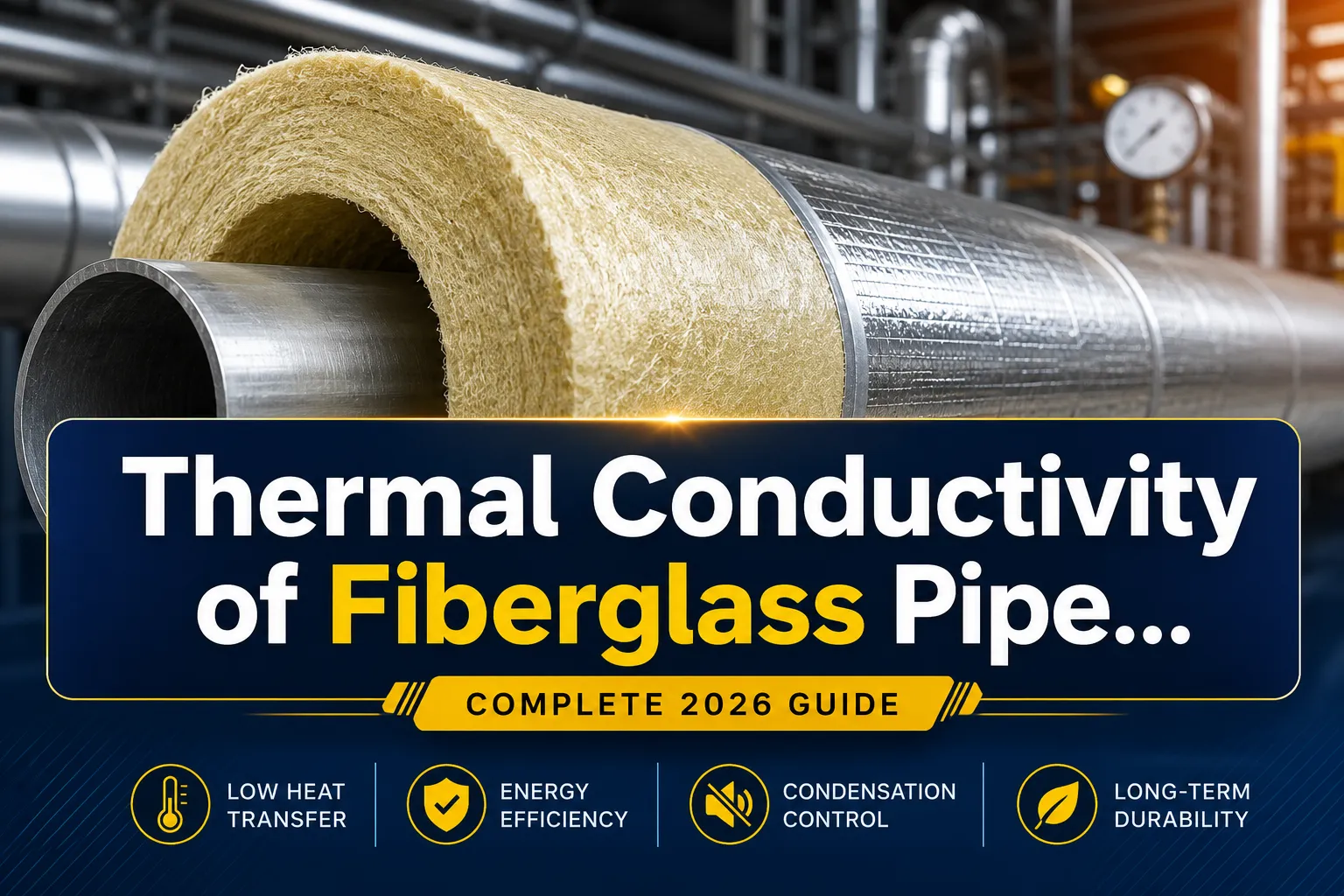
Fiberglass pipe insulation typically has a thermal conductivity (k-value) ranging from 0.032 to 0.040 W/mK at 10°C, making it an effective mid-range insulation material for most commercial and residential piping systems. The thermal conductivity of fiberglass pipe insulation varies based on density, temperature, moisture content, and manufacturing quality, with lower k-values indicating better insulating performance.
Key Takeaways
- Fiberglass pipe insulation k-values range from 0.032-0.040 W/mK, offering good thermal performance for most applications
- Density affects performance: higher density fiberglass (48-96 kg/m³) provides better thermal conductivity than lower density options
- Moisture significantly degrades fiberglass thermal performance, increasing k-values by 50-200% when saturated
- Fiberglass costs 30-50% less than premium alternatives like aerogel but offers higher k-values than foam or mineral wool
- Temperature impacts performance: fiberglass k-values increase at higher temperatures, reducing insulation effectiveness
- Proper vapor barriers and jacketing are essential to maintain long-term thermal performance
- Thickness requirements depend on pipe temperature, ambient conditions, and energy efficiency goals
- Fiberglass works best for moderate temperature applications (0-150°C) with proper moisture protection
What Is Thermal Conductivity and How Does It Work
Thermal conductivity measures a material's ability to conduct heat, expressed as the k-value in watts per meter-kelvin (W/mK). Lower k-values indicate better insulating properties because the material transfers less heat through its structure.
For pipe insulation, thermal conductivity determines how much heat energy passes through the insulation layer from the pipe to the surrounding environment. This directly affects:
- Energy efficiency: Lower k-values reduce heat loss and energy costs
- Condensation control: Better insulation prevents surface condensation on cold pipes
- Process temperature maintenance: Consistent thermal performance keeps fluids at target temperatures
- System sizing: More effective insulation allows smaller heating/cooling equipment
The heat transfer rate through pipe insulation follows the formula: Q = 2πkL(T₁-T₂)/ln(r₂/r₁), where k represents thermal conductivity. Choose insulation with k-values below 0.040 W/mK for energy-critical applications or when local energy codes require high-performance insulation.
Fiberglass Pipe Insulation Thermal Conductivity Values
Standard fiberglass pipe insulation exhibits k-values between 0.032-0.040 W/mK at 10°C, with performance varying by density and manufacturing quality. Higher-density fiberglass products typically achieve better thermal conductivity ratings.
Typical K-Value Ranges by Density
- Low density (32-48 kg/m³): 0.038-0.042 W/mK
- Medium density (48-64 kg/m³): 0.035-0.038 W/mK
- High density (64-96 kg/m³): 0.032-0.035 W/mK
- Premium grades (96+ kg/m³): 0.030-0.033 W/mK
Temperature significantly affects fiberglass k-values. At 50°C, typical k-values increase to 0.036-0.044 W/mK. At 100°C, expect k-values of 0.040-0.048 W/mK. This temperature dependency means fiberglass performs best on moderate-temperature systems below 150°C.
Common mistake: Specifying fiberglass based only on room temperature k-values. Always check thermal conductivity ratings at your system's operating temperature to ensure adequate performance.
How Does Fiberglass Compare to Other Pipe Insulation Materials
Fiberglass offers moderate thermal performance compared to other pipe insulation materials, with k-values higher than foam plastics but lower than mineral wool. The choice depends on balancing thermal performance, cost, and application requirements.
Thermal Conductivity Comparison Table
| Material | K-Value (W/mK) | Cost Relative to Fiberglass | Temperature Limit |
|---|---|---|---|
| Aerogel | 0.012-0.018 | 300-500% | 200°C |
| Polyurethane foam | 0.022-0.028 | 150-200% | 110°C |
| Polyisocyanurate foam | 0.020-0.025 | 180-220% | 150°C |
| Fiberglass | 0.032-0.040 | 100% (baseline) | 230°C |
| Mineral wool | 0.035-0.042 | 120-150% | 750°C |
| Elastomeric foam | 0.036-0.040 | 200-250% | 105°C |
Choose fiberglass when you need balanced performance at moderate cost. It works well for HVAC systems, domestic hot water, and low-pressure steam applications where premium thermal performance isn't critical.
Select alternatives like polyurethane foam for maximum energy savings on chilled water systems, or mineral wool for high-temperature applications above 150°C. For more information on thermal insulation options, see our thermal insulation sandwich panel guide.
Why Does Fiberglass Thermal Conductivity Decrease Over Time
Fiberglass insulation thermal conductivity typically increases (worsens) over time due to moisture absorption, fiber settling, and physical degradation. This performance decline can increase k-values by 15-30% over a 10-15 year period without proper protection.
Primary Degradation Factors
Moisture infiltration represents the biggest threat to fiberglass thermal performance. Even small amounts of moisture can increase k-values dramatically:
- 5% moisture content: 20-30% increase in k-value
- 10% moisture content: 50-80% increase in k-value
- Saturation: 100-200% increase in k-value
Fiber settling and compression occurs naturally over time, especially in vertical installations. This reduces the air spaces that provide insulating value, gradually increasing thermal conductivity.
UV degradation and temperature cycling break down fiber binders and cause micro-cracking in facing materials, allowing moisture penetration and reducing structural integrity.
Prevent performance degradation by installing proper vapor barriers, using weather-resistant jacketing, and ensuring complete sealing at joints and penetrations. Inspect installations annually and replace sections showing visible moisture damage or compression.
Best Fiberglass Pipe Insulation for Cold Pipes
For cold pipe applications, choose fiberglass with k-values below 0.035 W/mK and include continuous vapor barriers to prevent condensation within the insulation. Cold pipe insulation requires different considerations than hot pipe applications due to condensation risks.
Cold Pipe Insulation Requirements
Vapor barrier placement is critical for cold pipes. Install the vapor barrier on the warm (exterior) side of the insulation to prevent humid air from reaching the cold pipe surface and condensing within the fiberglass.
Minimum thickness guidelines for cold pipes in typical climates:
- Chilled water (7-12°C): 25-38mm thickness
- Refrigerated systems (-1 to 4°C): 38-50mm thickness
- Low-temperature systems (-18°C): 50-75mm thickness
Joint sealing becomes more important on cold systems. Use vapor-barrier tape or mastic to seal all joints, seams, and penetrations. Any air leakage allows moisture infiltration that degrades thermal performance.
Choose closed-cell foam alternatives like elastomeric rubber for critical cold applications where moisture control is paramount. Fiberglass works adequately for moderate cold applications with proper vapor barrier installation.
Fiberglass vs Foam vs Mineral Wool Pipe Insulation
Fiberglass provides the best cost-performance balance for moderate-temperature applications, while foam offers superior thermal performance and mineral wool excels in high-temperature environments. Each material serves different application niches based on performance priorities.
Performance Comparison
Thermal Performance Rankings (best to worst k-values):
- Polyurethane/polyiso foam (0.020-0.028 W/mK)
- Fiberglass (0.032-0.040 W/mK)
- Mineral wool (0.035-0.042 W/mK)
Moisture Resistance Rankings:
- Closed-cell foam (excellent)
- Mineral wool (good with proper facing)
- Fiberglass (poor without vapor barriers)
Temperature Capability Rankings:
- Mineral wool (up to 750°C)
- Fiberglass (up to 230°C)
- Foam plastics (up to 150°C)
Choose fiberglass for HVAC systems, domestic water heating, and general commercial applications where moderate thermal performance meets requirements at lowest cost. Select foam for energy-critical applications or where space constraints require thinner insulation. Use mineral wool for high-temperature steam, industrial processes, or fire-rated assemblies.
For building applications requiring similar thermal performance considerations, explore our thermal performance sandwich panel options.
Thermal Conductivity Rating K-Value Explained
The k-value represents thermal conductivity in watts per meter-kelvin (W/mK), measuring how much heat energy passes through one meter of material with a one-degree temperature difference. Lower k-values indicate better insulating performance.
Understanding K-Value Measurements
Standard test conditions for k-value measurements typically use:
- Mean temperature of 10°C or 24°C
- Dry material conditions
- Steady-state heat flow
- Laboratory-controlled environment
Real-world k-values often differ from laboratory ratings due to:
- Temperature effects: Higher temperatures increase k-values
- Moisture content: Any moisture significantly increases thermal conductivity
- Installation quality: Compression or gaps reduce effective performance
- Aging: Material degradation increases k-values over time
Effective thermal conductivity accounts for real installation conditions and may be 20-40% higher than laboratory k-values. Always apply safety factors when calculating insulation thickness requirements to account for performance variations.
Use k-values measured at your system's operating temperature range for accurate thermal calculations. Avoid using room temperature ratings for hot or cold systems.
Does Moisture Affect Fiberglass Insulation Performance
Moisture dramatically degrades fiberglass thermal performance, with even small amounts of water increasing k-values by 50-200%. Water conducts heat approximately 25 times better than air, replacing the insulating air spaces within fiberglass with highly conductive moisture.
Moisture Impact on Thermal Conductivity
Progressive performance degradation occurs as moisture content increases:
- 1-2% moisture: 10-15% increase in k-value
- 5% moisture: 30-50% increase in k-value
- 10% moisture: 80-120% increase in k-value
- Saturation: 150-250% increase in k-value
Moisture sources in pipe insulation systems include:
- Vapor diffusion through inadequate vapor barriers
- Air leakage at joints and penetrations
- Condensation on cold pipes
- External water infiltration from weather or leaks
- Installation during humid conditions without proper drying
Prevent moisture problems by installing continuous vapor barriers on the warm side of insulation, sealing all joints with appropriate tapes or mastics, and using weather-resistant outer jacketing. Replace any fiberglass insulation showing visible moisture staining or compression as performance cannot be restored once saturated.
Consider closed-cell foam alternatives for applications with high moisture risk or where vapor barrier installation is difficult to execute properly.
How Thick Does Fiberglass Pipe Insulation Need to Be
Fiberglass pipe insulation thickness depends on pipe temperature, ambient conditions, energy cost, and local code requirements, typically ranging from 25mm for moderate applications to 100mm+ for energy-critical systems. Economic thickness calculations balance insulation cost against energy savings over the system lifetime.
Thickness Selection Guidelines
Minimum thickness recommendations by application:
- Domestic hot water (60°C): 25-38mm in conditioned spaces, 38-50mm outdoors
- HVAC heating (80°C): 38-50mm for distribution, 25mm for terminal units
- Low-pressure steam (120°C): 50-75mm depending on energy costs
- Chilled water (7°C): 25-38mm with vapor barrier
- High-temperature water (150°C): 75-100mm for economic operation
Economic thickness analysis considers:
- Energy cost per unit (electricity, gas, steam rates)
- Operating hours per year
- Pipe surface area and heat loss rates
- Insulation material and installation costs
- System design life (typically 15-20 years)
Code requirements may mandate minimum thicknesses. Many energy codes require R-values equivalent to 38-50mm of fiberglass for mechanical systems. Always check local building codes as they may supersede economic calculations.
Common mistake: Under-insulating based on first cost only. Proper economic analysis usually justifies 50-75mm thickness for most applications when energy costs are considered over system life.
Can You Improve Fiberglass Thermal Conductivity
You cannot improve the inherent thermal conductivity of existing fiberglass insulation, but you can optimize system performance through proper installation, moisture control, and strategic thickness increases. Focus on maintaining design k-values rather than trying to enhance material properties.
Performance Optimization Strategies
Installation quality improvements:
- Eliminate air gaps between insulation sections
- Avoid compression during installation
- Use proper joint sealing techniques
- Install continuous vapor barriers without breaks
Moisture control measures:
- Apply weather-resistant outer jacketing
- Seal all penetrations and joints with appropriate materials
- Install proper vapor barriers on the correct side
- Provide adequate drainage for outdoor installations
System design enhancements:
- Increase insulation thickness in critical areas
- Add reflective facings to reduce radiant heat transfer
- Use multiple layers with staggered joints
- Consider hybrid systems combining fiberglass with higher-performance materials
Retrofit improvements for existing systems:
- Add outer layers of higher-performance insulation
- Install radiant barriers over existing fiberglass
- Upgrade vapor barriers and jacketing systems
- Replace degraded sections with premium materials
Consider upgrading to higher-performance materials like polyurethane foam or aerogel for critical applications where maximum thermal performance justifies higher costs. For comprehensive insulation solutions, explore our pipe insulation sandwich panel systems.
Fiberglass Insulation Thermal Conductivity at Different Temperatures
Fiberglass thermal conductivity increases with temperature, with k-values rising approximately 0.0001-0.0002 W/mK per degree Celsius above room temperature. This temperature dependency affects insulation performance calculations for hot systems.
Temperature-Dependent K-Values
Typical fiberglass k-value progression:
- 10°C: 0.032-0.038 W/mK (baseline rating)
- 50°C: 0.036-0.042 W/mK (12-15% increase)
- 100°C: 0.040-0.046 W/mK (25-30% increase)
- 150°C: 0.044-0.050 W/mK (35-40% increase)
- 200°C: 0.048-0.054 W/mK (45-50% increase)
Heat transfer mechanisms change at higher temperatures:
- Conduction through fibers increases with temperature
- Convection within air spaces becomes more significant
- Radiation heat transfer increases proportionally to temperature⁴
Design implications for high-temperature systems:
- Use k-values at operating temperature, not room temperature ratings
- Consider thicker insulation to compensate for higher k-values
- Evaluate mineral wool alternatives for systems above 150°C
- Account for temperature cycling effects on long-term performance
Calculate heat loss using mean temperature k-values for accurate results. For a pipe at 100°C in 20°C ambient conditions, use the k-value at 60°C mean temperature rather than the pipe temperature rating.
Frequently Asked Questions
What is the typical k-value range for fiberglass pipe insulation?
Fiberglass pipe insulation typically has k-values between 0.032-0.040 W/mK at 10°C, with higher-density products achieving lower (better) k-values around 0.032-0.035 W/mK.
How does moisture affect fiberglass thermal conductivity?
Moisture dramatically increases fiberglass k-values, with just 5% moisture content increasing thermal conductivity by 30-50%. Saturated fiberglass can have k-values 150-200% higher than dry material.
Is fiberglass or foam better for pipe insulation?
Foam offers better thermal performance (k-values 0.020-0.028 W/mK) but costs 50-100% more than fiberglass. Choose foam for energy-critical applications and fiberglass for cost-sensitive moderate-temperature systems.
What thickness of fiberglass insulation do I need for hot water pipes?
For domestic hot water at 60°C, use 25-38mm thickness in conditioned spaces or 38-50mm outdoors. Higher temperatures or energy-critical applications may require 50-75mm thickness.
Does fiberglass insulation performance degrade over time?
Yes, fiberglass k-values typically increase 15-30% over 10-15 years due to moisture absorption, fiber settling, and physical degradation. Proper vapor barriers and jacketing minimize this degradation.
Can I use fiberglass insulation on chilled water pipes?
Fiberglass works on chilled water pipes with proper vapor barrier installation on the exterior (warm) side. However, closed-cell foam provides better moisture resistance for critical cold applications.
What temperature range is suitable for fiberglass pipe insulation?
Fiberglass works well from 0°C to 150°C, with maximum ratings up to 230°C. Consider mineral wool for higher temperatures or foam for maximum efficiency at moderate temperatures.
How do I prevent moisture problems in fiberglass pipe insulation?
Install continuous vapor barriers on the warm side, seal all joints with appropriate tapes or mastics, use weather-resistant jacketing, and ensure proper drainage for outdoor installations.
What's the difference between fiberglass and mineral wool thermal conductivity?
Both materials have similar k-values (0.032-0.042 W/mK), but mineral wool handles much higher temperatures (up to 750°C) while fiberglass costs less and works adequately for moderate-temperature applications.
Should I specify fiberglass based on room temperature k-values?
No, always use k-values measured at your system's operating temperature. Fiberglass k-values increase with temperature, so room temperature ratings underestimate actual thermal conductivity in hot systems.
How does fiberglass density affect thermal conductivity?
Higher density fiberglass generally provides better k-values: low density (32-48 kg/m³) averages 0.038-0.042 W/mK while high density (64-96 kg/m³) achieves 0.032-0.035 W/mK.
Can I improve existing fiberglass insulation performance?
You cannot improve the material's inherent k-value, but you can optimize performance through better moisture control, proper vapor barriers, eliminating air gaps, and adding outer layers of higher-performance insulation.
SEO Meta Title: Fiberglass Pipe Insulation Thermal Conductivity Guide 2026