Last updated: July 31, 2026

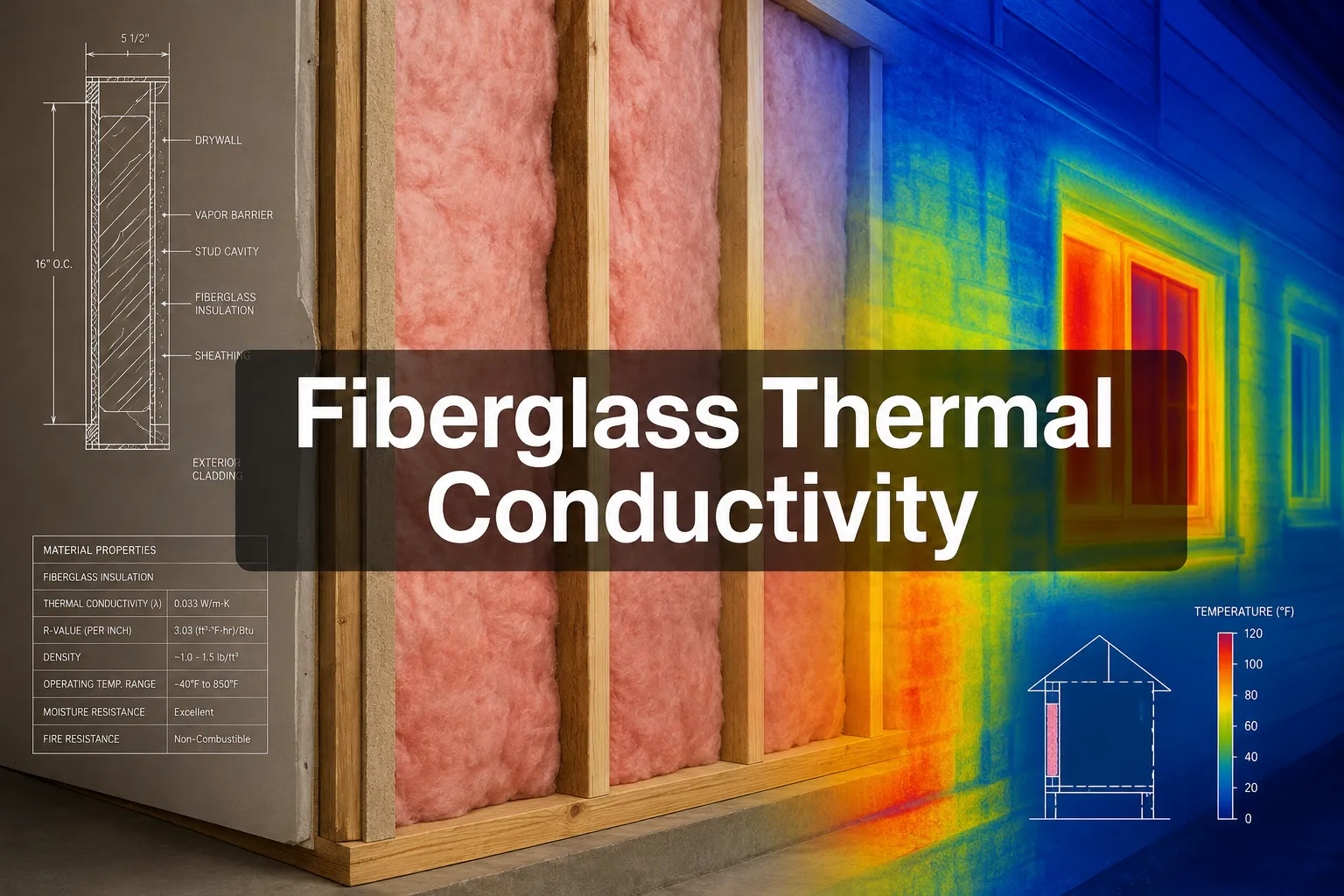
Fiberglass insulation typically has a thermal conductivity (k-value) ranging from 0.030 to 0.040 W/m·K, making it an effective thermal barrier that significantly reduces heat transfer through building assemblies. The thermal conductivity of fiberglass insulation directly determines its R-value performance and overall effectiveness in controlling energy costs.
Key Takeaways
- Fiberglass insulation has a thermal conductivity between 0.030-0.040 W/m·K under standard conditions
- Lower thermal conductivity values indicate better insulating performance
- Moisture can increase fiberglass thermal conductivity by up to 50%, severely reducing effectiveness
- Air movement and compression significantly impact thermal performance
- Fiberglass maintains stable thermal properties over decades when properly installed
- Temperature variations affect thermal conductivity measurements and real-world performance
- Proper installation prevents thermal bridging and maintains designed thermal resistance
- Quality fiberglass products meet ASTM C518 testing standards for thermal conductivity
What Is Thermal Conductivity and How Does It Affect Insulation
Thermal conductivity measures a material's ability to conduct heat through its structure, expressed in watts per meter-kelvin (W/m·K). For insulation materials like fiberglass, lower thermal conductivity values indicate superior insulating performance because less heat transfers through the material.
The thermal conductivity of fiberglass insulation directly impacts building energy efficiency. Materials with high thermal conductivity allow rapid heat transfer, while low-conductivity materials like fiberglass create effective thermal barriers. This property determines how much insulation thickness you need to achieve specific R-values.
Key factors affecting thermal conductivity:
- Material density and fiber arrangement
- Air pocket size and distribution
- Moisture content and humidity exposure
- Temperature differential across the material
- Installation quality and compression levels
Fiberglass achieves low thermal conductivity through its structure of fine glass fibers that trap air pockets. These stationary air spaces provide the primary insulating value, while the glass fibers simply hold the air in place.
Fiberglass Insulation R-Value vs Thermal Conductivity Difference
R-value and thermal conductivity measure opposite characteristics of insulation performance. R-value indicates thermal resistance (how well material resists heat flow), while thermal conductivity measures heat transfer ability. These values have an inverse relationship – as thermal conductivity decreases, R-value increases proportionally.
The relationship follows this formula: R-value = thickness (meters) ÷ thermal conductivity (W/m·K). For example, 100mm of fiberglass with 0.035 W/m·K thermal conductivity provides R-2.86 (metric) or approximately R-16 (imperial).
Practical differences:
- R-value: Consumer-friendly number showing total thermal resistance
- Thermal conductivity: Technical specification used by engineers and manufacturers
- Temperature dependency: Both values change with operating temperatures
- Thickness impact: R-value scales with thickness; thermal conductivity remains constant for the material
Understanding both measurements helps when comparing different insulation products or calculating required thicknesses for specific thermal performance sandwich panel applications.
How Does Moisture Affect Fiberglass Thermal Conductivity
Moisture dramatically increases the thermal conductivity of fiberglass insulation because water conducts heat approximately 25 times better than air. Even small amounts of moisture can reduce insulation effectiveness by 30-50%, making moisture control critical for maintaining thermal performance.
When fiberglass absorbs moisture, water displaces the insulating air pockets and creates thermal bridges through the material. This effect compounds in cold climates where moisture can freeze, further increasing thermal conductivity and potentially damaging the insulation structure.
Moisture impact levels:
- 1-2% moisture content: 15-25% reduction in thermal resistance
- 5% moisture content: 40-50% performance loss
- Saturated conditions: Up to 90% effectiveness reduction
- Freeze-thaw cycles: Additional structural damage and permanent performance loss
Prevention strategies include:
- Installing proper vapor barriers on the warm side
- Ensuring adequate ventilation in insulated cavities
- Using faced fiberglass products in appropriate applications
- Addressing air leaks that can carry moisture into insulation
Proper moisture management maintains the designed thermal conductivity throughout the insulation's service life.
Fiberglass vs Mineral Wool Thermal Conductivity Comparison
Fiberglass and mineral wool have similar thermal conductivity ranges, but mineral wool typically performs slightly better with k-values between 0.032-0.038 W/m·K compared to fiberglass at 0.035-0.040 W/m·K. However, both materials provide comparable insulating performance in most applications.
The thermal conductivity difference translates to roughly 5-10% better performance for mineral wool, but this advantage often gets offset by cost considerations and installation factors. Both materials achieve their insulating properties through trapped air spaces between fibers.
| Property | Fiberglass | Mineral Wool |
|---|---|---|
| Thermal Conductivity | 0.035-0.040 W/m·K | 0.032-0.038 W/m·K |
| Moisture Resistance | Moderate | Better |
| Fire Resistance | Good | Excellent |
| Cost | Lower | Higher |
Choose fiberglass when: Budget is primary concern, standard residential applications, readily available local supply.
Choose mineral wool when: Fire resistance is critical, moisture exposure likely, superior acoustic performance needed.
Best Fiberglass Insulation for Cold Climates Thermal Performance
High-density fiberglass batts with thermal conductivity values at the lower end of the range (0.030-0.035 W/m·K) provide optimal performance in cold climates. These products maintain better thermal resistance under temperature stress and resist compression that can occur in extreme conditions.
Cold climate applications benefit from fiberglass products specifically designed for thermal stability. Look for batts with consistent density throughout their thickness and reinforced facing materials that prevent air infiltration.
Recommended specifications for cold climates:
- Thermal conductivity: 0.030-0.035 W/m·K maximum
- Density: 12-16 kg/m³ for batts, 25-40 kg/m³ for boards
- Facing: Kraft paper or foil-faced for vapor control
- Installation: Continuous coverage without gaps or compression
Performance considerations:
- Temperature cycling effects on long-term thermal conductivity
- Air sealing requirements to prevent convective heat loss
- Proper vapor barrier placement to prevent condensation
- Integration with building insulation systems for complete thermal envelope
Quality installation matters more than small differences in thermal conductivity values. Gaps, compression, and thermal bridges can reduce system performance by 25-40% regardless of the insulation's rated properties.
Does Fiberglass Thermal Conductivity Degrade Over Time
Properly installed fiberglass insulation maintains stable thermal conductivity for 50+ years under normal conditions. The glass fibers themselves don't degrade significantly, and the air-trapping structure remains intact when protected from moisture, pests, and physical damage.
However, several factors can cause gradual performance degradation. Settling in loose-fill applications can increase density and thermal conductivity. Moisture exposure, even if dried out, can permanently alter fiber structure and reduce effectiveness.
Factors affecting long-term performance:
- Settling: Loose-fill products may lose 10-15% effectiveness over 20 years
- Compression: Traffic or storage loads can permanently reduce thickness
- Moisture history: Previous wetting events may cause lasting damage
- Air infiltration: Gaps developing around insulation reduce system performance
Maintenance considerations:
- Inspect for settling or compression annually
- Check for moisture intrusion and air leaks
- Replace sections showing visible degradation
- Maintain proper ventilation to prevent moisture problems
Quality fiberglass products from reputable manufacturers typically carry 25-50 year warranties, reflecting confidence in long-term thermal performance stability.
How to Measure Thermal Conductivity of Fiberglass
Thermal conductivity of fiberglass insulation is measured using standardized test methods, primarily ASTM C518 (Steady-State Thermal Transmission Properties by Means of the Heat Flow Meter Apparatus). This test creates controlled temperature conditions across a sample and measures heat flow to calculate thermal conductivity.
Professional testing requires specialized equipment including heat flow meters, temperature controllers, and environmental chambers. The test specimen is placed between hot and cold plates, and thermal conductivity is calculated from the steady-state heat flow, temperature difference, and sample thickness.
Standard test conditions:
- Mean temperature: 24°C (75°F)
- Temperature difference: 22°C across sample
- Sample size: Minimum 200mm x 200mm
- Equilibrium time: 2-4 hours depending on thickness
Field estimation methods:
- R-value measurements using surface thermometers
- Thermal imaging to identify performance variations
- Manufacturer specifications for installed products
- Professional energy audits with calibrated equipment
Most building applications rely on manufacturer-provided thermal conductivity values rather than field testing. These values are determined through extensive laboratory testing and quality control programs.
Fiberglass Thermal Conductivity at Different Temperatures
The thermal conductivity of fiberglass insulation increases with temperature, typically rising 10-20% as temperatures increase from 0°C to 50°C. This temperature dependency affects real-world performance compared to standard laboratory test conditions at 24°C mean temperature.
Higher temperatures increase molecular activity in both the glass fibers and trapped air, enhancing heat transfer mechanisms. This effect is more pronounced in high-temperature applications like pipe insulation sandwich panel systems.
Temperature effects on thermal conductivity:
- 0°C: Approximately 5-8% lower than standard values
- 24°C: Standard test condition (baseline)
- 40°C: 8-12% higher than standard values
- 60°C: 15-20% higher than standard values
Practical implications:
- Summer cooling loads may be higher than calculated using standard values
- Winter heating performance may be slightly better than expected
- High-temperature applications require adjusted thermal calculations
- Extreme temperature cycling can affect long-term stability
Engineers account for temperature effects by using appropriate mean temperatures in thermal calculations or applying correction factors based on expected operating conditions.
Why Does Fiberglass Lose Effectiveness When Wet
Fiberglass loses effectiveness when wet because water has 25 times higher thermal conductivity than air (0.6 W/m·K vs 0.024 W/m·K). When moisture displaces the insulating air pockets between fibers, it creates direct thermal bridges that dramatically increase heat transfer through the material.
The fiber structure of fiberglass readily absorbs and holds moisture through capillary action. Once wet, the material can retain moisture for extended periods, especially in enclosed cavities with limited air circulation.
Heat transfer mechanisms in wet fiberglass:
- Conduction: Direct heat transfer through water-filled fiber contacts
- Convection: Moisture movement carrying heat through the material
- Thermal bridging: Continuous water paths bypassing air gaps
- Reduced air space: Compressed fibers from water weight
Recovery limitations:
- Drying doesn't always restore full performance
- Fiber structure may remain compressed
- Salt deposits from evaporation can permanently increase conductivity
- Mold growth can further degrade thermal properties
Prevention through proper vapor barriers, air sealing, and moisture management is far more effective than attempting to restore wet insulation performance.
Fiberglass Thermal Conductivity K-Value Explained
The k-value represents thermal conductivity measured in watts per meter-kelvin (W/m·K), indicating how much heat flows through one meter of material with a one-degree temperature difference. For fiberglass insulation, lower k-values indicate better insulating performance.
Fiberglass k-values typically range from 0.030 to 0.040 W/m·K, depending on density, fiber arrangement, and manufacturing quality. This measurement is intrinsic to the material and doesn't change with thickness, unlike R-value which increases proportionally with insulation thickness.
Understanding k-value specifications:
- 0.030 W/m·K: High-performance fiberglass products
- 0.035 W/m·K: Standard residential batt insulation
- 0.040 W/m·K: Basic or lower-density products
- Higher values: Indicate poorer insulating performance
Relationship to other thermal properties:
- R-value = thickness ÷ k-value
- U-value = k-value ÷ thickness
- Lower k-values enable thinner insulation for same R-value
Manufacturers determine k-values through standardized testing, and these values form the basis for R-value calculations and thermal insulation sandwich panel performance ratings.
Is Fiberglass Good Insulation for Attic Thermal Conductivity
Fiberglass provides excellent attic insulation with thermal conductivity values that deliver cost-effective thermal performance for most residential applications. The material's low thermal conductivity (0.030-0.040 W/m·K) combined with easy installation and reasonable cost makes it a practical choice for attic applications.
Attic conditions suit fiberglass insulation well because the space typically remains dry and experiences minimal physical disturbance. Proper installation techniques can achieve continuous coverage that maximizes the thermal conductivity benefits.
Attic-specific advantages:
- Excellent thermal performance in dry conditions
- Available in batts, rolls, and loose-fill for different installation needs
- Cost-effective for large attic areas
- Compatible with standard construction practices
Installation considerations for optimal thermal performance:
- Maintain full thickness without compression
- Seal air leaks before installing insulation
- Ensure continuous coverage without gaps
- Install vapor barriers on conditioned space side in cold climates
Performance optimization:
- Use loose-fill for irregular spaces to maintain consistent thermal conductivity
- Install baffles to prevent wind washing that can degrade performance
- Consider cold storage insulation techniques for extreme climate applications
Proper installation typically delivers 90-95% of the rated thermal performance, making fiberglass an effective attic insulation choice.
Fiberglass Insulation Thermal Conductivity Standards and Ratings
Fiberglass insulation thermal conductivity is regulated by ASTM C518 testing standards, which establish consistent measurement protocols for thermal transmission properties. These standards ensure reliable performance data for building design and energy code compliance.
ASTM C518 specifies test conditions including sample preparation, temperature control, and measurement procedures. Products meeting these standards display thermal conductivity values that engineers can confidently use in thermal calculations and building energy modeling.
Key testing standards:
- ASTM C518: Primary thermal conductivity test method
- ASTM C177: Alternative guarded hot plate method
- ISO 8301: International equivalent standard
- ASTM C687: Thermal resistance determination for thick specimens
Rating and certification systems:
- Energy Star qualification requirements for residential insulation
- Building code compliance through standardized R-value tables
- Manufacturer quality control testing protocols
- Third-party verification programs
Performance verification:
- Regular production testing to maintain consistent thermal conductivity
- Batch testing for quality control
- Independent laboratory verification
- Field performance monitoring in some applications
These standards provide confidence that fiberglass insulation will deliver the thermal conductivity performance specified for building insulation applications.
How Does Air Movement Affect Fiberglass Thermal Conductivity
Air movement through fiberglass insulation significantly increases effective thermal conductivity by adding convective heat transfer to the normal conductive heat transfer through the material. Even small air currents can reduce insulation effectiveness by 20-40% compared to still-air conditions.
Fiberglass relies on trapped, motionless air for its insulating properties. When air moves through the fiber matrix, it carries heat directly across the insulation, bypassing the intended thermal resistance mechanism.
Types of air movement effects:
- Wind washing: Exterior air moving through insulation
- Convective loops: Air circulation within insulation cavities
- Stack effect: Pressure-driven air movement in wall cavities
- Infiltration: Air leaks carrying heat through insulation
Mitigation strategies:
- Install air barriers on both sides of insulation
- Seal all penetrations and gaps in building envelope
- Use faced insulation products where appropriate
- Ensure proper installation density to resist air movement
Performance impact:
- 1 mph air movement can reduce effectiveness by 15-25%
- Significant air leaks can eliminate insulation benefits entirely
- Proper air sealing often more important than insulation thickness
- Combined air sealing and insulation provides optimal thermal performance
Effective thermal design requires controlling air movement as much as selecting appropriate thermal conductivity values for the insulation material.
Fiberglass vs Spray Foam Thermal Conductivity: Which Is Better
Spray foam insulation has lower thermal conductivity than fiberglass, with closed-cell foam achieving 0.020-0.025 W/m·K compared to fiberglass at 0.030-0.040 W/m·K. However, the "better" choice depends on application requirements, budget, and installation conditions beyond just thermal conductivity.
Closed-cell spray foam provides superior thermal performance per inch of thickness, while open-cell foam (0.035-0.040 W/m·K) performs similarly to fiberglass but offers better air sealing properties.
Thermal conductivity comparison:
- Closed-cell spray foam: 0.020-0.025 W/m·K (best thermal performance)
- Fiberglass: 0.030-0.040 W/m·K (good performance, lower cost)
- Open-cell spray foam: 0.035-0.040 W/m·K (similar to fiberglass with air sealing benefits)
Decision factors beyond thermal conductivity:
- Cost: Fiberglass costs 50-70% less than spray foam
- Air sealing: Spray foam provides integrated air barrier
- Moisture: Closed-cell foam resists moisture better
- Installation: Fiberglass easier for DIY applications
Choose fiberglass when: Budget is primary concern, easy access for installation, standard residential applications.
Choose spray foam when: Space is limited, air sealing is critical, moisture resistance needed, maximum thermal performance required.
Both materials can achieve excellent thermal performance when properly installed with appropriate air sealing measures.
Frequently Asked Questions
What is the typical thermal conductivity range for fiberglass insulation?
Fiberglass insulation typically has thermal conductivity values between 0.030 and 0.040 W/m·K, with higher-quality products at the lower end of this range providing better insulating performance.
How does moisture affect fiberglass thermal conductivity?
Moisture can increase fiberglass thermal conductivity by 30-50% because water conducts heat 25 times better than air, displacing the insulating air pockets between fibers.
Does fiberglass thermal conductivity change with temperature?
Yes, thermal conductivity increases 10-20% as temperatures rise from 0°C to 50°C, with higher temperatures enhancing heat transfer through both the fibers and trapped air.
How long does fiberglass maintain its thermal conductivity?
Properly installed fiberglass insulation maintains stable thermal conductivity for 50+ years under normal conditions, with minimal degradation when protected from moisture and physical damage.
What's the difference between R-value and thermal conductivity?
R-value measures thermal resistance (higher is better), while thermal conductivity measures heat transfer ability (lower is better). They have an inverse relationship: R-value = thickness ÷ thermal conductivity.
Can you measure fiberglass thermal conductivity in the field?
Professional measurement requires laboratory equipment following ASTM C518 standards. Field assessments typically use thermal imaging, surface temperature measurements, or energy audit techniques for performance evaluation.
How does air movement affect fiberglass thermal performance?
Air movement through fiberglass can reduce effectiveness by 20-40% by adding convective heat transfer. Proper air sealing is essential to maintain the designed thermal conductivity performance.
Is fiberglass or mineral wool better for thermal conductivity?
Mineral wool has slightly better thermal conductivity (0.032-0.038 W/m·K vs 0.035-0.040 W/m·K), but the 5-10% difference is often offset by cost and availability considerations.
What thermal conductivity should I look for in cold climates?
For cold climates, choose fiberglass with thermal conductivity values of 0.030-0.035 W/m·K maximum, combined with proper vapor barriers and air sealing for optimal performance.
How does fiberglass compare to spray foam thermal conductivity?
Closed-cell spray foam has better thermal conductivity (0.020-0.025 W/m·K) than fiberglass, but costs significantly more. Open-cell foam performs similarly to fiberglass while providing better air sealing.
Does fiberglass thermal conductivity vary by manufacturer?
Yes, thermal conductivity can vary between manufacturers based on fiber quality, density, and manufacturing processes, though all products must meet ASTM testing standards for performance claims.
What happens to thermal conductivity when fiberglass gets compressed?
Compression increases density and thermal conductivity, reducing insulation effectiveness. Maintaining full thickness during installation is critical for achieving rated thermal performance.
Conclusion
The thermal conductivity of fiberglass insulation, typically ranging from 0.030 to 0.040 W/m·K, makes it an effective and economical choice for most building applications. Understanding this fundamental property helps optimize insulation performance through proper material selection, installation techniques, and moisture management.
Key success factors include choosing products with lower thermal conductivity values, maintaining proper installation thickness, controlling moisture exposure, and implementing effective air sealing. While newer materials like spray foam offer superior thermal conductivity, fiberglass remains competitive when cost-effectiveness and ease of installation are priorities.
Next steps for optimal thermal performance:
- Calculate required R-values based on climate and building codes
- Select fiberglass products with thermal conductivity appropriate for your application
- Implement comprehensive air sealing before insulation installation
- Consider professional energy modeling for complex projects
- Explore building insulation panel systems for commercial applications
Proper understanding and application of fiberglass thermal conductivity principles ensures energy-efficient building performance and long-term cost savings through reduced heating and cooling demands.
SEO Meta Title: Fiberglass Insulation Thermal Conductivity Guide 2026
Meta Description: Complete guide to fiberglass insulation thermal conductivity (k-values 0.030-0.040 W/m·K). Learn how moisture, temperature, and installation affect performance.