Last updated: July 31, 2026

Quick Answer: Pipe insulation thermal conductivity measures how easily heat transfers through insulation materials, expressed in W/m·K units. Lower values mean better insulation performance. Most pipe insulation materials range from 0.023 W/m·K (aerogel) to 0.040 W/m·K (fiberglass), with proper selection reducing energy losses by 80-95% compared to uninsulated pipes.
Key Takeaways
- Thermal conductivity values below 0.035 W/m·K provide excellent pipe insulation performance for most applications
- Fiberglass insulation typically rates 0.032-0.040 W/m·K, while closed-cell foam achieves 0.025-0.035 W/m·K
- Insulation thickness doesn't change thermal conductivity but increases total thermal resistance (R-value)
- Temperature ratings must match your pipe operating conditions – some materials lose effectiveness above 150°F
- Moisture resistance affects long-term thermal performance more than initial conductivity ratings
- Cost per BTU saved varies significantly between materials despite similar conductivity values
- Installation quality impacts real-world performance regardless of material specifications
- Building codes often specify minimum R-values rather than maximum conductivity limits
What Is Thermal Conductivity in Pipe Insulation
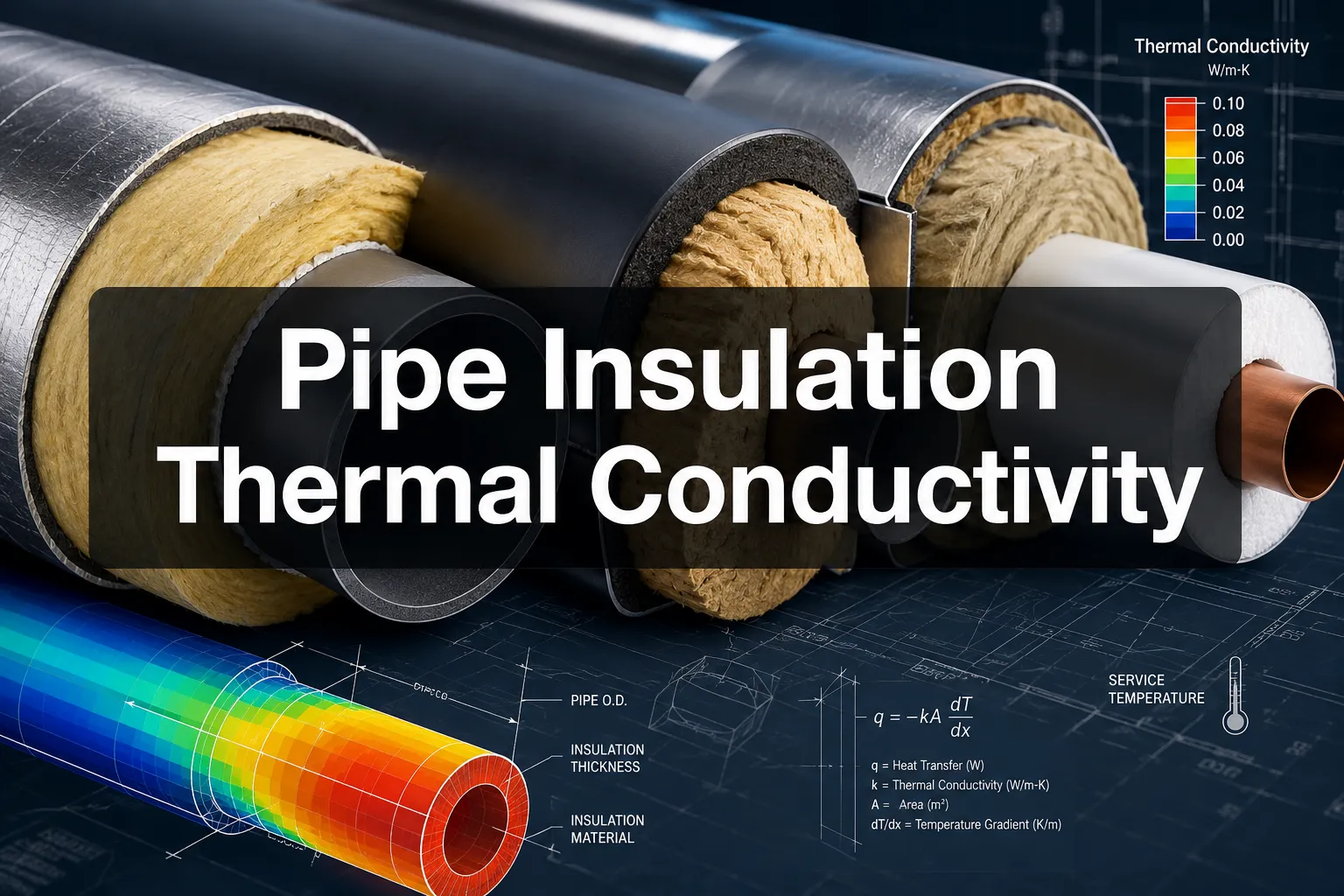
Thermal conductivity measures how quickly heat moves through a material under steady-state conditions. For pipe insulation, this property determines how effectively the material prevents heat transfer between the pipe contents and surrounding environment.
The measurement uses watts per meter-kelvin (W/m·K) units, representing the heat flow rate through one meter of material with a one-degree temperature difference. Lower thermal conductivity values indicate better insulating performance because less heat passes through the material.
Most pipe insulation materials fall within these thermal conductivity ranges:
- Aerogel: 0.023-0.025 W/m·K (premium performance)
- Closed-cell foam: 0.025-0.035 W/m·K (excellent moisture resistance)
- Mineral wool: 0.030-0.038 W/m·K (high temperature capability)
- Fiberglass: 0.032-0.040 W/m·K (cost-effective standard)
- Open-cell foam: 0.035-0.045 W/m·K (budget option)
Temperature affects thermal conductivity measurements. Most manufacturers report values at 75°F mean temperature, but conductivity typically increases as temperature rises. For accurate comparisons, always check the test temperature conditions.
How Thermal Conductivity Affects Energy Loss in Pipes
Lower thermal conductivity directly reduces energy losses through pipe walls. Uninsulated pipes can lose 80-95% more energy than properly insulated systems, with the exact impact depending on pipe diameter, fluid temperature, and ambient conditions.
The relationship follows basic heat transfer principles. Heat loss rate equals thermal conductivity multiplied by surface area and temperature difference, then divided by insulation thickness. This means halving the thermal conductivity cuts energy losses in half, assuming other factors remain constant.
For a 4-inch hot water pipe at 140°F in a 70°F basement:
- Uninsulated copper pipe: Loses approximately 400 BTU/hr per linear foot
- Fiberglass insulation (0.036 W/m·K, 1-inch thick): Reduces loss to 45 BTU/hr per foot
- Closed-cell foam (0.028 W/m·K, 1-inch thick): Reduces loss to 35 BTU/hr per foot
Pipe diameter significantly influences the impact of thermal conductivity. Smaller pipes have higher surface-area-to-volume ratios, making thermal conductivity differences more critical for energy savings. Large industrial pipes may achieve acceptable performance with higher conductivity materials due to their favorable geometry.
Pipe Insulation Materials Ranked by Thermal Conductivity
Aerogel insulation delivers the lowest thermal conductivity at 0.023-0.025 W/m·K but costs 5-10 times more than conventional options. Use aerogel where space constraints prevent adequate thickness of standard materials or where extreme performance justifies the premium cost.
Closed-cell polyurethane foam offers excellent performance at 0.025-0.035 W/m·K with superior moisture resistance. This combination makes it ideal for outdoor applications, underground pipes, or humid environments where moisture infiltration degrades other materials.
Mineral wool (rock wool or slag wool) provides 0.030-0.038 W/m·K thermal conductivity with exceptional high-temperature capability up to 1200°F. Choose mineral wool for steam pipes, industrial processes, or applications requiring fire resistance.
Fiberglass pipe insulation delivers reliable 0.032-0.040 W/m·K performance at the lowest initial cost. The material works well for indoor residential and commercial applications where moisture exposure remains minimal and temperatures stay below 450°F.
Elastomeric foam typically rates 0.035-0.040 W/m·K with excellent flexibility and ease of installation. The material excels for refrigeration lines, chilled water systems, and applications requiring frequent maintenance access.
For comprehensive guidance on selecting appropriate insulation systems, review our complete pipe insulation sandwich panel guide which covers material combinations and installation considerations.
Fiberglass vs Foam Pipe Insulation Thermal Conductivity Comparison
Closed-cell foam consistently outperforms fiberglass in thermal conductivity tests, typically achieving 15-25% better insulation values. Foam materials average 0.028 W/m·K compared to fiberglass at 0.036 W/m·K under standard test conditions.
However, real-world performance depends heavily on installation quality and environmental conditions. Fiberglass loses significant effectiveness when wet, with thermal conductivity increasing 3-5 times when moisture content exceeds 5% by volume. Closed-cell foam maintains stable performance even with surface moisture exposure.
Temperature stability differs between materials. Fiberglass maintains consistent thermal conductivity across wider temperature ranges, while some foam formulations show increasing conductivity above 150°F. For high-temperature applications, verify foam performance ratings at actual operating conditions.
Installation factors affect comparative performance. Fiberglass requires careful vapor barrier installation to prevent moisture infiltration, adding complexity and potential failure points. Foam insulation provides inherent moisture resistance but demands proper joint sealing to prevent thermal bridging.
Cost considerations extend beyond material prices. While foam costs 40-70% more initially, the superior thermal performance may justify the premium through reduced energy costs and thinner required thickness in space-constrained installations.
What Thermal Conductivity Rating Do I Need for My Pipes
For residential hot water systems, target thermal conductivity values below 0.035 W/m·K with minimum 1-inch thickness on pipes up to 2 inches diameter. This combination typically reduces heat losses by 85-90% compared to uninsulated pipes.
Commercial HVAC applications benefit from thermal conductivity ratings below 0.030 W/m·K, especially for chilled water lines where condensation control becomes critical. Lower conductivity materials reduce both energy losses and surface condensation risks.
Industrial process pipes require material selection based on operating temperature ranges rather than thermal conductivity alone. For steam lines above 300°F, choose materials maintaining stable conductivity at operating temperatures, even if room-temperature values appear higher.
Outdoor and underground installations demand materials with thermal conductivity below 0.032 W/m·K plus exceptional moisture resistance. Moisture infiltration can triple effective thermal conductivity, negating any initial performance advantages.
Economic optimization typically occurs with materials offering 0.028-0.035 W/m·K thermal conductivity for most applications. Ultra-low conductivity materials rarely provide cost-effective payback periods unless space constraints or extreme performance requirements justify the premium.
Consider local building codes and energy efficiency programs when selecting thermal conductivity targets. Many jurisdictions specify minimum R-values rather than maximum conductivity limits, potentially allowing higher-conductivity materials with increased thickness.
How to Measure Thermal Conductivity of Pipe Insulation
Laboratory testing using ASTM C177 or C518 standards provides the most accurate thermal conductivity measurements. These methods use guarded hot plate or heat flow meter apparatus to establish steady-state heat transfer through material samples under controlled conditions.
Field testing requires specialized equipment like thermal conductivity meters or heat flux sensors. These instruments measure actual heat transfer rates through installed insulation, accounting for real-world factors like compression, moisture content, and thermal bridging.
Temperature correction becomes necessary when comparing materials tested at different conditions. Most manufacturers report thermal conductivity at 75°F mean temperature, but actual performance varies with operating conditions. Use manufacturer correction factors or request testing at specific operating temperatures.
Sample preparation significantly affects measurement accuracy. Ensure test samples represent actual installation conditions, including any compression from pipe contact, vapor barriers, or protective jacketing. Moisture content should match expected field conditions.
Quality control testing during installation helps verify expected performance. Infrared thermography can identify areas where actual thermal performance differs from design assumptions, indicating installation defects or material degradation.
For projects requiring verified performance, specify third-party testing of actual materials rather than relying solely on manufacturer data. Independent testing eliminates potential bias and provides legally defensible performance documentation.
Does Pipe Insulation Thickness Affect Thermal Conductivity
Insulation thickness does not change the material's thermal conductivity value, which remains a fundamental material property independent of dimensions. However, thickness directly affects total thermal resistance (R-value), which determines actual heat transfer rates.
R-value increases proportionally with thickness for most insulation materials. Doubling the thickness doubles the R-value, cutting heat transfer rates in half. This relationship holds true until thickness approaches the pipe diameter, where diminishing returns begin.
Economic optimization typically occurs at 1-2 inch thickness for residential applications and 2-4 inches for commercial systems. Beyond these ranges, additional thickness provides minimal energy savings relative to increased material and installation costs.
Space constraints often limit practical thickness more than thermal performance requirements. In tight mechanical rooms or buried applications, higher-performance materials with lower thermal conductivity may prove more cost-effective than increased thickness of standard materials.
Thermal bridging through pipe supports, hangers, and penetrations can negate the benefits of increased thickness. Proper design addresses these heat transfer paths regardless of insulation thickness or thermal conductivity.
For detailed information on optimizing insulation thickness for different applications, consult our thermal performance sandwich panel guide which covers thickness calculations and performance optimization strategies.
Best Pipe Insulation for Cold Climates Thermal Conductivity
Closed-cell foam insulation with thermal conductivity below 0.030 W/m·K performs best in cold climates due to superior moisture resistance and stable performance at low temperatures. The material prevents freeze damage while maintaining consistent thermal properties.
Aerogel insulation offers exceptional cold-weather performance with thermal conductivity as low as 0.023 W/m·K, but extreme cold can make the material brittle. Verify temperature ratings extend below expected ambient conditions before specifying aerogel for outdoor applications.
Mineral wool maintains stable thermal conductivity in cold conditions but requires excellent vapor barrier systems to prevent moisture infiltration and ice formation within the insulation. Proper installation becomes critical for cold-climate performance.
Avoid open-cell foam materials in cold climates where freeze-thaw cycles can damage the cellular structure and increase thermal conductivity over time. These materials also absorb moisture, leading to ice formation and insulation failure.
Vapor barrier systems become critical in cold climates regardless of insulation thermal conductivity. Moisture migration and condensation can increase effective thermal conductivity by 200-500%, negating any material performance advantages.
Installation considerations for cold climates include continuous insulation systems that eliminate thermal bridging and proper sealing of all joints and penetrations. Even premium low-conductivity materials fail when installation allows air infiltration or moisture entry.
Pipe Insulation Thermal Conductivity R-Value Explained
R-value represents total thermal resistance calculated by dividing insulation thickness by thermal conductivity. Higher R-values indicate better insulating performance, combining both material properties and installed thickness into a single performance metric.
The relationship follows this formula: R-value = Thickness (in inches) ÷ (Thermal Conductivity × 12). For example, 2 inches of insulation with 0.030 W/m·K thermal conductivity provides R-5.6 thermal resistance.
Building codes typically specify minimum R-values rather than maximum thermal conductivity limits. This approach allows designers flexibility to achieve required performance through material selection, thickness optimization, or combinations of both factors.
R-value requirements vary by application and climate zone. Residential hot water pipes typically require R-3 to R-6, while commercial chilled water systems may need R-8 to R-12 to prevent condensation and maintain energy efficiency.
System R-value differs from material R-value due to thermal bridging through pipe supports, fittings, and installation gaps. Design calculations should account for these real-world factors that reduce overall system performance below theoretical material values.
Comparative R-value analysis provides the most practical method for evaluating insulation options. Focus on total installed R-value per dollar rather than thermal conductivity alone, as installation costs and material availability significantly impact project economics.
Why Is My Pipe Insulation Not Keeping Water Warm
Moisture infiltration commonly increases effective thermal conductivity by 300-500%, causing dramatic performance loss even with premium low-conductivity materials. Check for damaged vapor barriers, unsealed joints, or condensation within the insulation system.
Thermal bridging through pipe supports, hangers, and fittings creates heat transfer paths that bypass the insulation. These thermal bridges can account for 20-40% of total heat losses, regardless of insulation thermal conductivity performance.
Installation gaps at joints, valves, and fittings eliminate insulation effectiveness in those areas. Even small uninsulated sections create significant heat loss due to the high surface area and direct exposure of pipe materials.
Compressed insulation loses thermal resistance proportional to density increases. Insulation compressed to 50% of original thickness may lose 30-60% of its R-value, effectively increasing thermal conductivity in the compressed areas.
Age-related degradation can increase thermal conductivity over time, particularly in foam materials exposed to temperature cycling or UV radiation. Fiberglass may settle or compress, reducing thickness and thermal resistance.
Inadequate thickness for the application results in higher than expected heat losses. Verify that installed thickness provides sufficient R-value for the temperature difference and energy efficiency requirements, regardless of material thermal conductivity ratings.
Common Mistakes When Choosing Pipe Insulation by Conductivity
Focusing solely on thermal conductivity values while ignoring temperature ratings, moisture resistance, and installation requirements leads to poor real-world performance. Material selection requires balancing multiple factors beyond just thermal properties.
Comparing materials at different test temperatures provides misleading thermal conductivity comparisons. Ensure all materials are rated at the same mean temperature, or apply appropriate correction factors for accurate performance evaluation.
Ignoring moisture sensitivity when selecting low thermal conductivity materials can result in dramatic performance loss. Materials with excellent dry thermal conductivity may perform poorly when exposed to moisture or humidity.
Underestimating installation complexity for premium low-conductivity materials often increases total project costs beyond initial expectations. Factor installation labor, special tools, and quality control requirements into material selection decisions.
Specifying thermal conductivity without thickness requirements allows contractors to reduce insulation thickness while meeting conductivity specifications. Always specify both thermal conductivity limits and minimum thickness requirements.
Overlooking local availability of specialized low-conductivity materials can delay projects and increase costs. Verify material availability and lead times before finalizing specifications, especially for premium materials like aerogel insulation.
For comprehensive guidance on avoiding common specification errors, reference our thermal insulation sandwich panel guide for Bangladesh which covers regional material availability and installation considerations.
Pipe Insulation Thermal Conductivity Standards and Codes
ASTM C177 and C518 establish standard test methods for measuring thermal conductivity of pipe insulation materials. These standards ensure consistent testing conditions and comparable results across different manufacturers and material types.
International Energy Conservation Code (IECC) specifies minimum R-values for pipe insulation in different climate zones and applications. While not directly limiting thermal conductivity, these requirements effectively establish maximum allowable conductivity for given thickness limits.
ASHRAE Standard 90.1 provides commercial building insulation requirements that indirectly affect thermal conductivity selection. The standard emphasizes system performance rather than material properties, allowing flexibility in achieving required efficiency levels.
Local building codes may impose additional requirements beyond national standards, particularly in extreme climate zones or energy-efficient building programs. Verify local requirements before finalizing thermal conductivity specifications.
Industry standards like those from the National Insulation Association provide installation guidelines that affect real-world thermal performance regardless of material conductivity ratings. Proper installation becomes critical for achieving design performance.
Quality assurance standards require documentation of thermal conductivity values and installation procedures. Maintain records of material certifications, test results, and installation inspections to demonstrate code compliance and warranty coverage.
How Much Money Can I Save with Low Thermal Conductivity Pipe Insulation
Energy savings typically range from 15-40% when upgrading from standard fiberglass (0.036 W/m·K) to premium low-conductivity materials (0.025 W/m·K), depending on pipe size, temperature difference, and local energy costs.
Payback periods for premium insulation materials usually fall between 2-7 years for commercial applications and 5-12 years for residential systems. Calculate payback based on total installed cost differences rather than material cost alone.
Annual savings calculations require accurate data on current energy losses, operating hours, and energy costs. For a typical 100-foot run of 4-inch hot water piping, upgrading to low-conductivity insulation might save $200-600 annually in energy costs.
Utility rebates and tax incentives can significantly improve payback periods for energy-efficient insulation upgrades. Many utilities offer rebates of $2-8 per linear foot for qualifying pipe insulation improvements.
Maintenance cost reductions provide additional savings through reduced system cycling, longer equipment life, and improved temperature control. These indirect benefits often equal 20-50% of direct energy savings over the system lifetime.
Consider total lifecycle costs including material, installation, maintenance, and energy costs over 15-20 year periods. Premium materials with lower thermal conductivity often provide superior total value despite higher initial costs.
Pipe Insulation Thermal Conductivity for Outdoor vs Indoor Pipes
Outdoor installations require thermal conductivity below 0.030 W/m·K combined with exceptional moisture resistance to maintain long-term performance. Weather exposure, temperature cycling, and UV radiation create more demanding conditions than indoor applications.
Indoor pipe insulation can achieve acceptable performance with thermal conductivity up to 0.040 W/m·K when properly installed with appropriate vapor barriers. Controlled environmental conditions reduce the performance demands on insulation materials.
Temperature cycling effects differ significantly between indoor and outdoor applications. Outdoor insulation experiences daily temperature swings of 40-80°F, while indoor materials typically see variations of 10-20°F, affecting material stability and thermal performance.
Moisture exposure creates the largest performance difference between indoor and outdoor applications. Outdoor insulation must resist rain, snow, humidity, and ground moisture that can increase effective thermal conductivity by 200-500%.
UV radiation degrades many insulation materials over time, potentially increasing thermal conductivity and reducing mechanical integrity. Specify UV-resistant materials or protective jacketing for outdoor applications regardless of initial thermal conductivity ratings.
Installation complexity increases for outdoor applications due to weather protection requirements, drainage considerations, and expansion joint accommodation. Factor these installation challenges into material selection and project cost estimates.
For specialized outdoor insulation applications, explore our resources on building insulation solutions which cover weather-resistant systems and installation techniques.
Frequently Asked Questions
What is the best thermal conductivity for pipe insulation?
Thermal conductivity below 0.030 W/m·K provides excellent performance for most applications. Materials in the 0.025-0.035 W/m·K range offer the best balance of performance, cost, and availability for residential and commercial pipe insulation projects.
How does temperature affect pipe insulation thermal conductivity?
Thermal conductivity typically increases 10-30% as temperature rises from 75°F to 200°F. Always verify material performance at actual operating temperatures rather than relying solely on room-temperature test data for accurate performance predictions.
Can I use the same insulation for hot and cold pipes?
Yes, but verify temperature ratings and vapor barrier requirements. Cold pipes need vapor barriers on the outside to prevent condensation, while hot pipes may require vapor barriers on the inside to prevent moisture infiltration.
Why does my pipe insulation feel warm to touch?
Warm insulation surfaces indicate heat transfer through the material. This is normal for thin insulation or high-temperature applications, but excessive surface temperatures suggest inadequate thickness or damaged insulation requiring investigation.
How long does pipe insulation thermal performance last?
Quality pipe insulation maintains thermal conductivity within 10-20% of original values for 15-25 years when properly installed and protected from moisture. Outdoor installations may require replacement every 10-15 years due to weather exposure.
Should I choose thicker insulation or lower thermal conductivity material?
Compare total R-value per dollar for your specific application. Thicker standard materials often provide better value than premium thin materials, unless space constraints or installation complexity favor high-performance options.
Does pipe insulation thermal conductivity affect fire safety?
Thermal conductivity doesn't directly affect fire safety, but material selection impacts fire resistance ratings. Choose insulation materials with appropriate fire ratings for your application, then optimize thermal conductivity within those constraints.
Can I improve existing pipe insulation thermal performance?
Yes, by adding insulation layers, sealing gaps, or replacing damaged sections. However, verify that existing insulation remains dry and structurally sound before adding new materials over deteriorated insulation systems.
What thermal conductivity do building codes require?
Most codes specify minimum R-values rather than maximum thermal conductivity limits. Typical requirements range from R-3 to R-8 depending on application, climate zone, and pipe operating temperature.
How do I verify pipe insulation thermal conductivity claims?
Request third-party test reports following ASTM standards, verify test temperatures match your application, and consider field testing for critical applications. Manufacturer data provides starting points, but independent verification ensures performance claims.
Does pipe diameter affect required thermal conductivity?
Smaller pipes benefit more from low thermal conductivity materials due to higher surface-area-to-volume ratios. Large pipes may achieve acceptable performance with higher conductivity materials due to favorable geometry and heat transfer characteristics.
Can moisture increase pipe insulation thermal conductivity?
Yes, moisture can increase effective thermal conductivity by 200-500% depending on material type and moisture content. Proper vapor barrier installation and moisture-resistant materials prevent this performance degradation in humid environments.
Conclusion
Pipe insulation thermal conductivity serves as a critical factor in energy efficiency, cost savings, and system performance. Materials with thermal conductivity values below 0.030 W/m·K provide excellent performance for most applications, while proper installation and moisture protection often matter more than small differences in material properties.
Success requires balancing thermal conductivity with temperature ratings, moisture resistance, installation complexity, and total project costs. Focus on achieving appropriate R-values through optimal combinations of material selection and thickness rather than pursuing the lowest possible thermal conductivity regardless of other factors.
Take action by evaluating your current pipe insulation performance through energy audits or thermal imaging. Calculate potential savings from insulation upgrades, verify local code requirements, and obtain quotes for both standard and premium insulation materials. Consider consulting with insulation professionals for complex applications or when significant energy savings justify detailed analysis.
Next steps include requesting material samples, reviewing manufacturer test data at your operating temperatures, and developing installation specifications that ensure real-world performance matches design expectations. Remember that proper installation and long-term maintenance often determine success more than initial thermal conductivity ratings alone.
SEO Meta Title: Pipe Insulation Thermal Conductivity Guide: Best Materials 2026