Last updated: July 31, 2026

Quick Answer: Tongue and groove insulated panels are interlocking building components that combine structural support with thermal insulation in a single unit. The tongue-and-groove joint system creates seamless connections between panels, eliminating thermal bridges while providing superior energy efficiency compared to traditional construction methods.
Key Takeaways
- Seamless Integration: Tongue and groove insulated panels interlock perfectly, creating continuous insulation without gaps or thermal bridges
- Energy Efficiency: R-values range from R-7 to R-30+ depending on core material and thickness, significantly outperforming traditional wall systems
- Cost Range: Expect $8-25 per square foot installed, with long-term energy savings offsetting higher upfront costs
- Installation Speed: Professional crews can install 500-1000 square feet per day, reducing labor costs by 30-50%
- Versatile Applications: Suitable for metal buildings, garages, warehouses, cold storage, and residential construction
- Moisture Control: Built-in vapor barriers eliminate the need for separate moisture protection systems
- Structural Strength: Load-bearing capabilities allow for simplified framing and reduced structural requirements
What Are Tongue and Groove Insulated Panels
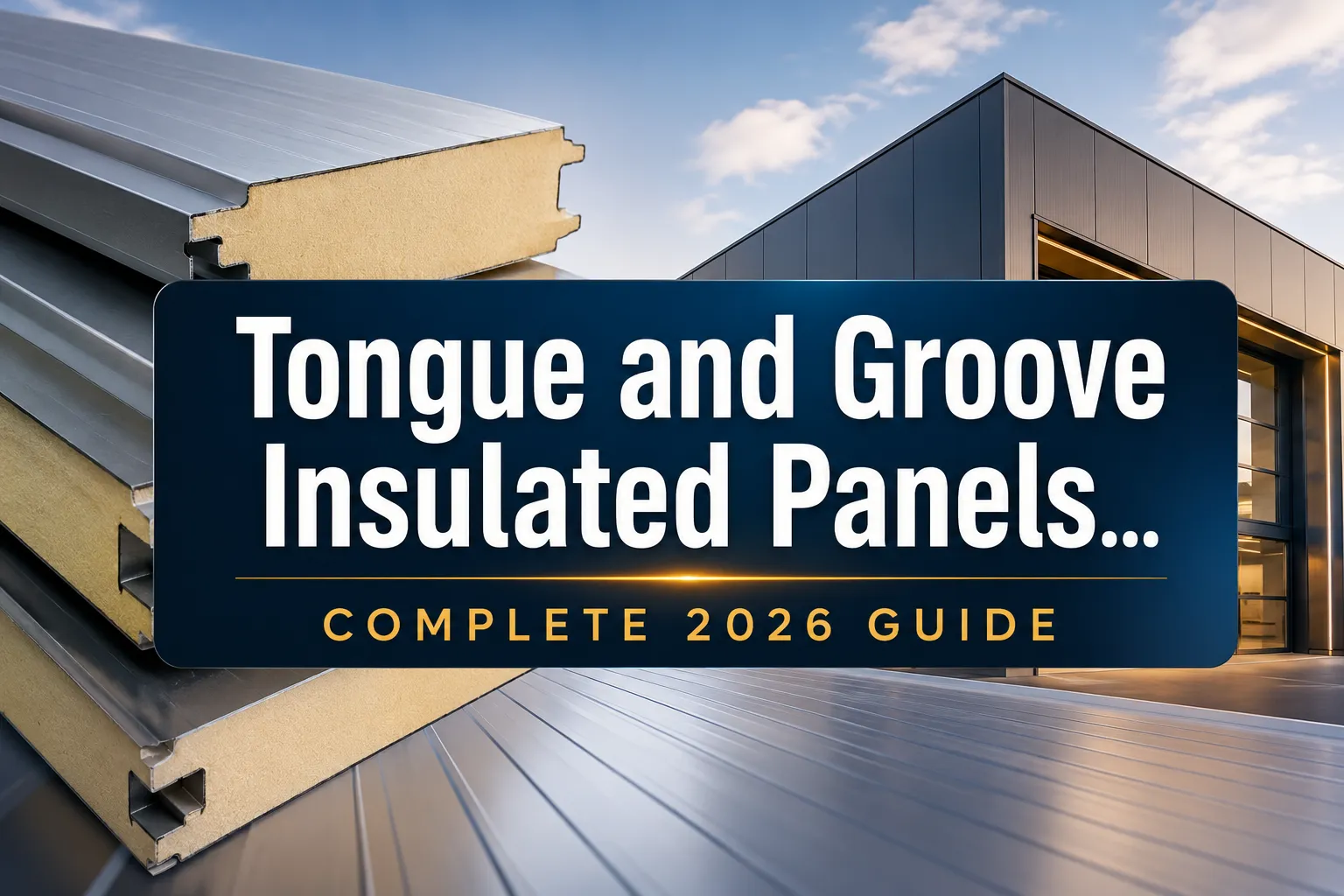
Tongue and groove insulated panels are prefabricated building components that feature interlocking edges designed to create continuous, seamless wall and roof systems. Each panel consists of an insulating core sandwiched between two metal faces, with specially formed edges that lock together during installation.
The tongue is a protruding ridge along one edge of the panel, while the groove is a corresponding channel on the opposite edge. When panels are installed side by side, the tongue of one panel fits precisely into the groove of the adjacent panel, creating a weathertight seal.
Core Construction Elements
Insulating Core Materials:
- Polyurethane (PU) foam: Highest R-value per inch (R-6 to R-8)
- Expanded polystyrene (EPS): Cost-effective option (R-4 to R-5 per inch)
- Mineral wool (Rockwool): Fire-resistant and soundproof (R-4 to R-4.5 per inch)
- Polyisocyanurate (PIR): High-performance with excellent fire ratings
Face Materials:
- Galvanized steel with various coatings
- Aluminum for corrosion resistance
- Stainless steel for specialized applications
- Composite materials for specific environments
The interlocking design eliminates the need for additional sealants or weatherstripping at panel joints, making these systems particularly valuable for factory building construction and industrial applications.
How Do Tongue and Groove Panels Work
Tongue and groove panels work by creating a mechanical interlock that forms continuous insulation while maintaining structural integrity. The system functions on three key principles: thermal continuity, moisture management, and structural load distribution.
Thermal Performance Mechanism:
The interlocking joint design prevents thermal bridging by eliminating direct metal-to-metal contact between the interior and exterior faces. The insulating core extends fully through the joint area, maintaining consistent R-values across the entire wall or roof system.
Installation Process:
- Panel Alignment: First panel is positioned and secured to the structure
- Joint Engagement: Subsequent panels slide into position with the tongue entering the groove
- Compression Sealing: Panels compress together, creating weathertight seals
- Mechanical Fastening: Panels attach to structural members through hidden fastener systems
Load Transfer System:
The tongue and groove connection distributes loads across multiple panels rather than concentrating stress at individual fastener points. This creates a composite structural system where panels work together to resist wind, snow, and seismic forces.
For specialized applications like cold storage facilities, the continuous insulation prevents condensation and maintains precise temperature control.
Tongue and Groove Insulated Panels vs Regular Insulation
Tongue and groove insulated panels offer significant advantages over traditional insulation methods, particularly in terms of installation speed, thermal performance, and long-term durability.
Performance Comparison:
| Factor | Tongue & Groove Panels | Traditional Insulation |
|---|---|---|
| Installation Time | 1-2 days for 1000 sq ft | 5-7 days for same area |
| Thermal Bridges | Eliminated completely | Common at studs/joints |
| Air Infiltration | Minimal with tight seals | Higher without proper sealing |
| Moisture Control | Integrated vapor barrier | Requires separate barrier |
| Structural Support | Load-bearing capability | Non-structural |
Energy Efficiency Differences:
Traditional wall systems with fiberglass insulation typically achieve effective R-values 20-30% lower than rated values due to thermal bridging and air infiltration. Tongue and groove panels maintain their full rated R-value because the continuous insulation eliminates these performance degraders.
Installation Labor Savings:
Conventional insulation requires separate installation of framing, insulation, vapor barriers, and exterior sheathing. Tongue and groove panels combine all these functions, reducing labor requirements by 40-60% and eliminating coordination between multiple trades.
Long-term Performance:
Unlike traditional insulation that can settle, compress, or absorb moisture over time, tongue and groove panels maintain consistent performance for decades. The rigid foam cores don't settle, and the metal faces protect against moisture intrusion and pest damage.
Tongue and Groove Panels Cost Per Square Foot
Tongue and groove insulated panels typically cost $8-25 per square foot installed, with pricing varying significantly based on core material, thickness, face materials, and project complexity.
Cost Breakdown by Core Type:
- EPS Core Panels: $8-14 per square foot installed
- Polyurethane Core: $12-20 per square foot installed
- Mineral Wool Core: $15-25 per square foot installed
- PIR Core Panels: $18-25 per square foot installed
Factors Affecting Panel Costs:
Material Specifications:
- Panel thickness (2" to 8" common range)
- Face material gauge and coating type
- Core density and fire ratings
- Custom colors and finishes
Project Variables:
- Order quantity (bulk pricing available)
- Delivery distance from manufacturing facility
- Site accessibility and crane requirements
- Installation complexity and height
Hidden Cost Savings:
While initial costs appear higher than traditional construction, tongue and groove panels eliminate expenses for separate insulation, vapor barriers, and exterior sheathing. Total installed costs often match or beat conventional systems when all components are considered.
Return on Investment:
Energy savings typically range from 20-40% compared to traditional construction, with payback periods of 5-8 years depending on local energy costs and climate conditions. For current pricing in your area, consult our sandwich panel price guide.
Best Tongue and Groove Insulated Panels Brands
Leading manufacturers of tongue and groove insulated panels offer different specializations, quality levels, and warranty terms that affect long-term performance and value.
Top-Tier Manufacturers:
Kingspan:
- Premium polyurethane and PIR core panels
- Industry-leading R-values up to R-30+
- 20-year thermal performance warranties
- Excellent fire ratings and certifications
Metl-Span:
- Wide range of core materials and thicknesses
- Strong focus on architectural applications
- Comprehensive technical support
- Proven track record in extreme climates
MBCI (Metal Building Components Inc.):
- Cost-effective solutions for industrial buildings
- Reliable EPS and polyurethane options
- Strong distribution network
- Good value for large-scale projects
Regional Quality Manufacturers:
Many regional manufacturers provide competitive alternatives with shorter delivery times and local support. When selecting manufacturers, prioritize those offering comprehensive warranties and technical documentation.
Selection Criteria:
- Warranty Coverage: Look for 15+ year thermal performance guarantees
- Certifications: Verify compliance with local building codes and energy standards
- Technical Support: Ensure availability of installation guidance and engineering support
- Delivery Capability: Confirm ability to meet project timelines
For projects in Bangladesh and similar markets, consider established local panel manufacturers that understand regional climate requirements and building practices.
How to Install Tongue and Groove Insulated Panels
Installing tongue and groove insulated panels requires careful planning, proper equipment, and attention to detail to achieve optimal performance and weathertightness.
Pre-Installation Requirements:
Structural Preparation:
- Verify structural frame meets panel load requirements
- Install proper flashing at foundation and roof interfaces
- Ensure frame is plumb, level, and square within tolerance
- Complete electrical and plumbing rough-ins before panel installation
Equipment and Tools Needed:
- Mobile crane or forklift for panel handling
- Magnetic drill for fastener installation
- Panel lifting devices and suction cups
- Sealants and weatherstripping materials
- Safety equipment for working at height
Step-by-Step Installation Process:
-
Starting Corner Installation
- Position first panel at building corner
- Verify plumb and level alignment
- Secure with appropriate fasteners at structural members
- Install corner trim and flashing
-
Subsequent Panel Installation
- Lift next panel into position using proper equipment
- Align tongue with groove of installed panel
- Apply gentle pressure to engage joint fully
- Check for gaps or misalignment before fastening
-
Joint Sealing and Fastening
- Apply structural sealant at panel joints if specified
- Install fasteners through panel faces into structural members
- Maintain proper fastener spacing per manufacturer requirements
- Install trim pieces at openings and transitions
Critical Installation Details:
- Maintain consistent panel alignment to prevent stress concentrations
- Use proper lifting techniques to avoid panel damage
- Install temporary bracing during construction to prevent panel movement
- Verify weathertightness at all joints and penetrations
Common Installation Mistakes:
- Forcing misaligned panels together, which damages joint integrity
- Over-tightening fasteners, which can compress insulation cores
- Inadequate temporary support during installation
- Skipping sealant application at critical joints
Professional installation teams can typically install 500-1000 square feet per day depending on panel size and building complexity.
Tongue and Groove Panels for Garage vs Attic Applications
Tongue and groove insulated panels serve different purposes and face distinct performance requirements when used in garage versus attic applications.
Garage Applications:
Garage installations prioritize durability, impact resistance, and temperature control for vehicle storage and workshop activities. Panels typically mount vertically on exterior walls or horizontally for overhead doors.
Recommended Specifications:
- 4-6 inch thickness for climate control
- Steel faces with impact-resistant coatings
- EPS or polyurethane cores for cost-effectiveness
- R-values of R-15 to R-25 depending on climate
Installation Considerations:
- Reinforce panel areas subject to impact damage
- Install proper ventilation to manage moisture from vehicles
- Consider fire-rated panels near heating equipment
- Plan electrical conduit routing before panel installation
Attic Applications:
Attic installations focus on maximum thermal performance and moisture management, typically using panels as roof decking or ceiling systems.
Performance Requirements:
- Higher R-values (R-25 to R-35) for energy efficiency
- Superior moisture resistance to prevent condensation
- Structural capability to support roof loads
- Fire resistance for safety compliance
Design Differences:
- Thicker panels (6-8 inches) for enhanced insulation
- Vapor barrier facing toward interior spaces
- Proper ventilation design to prevent moisture buildup
- Integration with existing HVAC systems
Application-Specific Benefits:
Garage Advantages:
- Eliminates need for separate insulation and drywall
- Provides cleanable, durable interior surfaces
- Simplifies electrical installation with surface-mounted systems
- Reduces construction time by 50-70%
Attic Advantages:
- Creates usable storage space with finished ceiling
- Eliminates traditional insulation settling and gaps
- Provides superior air sealing compared to batt insulation
- Reduces HVAC load and energy costs significantly
Choose panel specifications based on primary use requirements and local building code compliance needs.
Do Tongue and Groove Panels Need Vapor Barrier
Most tongue and groove insulated panels include integrated vapor control systems, but additional vapor barriers may be required depending on climate conditions, building use, and local code requirements.
Built-in Vapor Control:
High-quality tongue and groove panels typically incorporate vapor barriers as part of their face materials. The metal faces themselves provide excellent vapor resistance, with permeability ratings well below code requirements for vapor barriers.
When Additional Barriers Are Needed:
High-Humidity Applications:
- Swimming pool enclosures
- Industrial processes generating moisture
- Cold storage facilities with extreme temperature differentials
- Greenhouses and agricultural buildings
Climate Considerations:
In mixed climates or areas with significant seasonal temperature variations, additional vapor control may be necessary on the warm side of the assembly to prevent condensation within the panel core.
Code Compliance Requirements:
Some building codes mandate specific vapor barrier installations regardless of panel specifications. Verify local requirements with building officials before finalizing designs.
Proper Vapor Barrier Installation:
Location Principles:
- Install vapor barriers on the warm side of insulation
- In heating climates: interior side of panels
- In cooling climates: exterior side of panels
- In mixed climates: consult with building professionals
Installation Details:
- Seal all joints and penetrations completely
- Use compatible materials that won't degrade over time
- Avoid creating double vapor barriers that trap moisture
- Provide ventilation paths for moisture management
Common Vapor Barrier Mistakes:
- Installing barriers on wrong side of assembly for climate
- Creating vapor barriers on both sides of panels
- Poor sealing at joints and penetrations
- Using incompatible materials that fail prematurely
For specialized applications like clean room construction, vapor control becomes critical for maintaining environmental conditions and preventing contamination.
Tongue and Groove Insulated Panels R-Value Comparison
R-value performance varies significantly among different core materials and panel thicknesses, with tongue and groove systems maintaining higher effective R-values than traditional construction methods.
R-Value by Core Material and Thickness:
| Core Material | 2" Thickness | 4" Thickness | 6" Thickness | 8" Thickness |
|---|---|---|---|---|
| EPS Foam | R-8 | R-16 | R-24 | R-32 |
| Polyurethane | R-12 | R-24 | R-36 | R-48 |
| Mineral Wool | R-8 | R-16 | R-24 | R-32 |
| PIR Foam | R-14 | R-28 | R-42 | R-56 |
Effective vs. Rated R-Values:
Unlike traditional insulation systems that lose 20-30% of their rated R-value due to thermal bridging, tongue and groove panels maintain their full rated performance because the continuous insulation eliminates thermal bridges.
Climate-Specific Recommendations:
Cold Climates (Zones 6-8):
- Minimum R-25 for walls, R-35 for roofs
- Polyurethane or PIR cores for maximum performance
- 6-8 inch panel thickness typically required
Moderate Climates (Zones 3-5):
- R-15 to R-25 for walls, R-25 to R-35 for roofs
- EPS cores provide cost-effective performance
- 4-6 inch panels meet most requirements
Hot Climates (Zones 1-2):
- R-10 to R-15 for walls, R-20 to R-25 for roofs
- Focus on reflective face materials
- 2-4 inch panels often sufficient
Performance Verification:
Third-party testing confirms that quality tongue and groove panels achieve their rated R-values in real-world conditions. Look for panels tested to ASTM C518 standards for thermal conductivity.
Energy Code Compliance:
Most current energy codes require continuous insulation to eliminate thermal bridging. Tongue and groove panels inherently meet these requirements, while traditional construction methods require additional continuous insulation layers.
For detailed thermal performance specifications, reference our thermal performance guide for comprehensive comparisons.
Common Mistakes When Installing Tongue and Groove Panels
Avoiding installation errors ensures optimal performance, longevity, and warranty compliance for tongue and groove insulated panel systems.
Critical Installation Errors:
Joint Alignment Problems:
Forcing misaligned panels together damages the tongue and groove connection, creating gaps that allow air infiltration and moisture penetration. Always verify proper alignment before applying pressure to engage joints.
Incorrect Fastener Installation:
- Over-tightening fasteners compresses insulation cores and reduces R-values
- Under-tightening allows panel movement and joint separation
- Wrong fastener types can cause corrosion or structural failure
- Improper fastener spacing creates stress concentrations
Inadequate Weather Sealing:
Skipping sealant application at critical joints allows water infiltration that can damage insulation cores and create mold problems. Pay special attention to:
- Horizontal joints in wall applications
- Roof-to-wall transitions
- Around penetrations and openings
- At foundation interfaces
Structural Support Issues:
Insufficient Temporary Bracing:
Panels require temporary support during installation to prevent movement and maintain alignment. Inadequate bracing can cause:
- Joint separation during construction
- Panel damage from wind loads
- Safety hazards for installation crews
- Permanent alignment problems
Improper Load Path Design:
Failing to verify that structural frames can support panel loads leads to deflection problems that stress joints and reduce performance.
Moisture Management Failures:
Inadequate Ventilation:
Trapped moisture within wall or roof assemblies can degrade insulation performance and create durability problems. Ensure proper ventilation design for:
- Attic spaces with panel ceilings
- Wall cavities in high-humidity climates
- Areas with significant temperature differentials
Vapor Barrier Mistakes:
Installing vapor barriers on the wrong side of assemblies or creating double vapor barriers traps moisture and causes problems.
Prevention Strategies:
- Follow manufacturer installation instructions precisely
- Use experienced installation crews familiar with panel systems
- Conduct regular quality inspections during installation
- Verify weather conditions are suitable for installation
- Plan electrical and mechanical penetrations before panel installation
Quality Control Checkpoints:
- Verify panel alignment before fastening
- Check joint engagement and sealing
- Confirm proper fastener installation
- Test weathertightness at completion
- Document installation for warranty compliance
Proper installation practices ensure panels achieve their designed performance and maintain warranty coverage throughout their service life.
Are Tongue and Groove Panels Worth It
Tongue and groove insulated panels provide excellent value for most commercial and industrial applications, with energy savings and construction efficiency typically justifying higher upfront costs.
Financial Analysis:
Upfront Cost Premium:
Tongue and groove panels cost 15-30% more initially than traditional construction methods. However, this premium is often offset by:
- Reduced labor costs (30-50% faster installation)
- Eliminated separate insulation and vapor barrier costs
- Simplified construction scheduling
- Reduced equipment rental time
Long-term Energy Savings:
Superior thermal performance typically reduces heating and cooling costs by 20-40% compared to traditional construction. Payback periods range from 4-8 years depending on:
- Local energy costs
- Climate conditions
- Building use patterns
- Utility rebate programs
Operational Benefits:
Maintenance Advantages:
- No insulation settling or degradation over time
- Durable metal faces resist damage and wear
- Easy cleaning and maintenance
- Reduced pest infiltration problems
Performance Reliability:
Panels maintain consistent R-values throughout their service life, while traditional insulation can lose 20-30% of its effectiveness due to settling, moisture, and air infiltration.
Best Applications for Value:
High-Value Applications:
- Temperature-controlled facilities
- Buildings with high energy costs
- Structures requiring fast construction
- Projects in extreme climates
Marginal Applications:
- Low-occupancy buildings with minimal climate control needs
- Temporary or short-term structures
- Projects with extremely tight budgets
- Applications where appearance is not important
Decision Factors:
Choose Tongue and Groove Panels When:
- Energy efficiency is a priority
- Construction speed matters
- Long-term ownership is planned
- Building codes require continuous insulation
- Professional appearance is important
Consider Alternatives When:
- Initial cost is the primary concern
- Building has minimal insulation requirements
- Traditional construction expertise is readily available
- Future modifications are likely
For most commercial and industrial applications, the combination of energy savings, construction efficiency, and long-term performance makes tongue and groove panels a worthwhile investment.
Tongue and Groove Panels Moisture Problems
While tongue and groove insulated panels generally provide excellent moisture resistance, certain conditions can create problems that require careful design and installation attention.
Common Moisture Issues:
Condensation Problems:
Condensation occurs when warm, humid air contacts cold panel surfaces, typically at thermal bridges or poorly sealed joints. This is most common in:
- Buildings with high internal humidity
- Facilities with significant temperature differentials
- Installations with inadequate vapor control
- Areas with poor ventilation design
Water Infiltration:
Despite tight joints, water can penetrate panel systems through:
- Damaged or improperly sealed joints
- Fastener penetrations without proper sealing
- Flashing failures at transitions
- Panel damage from impact or settling
Moisture Accumulation:
Trapped moisture within panel cores can occur when:
- Panels are installed wet or damaged
- Vapor barriers are installed incorrectly
- Ventilation systems are inadequate
- Building use creates excessive humidity
Prevention Strategies:
Design Solutions:
- Specify panels with appropriate vapor barriers for climate
- Design adequate ventilation systems
- Plan proper drainage at all horizontal surfaces
- Include thermal breaks at structural connections
Installation Best Practices:
- Store panels properly before installation to prevent moisture absorption
- Seal all joints and penetrations completely
- Install flashing correctly at all transitions
- Verify panels are dry before installation
Maintenance Requirements:
- Inspect joints and sealants annually
- Maintain ventilation systems properly
- Address any panel damage promptly
- Monitor interior humidity levels
Problem Resolution:
Early Detection:
- Look for water stains or discoloration
- Check for musty odors indicating mold growth
- Monitor for ice formation in cold weather
- Inspect joints for separation or damage
Remediation Steps:
- Identify and eliminate moisture source
- Remove damaged insulation if necessary
- Improve ventilation or vapor control
- Repair or replace damaged panels
- Monitor conditions to prevent recurrence
High-Risk Applications:
Special attention to moisture control is required for:
- Poultry farm construction with high humidity
- Cold storage facilities with temperature differentials
- Swimming pool enclosures
- Industrial processes generating moisture
Proper design, installation, and maintenance prevent most moisture problems while ensuring long-term panel performance.
Who Should Use Tongue and Groove Insulated Panels
Tongue and groove insulated panels work best for specific building types, climates, and project requirements where their advantages outweigh the higher initial costs.
Ideal Candidates:
Commercial and Industrial Buildings:
- Warehouses requiring temperature control
- Manufacturing facilities with climate-sensitive processes
- Cold storage and food processing plants
- Retail buildings with high energy costs
- Office buildings prioritizing energy efficiency
Agricultural Applications:
- Livestock facilities requiring environmental control
- Grain storage buildings
- Equipment storage with temperature requirements
- Greenhouse and growing facilities
Specialized Facilities:
- Clean rooms and controlled environments
- Hospitals and healthcare facilities
- Data centers with cooling requirements
- Aircraft hangars and large-span buildings
Project Characteristics Favoring Panels:
Fast Construction Requirements:
Projects with tight schedules benefit from the 40-60% reduction in installation time compared to traditional construction methods.
Energy Efficiency Priorities:
Buildings with high energy costs or sustainability goals achieve significant savings from the superior thermal performance of continuous insulation.
Extreme Climate Conditions:
Locations with severe hot or cold weather require the consistent performance that tongue and groove panels provide.
Who Should Consider Alternatives:
Limited Budget Projects:
When initial cost is the primary concern and long-term energy savings are not prioritized, traditional construction may be more appropriate.
Small Residential Applications:
Single-family homes and small residential projects may not achieve sufficient economies of scale to justify the cost premium.
Frequently Modified Buildings:
Structures requiring regular reconfiguration may benefit from more flexible traditional construction methods.
Selection Criteria:
Building Size: Projects over 5,000 square feet typically achieve better economies of scale
Energy Costs: Areas with high utility rates see faster payback periods
Climate: Extreme temperatures increase the value proposition
Ownership: Long-term ownership maximizes the return on investment
Code Requirements: Areas requiring continuous insulation favor panel systems
Professional Consultation:
Work with experienced designers familiar with panel systems to evaluate whether tongue and groove panels are appropriate for your specific project requirements and constraints.
Tongue and Groove Panels for Metal Buildings
Metal buildings represent an ideal application for tongue and groove insulated panels, offering structural integration, thermal performance, and construction efficiency advantages.
Structural Integration Benefits:
Tongue and groove panels can serve as both the building envelope and structural sheathing in metal building systems, reducing overall material requirements and simplifying construction.
Load-Bearing Capabilities:
Quality insulated panels provide significant structural capacity:
- Shear strength for lateral load resistance
- Compression resistance for roof loads
- Spanning capability between structural members
- Composite action with steel framing systems
Thermal Performance Advantages:
Continuous Insulation:
Metal buildings traditionally suffer from thermal bridging through steel framing members. Tongue and groove panels eliminate this problem by providing continuous insulation across the entire building envelope.
Condensation Control:
The vapor barrier properties of panel face materials prevent condensation problems common in uninsulated metal buildings, protecting contents and maintaining comfortable conditions.
Installation Efficiency:
Single-Trade Installation:
Panels combine multiple building functions (structure, insulation, interior finish, weather barrier) into one component installed by a single trade, reducing coordination requirements and construction time.
Weather Independence:
Panel installation can continue in weather conditions that would stop traditional insulation installation, maintaining construction schedules.
Design Considerations:
Structural Requirements:
- Verify panel load ratings meet building requirements
- Design proper connections to steel framing
- Consider thermal expansion and movement
- Plan for wind uplift resistance
Building Code Compliance:
- Confirm fire rating requirements
- Verify energy code compliance
- Check structural design requirements
- Obtain proper permits and inspections
Common Metal Building Applications:
Industrial Facilities:
- Manufacturing plants
- Warehouses and distribution centers
- Maintenance facilities
- Equipment storage buildings
Commercial Buildings:
- Retail stores and showrooms
- Office and administrative buildings
- Recreation facilities
- Educational buildings
Agricultural Structures:
- Livestock housing
- Equipment storage
- Grain handling facilities
- Processing buildings
Cost Considerations:
While panels increase the building envelope cost by 15-25%, they often reduce total project costs through:
- Faster construction schedules
- Reduced labor requirements
- Eliminated separate insulation systems
- Lower long-term energy costs
For metal building projects, tongue and groove panels provide an integrated solution that addresses structural, thermal, and aesthetic requirements in a single component system.
FAQ
How long do tongue and groove insulated panels last?
Quality tongue and groove insulated panels typically last 30-50 years with proper installation and maintenance. The metal faces resist weathering and impact damage, while rigid foam cores don't settle or degrade like traditional insulation materials.
Can tongue and groove panels be painted or refinished?
Yes, most panels accept paint and coatings designed for metal surfaces. Factory-applied coatings typically last 20-30 years, and panels can be repainted to extend service life or change appearance. Clean surfaces thoroughly and use compatible primer systems for best results.
Do tongue and groove panels require special structural support?
Panels have load-bearing capabilities but still require proper structural framing designed for the specific loads and spans involved. Consult with structural engineers to verify that existing or planned framing meets panel manufacturer requirements.
How do you cut openings in tongue and groove panels after installation?
Use appropriate metal cutting tools like circular saws with metal-cutting blades or plasma cutters. Seal cut edges with compatible sealants to prevent moisture infiltration into foam cores. Plan major openings during design phase when possible.
Are tongue and groove panels fire-resistant?
Fire resistance varies by core material. Mineral wool cores provide excellent fire resistance, while foam cores may require fire-rated assemblies or protective coatings depending on building codes. Verify fire ratings meet local requirements.
Can tongue and groove panels be installed in cold weather?
Yes, but follow manufacturer guidelines for temperature limitations. Some sealants and adhesives have minimum temperature requirements. Store panels in heated areas before installation to prevent condensation problems.
Do tongue and groove panels work with radiant heating systems?
Panels are compatible with radiant heating but require careful design to prevent overheating foam cores. Limit surface temperatures to manufacturer recommendations and consider thermal expansion effects on joints.
How do you repair damaged tongue and groove panels?
Minor damage can often be repaired with compatible sealants and patching materials. Extensive damage typically requires panel replacement. Maintain spare panels for repairs, as color matching can be difficult with aged panels.
Are tongue and groove panels recyclable?
Metal faces are fully recyclable, while foam core recyclability varies by material type. Some manufacturers offer take-back programs for end-of-life panels. Consider recyclability during material selection for sustainable projects.
What warranty coverage is typical for tongue and groove panels?
Quality manufacturers offer 15-20 year warranties on thermal performance and 20-30 year warranties on finish coatings. Structural warranties typically range from 10-20 years. Warranty terms vary significantly between manufacturers.
Can tongue and groove panels be used for curved or complex shapes?
Standard panels work best for flat or slightly curved applications. Complex curves or unusual shapes may require custom fabrication or alternative construction methods. Consult manufacturers for specific geometric requirements.
Do tongue and groove panels affect wireless or cellular signals?
Metal-faced panels can reduce wireless signal strength, similar to other metal building components. Consider signal boosters or distributed antenna systems for buildings requiring strong wireless connectivity.
Conclusion
Tongue and groove insulated panels represent a proven solution for energy-efficient building construction, combining structural capability, thermal performance, and installation efficiency in a single integrated system. The interlocking joint design eliminates thermal bridging while providing superior air sealing compared to traditional construction methods.
For commercial and industrial applications, these panels typically deliver strong returns through reduced construction time, lower energy costs, and minimal maintenance requirements. The 20-40% energy savings and 4-8 year payback periods make them particularly attractive for temperature-controlled facilities and buildings in extreme climates.
Key decision factors include:
- Project size and complexity
- Long-term ownership plans
- Energy efficiency priorities
- Construction timeline requirements
- Local building code compliance needs
Next steps for implementation:
- Assess Project Requirements: Evaluate building size, use, and performance requirements to determine if panels are appropriate
- Compare Total Costs: Calculate installed costs including labor savings and long-term energy benefits
- Select Qualified Suppliers: Choose manufacturers offering appropriate warranties and technical support
- Engage Experienced Contractors: Work with installation crews familiar with panel systems
- Plan Integration Details: Coordinate electrical, mechanical, and structural requirements before installation
For projects meeting the appropriate criteria, tongue and groove insulated panels provide a reliable path to high-performance building envelopes with proven long-term value. Consider consulting with experienced panel manufacturers to evaluate specific project requirements and develop optimal solutions.
SEO Meta Title: Tongue and Groove Insulated Panels: Complete 2026 Guide