Last updated: July 31, 2026

Quick Answer
A sandwich panel for cold storage consists of two metal facings with an insulating core material (typically polyurethane or polystyrene) that provides superior thermal performance for refrigerated facilities. These panels deliver R-values of 20-40+ depending on thickness, maintain consistent temperatures from -40°F to +40°F, and offer faster installation than traditional insulation methods. Modern cold storage sandwich panels cost $8-25 per square foot installed and can reduce energy consumption by 15-30% compared to conventional wall systems.
Key Takeaways
- Sandwich panels combine structural strength with high thermal resistance in one prefabricated unit
- Polyurethane (PU) cores provide better insulation than polystyrene (EPS) but cost 20-40% more
- Panel thickness ranges from 2-8 inches, with 4-6 inches optimal for most commercial cold storage
- Proper vapor barrier installation prevents moisture infiltration and condensation issues
- Professional installation ensures airtight seals and maximizes energy efficiency
- Expected lifespan exceeds 20-25 years with minimal maintenance requirements
- Food-grade panels meet FDA and USDA requirements for direct food contact applications
What Are Sandwich Panels and How Do They Work for Cold Storage
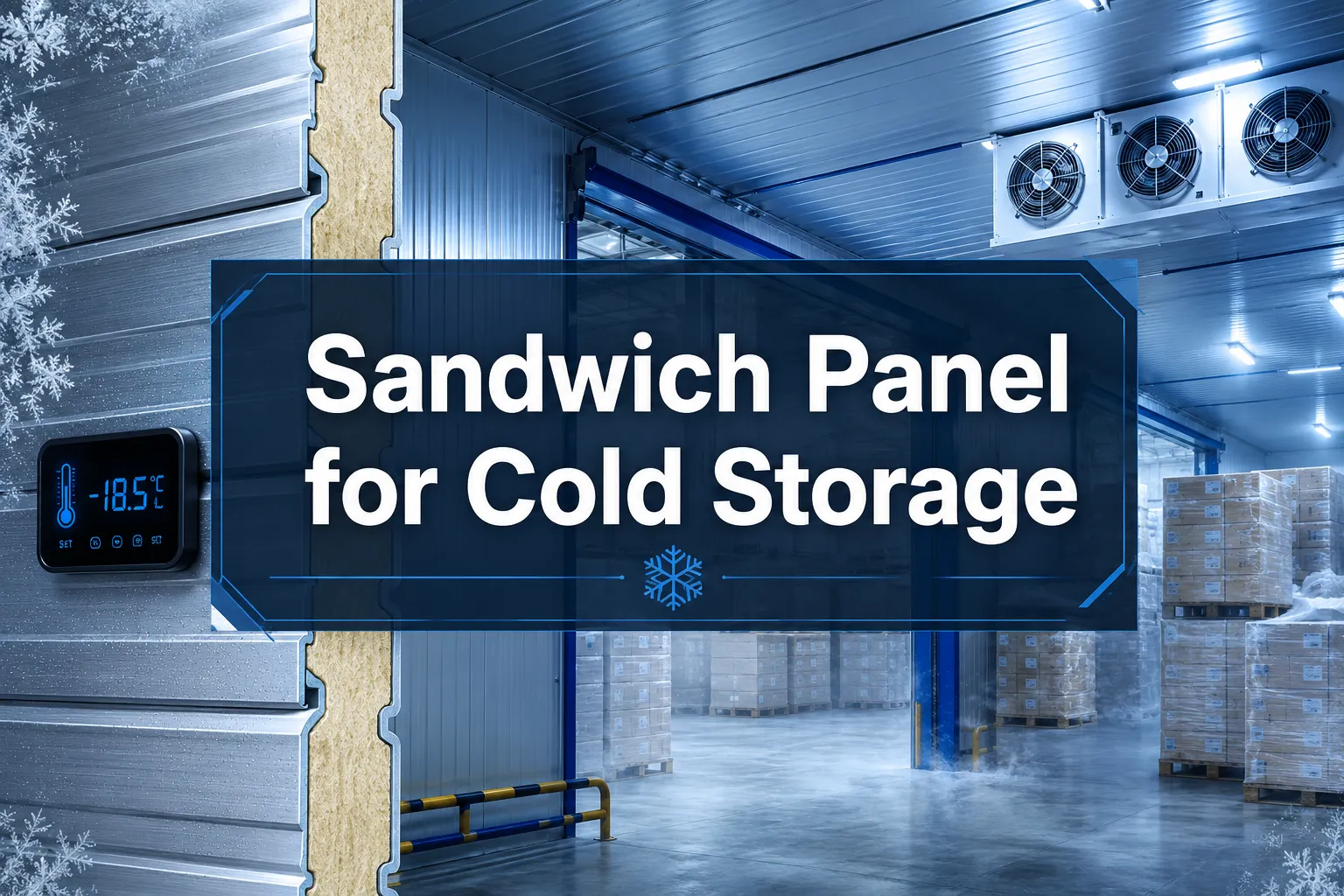
Sandwich panels for cold storage are composite building materials featuring two thin metal skins bonded to a thick insulating core. The outer facings (typically steel or aluminum) provide structural integrity and weather protection, while the core material creates a thermal barrier that maintains consistent internal temperatures.
The panels work through three key mechanisms:
- Thermal resistance: The insulating core blocks heat transfer between interior and exterior environments
- Vapor control: Integrated vapor barriers prevent moisture migration that could compromise insulation
- Structural support: The composite design allows panels to function as both insulation and load-bearing walls
Most cold storage applications use panels with polyurethane (PU) or expanded polystyrene (EPS) cores. PU cores offer superior insulation properties with R-values of 6-8 per inch, while EPS provides cost-effective performance at R-4 per inch. The metal facings are typically 0.5-0.7mm thick galvanized steel with food-safe coatings for interior surfaces.
Common mistake: Choosing panels based solely on price rather than thermal performance requirements. A thicker, higher-quality panel often delivers better long-term value through reduced energy costs.
Sandwich Panel vs Traditional Insulation for Cold Storage
Sandwich panels outperform traditional insulation methods in cold storage applications through faster installation, better thermal continuity, and reduced labor costs. Traditional systems require separate framing, insulation installation, vapor barriers, and interior finishing – a process that can take 3-4 times longer than panel installation.
Performance Comparison
| Factor | Sandwich Panels | Traditional Insulation |
|---|---|---|
| Installation Speed | 2-3 days typical room | 7-10 days same room |
| Thermal Bridges | Minimal with proper joints | Common at studs/framing |
| Vapor Control | Integrated system | Multiple components |
| Labor Requirements | 2-3 installers | 4-6 tradespeople |
| Quality Consistency | Factory-controlled | Site-dependent |
Key advantages of sandwich panels:
- Eliminate thermal bridging through continuous insulation
- Reduce air infiltration with tongue-and-groove joints
- Provide immediate weather protection during construction
- Deliver consistent R-values across the entire wall system
Choose traditional insulation when: Building codes require specific materials, retrofitting existing structures with complex geometries, or when initial budget constraints outweigh long-term operating costs.
For more details on specific panel types, see our complete guide to PU sandwich panels for cold rooms.
How Thick Should Sandwich Panels Be for Cold Storage
Panel thickness for cold storage depends on target temperature, local climate, and energy efficiency goals. Most commercial applications use 4-6 inch panels, while specialized freezer applications may require 6-8 inches for optimal performance.
Thickness Guidelines by Application
Walk-in coolers (35-40°F): 3-4 inch panels typically sufficient
- Minimum R-20 thermal resistance
- Suitable for short-term storage applications
- Cost-effective for smaller facilities
Commercial freezers (-10 to 0°F): 4-6 inch panels recommended
- R-25 to R-35 thermal resistance
- Balances performance with cost considerations
- Standard for most food service applications
Industrial cold storage (-20 to -40°F): 6-8 inch panels required
- R-35 to R-50+ thermal resistance
- Essential for pharmaceutical and specialty food storage
- Higher upfront cost offset by energy savings
Calculation method: Determine required R-value based on temperature differential, then select panel thickness. For example, maintaining -20°F in a 90°F climate requires approximately R-30 minimum performance.
Edge case: Extremely high-temperature differentials (below -40°F) may require custom panel thicknesses or dual-wall systems with air gaps.
Learn more about selecting appropriate thickness in our guide to choosing sandwich panel thickness.
Sandwich Panel Cost and Pricing for Commercial Cold Rooms
Sandwich panel costs range from $8-25 per square foot installed, with material costs representing 60-70% of total project expense. Pricing varies significantly based on panel specifications, project size, and installation complexity.
Cost Breakdown by Panel Type
EPS core panels: $8-15 per sq ft installed
- Most economical option for budget-conscious projects
- Suitable for moderate temperature applications
- 3-4 inch thickness typical
PU core panels: $12-20 per sq ft installed
- Premium performance with superior R-values
- Recommended for demanding applications
- 4-6 inch thickness standard
Specialty panels (fire-rated, pharmaceutical): $18-25 per sq ft installed
- Enhanced safety or regulatory compliance features
- Custom colors, textures, or coatings available
- Longer lead times typical
Additional Cost Factors
- Project size: Larger projects (5,000+ sq ft) receive 10-15% volume discounts
- Accessibility: Difficult installation sites increase labor costs 15-25%
- Customization: Non-standard sizes or features add 20-30% premium
- Regional variations: Remote locations may include significant shipping costs
Budget planning tip: Include 10-15% contingency for unforeseen site conditions or specification changes during construction.
For current pricing in specific markets, check our sandwich panel price guide for Bangladesh.
Best Sandwich Panel Materials for Temperature Control
Polyurethane (PU) cores provide the best thermal performance for cold storage applications, offering R-values of 6-8 per inch compared to 3.8-4.2 for EPS alternatives. However, material selection should balance performance requirements with budget constraints and specific application needs.
Core Material Comparison
Polyurethane (PU) advantages:
- Highest R-value per inch of thickness
- Excellent adhesion to metal facings
- Superior long-term thermal stability
- Minimal moisture absorption (closed-cell structure)
Expanded Polystyrene (EPS) advantages:
- Lower material cost (30-40% less than PU)
- Good thermal performance for moderate applications
- Recyclable and environmentally friendly
- Easier to cut and modify on-site
Facing material options:
- Galvanized steel: Most common, cost-effective, good corrosion resistance
- Stainless steel: Premium option for food-grade applications, easy cleaning
- Aluminum: Lightweight, excellent corrosion resistance, higher cost
Decision criteria: Choose PU panels when energy efficiency is paramount or space constraints limit panel thickness. Select EPS panels for budget-sensitive projects where slightly thicker walls are acceptable.
Common mistake: Specifying food-grade interior surfaces for non-food applications, which adds unnecessary cost without functional benefit.
How to Install Sandwich Panels in Existing Cold Storage
Installing sandwich panels in existing cold storage requires careful planning for structural support, vapor barriers, and thermal bridging elimination. The process typically involves removing existing wall systems, upgrading structural framing if necessary, and installing panels with continuous sealing systems.
Installation Process Steps
1. Structural assessment and preparation
- Evaluate existing framing capacity for panel loads
- Remove old insulation and interior finishes
- Install additional structural support if required
- Address any moisture or mold issues
2. Vapor barrier installation
- Apply continuous vapor barrier on warm side of assembly
- Seal all penetrations and joints with compatible materials
- Overlap seams minimum 6 inches with sealed joints
3. Panel installation sequence
- Start from corners and work systematically
- Maintain consistent joint compression for airtight seals
- Install panels plumb and level to prevent thermal bridging
- Seal all panel joints with manufacturer-approved sealants
4. Finishing and commissioning
- Install trim pieces and corner details
- Complete electrical and mechanical penetrations with sealed fittings
- Test system for air leaks before final commissioning
Critical consideration: Existing structures may require structural upgrades to support panel loads and wind/seismic forces. Professional engineering evaluation recommended for installations over 12 feet high.
For professional installation services, see our sandwich panel installation guide.
Sandwich Panel Moisture Barrier Requirements
Proper vapor barrier installation prevents moisture infiltration that can compromise insulation performance and create mold conditions. Cold storage applications require continuous vapor barriers on the warm side of the insulation system, typically achieving permeance ratings below 0.1 perms.
Vapor Barrier System Components
Primary barrier materials:
- 6-mil polyethylene sheeting (minimum thickness)
- Self-adhering membrane systems (premium option)
- Foil-faced barrier materials for enhanced durability
Sealing requirements:
- All seams overlapped minimum 6 inches
- Sealed with compatible tape or adhesive systems
- Penetrations sealed with boots or gasket systems
- Continuous barrier from floor to ceiling
Installation best practices:
- Install on warm (exterior) side of insulation
- Maintain continuity at panel joints and corners
- Protect from damage during construction
- Inspect for tears or gaps before panel installation
Failure consequences: Inadequate vapor barriers allow moisture migration into insulation, reducing R-values by 20-50% and potentially creating structural damage from freeze-thaw cycles.
Quality control: Use infrared thermography after installation to identify thermal bridges or air leaks that indicate vapor barrier failures.
Can Sandwich Panels Be Used for Walk-in Coolers
Yes, sandwich panels are ideal for walk-in coolers and often provide superior performance compared to traditional cooler construction methods. Panels designed specifically for walk-in applications typically use 3-4 inch thickness with food-grade interior surfaces and integrated door frame systems.
Walk-in Cooler Panel Specifications
Recommended panel features:
- 3-4 inch PU or EPS core for 35-40°F applications
- Food-grade interior surfaces (NSF-approved materials)
- Tongue-and-groove joints for airtight assembly
- Compatible door frame systems available
- Easy-clean surface textures
Installation advantages:
- Faster assembly than stick-built alternatives (1-2 days vs 5-7 days)
- Factory-controlled quality and insulation performance
- Modular design allows future expansion or relocation
- Integrated electrical chases and equipment mounting systems
Size limitations: Most manufacturers offer panels up to 12 feet wide and 20+ feet long, suitable for coolers up to several thousand square feet.
Cost comparison: Panel systems typically cost 15-25% more initially but save 20-30% on total project costs through reduced labor and faster installation.
For walk-in cooler applications, consider our specialized cold room door panels for complete system integration.
Sandwich Panel R-Value and Thermal Performance Specifications
R-values for cold storage sandwich panels range from R-15 to R-50+ depending on core material and thickness. Understanding thermal performance specifications helps optimize energy efficiency while controlling construction costs.
R-Value by Core Material and Thickness
Polyurethane (PU) core panels:
- 2 inch: R-12 to R-16
- 4 inch: R-25 to R-32
- 6 inch: R-37 to R-48
- 8 inch: R-50 to R-64
EPS core panels:
- 2 inch: R-8 to R-10
- 4 inch: R-15 to R-20
- 6 inch: R-23 to R-30
- 8 inch: R-30 to R-40
Performance factors affecting R-values:
- Core density (higher density = better performance)
- Aging characteristics (some materials degrade over time)
- Temperature differential (extreme cold reduces effectiveness)
- Installation quality (thermal bridges reduce system performance)
System R-value vs panel R-value: Installed system performance typically 10-20% lower than panel ratings due to thermal bridging at joints, fasteners, and structural connections.
Specification tip: Design for 15-20% safety margin above calculated R-value requirements to account for real-world installation conditions and future performance degradation.
Learn more about thermal performance in our thermal insulation sandwich panel guide.
Polyurethane vs Polystyrene Sandwich Panels for Cold Storage
Polyurethane panels deliver 30-50% better thermal performance than polystyrene alternatives but cost approximately 25-40% more per square foot. The choice between materials depends on performance requirements, budget constraints, and long-term operating cost considerations.
Detailed Material Comparison
Polyurethane (PU) characteristics:
- R-value: 6-8 per inch thickness
- Moisture resistance: Excellent (closed-cell structure)
- Temperature range: -40°F to +200°F operating range
- Lifespan: 25+ years with minimal degradation
- Cost: $12-20 per sq ft installed
Polystyrene (EPS) characteristics:
- R-value: 3.8-4.2 per inch thickness
- Moisture resistance: Good (requires proper vapor barriers)
- Temperature range: -20°F to +160°F operating range
- Lifespan: 20+ years with gradual R-value decline
- Cost: $8-15 per sq ft installed
Performance in extreme conditions:
- Below -20°F: PU maintains performance, EPS efficiency decreases
- High humidity: PU resists moisture absorption better
- Freeze-thaw cycles: PU shows superior durability
Decision matrix: Choose PU for demanding applications (pharmaceutical storage, extreme temperatures, energy-critical facilities). Select EPS for moderate applications where budget constraints are primary consideration.
Hybrid approach: Some projects use PU panels for exterior walls and EPS for interior partitions to balance performance and cost.
Sandwich Panel Condensation Problems and Solutions
Condensation in cold storage sandwich panels typically results from vapor barrier failures, thermal bridging, or inadequate insulation thickness. Prevention requires proper system design, quality installation, and regular maintenance protocols.
Common Condensation Causes
Vapor barrier defects:
- Tears or gaps in continuous barrier system
- Inadequate sealing at penetrations and joints
- Wrong-side installation (barrier on cold side)
Thermal bridging issues:
- Metal fasteners conducting heat through insulation
- Structural members creating cold spots
- Panel joint gaps allowing air infiltration
Design inadequacies:
- Insufficient insulation thickness for temperature differential
- Missing or inadequate edge insulation details
- Poor drainage design allowing moisture accumulation
Prevention Strategies
Design solutions:
- Calculate required R-values with 15-20% safety margin
- Specify thermal break details at structural connections
- Design positive drainage for all horizontal surfaces
- Include dew point analysis in system design
Installation best practices:
- Maintain continuous vapor barrier integrity
- Use thermal break fasteners where possible
- Seal all panel joints with compatible materials
- Install proper flashing and drainage details
Maintenance protocols:
- Annual inspection of vapor barrier integrity
- Monitor interior humidity levels and ventilation
- Address any leaks or damage immediately
- Keep drainage systems clear and functional
Troubleshooting existing problems: Use infrared thermography to identify problem areas, then address root causes rather than symptoms.
How Long Do Sandwich Panels Last in Cold Storage Applications
Quality sandwich panels in cold storage applications typically last 20-25+ years with proper installation and maintenance. Panel lifespan depends on core material quality, facing protection systems, environmental conditions, and maintenance practices.
Lifespan Factors by Component
Core material durability:
- PU cores: 25+ years with minimal R-value degradation
- EPS cores: 20-25 years with gradual performance decline
- Environmental exposure affects aging rate significantly
Facing material longevity:
- Galvanized steel: 15-20 years before coating degradation
- Stainless steel: 25+ years with proper maintenance
- Aluminum: 20-25+ years with excellent corrosion resistance
System performance over time:
- Years 1-10: Minimal performance degradation (less than 5%)
- Years 10-20: Gradual decline (5-15% R-value reduction)
- Years 20+: More significant aging effects vary by material quality
Maintenance Requirements
Annual inspections:
- Check panel joints and sealants for gaps or damage
- Inspect facing materials for corrosion or impact damage
- Verify vapor barrier integrity at accessible locations
- Monitor energy consumption for performance trends
Preventive maintenance:
- Clean surfaces regularly to prevent corrosion
- Address minor damage before it spreads
- Maintain proper drainage and ventilation systems
- Replace worn sealants and gaskets as needed
Life extension strategies: High-quality panels with proper maintenance often exceed 25-year design life, while poor installation or deferred maintenance can reduce lifespan to 10-15 years.
Food Storage vs Pharmaceutical Cold Room Panel Requirements
Pharmaceutical cold storage requires more stringent panel specifications than food applications, including enhanced cleanability, regulatory compliance documentation, and often higher performance standards for temperature stability.
Regulatory Requirements Comparison
Food storage panel requirements:
- FDA food contact surface approval (interior faces)
- USDA/FSIS compliance for meat processing facilities
- NSF certification for commercial food service
- Easy-clean surfaces with minimal crevices
Pharmaceutical storage requirements:
- GMP (Good Manufacturing Practice) compliance
- FDA 21 CFR Part 11 documentation capabilities
- Enhanced surface smoothness and cleanability
- Validated cleaning and sanitization procedures
- Temperature mapping and qualification support
Performance Specification Differences
Food storage priorities:
- Cost-effective thermal performance
- Durability under normal cleaning protocols
- Resistance to typical food processing chemicals
- Standard temperature tolerances (±2-5°F typical)
Pharmaceutical priorities:
- Precise temperature control (±1-2°F or tighter)
- Enhanced surface finish and cleanability
- Chemical resistance to sanitizing agents
- Complete documentation and validation support
- Often requires higher R-values for stability
Material upgrades for pharmaceutical use:
- Stainless steel interior surfaces (316L grade typical)
- Specialized coatings for enhanced cleanability
- Sealed panel joints to prevent contamination
- Higher-grade sealants and gaskets
Cost implications: Pharmaceutical-grade panels typically cost 25-50% more than food-grade equivalents due to enhanced materials and documentation requirements.
Where to Buy Sandwich Panels for Cold Storage Installation
Reputable sandwich panel suppliers offer complete systems including panels, accessories, technical support, and often installation services. Selecting the right supplier involves evaluating product quality, technical capabilities, local support, and project experience.
Supplier Selection Criteria
Product quality factors:
- Manufacturing certifications (ISO 9001, quality standards)
- Material certifications and test reports
- Warranty terms and coverage details
- Reference projects and performance history
Technical support capabilities:
- Engineering and design assistance
- Custom panel fabrication abilities
- Installation training and support
- Ongoing technical service availability
Local market considerations:
- Regional availability and lead times
- Local installation and service networks
- Shipping costs and logistics capabilities
- Regional building code knowledge
Purchasing Process Best Practices
Request detailed specifications:
- Core material type, density, and performance data
- Facing material specifications and coatings
- Joint design and sealing system details
- Accessory availability (corners, trim, doors)
Evaluate total project cost:
- Panel material costs per square foot
- Required accessories and fasteners
- Shipping and handling charges
- Installation services if needed
Verify supplier capabilities:
- Manufacturing capacity and lead times
- Quality control procedures and testing
- Technical support and engineering services
- Warranty terms and local service availability
For suppliers in Bangladesh and surrounding regions, explore our comprehensive supplier directory and manufacturer comparison guide.
Frequently Asked Questions
What is the minimum thickness for cold storage sandwich panels?
Most cold storage applications require minimum 3-4 inch panels for walk-in coolers (35-40°F) and 4-6 inches for freezer applications (0 to -10°F). Thinner panels may not provide adequate thermal performance for consistent temperature control.
Can sandwich panels be installed over existing walls?
Yes, but existing walls must provide adequate structural support and proper vapor barrier installation is critical. The existing wall system should be evaluated for moisture issues and structural capacity before panel installation.
How do you seal joints between sandwich panels?
Panel joints use tongue-and-groove connections with manufacturer-approved sealants. Apply continuous beads of structural sealant in the groove before joining panels, then compress joints to manufacturer specifications for airtight seals.
What's the difference between cold storage and freezer panels?
Freezer panels typically require greater thickness (4-6+ inches vs 3-4 inches), higher R-values, and enhanced vapor barriers due to greater temperature differentials. Freezer applications also need more robust joint sealing systems.
Do sandwich panels require special electrical considerations?
Yes, all electrical penetrations must maintain vapor barrier continuity and thermal performance. Use sealed electrical boxes, gasket systems for conduit penetrations, and avoid creating thermal bridges through the panel system.
Can damaged sandwich panels be repaired?
Minor facing damage can often be repaired with compatible patches and sealants. Core damage typically requires panel replacement. Maintain spare panels for critical repairs and address damage quickly to prevent moisture infiltration.
How do you calculate the required R-value for cold storage?
Calculate based on temperature differential, desired energy efficiency, and local climate conditions. Generally, allow R-2 to R-3 per degree Fahrenheit of temperature difference between interior and exterior design conditions.
What maintenance do sandwich panels require?
Annual inspection of joints and sealants, cleaning of surfaces to prevent corrosion, monitoring for impact damage, and maintaining proper drainage systems. Replace worn sealants and address any damage promptly.
Are there fire-rated sandwich panels for cold storage?
Yes, fire-rated panels use mineral wool cores or fire-retardant treatments to achieve ratings up to 2-4 hours. These panels cost 25-40% more but may be required by building codes in certain applications.
Can sandwich panels support equipment mounting?
Standard panels can support light equipment with proper fastening systems. Heavy equipment requires structural backing or reinforcement panels designed for load-bearing applications. Consult manufacturer specifications for load limits.
What's the lead time for custom sandwich panels?
Standard panels typically ship in 2-4 weeks, while custom sizes, colors, or specifications may require 4-8 weeks. Plan accordingly and order early for project schedules, especially during peak construction seasons.
Do sandwich panels work in high-humidity environments?
Yes, but proper vapor barrier design becomes more critical. Enhanced sealing systems and potentially thicker panels may be required to prevent condensation issues in extreme humidity conditions.
SEO Meta Title: Sandwich Panel for Cold Storage: Complete 2026 Guide & Specs