
Last updated: May 20, 2026
Quick Answer
A Dhaka factory panel supplier provides insulated structural panels, most commonly sandwich panels, used to build and enclose factory walls, roofs, and partitions. In 2026, Dhaka's industrial zones host dozens of local and import-linked suppliers offering EPS, PU, and rockwool core panels. Prices vary widely based on core material, thickness, and order volume, but most buyers can source panels locally within 7–21 days.
Key Takeaways
- Factory panels in Dhaka are primarily sandwich panels (EPS, PU, or rockwool core) used for walls, roofs, clean rooms, and cold storage.
- Local Dhaka suppliers generally offer faster delivery and lower cost than imported alternatives; imported panels may carry tighter quality certifications.
- Panel costs in Bangladesh range roughly from BDT 350 to BDT 1,200+ per square foot depending on core type and thickness (estimates based on 2025–2026 market rates).
- Industries driving demand include garments, pharmaceuticals, food processing, cold storage, poultry, and electronics assembly.
- The most common buyer mistake is choosing panel thickness based on price alone rather than thermal or fire-resistance requirements.
- A well-maintained industrial panel system can last 20–30 years; poor installation or neglected maintenance cuts that lifespan significantly.
- Safety standards relevant to Bangladesh include BNBC (Bangladesh National Building Code) and, for export-oriented factories, international fire and hygiene codes.
- Chinese-manufactured panels are widely available in Dhaka but require careful verification of certifications before purchase.
What Are Factory Panels Used for in Dhaka Manufacturing?
Factory panels in Dhaka serve as the primary building envelope for industrial structures. They form walls, roofs, internal partitions, clean rooms, and cold storage enclosures, replacing traditional brick-and-mortar construction with faster, lighter, and thermally efficient alternatives.
Common applications in Dhaka factories:
- Exterior walls and roofing — insulated panels reduce heat gain in Bangladesh's tropical climate, cutting cooling costs.
- Clean room enclosures — pharmaceutical and electronics factories use smooth-faced PU panels to meet hygiene standards. See the Clean Room Sandwich Panel Bangladesh buyer's guide for specifications.
- Cold storage rooms — thick PU panels (100mm–200mm) maintain low temperatures for food and pharmaceutical storage.
- Internal partitions — lightweight panels divide production floors without structural load concerns.
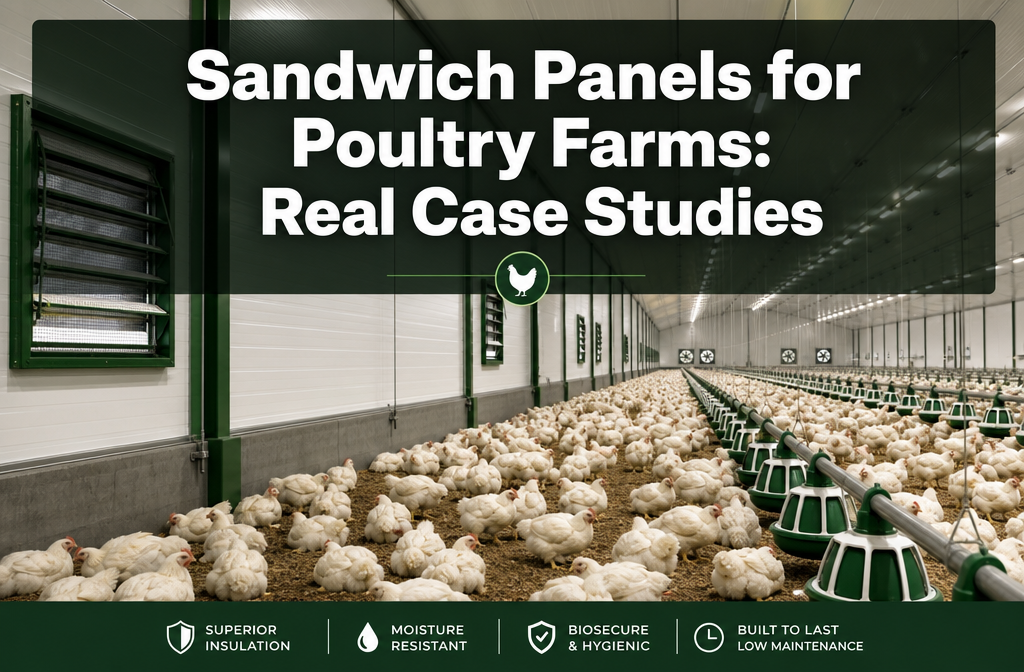
- Poultry and agricultural sheds — rockwool or EPS panels manage temperature and humidity.
Why this matters for buyers: The application determines the correct core material and thickness. A panel suitable for an exterior wall is not necessarily right for a pharmaceutical clean room.
Which Industries Need Factory Panels in Bangladesh?
Nearly every sector of Bangladesh's industrial economy uses factory panels, but demand is concentrated in a handful of high-growth industries.
Top industries using factory panels in Dhaka and surrounding zones:
| Industry | Primary Panel Type | Key Requirement |
|---|---|---|
| Garments / RMG | EPS or PU sandwich panel | Fire resistance, speed of construction |
| Pharmaceuticals | PU clean room panel | GMP compliance, hygiene surface |
| Food processing | PU or rockwool panel | Food-grade surface, moisture resistance |
| Cold storage | High-density PU panel | Thermal efficiency (U-value) |
| Poultry farming | Rockwool or EPS panel | Ventilation compatibility, durability |
| Electronics assembly | PU clean room panel | ESD control, dust-free environment |
| Hospitals / clinics | PU or rockwool panel | Fire rating, acoustic performance |
For garment and RMG factories specifically, the sandwich panel for factory building complete guide covers structural requirements in detail.
How Much Do Industrial Panels Cost in Bangladesh?
Panel costs in Bangladesh depend on core material, thickness, facing type, and order quantity. The figures below are market estimates based on 2025–2026 supplier pricing in Dhaka; always request a formal quotation because exchange rates and raw material costs shift frequently.
Estimated price ranges (per square foot, supply only):
- EPS core sandwich panel — BDT 350–550 (50mm–100mm thickness)
- PU core sandwich panel — BDT 550–900 (50mm–150mm thickness)
- Rockwool core sandwich panel — BDT 700–1,200+ (50mm–100mm thickness)
- Installation labor — typically adds BDT 80–150 per sq ft depending on complexity
For a detailed breakdown, the sandwich panel price in Bangladesh 2026 guide covers cost drivers and how to negotiate with suppliers.
Factors that push prices up:
- Thicker core (beyond 100mm)
- Double-skin steel facing with anti-corrosion coating
- Fire-rated or food-grade surface finish
- Small order quantities (below 500 sq ft)
- Urgent delivery timelines
Best Dhaka Factory Panel Supplier: How to Find and Evaluate One
The best Dhaka factory panel supplier for a given project is not necessarily the cheapest or the largest — it's the one that can consistently deliver the right specification, on time, with post-sale support.
Step-by-step evaluation process:
- Define your specification first. Know the required core material, thickness, fire rating, and surface finish before contacting any supplier.
- Request a physical sample. A reputable supplier will provide panel samples for inspection. Check core density, facing adhesion, and edge quality.
- Verify production capacity. Ask whether panels are locally manufactured or sourced from a third party. Local manufacturers can often customize dimensions; traders cannot.
- Check references. Ask for two or three completed factory projects of similar scale. Visit one if possible.
- Review warranty terms. Industry-standard warranty for sandwich panels is 10–15 years on the steel facing; shorter terms are a red flag.
- Compare total cost, not unit price. Include delivery, installation, and waste factor (typically 5–8% for complex layouts).
For a broader look at suppliers across Bangladesh, the sandwich panel suppliers in Bangladesh buyer's guide lists key players and evaluation criteria.
Difference Between Local and Imported Factory Panels
Local Dhaka-manufactured panels and imported panels (primarily from China, South Korea, and India) each have clear advantages depending on the buyer's priorities.
Local panels:
- Faster lead times (often 7–14 days vs. 45–90 days for sea freight imports)
- Easier to customize dimensions and finishes
- Lower landed cost in most cases
- After-sales support is more accessible
- Quality varies significantly between manufacturers — inspect carefully
Imported panels:
- Often carry internationally recognized certifications (CE, FM, UL)
- More consistent quality control in established Chinese or Korean factories
- Better suited for projects requiring specific international compliance (e.g., export-zone factories audited by foreign buyers)
- Higher cost when import duties, freight, and port handling are included
- Replacement parts and matching panels for future expansion can be difficult to source locally
Decision rule: Choose local panels if your project is domestic-use and timeline is tight. Choose imported panels if your factory must meet international buyer audits or specific fire/hygiene certification standards that local suppliers cannot document.
Are Chinese or Local Dhaka Panels More Reliable?
Neither is universally more reliable — reliability depends on the specific manufacturer, not the country of origin. That said, there are meaningful differences in how risk is distributed.
Chinese panels from established factories (with verifiable CE or FM certification) often have more consistent core density and steel thickness tolerances. However, buyers in Dhaka have reported receiving panels where the actual specifications differed from the quoted specs, particularly with smaller trading companies rather than direct factory orders.
Local Dhaka manufacturers, when audited in person, allow buyers to verify production quality directly. The risk is that quality control varies widely across the local market.
Practical guidance:
- For Chinese panels: always request a third-party inspection report (SGS or Bureau Veritas) before shipment.
- For local panels: visit the production facility, request core density test results, and check steel thickness with a gauge on delivery.
Common Mistakes When Selecting Industrial Panels
Experienced project managers consistently identify the same errors when sourcing from a Dhaka factory panel supplier.
The most costly mistakes:
- Choosing thickness by price. A thinner, cheaper panel that fails thermal requirements will cost more in energy bills over five years than the upfront saving.
- Ignoring fire rating. Bangladesh's BNBC and international buyer codes (for RMG factories) specify minimum fire performance. EPS panels without fire-retardant treatment are a liability.
- Skipping site measurement verification. Panel dimensions must account for structural tolerances. Gaps or overlaps discovered on-site are expensive to fix.
- Not specifying the facing steel grade. Standard G550 galvanized steel is suitable for most applications; coastal or high-humidity environments need higher corrosion protection.
- Ordering without a written specification sheet. Verbal agreements on core density or facing thickness are unenforceable. Always get a signed technical data sheet before payment.
How to Choose the Right Panel for Your Factory
Choosing the right panel comes down to matching three variables: thermal performance, structural load, and surface requirement.
Quick selection guide:
- High thermal insulation needed (cold storage, food processing): PU core, minimum 100mm. See the PU panel cold storage Bangladesh guide for thickness recommendations.
- Fire resistance is the priority (garments, chemicals): Rockwool core panel — mineral wool does not combust.
- Budget-constrained general factory wall: EPS core with fire-retardant treatment is the most cost-effective starting point.
- Clean room or pharmaceutical: PU panel with smooth white steel facing, no exposed joints.
- Acoustic separation needed: Rockwool core panels offer the best sound attenuation. The sandwich panel acoustic insulation guide explains performance ratings.
For a side-by-side comparison of EPS and PU options, the EPS vs PU sandwich panel comparison is a useful reference.
Safety Standards for Factory Panels in Bangladesh
Factory panels in Bangladesh must comply with the Bangladesh National Building Code (BNBC), which governs structural loads, fire resistance, and material specifications. Export-oriented factories (particularly RMG) also face audit requirements from international brands and certifying bodies.
Key standards and requirements:
- BNBC fire resistance: Walls in industrial buildings typically require a minimum 1-hour fire rating. Rockwool panels meet this; untreated EPS panels generally do not.
- International buyer codes: Many European and North American brands require factories to meet local equivalents of FM Global or NFPA standards for fire suppression and panel materials.
- Food-grade surfaces: Food processing and pharmaceutical facilities must use panels with surfaces that meet hygiene standards (smooth, non-porous, cleanable).
- Structural wind load: Dhaka and coastal Bangladesh are in cyclone-risk zones. Panel fixing systems must be designed for local wind load requirements per BNBC.
Always ask a supplier to provide a fire test certificate (not just a claim) and verify the certificate references the specific panel specification being supplied.
Installation Challenges for Factory Panels
Even high-quality panels underperform if installation is poor. The most frequent installation problems in Dhaka factory projects include:
- Joint sealing failures — improper application of sealant at panel joints allows moisture ingress, leading to core degradation and corrosion.
- Incorrect fixing spacing — under-fixed panels can deflect under wind load or vibration from heavy machinery.
- Cutting damage — cutting panels with angle grinders rather than panel saws leaves metal filings on the surface that cause rust staining within months.
- Thermal bridging at connections — metal-to-metal connections without thermal breaks reduce insulation performance, especially in cold rooms.
- Misaligned substructure — panels require a flat, plumb steel frame. Errors in the primary structure compound at every panel joint.
The sandwich panel roof installation guide provides step-by-step installation best practices applicable to both roof and wall systems.
Maintenance Tips for Industrial Electrical and Structural Panels
A well-maintained factory panel system in Bangladesh can last 20–30 years. Neglected panels typically show significant degradation within 8–12 years, particularly in Dhaka's humid, polluted environment.
Annual maintenance checklist:
- Inspect all panel joints and re-apply sealant where cracking or separation is visible.
- Clean panel surfaces with mild detergent and water — avoid abrasive cleaners that scratch the coating.
- Check fixing points for corrosion and tighten or replace as needed.
- Clear debris from roof panel drainage channels to prevent standing water.
- Inspect cut edges for rust and apply touch-up paint or edge protection immediately.
- For cold storage panels, verify door seals and check for condensation on panel faces, which indicates insulation failure.
The maintenance of sandwich panels complete guide covers inspection schedules and repair procedures in detail.
Typical Lifespan of Industrial Panels and Alternative Suppliers
Panel lifespan: A quality sandwich panel installed correctly in a Dhaka factory environment can last 20–30 years for the core insulation. The steel facing typically carries a manufacturer warranty of 10–15 years against perforation from corrosion, though surface coating life depends heavily on the local environment and maintenance.
Factors that shorten lifespan:
- Coastal or high-humidity environments without enhanced corrosion-resistant coatings
- Chemical exposure (acid fumes, solvents) without appropriate facing specification
- Physical impact damage left unrepaired
- Poor installation allowing moisture into panel joints
Alternative panel suppliers in Dhaka: Beyond the major local manufacturers, buyers can source panels through:
- Import agents handling Chinese or Korean factory-direct orders
- Regional suppliers in Gazipur, Narayanganj, and Chattogram with delivery to Dhaka
- Project-based fabricators who manufacture to order for large industrial projects
For a comprehensive overview of manufacturers operating in and around Dhaka, the sandwich panel manufacturers in Dhaka buyer's guide is a practical starting point.
FAQ
Q: What is the minimum order quantity from a Dhaka factory panel supplier?
Most local suppliers accept orders from 200–500 square feet, though smaller orders may carry a premium. Large manufacturers typically prefer orders above 1,000 sq ft for standard lead times.
Q: How long does delivery take from a Dhaka panel supplier?
Local manufacturers typically deliver within 7–21 days for standard specifications. Custom dimensions or special coatings may extend this to 30 days. Imported panels take 45–90 days depending on origin.
Q: Can factory panels be used for both walls and roofs?
Yes, but roof panels require different profiles (typically trapezoidal or standing seam) and higher structural ratings than wall panels. Always specify the application when ordering.
Q: Do Dhaka suppliers provide installation services?
Many do, either directly or through subcontracted installation teams. Always clarify whether the quoted price is supply-only or supply-and-install, and confirm the installer's experience with your specific panel type.
Q: What fire rating should I specify for a garment factory in Bangladesh?
BNBC and most international buyer codes require a minimum 1-hour fire rating for industrial walls. Rockwool core panels reliably meet this; EPS panels require fire-retardant treatment and testing documentation.
Q: Are there panels suitable for both insulation and acoustic control?
Yes. Rockwool core panels provide both thermal insulation and meaningful sound attenuation, making them suitable for factories near residential areas or where noise between production zones must be controlled.
Q: What thickness of PU panel is needed for a cold storage room in Dhaka?
For a standard cold storage room operating at 0°C to 5°C, 100mm PU panels are typically sufficient. For freezer rooms (below -18°C), 150mm–200mm panels are recommended.
Q: How do I verify a supplier's panel quality before a large order?
Request a third-party test report for core density and steel thickness. For large orders, consider commissioning an independent inspection at the factory before shipment or delivery.
Q: Is it cheaper to import panels or buy locally in 2026?
For most standard specifications, local Dhaka panels are cheaper on a landed-cost basis once import duties (typically 15–25% for panel materials) and freight are included. Imported panels are worth the premium only when specific certifications are required.
Q: What certifications should a reputable panel supplier provide?
At minimum: a technical data sheet with core density and steel thickness, a fire test certificate from a recognized laboratory, and a manufacturer's warranty document. ISO 9001 certification is a positive indicator of quality management.
Conclusion
Sourcing from the right Dhaka factory panel supplier in 2026 is a decision that affects construction speed, long-term energy costs, fire safety, and regulatory compliance. The key steps are straightforward: define your specification before approaching suppliers, verify claims with documentation and site visits, compare total project cost rather than unit price, and plan for proper installation and maintenance from day one.
Actionable next steps:
- Identify your panel application (wall, roof, clean room, cold storage) and write a basic specification covering core material, thickness, and fire rating.
- Request quotations from at least three local Dhaka suppliers and one import agent for comparison.
- Ask each supplier for a physical sample and a fire test certificate before committing to an order.
- Review the factory building panel Bangladesh complete guide for a full checklist of what to include in your supplier brief.
- Budget for professional installation and schedule an annual maintenance inspection to protect your investment over the panel's full lifespan.
References
- Bangladesh National Building Code (BNBC), Housing and Building Research Institute, 2020. https://www.hbri.gov.bd
- International Finance Corporation (IFC), Bangladesh Garment Sector Environmental Guidelines, 2019. https://www.ifc.org
- FM Global, Property Loss Prevention Data Sheet 1-28: Insulated Steel-Deck Roofs, 2021. https://www.fmglobal.com