Last updated: July 31, 2026

Quick Answer: EPS sandwich panel walls are prefabricated building components consisting of expanded polystyrene foam core sandwiched between two metal sheets, typically steel or aluminum. These panels provide excellent thermal insulation, quick installation, and cost-effective construction for industrial, commercial, and agricultural buildings.
Key Takeaways
- EPS sandwich panels offer R-values of 3.6 to 4.2 per inch, providing superior thermal performance compared to traditional wall systems
- Installation costs range from $8-15 per square foot, including materials and labor for most commercial applications
- Standard thickness options include 50mm, 75mm, 100mm, 150mm, and 200mm to meet different insulation requirements
- Fire ratings typically achieve Class B or Class C classifications when properly manufactured with fire-retardant additives
- Lifespan extends 25-30 years with proper installation and maintenance in most climate conditions
- Moisture resistance requires proper vapor barriers and sealed joints to prevent condensation issues
- Common applications include warehouses, factories, cold storage facilities, and agricultural buildings
What Is an EPS Sandwich Panel Wall
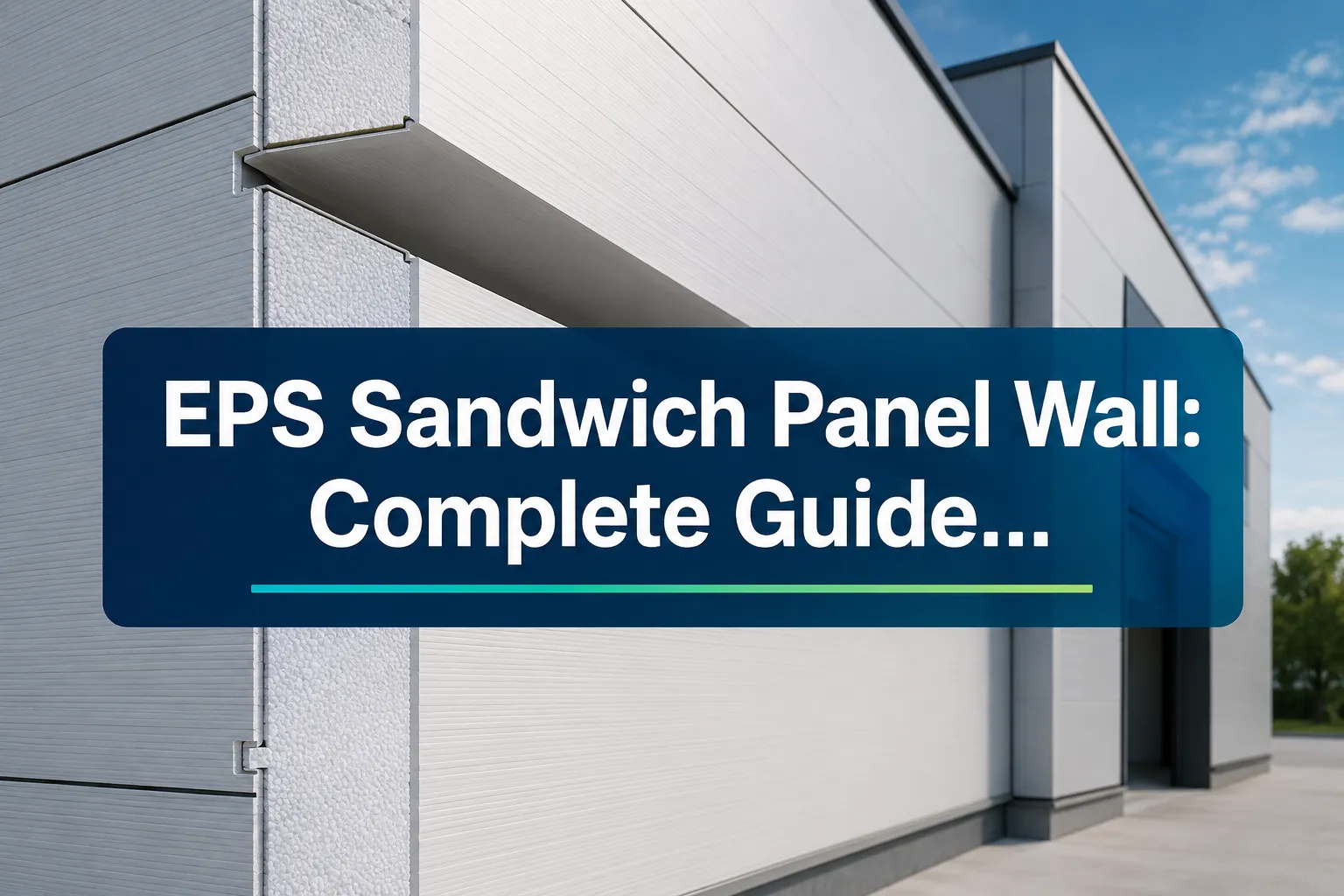
An EPS sandwich panel wall is a composite building material featuring an expanded polystyrene (EPS) foam core bonded between two protective metal facings. The metal skins, usually made from galvanized steel, aluminum, or pre-painted steel, provide structural strength and weather protection while the EPS core delivers thermal insulation.
The manufacturing process involves injecting expanded polystyrene beads between the metal sheets under controlled pressure and temperature. This creates a monolithic panel that combines the structural properties of metal with the insulating capabilities of foam. Panel widths typically range from 950mm to 1200mm, with lengths up to 12 meters depending on transportation constraints.
EPS panels differ from other insulated sandwich panel options primarily in their core material. While polyurethane (PU) panels offer higher R-values, EPS panels provide better moisture resistance and lower cost. Rockwool panels excel in fire resistance but weigh significantly more than EPS alternatives.
Choose EPS sandwich panels when: you need cost-effective insulation for non-fire-critical applications, require lightweight panels for existing structure retrofits, or prioritize moisture resistance in humid climates.
How Do EPS Sandwich Panels Work
EPS sandwich panels function through the thermal bridge principle, where the continuous EPS core eliminates heat transfer between interior and exterior metal facings. The expanded polystyrene contains millions of closed air cells that resist heat conduction, while the metal skins handle structural loads and environmental protection.
The thermal performance depends on three key factors:
- Core density: Higher density EPS (18-25 kg/m³) provides better compressive strength but slightly lower R-values
- Panel thickness: Each additional 25mm of EPS core adds approximately R-3.5 to the overall thermal resistance
- Joint sealing: Proper installation with sealed joints prevents thermal bridging at panel connections
Structural mechanics: The metal facings work in tension and compression while the EPS core resists shear forces. This composite action allows panels to span significant distances without intermediate support. Standard panels can span 4-6 meters between structural supports depending on wind and snow loads.
Moisture control: EPS naturally resists water absorption (less than 2% by volume), but vapor barriers on the warm side prevent condensation within the panel core. Proper installation includes sealed joints and appropriate vapor retarders based on climate conditions.
EPS Sandwich Panel Wall Cost Per Square Foot
EPS sandwich panel walls typically cost $8-15 per square foot installed, including materials, labor, and basic accessories. Material costs alone range from $4-8 per square foot depending on panel thickness, metal gauge, and coating specifications.
Cost breakdown by thickness:
- 50mm panels: $4-6 per sq ft (materials only)
- 75mm panels: $5-7 per sq ft (materials only)
- 100mm panels: $6-8 per sq ft (materials only)
- 150mm+ panels: $7-10 per sq ft (materials only)
Additional cost factors:
- Premium coatings (PVDF, high-durability polyester): Add $1-2 per sq ft
- Fire-rated panels with additives: Add $0.50-1.50 per sq ft
- Custom colors or textures: Add $0.25-1.00 per sq ft
- Specialized accessories (corners, flashings): $2-5 per linear foot
Installation labor: Professional installation adds $3-6 per square foot depending on project complexity, site accessibility, and regional labor rates. Sandwich panel installation services often provide package pricing for large projects.
Choose thicker panels when: building codes require higher R-values, energy costs justify the premium, or extreme climate conditions demand maximum thermal performance.
EPS Sandwich Panel Installation Process
EPS sandwich panel installation follows a systematic sequence: structural preparation, panel lifting and positioning, connection fastening, and joint sealing. Professional installation typically achieves 200-400 square feet per day per crew depending on panel size and project complexity.
Step-by-step installation:
- Structural preparation: Verify support spacing, install base flashing, and check frame alignment within ±6mm tolerance
- Panel handling: Use vacuum lifters or panel clamps to prevent surface damage during lifting and positioning
- First panel placement: Start from a corner or reference line, ensuring plumb and level positioning
- Connection methods: Secure panels using self-drilling screws through both facings into structural supports
- Joint sealing: Apply structural sealant to vertical joints and install weather seals as specified
- Accessory installation: Install corner trim, base flashing, and top capping to complete the weather barrier
Critical installation requirements:
- Minimum 6mm overlap at horizontal joints with sealant application
- Fastener spacing: 300-450mm on center depending on wind loads
- Thermal expansion joints every 30-40 meters in long runs
- Vapor barrier continuity at all penetrations and joints
Common installation mistakes: Inadequate fastener penetration (minimum 25mm into structural steel), missing sealant at panel joints, and failure to account for thermal movement in long panel runs.
Quality control: Inspect each panel for damage before installation, verify fastener pull-out resistance, and conduct water testing on completed sections before interior work begins.
EPS Sandwich Panel Wall vs Fiberglass Insulation
EPS sandwich panels outperform fiberglass insulation in thermal consistency, installation speed, and moisture resistance, while fiberglass systems cost 20-30% less initially. The choice depends on project priorities: long-term performance versus upfront cost savings.
| Factor | EPS Sandwich Panels | Fiberglass + Metal Siding |
|---|---|---|
| R-Value Consistency | R-3.8 per inch, no thermal bridging | R-3.1-3.7 per inch, 15-25% loss from framing |
| Installation Time | 2-3 days for 10,000 sq ft | 5-8 days for 10,000 sq ft |
| Moisture Performance | Closed-cell, water absorption <2% | Absorbs moisture, loses R-value when wet |
| Initial Cost | $8-15 per sq ft installed | $6-11 per sq ft installed |
| Air Sealing | Excellent with proper joint sealing | Requires separate air barrier system |
Energy performance comparison: EPS panels typically achieve 15-25% better thermal performance in real-world conditions due to continuous insulation and reduced air infiltration. This translates to $0.15-0.30 per square foot annually in energy savings for most commercial buildings.
Choose EPS panels when: project timeline is critical, moisture exposure is likely, or long-term energy performance justifies higher upfront costs. Choose fiberglass when: initial budget is constrained, fire resistance is paramount, or building codes specifically require mineral fiber insulation.
Best EPS Sandwich Panel Brands
Leading EPS sandwich panel manufacturers focus on consistent foam density, advanced adhesive systems, and quality metal coatings to ensure long-term performance. Brand selection should prioritize local availability, technical support, and warranty coverage over name recognition alone.
Top-tier manufacturers:
- Kingspan: Premium panels with Lambda core technology, 20-year warranties
- Metecno: Italian engineering, excellent fire-rated options
- Tata Steel (Colorcoat): Strong presence in Asia, reliable supply chain
- ArcelorMittal: Global availability, competitive pricing for large projects
Key selection criteria:
- Foam density consistency: Look for ±2 kg/m³ tolerance across panel batches
- Adhesive system: Polyurethane adhesives outperform traditional methods for long-term bond strength
- Metal coating warranty: Minimum 15-year coating warranties for exterior applications
- Technical support: Local engineering support for project-specific calculations
Regional considerations: Sandwich panel suppliers in Bangladesh often provide better service and faster delivery than international brands. Evaluate total project cost including shipping, technical support, and warranty service accessibility.
Quality verification: Request third-party test reports for thermal performance, fire ratings, and structural properties. Reputable manufacturers provide comprehensive technical documentation and project references.
EPS Sandwich Panel Fire Rating
EPS sandwich panels typically achieve Class B or Class C fire ratings when manufactured with fire-retardant additives, but cannot match the fire performance of mineral wool alternatives. Fire ratings depend on foam formulation, panel thickness, and facing materials.
Standard fire classifications:
- Class C (Flame Spread 76-200): Standard EPS panels with basic fire retardants
- Class B (Flame Spread 26-75): Enhanced fire-retardant EPS formulations
- Class A (Flame Spread 0-25): Requires mineral fiber cores like rockwool
Fire-retardant options:
- HBCD (Hexabromocyclododecane): Traditional additive, being phased out in many regions
- Polymeric flame retardants: Newer alternatives with better environmental profiles
- Expanded graphite: Intumescent additive that expands when heated
Building code considerations: Most commercial building codes allow Class B or C panels for non-fire-rated walls. Fire-rated assemblies typically require rockwool sandwich panels or additional fire-resistant sheathing.
Smoke development: EPS panels generate moderate smoke when burning. Specify low-smoke formulations for enclosed spaces or buildings with limited egress routes.
Fire safety best practices: Install fire stops at panel joints in fire-rated assemblies, maintain proper clearances from heat sources, and consider sprinkler protection for large EPS panel installations.
EPS Sandwich Panel Moisture Problems
EPS sandwich panels resist moisture absorption but can experience condensation issues when vapor barriers are inadequate or improperly installed. Proper design and installation prevent 95% of moisture-related problems in EPS panel systems.
Common moisture issues:
- Interstitial condensation: Occurs when warm, humid air penetrates panel joints and condenses on cold surfaces
- Joint infiltration: Poor sealant application allows water entry at panel connections
- Thermal bridging: Metal fasteners create cold spots that promote condensation
- Vapor drive: Seasonal moisture movement through panel assemblies
Prevention strategies:
- Vapor barrier placement: Install continuous vapor barriers on the warm side of panels
- Joint sealing: Use structural sealants rated for 20+ year service life
- Ventilation design: Provide adequate air circulation to prevent humidity buildup
- Insulation continuity: Minimize thermal bridges at connections and penetrations
Climate-specific considerations:
- Hot, humid climates: Focus on exterior moisture barriers and interior humidity control
- Cold climates: Emphasize interior vapor barriers and thermal bridge elimination
- Mixed climates: Design for bi-directional vapor flow with permeable exterior finishes
Troubleshooting moisture problems: Conduct thermal imaging surveys to identify condensation patterns, verify vapor barrier continuity, and check joint sealant condition. Most moisture issues stem from installation defects rather than material failures.
Who Uses EPS Sandwich Panels
EPS sandwich panels serve industrial, commercial, and agricultural applications where cost-effective insulation, quick construction, and moderate fire resistance meet project requirements. These panels excel in single-story buildings with large, unobstructed wall areas.
Primary applications:
- Manufacturing facilities: Factory buildings requiring climate control and quick construction
- Warehouses and distribution centers: Large-span buildings prioritizing energy efficiency
- Agricultural buildings: Poultry farms, livestock facilities, and equipment storage
- Cold storage facilities: Refrigerated warehouses and food processing plants
- Retail buildings: Big-box stores, shopping centers, and automotive dealerships
Industry preferences:
- Food processing: Smooth, cleanable surfaces meet sanitary requirements
- Pharmaceuticals: Controlled environments with precise temperature and humidity
- Automotive: Paint booths and assembly areas requiring thermal stability
- Logistics: Temperature-controlled distribution and e-commerce fulfillment centers
Building types to avoid: High-rise construction (structural limitations), hospitals and schools (fire code restrictions), and buildings requiring Class A fire ratings throughout.
Project size considerations: EPS panels become most cost-effective on projects exceeding 5,000 square feet where installation efficiency offsets material premiums.
EPS Sandwich Panel Thickness Options
EPS sandwich panel thickness ranges from 50mm to 200mm, with 75mm and 100mm panels covering most commercial applications. Panel thickness selection depends on thermal requirements, structural loads, and building code compliance.
Standard thickness options:
- 50mm (2 inches): R-7.5, suitable for mild climates and non-conditioned spaces
- 75mm (3 inches): R-11.4, most common for commercial buildings
- 100mm (4 inches): R-15.2, cold storage and high-performance applications
- 150mm (6 inches): R-22.8, freezer rooms and extreme climate conditions
- 200mm (8 inches): R-30.4, specialty applications requiring maximum insulation
Selection criteria:
- Climate zone: Colder regions require thicker panels to meet energy codes
- Building use: Conditioned spaces need higher R-values than warehouses
- Structural requirements: Thicker panels span longer distances between supports
- Economic analysis: Balance energy savings against material cost premiums
Custom thickness: Some manufacturers offer intermediate thicknesses (60mm, 80mm, 120mm) for specific performance targets. Custom options typically add 2-4 weeks to delivery schedules and 10-15% cost premiums.
Thermal bridge considerations: Thicker panels reduce the relative impact of thermal bridging at fasteners and connections, improving overall wall assembly performance.
How Long Do EPS Sandwich Panels Last
EPS sandwich panels typically last 25-30 years with proper installation and maintenance, with the metal facings determining overall service life more than the EPS core. Panel longevity depends on coating quality, environmental exposure, and maintenance practices.
Lifespan factors:
- Metal coating: Premium coatings (PVDF, high-durability polyester) last 25-30 years
- Standard coatings: Basic polyester systems require refinishing after 15-20 years
- EPS core stability: Maintains R-value and structural properties for 40+ years
- Environmental exposure: Coastal, industrial, and high-UV environments reduce coating life
Maintenance requirements:
- Annual inspection: Check sealant condition, fastener tightness, and surface damage
- Cleaning: Pressure wash panels every 2-3 years to maintain appearance and coating performance
- Sealant renewal: Replace joint sealants every 10-15 years depending on quality
- Touch-up painting: Address scratches and minor damage promptly to prevent corrosion
End-of-life considerations: EPS panels are recyclable, with metal facings having scrap value and EPS cores suitable for reprocessing into new foam products. Proper demolition techniques recover 80-90% of panel materials.
Warranty coverage: Most manufacturers provide 15-20 year warranties on metal coatings and 10-15 years on structural performance. Extended warranties are available for premium panel systems.
EPS Sandwich Panel Soundproofing Benefits
EPS sandwich panels provide moderate acoustic performance with Sound Transmission Class (STC) ratings of 25-35, suitable for industrial applications but inadequate for noise-sensitive environments. Soundproofing performance improves with panel thickness and proper installation details.
Acoustic characteristics:
- 75mm panels: STC 28-32, adequate for warehouse and manufacturing
- 100mm panels: STC 32-36, suitable for office and retail applications
- 150mm+ panels: STC 36-40, approaching commercial building standards
Sound transmission paths:
- Panel core: EPS provides minimal sound absorption compared to mineral fiber
- Metal facings: Thin steel facings transmit more sound than heavy materials
- Joint details: Unsealed gaps significantly reduce acoustic performance
- Structural connections: Rigid connections create sound bridges
Acoustic enhancement options:
- Double-wall systems: Two EPS panels with air gap achieve STC 45-50
- Interior linings: Add gypsum board or acoustic panels for sound absorption
- Resilient mounting: Isolate panels from structure to reduce vibration transmission
- Specialized cores: Perforated facings with sound-absorbing fill materials
Applications requiring better acoustics: Consider rockwool panels for superior sound absorption or design composite wall systems combining EPS panels with acoustic treatments.
Common Mistakes Installing EPS Sandwich Panels
The most frequent EPS panel installation errors involve inadequate fastening, poor joint sealing, and failure to accommodate thermal movement. These mistakes compromise both thermal performance and weather resistance.
Critical installation errors:
- Insufficient fastener penetration: Minimum 25mm into steel structure; shallow fastening causes panel failure
- Missing vapor barriers: Omitting interior vapor barriers leads to condensation and mold issues
- Inadequate joint sealing: Poor sealant application allows air and water infiltration
- Thermal bridge creation: Continuous metal connections bypass insulation effectiveness
- Improper panel handling: Surface damage during installation voids coating warranties
Fastening mistakes:
- Wrong fastener type: Standard screws lack proper sealing washers for weather resistance
- Incorrect spacing: Fasteners spaced too far apart (>450mm) allow panel movement and leakage
- Over-driving: Excessive fastener torque damages panel facings and reduces holding power
- Missing edge fastening: Inadequate fastening at panel edges creates lifting points for wind loads
Joint sealing errors:
- Incompatible sealants: Using non-structural sealants that fail under thermal movement
- Insufficient sealant depth: Shallow sealant beads fail prematurely under stress
- Poor surface preparation: Contaminated surfaces prevent proper sealant adhesion
- Missing backer rod: Sealant without proper backing creates weak bond lines
Prevention strategies: Use certified installers familiar with manufacturer specifications, conduct pre-installation training, and implement quality control checkpoints throughout the installation process.
EPS Sandwich Panels for Cold Climate
EPS sandwich panels perform well in cold climates when properly designed for thermal bridging, vapor control, and structural loads from snow and wind. Cold climate installations require thicker panels, enhanced vapor barriers, and careful attention to thermal expansion details.
Cold climate requirements:
- Minimum thickness: 100mm (4-inch) panels for climate zones 5-7
- Enhanced vapor barriers: Continuous interior vapor barriers with sealed penetrations
- Thermal bridge elimination: Minimize continuous metal connections through insulation
- Snow load capacity: Verify panel structural ratings for local snow loads
Design considerations:
- Condensation risk: Large temperature differentials increase condensation potential
- Thermal movement: 200mm panels expand/contract 12-15mm over temperature ranges
- Wind load resistance: Cold climate wind speeds often exceed standard design values
- Installation conditions: Cold weather affects sealant curing and panel handling
Performance optimization:
- Continuous insulation: Eliminate thermal bridges at structural connections
- Air sealing: Cold climates amplify air leakage penalties on energy performance
- Interior humidity control: Mechanical ventilation prevents moisture accumulation
- Quality installation: Cold weather installation requires modified procedures and materials
Energy code compliance: Most cold climate energy codes require R-20 to R-30 continuous insulation, necessitating 150-200mm EPS panels or supplemental insulation systems.
Conclusion
EPS sandwich panel walls offer an efficient solution for modern construction projects requiring cost-effective insulation, rapid installation, and reliable performance. With proper selection of panel thickness, attention to installation details, and appropriate applications, these systems deliver 25-30 years of service while meeting most commercial building requirements.
The key to successful EPS panel projects lies in matching panel specifications to project needs, working with experienced installers, and following manufacturer guidelines for vapor control and joint sealing. While EPS panels may not suit every application, particularly those requiring superior fire resistance or acoustic performance, they excel in industrial, commercial, and agricultural buildings where thermal efficiency and construction speed are priorities.
For your next project, evaluate EPS sandwich panels against traditional wall systems by considering total installed cost, energy performance, and long-term maintenance requirements. Consult with local suppliers and certified installers to develop specifications that meet building codes while optimizing performance and value.
Next steps: Request quotes from multiple suppliers, review local building code requirements, and schedule site visits to see completed installations. Consider engaging a building envelope consultant for complex projects or challenging environmental conditions.
SEO Meta Title: EPS Sandwich Panel Wall Guide: Cost, Installation & Benefits 2026