Last updated: July 31, 2026

Quick Answer
Sandwich panel thickness typically ranges from 50mm to 250mm, with the optimal thickness depending on your specific application, insulation requirements, and structural loads. Standard residential roofing uses 75-100mm panels, while industrial cold storage facilities require 150-250mm thickness for proper thermal performance.
Key Takeaways
- Standard sandwich panel thickness options range from 50mm to 250mm in 25mm increments
- Roofing applications typically require 75-100mm thickness for adequate insulation and structural support
- Wall panels can be thinner (50-75mm) than roof panels due to lower structural loads
- Thicker panels provide better insulation but cost significantly more per square meter
- Fire rating requirements may dictate minimum thickness specifications for certain buildings
- Cold storage facilities need 150-250mm thickness to maintain temperature control efficiently
- Panel thickness directly affects both thermal performance and structural capacity
- Custom thickness options are available but may increase lead times and costs
- Proper measurement includes the entire panel assembly, not just the core material
- Climate zone and building codes influence minimum thickness requirements
What Is Sandwich Panel Thickness and Why Does It Matter
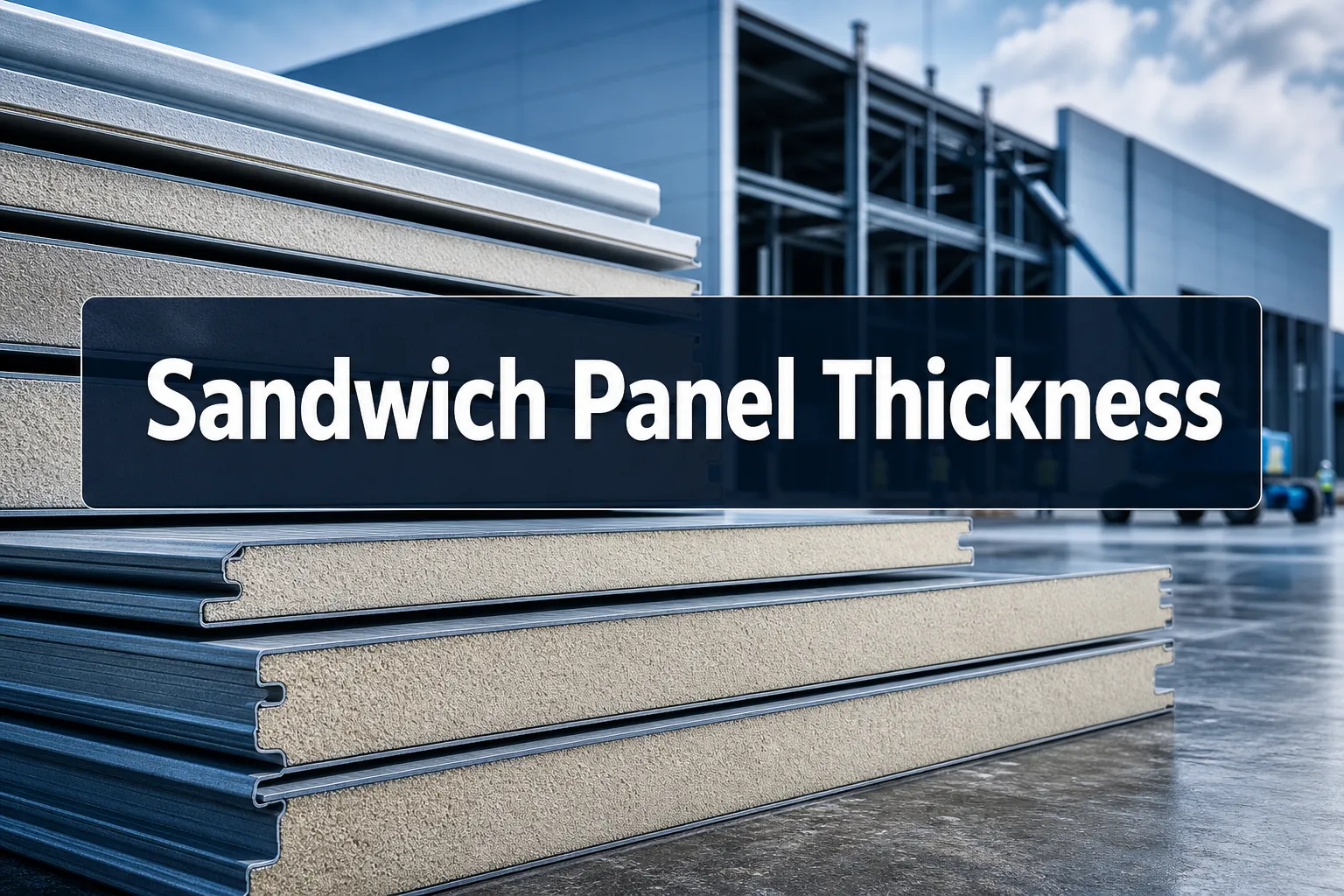
Sandwich panel thickness refers to the total measurement from the outer face of one metal sheet to the outer face of the opposite sheet, including the insulating core material in between. This measurement directly impacts the panel's thermal performance, structural strength, and fire resistance capabilities.
The thickness matters because it determines three critical performance factors: thermal insulation value, load-bearing capacity, and fire resistance rating. Thicker panels provide superior insulation with lower U-values, can span longer distances without additional support, and often achieve better fire ratings.
Common applications by thickness:
- 50-75mm: Interior partitions, low-load wall cladding
- 75-100mm: Standard roofing, exterior walls in moderate climates
- 100-150mm: Heavy-duty roofing, walls in extreme climates
- 150-250mm: Cold storage, freezer rooms, specialized industrial applications
Choose thicker panels when thermal performance is critical, structural loads are high, or fire ratings require enhanced protection. However, increased thickness means higher material costs and potentially more complex installation requirements.
How Thick Should Sandwich Panels Be for Roofing
Roofing sandwich panels should be 75-100mm thick for most residential and commercial applications, with 100mm being the most common choice for optimal balance of performance and cost. Industrial buildings or extreme climate zones may require 125-150mm thickness.
The roof panel thickness must account for several factors: snow loads, wind uplift forces, span distances between supports, and thermal performance requirements. Thicker panels can span longer distances, reducing the need for intermediate structural supports.
Roofing thickness guidelines:
- 75mm: Light commercial, residential, spans up to 4 meters
- 100mm: Standard commercial, spans up to 6 meters, moderate climates
- 125mm: Heavy commercial, industrial, spans up to 8 meters
- 150mm: Extreme loads, long spans over 8 meters, harsh climates
For detailed roofing specifications, consult our complete guide to roof panel thickness which covers load calculations and span tables.
Common mistake: Choosing thickness based only on insulation needs without considering structural requirements. Always verify that your selected thickness can handle the calculated loads for your specific span and loading conditions.
Sandwich Panel Thickness Chart for Different Applications
Different building applications require specific thickness ranges to meet performance, safety, and code requirements. This comprehensive chart shows standard thickness recommendations across various construction sectors.
| Application | Recommended Thickness | Core Material | Key Considerations |
|---|---|---|---|
| Residential Roofing | 75-100mm | EPS/Rockwool | Weather resistance, moderate loads |
| Commercial Roofing | 100-125mm | Rockwool/PIR | Fire rating, higher loads |
| Industrial Roofing | 125-150mm | Rockwool | Heavy equipment, long spans |
| Exterior Walls | 75-100mm | EPS/Rockwool | Thermal performance, wind loads |
| Interior Partitions | 50-75mm | EPS | Lightweight, cost-effective |
| Cold Storage | 150-200mm | PIR/PU | Superior insulation, moisture resistance |
| Freezer Rooms | 200-250mm | PIR/PU | Extreme temperature differential |
| Clean Rooms | 50-100mm | Rockwool | Smooth surfaces, fire safety |
| Poultry Farms | 75-100mm | EPS/Rockwool | Hygiene, temperature control |
Selection criteria: Match thickness to your primary requirement – structural (choose for loads), thermal (choose for insulation), or regulatory (choose for fire/building codes). When multiple factors apply, select the thickness that meets the most stringent requirement.
For specialized applications like poultry farm construction, thickness varies by zone within the same building based on temperature control needs.
How Do I Choose the Right Sandwich Panel Thickness
Choose sandwich panel thickness by evaluating three primary factors in order: structural requirements, thermal performance needs, and budget constraints. Start with structural calculations to determine minimum thickness, then verify thermal performance meets your insulation targets.
Step-by-step selection process:
- Calculate structural loads – Determine dead loads, live loads, wind loads, and snow loads for your application
- Check span requirements – Verify the thickness can span your planned support spacing
- Evaluate thermal needs – Calculate required R-value or U-value for your climate zone
- Review fire ratings – Ensure thickness meets local fire code requirements
- Consider installation factors – Thicker panels may require special handling equipment
- Compare total costs – Include material, shipping, and installation costs
Decision rules:
- Choose 75mm if spans are under 4m and insulation needs are moderate
- Choose 100mm for most standard commercial applications with 4-6m spans
- Choose 125mm+ for industrial applications, long spans, or extreme climates
- Choose 150mm+ for cold storage or when superior insulation is critical
For comprehensive selection guidance, review our detailed thickness selection guide which includes calculation worksheets and decision trees.
Common mistake: Selecting thickness based solely on initial cost without considering long-term energy savings from better insulation or reduced structural support requirements.
Sandwich Panel Thickness vs Insulation Value Comparison
Thicker sandwich panels provide significantly better insulation performance, but the relationship isn't always linear and depends heavily on the core material type. Each 25mm increase in thickness typically improves thermal resistance by 15-25%.
Thermal performance by thickness (typical values):
EPS Core Panels:
- 50mm: R-value ~1.8, U-value ~0.55 W/m²K
- 75mm: R-value ~2.7, U-value ~0.37 W/m²K
- 100mm: R-value ~3.6, U-value ~0.28 W/m²K
- 150mm: R-value ~5.4, U-value ~0.18 W/m²K
Rockwool Core Panels:
- 50mm: R-value ~1.4, U-value ~0.71 W/m²K
- 75mm: R-value ~2.1, U-value ~0.48 W/m²K
- 100mm: R-value ~2.8, U-value ~0.36 W/m²K
- 150mm: R-value ~4.2, U-value ~0.24 W/m²K
PIR/PU Core Panels:
- 50mm: R-value ~2.3, U-value ~0.43 W/m²K
- 100mm: R-value ~4.6, U-value ~0.22 W/m²K
- 150mm: R-value ~6.9, U-value ~0.14 W/m²K
The diminishing returns principle applies – going from 50mm to 100mm provides much greater improvement than going from 100mm to 150mm. For most applications, 100mm thickness offers the best cost-to-performance ratio.
Energy cost consideration: In cold storage applications, the energy savings from thicker insulation often pay for the additional panel cost within 2-3 years through reduced refrigeration loads.
Standard Sandwich Panel Thickness Options Available
Manufacturers typically produce sandwich panels in standard thickness increments of 25mm, ranging from 50mm to 250mm. These standardized options help control costs and ensure compatibility with standard fastening systems and accessories.
Most common standard thicknesses:
- 50mm, 75mm, 100mm: Widely available, shortest lead times, lowest costs
- 125mm, 150mm: Standard industrial options, moderate availability
- 175mm, 200mm, 225mm, 250mm: Specialized applications, longer lead times
Availability factors:
- Core material type affects thickness options (PIR cores may have limited thickness range)
- Panel width and length combinations may restrict thickness choices
- Custom colors or finishes may not be available in all thicknesses
- Some manufacturers specialize in specific thickness ranges
Non-standard thickness considerations:
Custom thicknesses between standard increments are possible but typically require minimum order quantities and extended lead times. The cost premium for custom thickness can be 15-30% above standard options.
When planning projects, specify standard thicknesses whenever possible to optimize cost and delivery schedules. For projects requiring multiple thickness values, consider whether design modifications could standardize on fewer thickness options.
Regional availability: In Bangladesh and similar markets, 75mm and 100mm thickness panels have the best availability and competitive pricing due to high demand volume.
Does Thicker Sandwich Panel Mean Better Insulation
Yes, thicker sandwich panels provide better insulation performance, but the improvement rate varies by core material and diminishes as thickness increases. The relationship follows the law of diminishing returns – doubling thickness doesn't double the insulation value.
Insulation improvement rates:
- 50mm to 75mm: ~40-50% improvement in thermal resistance
- 75mm to 100mm: ~30-35% improvement
- 100mm to 150mm: ~45-50% improvement
- 150mm to 200mm: ~25-30% improvement
Core material efficiency:
PIR and PU cores provide the highest insulation per millimeter of thickness, followed by EPS, then rockwool. However, rockwool offers superior fire performance that may outweigh its lower insulation efficiency in certain applications.
Practical limitations:
Beyond 150-200mm thickness, other factors become more important than raw insulation value: thermal bridging through fasteners and joints, air leakage around panel connections, and installation quality have greater impact on overall thermal performance.
Cost-benefit analysis: Calculate the energy cost savings from improved insulation against the additional panel cost. In most climates, going beyond 100-125mm thickness provides marginal energy savings that don't justify the cost increase for standard building applications.
Exception: Cold storage and freezer applications justify thick panels (150-250mm) because the extreme temperature differential makes the energy savings substantial and ongoing.
Sandwich Panel Thickness for Walls vs Roof Applications
Wall and roof applications require different thickness considerations due to varying structural loads, thermal requirements, and installation orientations. Roof panels typically need greater thickness than wall panels for the same building.
Structural differences:
- Roof panels: Must support snow loads, equipment loads, and maintenance personnel
- Wall panels: Primarily resist wind loads and their own weight
- Span requirements: Roofs often have longer unsupported spans than walls
Typical thickness relationships:
- If roof uses 100mm panels, walls can often use 75mm
- If roof requires 125mm for structural reasons, walls might use 100mm
- Cold storage buildings may use equal thickness for walls and roof
Thermal considerations:
Roof panels face greater temperature extremes due to direct solar exposure and radiation to the night sky. In hot climates, roof panels may need extra thickness for thermal performance even when structural requirements are met with thinner options.
Installation factors:
- Wall panels: Easier to handle thicker panels due to vertical installation
- Roof panels: Weight becomes more critical during installation at height
- Fastening systems: May differ between wall and roof applications
Decision framework: Size roof panels first based on structural and thermal requirements, then evaluate whether walls can use thinner panels while meeting thermal and wind load requirements. This approach often optimizes total project cost.
For detailed wall specifications, see our guide on sandwich panel wall cladding which covers thickness selection for various wall applications.
How to Measure Sandwich Panel Thickness Correctly
Measure sandwich panel thickness from the outer face of one metal skin to the outer face of the opposite metal skin, including both face sheets and the complete core thickness. This total measurement determines the panel's performance specifications and compatibility with accessories.
Proper measurement technique:
- Use calipers or thickness gauge for accuracy on panel samples
- Measure at multiple points along the panel length to check consistency
- Avoid measuring at joints where panels may be compressed or deformed
- Include any surface texturing or coating thickness in the measurement
- Document core material type along with thickness measurement
Common measurement errors:
- Measuring only the core material thickness (excluding face sheets)
- Taking measurements at panel edges where compression may occur
- Using rulers instead of precision measuring tools
- Measuring damaged or compressed areas of panels
Quality control standards:
Properly manufactured panels should maintain thickness within ±2mm of nominal specification. Greater variation may indicate manufacturing defects or improper handling during transport.
Field verification: When panels arrive on site, verify thickness on a sample basis before installation begins. Thickness variations can affect fastener selection, flashing details, and overall system performance.
Documentation: Record actual measured thickness for warranty purposes and to ensure compatibility with specified fastening systems and accessories. Some manufacturers provide thickness certificates with panel shipments.
Sandwich Panel Thickness Requirements for Fire Rating
Fire-rated sandwich panels must meet minimum thickness requirements to achieve specific fire resistance ratings, with thicker panels generally providing longer fire resistance periods. The core material type significantly influences the thickness needed for each rating level.
Common fire rating thicknesses:
Rockwool Core (Non-combustible):
- 60-minute rating: Minimum 75-100mm thickness
- 120-minute rating: Minimum 100-150mm thickness
- 240-minute rating: Minimum 150-200mm thickness
PIR Core (Fire-retardant):
- 30-minute rating: Minimum 75mm thickness
- 60-minute rating: Minimum 100mm thickness
- Higher ratings may require special core formulations
EPS Core (Combustible):
Limited fire rating capability regardless of thickness. Generally not suitable for applications requiring fire ratings above 30 minutes.
Testing standards: Fire ratings are determined by standardized tests that evaluate structural integrity, insulation, and flame penetration resistance. Thickness alone doesn't guarantee performance – core material fire properties are equally important.
Building code compliance: Many commercial and industrial buildings require specific fire ratings for walls and roofs. Verify local code requirements before selecting panel thickness, as inadequate fire rating can require costly retrofits.
For fire-critical applications, consult our fire-rated panel guide which covers testing standards and code compliance requirements.
Design consideration: Fire-rated panels may require special fasteners, sealants, and installation details to maintain the fire rating of the complete assembly.
Can You Cut Sandwich Panels to a Different Thickness
Sandwich panels cannot be cut to reduce thickness while maintaining their structural and thermal performance properties. The panels are manufactured as integrated assemblies where the face sheets and core are bonded together under controlled factory conditions.
Why thickness modification isn't feasible:
- Structural integrity: Face sheets provide the structural strength; removing one destroys the composite action
- Thermal performance: Reducing core thickness directly reduces insulation value
- Moisture protection: Cutting exposes core materials to moisture infiltration
- Fire rating: Any modification voids fire test certifications
Alternative solutions:
- Order correct thickness: Plan panel thickness requirements during design phase
- Use transition pieces: Special accessories can accommodate thickness changes between different panel areas
- Layer different panels: In some applications, multiple thinner panels can achieve desired total thickness
- Custom manufacturing: Some manufacturers offer non-standard thicknesses with longer lead times
Length and width cutting: Panels can be cut to length and width using appropriate tools, but thickness must remain as manufactured. Proper edge sealing is required after cutting to prevent moisture infiltration.
Installation planning: Design buildings to use standard panel thicknesses available from manufacturers. This approach optimizes cost, delivery time, and performance compared to attempting field modifications.
Quality impact: Any attempt to modify panel thickness will void manufacturer warranties and may compromise building performance and safety.
Sandwich Panel Thickness Cost Difference Analysis
Sandwich panel costs increase significantly with thickness, typically ranging from 15-25% cost increase for each 25mm thickness increment. The relationship isn't linear due to material costs, manufacturing complexity, and shipping weight factors.
Typical cost relationships (relative to 75mm baseline):
- 50mm panels: 85-90% of baseline cost
- 75mm panels: 100% baseline cost
- 100mm panels: 115-125% of baseline cost
- 125mm panels: 135-150% of baseline cost
- 150mm panels: 160-180% of baseline cost
- 200mm+ panels: 200-250% of baseline cost
Cost factors beyond material:
- Shipping costs: Increase with panel weight and volume
- Handling equipment: Thicker panels may require special lifting equipment
- Installation time: Heavier panels can slow installation progress
- Structural savings: Thicker panels may allow longer spans, reducing support structure costs
Total project cost analysis:
While thicker panels cost more initially, they may reduce other project costs:
- Fewer structural supports needed for longer spans
- Better insulation reduces HVAC equipment sizing
- Enhanced fire ratings may reduce sprinkler system requirements
Value engineering approach: Calculate total building cost including structure, mechanical systems, and long-term energy costs. The optimal thickness minimizes total lifecycle cost, not just initial panel cost.
For current pricing in your region, check our sandwich panel price guide which includes thickness-based pricing breakdowns.
Budget planning: Specify thickness early in design to get accurate project costs. Changing thickness late in the project can significantly impact both cost and schedule.
What Happens If Sandwich Panel Is Too Thin
Using sandwich panels that are too thin for the application can result in structural failure, poor thermal performance, code violations, and safety hazards. The consequences vary depending on how significantly the thickness is undersized.
Structural consequences:
- Excessive deflection: Panels may sag beyond acceptable limits
- Fastener failure: Inadequate edge distance for proper fastener engagement
- Span limitations: Panels may not safely span the intended distances
- Load capacity: Reduced ability to carry snow, wind, or equipment loads
Thermal performance issues:
- Higher energy costs: Poor insulation increases heating and cooling loads
- Condensation problems: Inadequate insulation can cause interior condensation
- Temperature control: Difficulty maintaining desired interior conditions
- Comfort issues: Cold surfaces and temperature variations
Code and safety violations:
- Building code non-compliance: May not meet minimum insulation or structural requirements
- Fire rating deficiency: Insufficient thickness for required fire resistance
- Insurance implications: Non-compliant construction may affect coverage
- Occupancy restrictions: Building may not receive occupancy permits
Long-term problems:
Undersized panels often require costly retrofits including additional insulation, structural reinforcement, or complete panel replacement. These corrections typically cost 2-3 times more than specifying correct thickness initially.
Prevention: Always verify panel thickness meets or exceeds structural, thermal, and code requirements before ordering. When in doubt, consult with qualified panel manufacturers who can provide engineering support.
Sandwich Panel Thickness for Cold Storage Facilities
Cold storage facilities require 150-250mm thick sandwich panels to maintain temperature differentials efficiently and prevent condensation problems. The extreme temperature difference between interior and exterior environments demands superior insulation performance that only thick panels can provide.
Thickness by storage temperature:
- Cooler storage (0°C to 5°C): 150-175mm thickness
- Freezer storage (-18°C to -25°C): 200-225mm thickness
- Deep freeze (-30°C and below): 225-250mm thickness
- Blast freezing areas: 250mm+ thickness may be required
Core material selection:
PIR (Polyisocyanurate) and PU (Polyurethane) cores are preferred for cold storage due to their superior insulation properties and moisture resistance. These materials maintain insulation value better than EPS in extreme temperature conditions.
Critical performance factors:
- Vapor barrier integrity: Thick panels provide better vapor barrier performance
- Thermal bridging minimization: Thicker cores reduce heat transfer through fasteners
- Structural capacity: Cold storage panels must support refrigeration equipment loads
- Condensation prevention: Adequate thickness prevents interior surface condensation
Energy cost justification: The higher cost of thick panels is typically recovered within 2-4 years through reduced refrigeration energy costs. Inadequate insulation can increase operating costs by 25-50% annually.
Installation considerations: Thick cold storage panels require special handling equipment and experienced installation crews. Panel joints must be carefully sealed to maintain thermal and vapor barrier continuity.
For specialized cold storage applications, see our complete cold storage panel guide which covers design and installation requirements.
Frequently Asked Questions
What is the most common sandwich panel thickness?
The most common sandwich panel thickness is 100mm, which provides an optimal balance of thermal performance, structural capacity, and cost for most commercial and residential applications.
How much does panel thickness affect insulation performance?
Each 25mm increase in thickness typically improves thermal resistance by 15-25%, depending on core material. Going from 75mm to 100mm provides approximately 30-35% better insulation performance.
Can I use different thicknesses on the same building?
Yes, different thicknesses can be used on the same building. Roofs often use thicker panels than walls, and special transition pieces accommodate thickness changes at connections.
What thickness do I need for a 6-meter span?
For a 6-meter span, you typically need 100mm thickness for standard commercial loads, or 125mm for heavy industrial applications. Always verify with structural calculations for your specific loads.
Do thicker panels require different fasteners?
Yes, thicker panels require longer fasteners to achieve proper penetration into the supporting structure. Fastener selection must account for total panel thickness plus any insulation or vapor barriers.
How do I know if my panels are thick enough?
Verify that your panel thickness meets structural load requirements, thermal performance targets, and local building code minimums. When any requirement isn't met, increase thickness accordingly.
What's the thickest sandwich panel available?
Most manufacturers produce panels up to 250mm thickness as standard products. Thicker panels are possible as custom products but require special manufacturing processes and longer lead times.
Does panel thickness affect installation difficulty?
Yes, thicker panels are heavier and may require special lifting equipment or additional installation crew members. Installation time per panel typically increases with thickness.
Can thin panels be doubled up instead of using thick panels?
Doubling thin panels doesn't provide the same performance as a single thick panel due to thermal bridging at connections and reduced structural efficiency. Single thick panels are preferred when possible.
How accurate are panel thickness measurements?
Quality panels should be within ±2mm of nominal thickness. Greater variation may indicate manufacturing defects or damage during handling and transport.
What thickness is required for fire ratings?
Fire rating thickness requirements depend on core material and desired rating period. Rockwool panels typically need 75mm minimum for 60-minute ratings, while higher ratings require greater thickness.
Do all manufacturers offer the same thickness options?
No, thickness availability varies by manufacturer, core material, and regional market demands. Standard thicknesses (75mm, 100mm) have the best availability across all suppliers.
Conclusion
Selecting the correct sandwich panel thickness is crucial for building performance, safety, and long-term cost-effectiveness. The optimal thickness depends on your specific application requirements, with structural loads, thermal performance needs, and fire rating requirements being the primary determining factors.
For most commercial applications, 100mm thickness provides the best balance of performance and cost. Residential projects can often use 75mm panels, while industrial and cold storage applications typically require 125mm or thicker panels. Always verify that your selected thickness meets structural, thermal, and code requirements before finalizing specifications.
Next steps for your project:
- Calculate structural loads and span requirements for your application
- Determine thermal performance targets based on climate and building use
- Review local building codes for minimum thickness requirements
- Compare total project costs including materials, installation, and long-term energy costs
- Consult with experienced manufacturers for technical support and verification
For expert guidance on your specific project requirements, consider working with established sandwich panel manufacturers who can provide engineering support and help optimize your thickness selection for performance and cost.
SEO Meta Title: Sandwich Panel Thickness Guide: How to Choose Right Specs 2026