Last updated: May 19, 2026
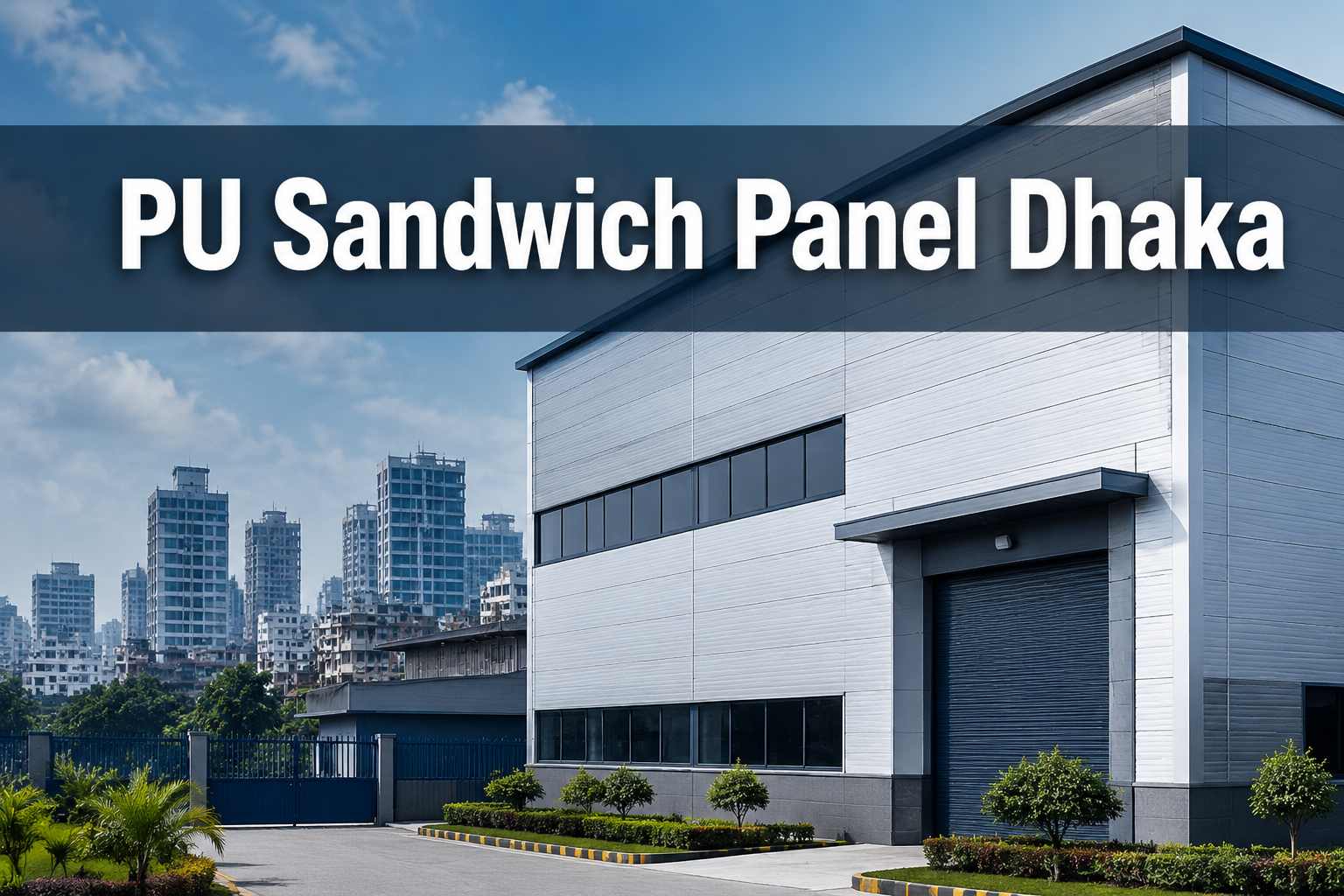
Quick Answer: PU sandwich panels in Dhaka are polyurethane-core insulated building panels used for walls, roofs, and cold rooms across industrial, commercial, and food-sector projects. They offer superior thermal performance compared to EPS alternatives, making them the preferred choice for cold storage, cleanrooms, and pharmaceutical facilities in Bangladesh's hot and humid climate. Prices, panel thickness, and supplier quality vary significantly, so knowing what to look for before buying saves both money and installation headaches.
Key Takeaways
- PU (polyurethane) sandwich panels consist of two steel face sheets bonded to a rigid foam core, delivering excellent thermal insulation and structural strength.
- Dhaka has a growing number of local manufacturers and suppliers, but quality standards differ widely — always verify core density and steel gauge before ordering.
- PU panels outperform EPS panels on thermal resistance (lower lambda value), making them better for cold rooms and temperature-sensitive applications.
- Common thicknesses available in Dhaka: 50mm, 75mm, 100mm, 150mm, and 200mm — the right choice depends on your target internal temperature.
- Typical applications in Dhaka include cold storage, food processing plants, pharmaceutical warehouses, cleanrooms, poultry farms, and prefabricated factory buildings.
- Installation is faster than conventional brick-and-mortar construction, often cutting build time by 40–60% (industry estimate based on contractor reports).
- Always ask for third-party test certificates for fire rating, thermal conductivity, and steel thickness before finalizing a supplier.
- Budget for accessories: cam-lock connectors, corner trims, panel doors, and sealants add 10–20% to panel costs.
What Is a PU Sandwich Panel and Why Does It Matter in Dhaka?
A PU sandwich panel is a prefabricated building element made of two pre-painted steel sheets with a rigid polyurethane foam core injected and bonded between them. The result is a lightweight, load-bearing panel that insulates, protects, and finishes a wall or roof in a single installation step.
Dhaka's construction sector has adopted these panels rapidly because the city's climate — averaging 30–35°C with high humidity for much of the year — puts enormous pressure on any building that needs to maintain a controlled internal temperature. Conventional brick walls simply cannot match the thermal performance of a 100mm PU core without adding prohibitive wall thickness.
For buyers sourcing PU sandwich panel in Dhaka, the key specs to understand are:
- Core density: Typically 38–42 kg/m³ for standard panels. Higher density means better structural integrity and insulation.
- Thermal conductivity (lambda): PU foam achieves approximately 0.022–0.025 W/mK, compared to EPS at around 0.035–0.040 W/mK. (Source: industry material data sheets from panel manufacturers.)
- Steel face thickness: Usually 0.4mm to 0.6mm. Thicker steel improves dent resistance and longevity.
- Panel width: Most Dhaka suppliers offer 950mm or 1000mm modular widths.
For a detailed comparison of core materials, see EPS vs PU Sandwich Panel: Which Is Right for You?.
Where Is PU Sandwich Panel Used in Dhaka?
PU sandwich panels are the go-to solution for any Dhaka project requiring thermal control, hygiene, or fast construction. The most common applications include:
| Application | Recommended Thickness | Key Reason for PU |
|---|---|---|
| Cold room / cold storage | 100mm – 200mm | High thermal resistance |
| Food processing facility | 75mm – 100mm | Hygiene-grade surface |
| Pharmaceutical warehouse | 100mm | Temperature + humidity control |
| Cleanroom / hospital OT | 75mm – 100mm | Smooth, antibacterial surface |
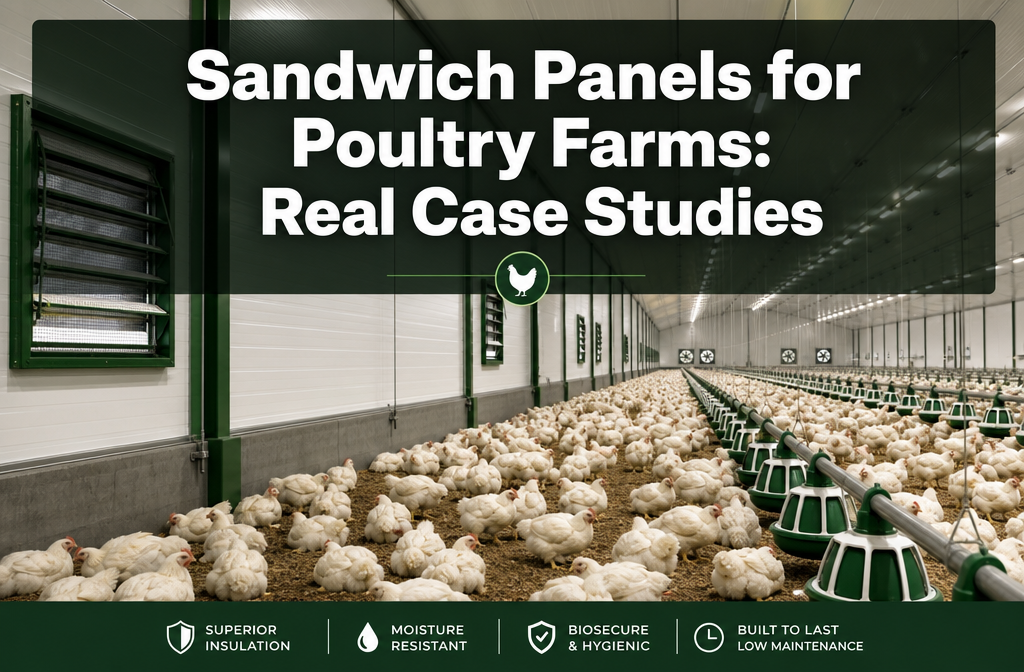
| Poultry farm | 50mm – 75mm | Ventilation + insulation balance |
| Prefabricated factory | 50mm – 75mm | Speed + cost efficiency |
Cold storage is the single largest demand driver for PU panels in Dhaka. As Bangladesh's food export sector grows, refrigerated warehouses and processing units are being built at pace across Gazipur, Savar, and the Dhaka Export Processing Zone. For a deeper look at this application, the PU Sandwich Panel for Cold Room: Complete Guide 2026 covers thickness selection, vapor barriers, and cam-lock joining systems.
Cleanrooms for pharmaceutical and electronics manufacturing are another fast-growing segment. These require smooth, non-porous panel surfaces that resist microbial growth — a standard feature of quality PU panels with polyester-coated steel faces. See the Clean Room Sandwich Panel Bangladesh: Full Buyer's Guide for GMP compliance requirements.
How to Choose the Right PU Sandwich Panel Thickness in Dhaka
Panel thickness is the single most important technical decision. Choosing too thin wastes energy; choosing too thick wastes money.
The rule of thumb: The colder the target internal temperature, the thicker the panel needed.
- +5°C to +10°C (chiller rooms): 75mm to 100mm
- -18°C to -25°C (blast freezers): 150mm to 200mm
- Ambient-controlled rooms (20–25°C): 50mm to 75mm
- Factory walls with no temperature target: 50mm is usually sufficient
A full breakdown of selection criteria, including roof vs. wall vs. floor panel differences, is available in the How to Choose Sandwich Panel Thickness (2026 Guide).
Common mistake: Many Dhaka buyers select thickness based on price alone and under-specify for cold storage. A 75mm panel used in a -18°C freezer will cause the refrigeration system to overwork, increasing electricity costs and shortening compressor life. The energy cost difference over five years almost always exceeds the upfront saving on panel cost.
What Does PU Sandwich Panel Cost in Dhaka in 2026?
Pricing for PU sandwich panels in Dhaka depends on four main variables: panel thickness, steel gauge, surface finish, and order volume.
Estimated price ranges (2026, Dhaka market):
- 50mm PU panel: BDT 900 – 1,200 per square meter
- 75mm PU panel: BDT 1,100 – 1,500 per square meter
- 100mm PU panel: BDT 1,300 – 1,800 per square meter
- 150mm PU panel: BDT 1,700 – 2,300 per square meter
Note: These are market estimates based on supplier quotations. Actual prices vary by supplier, steel coil prices, and project volume. Always get at least three written quotations.
Accessories — cam-lock connectors, corner profiles, ridge caps, and insulated panel doors — typically add 12–18% to the base panel cost. For a full pricing breakdown including accessories, see Sandwich Panel Price in Bangladesh 2026 | Full Guide.
Choose PU if: Your project requires thermal performance below +5°C, or if hygiene standards (food, pharma, medical) are a requirement.
Choose EPS if: Budget is the primary constraint and the application is a factory wall or roof with no temperature control requirement.
How to Find Reliable PU Sandwich Panel Suppliers in Dhaka
Not all Dhaka suppliers produce panels to consistent quality standards. The local market includes both manufacturers who produce panels in-house and traders who import or resell panels of variable origin.
Steps to verify a supplier:
- Ask for a factory visit or video tour. Reputable manufacturers will show their foaming line and steel coil inventory.
- Request test certificates. Look for thermal conductivity (lambda value), core density, and steel thickness test reports from a recognized laboratory.
- Check fire rating documentation. PU foam is combustible unless treated with fire-retardant additives. Ask for the fire class rating (B2 or better for most commercial applications).
- Review past project references. Ask for photos and contact details of completed cold room or factory projects in Dhaka.
- Confirm warranty terms in writing. Reputable suppliers offer 10–15 year warranties on panel integrity.
For a vetted list of manufacturers operating in and around Dhaka, the Sandwich Panel Manufacturers in Dhaka: 2026 Buyer's Guide is a useful starting point.
PU vs. EPS vs. Rockwool: Which Core Is Best for Dhaka Projects?
Three core materials dominate the Dhaka sandwich panel market. Here's a direct comparison:
| Property | PU (Polyurethane) | EPS (Polystyrene) | Rockwool (Mineral Wool) |
|---|---|---|---|
| Thermal conductivity | ~0.022 W/mK | ~0.038 W/mK | ~0.040 W/mK |
| Fire resistance | Combustible (FR grade available) | Combustible | Non-combustible |
| Moisture resistance | Excellent | Good | Poor (absorbs moisture) |
| Cost | Higher | Lower | Highest |
| Best for | Cold rooms, cleanrooms | Factory walls, roofs | Fire-rated applications |
Bottom line: PU wins on thermal performance and moisture resistance, making it the right choice for cold storage and hygiene-critical spaces in Dhaka. Rockwool is the choice when fire resistance is the non-negotiable requirement. EPS suits budget-driven factory and warehouse projects where temperature control is not critical.
For fire safety considerations, the Rockwool Sandwich Panel Fire Safety: Complete 2026 Guide covers when to specify mineral wool over PU.
Installation Considerations for PU Sandwich Panel in Dhaka
PU sandwich panels are faster to install than conventional construction, but errors during installation cause long-term problems — especially in cold room applications where vapor infiltration destroys insulation performance over time.
Key installation steps for Dhaka projects:
- Prepare the structural frame (steel or concrete) to correct tolerances. Panel systems require flat, level bearing surfaces.
- Install floor panels first (for cold rooms), then walls, then ceiling panels.
- Use cam-lock connectors at panel joints to create a continuous, airtight seal.
- Apply polyurethane sealant at all joints, penetrations, and perimeters. This is the most commonly skipped step and the most consequential.
- Install panel doors with proper magnetic gaskets to maintain the cold chain.
- Inspect all joints before commissioning. Use a thermal camera if available to identify cold bridges.
For a step-by-step installation guide specific to cold room applications, see Cold Room Sandwich Panel Installation Guide 2026.
Edge case: In Dhaka's monsoon season, storing uninstalled panels on-site requires covering them with waterproof sheeting. PU foam does not absorb water, but prolonged exposure to standing water can delaminate the steel face bond on lower-quality panels.
FAQ: PU Sandwich Panel Dhaka
Q: What is the minimum order quantity for PU sandwich panels in Dhaka?
Most Dhaka manufacturers accept orders from 50 square meters upward. Smaller orders are possible from traders but typically cost 15–25% more per square meter.
Q: How long does delivery take from a Dhaka supplier?
For stock panels (standard thickness and color), delivery is typically 7–14 days. Custom orders — non-standard thickness, special colors, or fire-rated grades — usually take 3–5 weeks.
Q: Can PU sandwich panels be used for roofing in Dhaka?
Yes. PU panels are used for roofing in temperature-controlled buildings. For standard factory or warehouse roofs without temperature requirements, EPS or profiled steel is more cost-effective. See the Sandwich Panel Roof Installation Bangladesh: 2026 Guide for slope, fixing, and waterproofing details.
Q: Are PU sandwich panels suitable for Dhaka's humid climate?
Yes. PU foam has a closed-cell structure that resists moisture absorption, making it well-suited to Bangladesh's high-humidity environment. EPS is also acceptable, but PU performs better over the long term in wet conditions.
Q: What fire rating should I specify for a food processing plant in Dhaka?
For food processing facilities, specify fire-retardant (FR) grade PU panels with a minimum B2 fire classification. Check with your local fire department and building authority for any additional requirements.
Q: How do I maintain PU sandwich panels after installation?
Clean panel surfaces with mild detergent and water. Avoid abrasive cleaners that scratch the steel coating. Inspect joints and sealants annually. For a full maintenance schedule, see the Maintenance of Sandwich Panels: Complete 2026 Guide.
Q: Can PU panels be cut on-site in Dhaka?
Yes, using a circular saw with a fine-tooth blade or a jigsaw. Always cut with the steel face up to minimize burring. Seal all cut edges immediately with touch-up paint to prevent rust in Dhaka's humid conditions.
Q: What is the lifespan of a PU sandwich panel in Bangladesh?
With proper installation and maintenance, quality PU panels last 20–30 years. The steel face coating (typically PVDF or polyester) is the limiting factor — cheaper coatings degrade faster in UV-exposed roofing applications.
Q: Is PU sandwich panel suitable for a hospital OT room in Dhaka?
Yes. PU panels with smooth, antibacterial-coated steel faces are widely used for hospital operating theatres. They meet hygiene requirements and allow easy cleaning. See the Hospital OT Room Sandwich Panel: Complete Guide 2026 for specification details.
Q: How does PU sandwich panel compare to conventional brick construction for factory buildings in Dhaka?
PU panel construction is typically 40–60% faster, lighter on the structural foundation, and significantly better at thermal and acoustic insulation. The upfront cost per square meter is higher than brick, but total project cost (including foundation, finishing, and energy savings) often favors panels for industrial applications.
Conclusion: Actionable Next Steps for Buying PU Sandwich Panel in Dhaka
PU sandwich panels are the right choice for any Dhaka project where thermal performance, hygiene, or construction speed is a priority. The technology is proven, local supply is available, and the long-term energy savings in cold chain or climate-controlled applications justify the higher upfront cost compared to EPS alternatives.
Before placing an order, take these steps:
- Define your application clearly — cold room, cleanroom, factory, or poultry farm — because this determines the correct thickness and surface finish.
- Get at least three supplier quotes with full specifications: core density, steel gauge, fire rating, and warranty terms.
- Ask for test certificates and, where possible, visit a completed project the supplier has delivered.
- Budget for accessories — cam-locks, trims, doors, and sealants — from the start to avoid cost surprises.
- Plan installation with a qualified contractor who has specific experience with sandwich panel systems, not just general construction.
For further research, the Insulated Sandwich Panel Bangladesh: Complete 2026 Guide covers the broader market context, and the Polyurethane Sandwich Panel Benefits: Full Guide 2026 goes deeper into the technical advantages of PU core materials.
References
- Sandwich Panel Manufacturers BD. EPS vs PU Sandwich Panel: Which Core Material? sandwichpaneltlbd.com (2024)
- Sandwich Panel Manufacturers BD. PU Sandwich Panel for Cold Room: Complete Guide. sandwichpaneltlbd.com (2024)
- Sandwich Panel Manufacturers BD. Sandwich Panel Price in Bangladesh. sandwichpaneltlbd.com (2024)
- Sandwich Panel Manufacturers BD. Cold Room Sandwich Panel Installation Guide. sandwichpaneltlbd.com (2024)
- Sandwich Panel Manufacturers BD. How to Choose Sandwich Panel Thickness. sandwichpaneltlbd.com (2024)