Last updated: July 31, 2026

Quick Answer
Rockwool sandwich panel specification includes core density of 80-150 kg/m³, thermal conductivity of 0.035-0.042 W/mK, fire rating up to A1 non-combustible, and thickness options from 50mm to 200mm. These panels feature galvanized steel or aluminum face sheets with mineral wool core, offering R-values between 1.4-5.7 m²K/W depending on thickness. Standard widths range from 950mm to 1200mm with lengths up to 12 meters.
Key Takeaways
- Core density: 80-150 kg/m³ mineral wool provides optimal thermal and acoustic performance
- Fire rating: A1 non-combustible classification meets strictest building codes
- Thermal performance: R-values from 1.4 to 5.7 m²K/W based on panel thickness
- Standard thickness: 50mm, 75mm, 100mm, 120mm, 150mm, and 200mm options available
- Face sheet materials: Galvanized steel (0.4-0.8mm) or aluminum (0.5-1.0mm) thickness
- Acoustic rating: Sound reduction up to 45 dB for 100mm panels
- Weight: 12-25 kg/m² depending on thickness and face sheet material
- Lifespan: 30-50 years with proper installation and maintenance
- Moisture resistance: Vapor permeability <0.05 mg/Pa·h·m with proper sealing
What Are Rockwool Sandwich Panels and How Do They Work
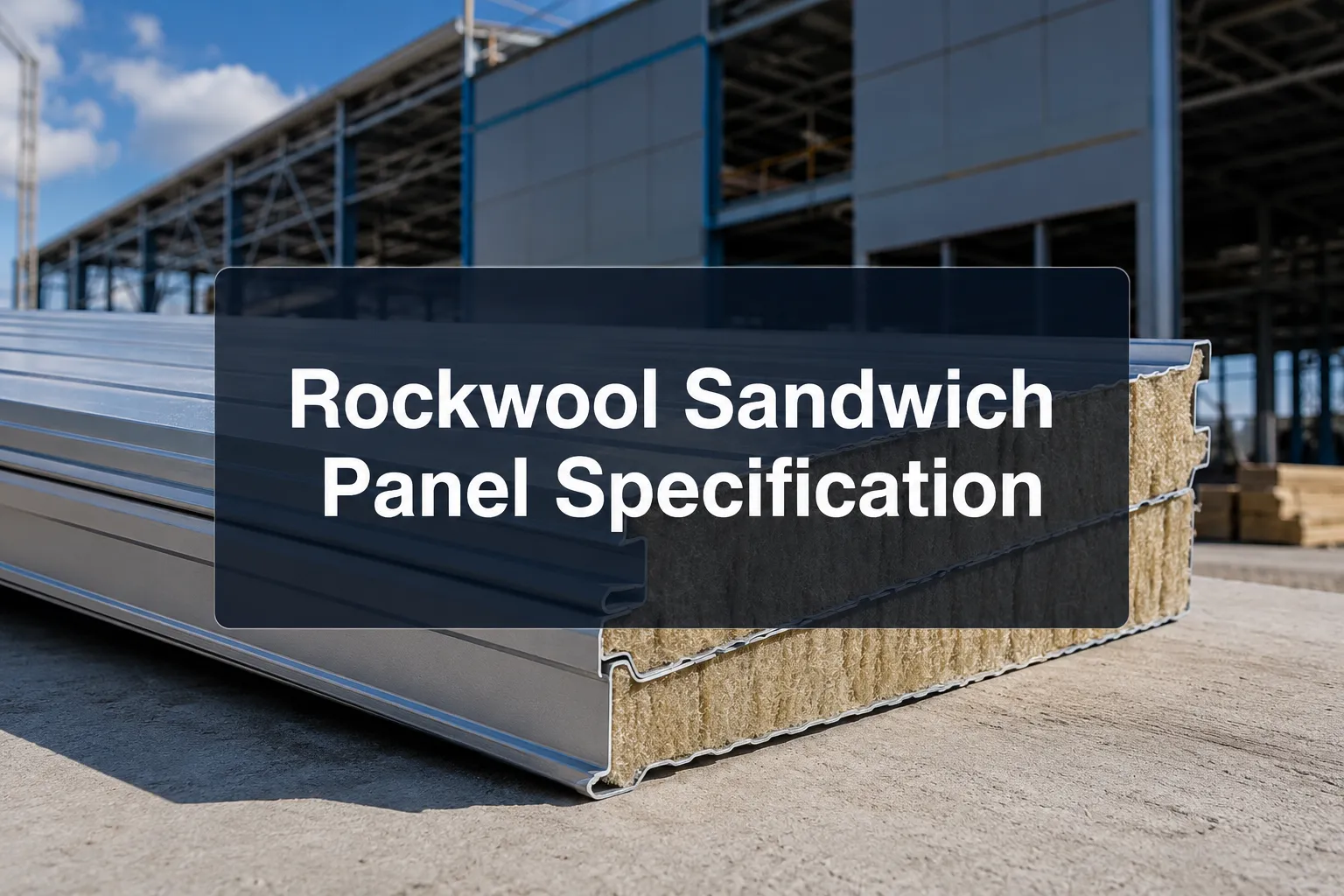
Rockwool sandwich panels consist of mineral wool insulation core bonded between two metal face sheets, creating a composite building element that provides structural strength, thermal insulation, and fire resistance in one product. The mineral wool core is manufactured from basalt rock and recycled steel slag, spun into fibers and formed into rigid boards.
The panels work through a combination of thermal bridging prevention and trapped air spaces within the mineral wool matrix. The metal face sheets provide structural rigidity and weather protection, while the rockwool core delivers insulation performance. The continuous core eliminates thermal bridges that occur with traditional framing methods.
Key structural components include:
- Outer face sheets (galvanized steel, aluminum, or composite materials)
- Mineral wool core with controlled density
- Adhesive bonding system between core and faces
- Edge sealing and joint systems for weather tightness
Choose rockwool panels when fire resistance is critical, such as industrial facilities, hospitals, or high-rise buildings. Avoid them for budget-sensitive projects where fire rating requirements are minimal, as they cost 15-30% more than EPS alternatives.
Rockwool vs Fiberglass vs Polyurethane Sandwich Panel Comparison
Rockwool sandwich panels outperform fiberglass and polyurethane options in fire resistance and acoustic performance, while polyurethane excels in thermal efficiency and fiberglass offers the lowest cost. Each material serves different project priorities and building code requirements.
Performance comparison by material:
| Property | Rockwool | Fiberglass | Polyurethane |
|---|---|---|---|
| Fire Rating | A1 Non-combustible | A2 Limited combustible | B2-C Combustible |
| R-Value (100mm) | 2.4-2.8 m²K/W | 2.2-2.6 m²K/W | 4.2-5.0 m²K/W |
| Sound Reduction | 35-45 dB | 25-35 dB | 20-30 dB |
| Moisture Resistance | Excellent | Good | Fair |
| Cost Premium | +20-30% | Baseline | +10-15% |
Select rockwool when fire codes require A1 rating or when acoustic control is essential. Choose polyurethane for maximum thermal efficiency in cold storage or energy-efficient buildings. Opt for fiberglass when budget constraints are primary and fire requirements are less stringent.
Rockwool Sandwich Panel Thickness and R-Value Specifications
Standard rockwool sandwich panel thickness ranges from 50mm to 200mm, with R-values increasing proportionally from 1.4 to 5.7 m²K/W. The thermal conductivity of mineral wool core typically measures 0.035-0.042 W/mK, depending on density and manufacturing process.
Thickness and thermal performance specifications:
- 50mm panels: R-value 1.4-1.6 m²K/W, suitable for interior partitions
- 75mm panels: R-value 2.1-2.4 m²K/W, minimum for exterior walls in mild climates
- 100mm panels: R-value 2.8-3.2 m²K/W, standard for most commercial applications
- 120mm panels: R-value 3.4-3.8 m²K/W, enhanced thermal performance
- 150mm panels: R-value 4.2-4.7 m²K/W, cold climate applications
- 200mm panels: R-value 5.7-6.3 m²K/W, maximum insulation for extreme conditions
The relationship between thickness and thermal performance is nearly linear, but diminishing returns occur beyond 150mm thickness. Core density affects both thermal and structural properties – higher density (120-150 kg/m³) provides better structural strength but slightly reduced thermal performance compared to lower density (80-100 kg/m³) cores.
Choose 100mm thickness for standard commercial buildings in moderate climates. Increase to 150mm or 200mm for cold storage facilities, hospitals requiring strict temperature control, or buildings targeting high energy efficiency ratings.
Rockwool Sandwich Panel Cost Per Square Meter Pricing
Rockwool sandwich panel pricing ranges from $25-45 per square meter depending on thickness, face sheet material, and order quantity. Standard 100mm panels with galvanized steel faces typically cost $30-35/m², while premium aluminum-faced or thicker panels can reach $40-50/m².
Price breakdown by specifications:
- 50mm galvanized steel: $25-30/m²
- 100mm galvanized steel: $30-35/m²
- 150mm galvanized steel: $38-45/m²
- 100mm aluminum faces: $35-42/m²
- Custom colors/coatings: Add $3-8/m²
- Fire-rated edge sealing: Add $2-5/m²
Installation costs add $8-15/m² depending on project complexity, access conditions, and local labor rates. Large projects (>1000m²) typically receive 10-20% volume discounts, while small orders may include minimum quantity charges.
Factor in additional costs for structural support modifications, crane rental for installation, and specialized fasteners. The total installed cost including labor ranges from $40-65/m² for typical commercial applications.
For current rockwool panel pricing in Bangladesh, local suppliers offer competitive rates with shorter delivery times than imported panels.
Fire Rating and Safety Specifications for Rockwool Panels
Rockwool sandwich panels achieve A1 non-combustible fire rating according to EN 13501-1 classification, meaning they do not contribute to fire load or produce flaming droplets during fire exposure. The mineral wool core maintains structural integrity up to 1000°C (1832°F) and provides fire resistance ratings from 30 to 120 minutes depending on panel thickness and construction details.
Fire performance specifications:
- Fire classification: A1 non-combustible (highest safety level)
- Melting point: >1000°C mineral wool core
- Fire resistance: 30-120 minutes structural integrity
- Smoke production: Class s1 (limited smoke emission)
- Flaming droplets: d0 (no flaming droplets)
- Toxic gas emission: Minimal due to inorganic composition
The panels meet international fire safety standards including ASTM E119, BS 476, and local building codes. Face sheet materials affect overall fire performance – steel faces maintain A1 rating while some organic coatings may reduce classification to A2.
Proper installation with fire-rated sealants and correct joint details is essential for maintaining fire resistance ratings. Fire safety considerations for rockwool panels include proper edge sealing and penetration details to prevent fire spread through panel joints.
Use A1-rated rockwool panels for hospitals, schools, high-rise buildings, and industrial facilities where fire safety is paramount. The superior fire performance justifies the cost premium in life-safety critical applications.
Applications Where Rockwool Sandwich Panels Excel
Rockwool sandwich panels are primarily used in commercial and industrial construction where fire resistance, acoustic control, and thermal performance are critical requirements. The panels excel in applications requiring A1 fire rating compliance and superior sound attenuation properties.
Primary application categories:
Healthcare facilities: Hospitals, clinics, and medical centers benefit from fire safety, acoustic privacy, and easy cleaning properties. The panels support strict hygiene requirements while providing thermal comfort.
Educational buildings: Schools and universities use rockwool panels for fire safety compliance and classroom acoustic control. The panels reduce noise transmission between spaces and provide safe egress in emergencies.
Industrial facilities: Manufacturing plants, warehouses, and processing facilities require fire-resistant construction that can withstand industrial processes and provide worker safety.
Cold storage and food processing: The combination of thermal performance, moisture resistance, and food-safe properties makes rockwool panels ideal for refrigerated facilities and food manufacturing.
Data centers and server rooms: Fire protection and thermal control are essential for protecting valuable electronic equipment and maintaining optimal operating temperatures.
Avoid rockwool panels for residential construction where cost sensitivity outweighs fire performance benefits, or in corrosive environments where the metal face sheets may degrade rapidly without proper protective coatings.
For specialized applications like poultry farming, rockwool panels provide ammonia resistance and easy sanitization while maintaining optimal environmental controls.
Installation Best Practices for Rockwool Sandwich Panels
Proper rockwool sandwich panel installation requires careful attention to structural support, weather sealing, and thermal bridge prevention to achieve specified performance levels. The panels must be installed on adequately designed structural framing with appropriate fastener spacing and edge details.
Critical installation requirements:
Structural support: Design purlins and girts to support panel loads plus wind and seismic forces. Maximum purlin spacing depends on panel thickness and loading conditions – typically 1.5-2.5 meters for wall panels and 1.2-2.0 meters for roof panels.
Fastener selection: Use appropriate fasteners for substrate material and loading conditions. Self-drilling screws with EPDM washers prevent water infiltration and provide adequate pull-out resistance.
Joint sealing: Apply structural sealant to all panel joints and penetrations to maintain thermal performance and weather resistance. Use fire-rated sealants where fire resistance ratings must be maintained.
Thermal bridge prevention: Install thermal breaks at structural connections and avoid continuous metal elements that bypass the insulation layer.
Quality control checklist:
- Verify structural adequacy before panel installation
- Check panel alignment and plumbness during installation
- Test joint sealing for air and water tightness
- Inspect fastener installation for proper engagement and sealing
- Document installation details for warranty compliance
Common installation errors include inadequate structural support, improper fastener spacing, and poor joint sealing that compromises thermal performance. Engage experienced installers familiar with sandwich panel systems to avoid costly rework.
Moisture Resistance and Vapor Barrier Properties
Rockwool sandwich panels provide excellent moisture resistance through the combination of water-repellent mineral wool core and properly sealed metal face sheets. The panels achieve vapor permeability ratings below 0.05 mg/Pa·h·m when joints are properly sealed, effectively functioning as a vapor barrier system.
The mineral wool core naturally resists moisture absorption due to its inorganic composition and hydrophobic treatment during manufacturing. Unlike organic insulation materials, rockwool maintains thermal performance even if exposed to moisture and dries quickly without supporting mold growth.
Moisture control features:
- Hydrophobic core treatment: Repels water while allowing vapor transmission
- Metal face sheet barrier: Prevents bulk water penetration when properly sealed
- Joint sealing system: Creates continuous vapor barrier when installed correctly
- Drainage design: Allows incidental moisture to drain without accumulation
Proper installation requires continuous air and vapor barrier through careful joint sealing and penetration details. Use compatible sealants that maintain adhesion to both metal faces and provide long-term durability under thermal cycling.
The panels perform well in high-humidity environments like clean rooms and food processing facilities where moisture control is critical for both building performance and process requirements.
Avoid installing panels in direct contact with ground moisture or in applications where continuous water exposure occurs without proper drainage and ventilation systems.
Weight and Load Capacity Specifications
Rockwool sandwich panels typically weigh 12-25 kg/m² depending on thickness and face sheet specifications, making them heavier than EPS alternatives but lighter than traditional masonry construction. The structural capacity varies significantly based on panel configuration, span conditions, and loading requirements.
Weight specifications by thickness:
- 50mm panels: 12-15 kg/m² (galvanized steel faces)
- 100mm panels: 16-20 kg/m² (standard configuration)
- 150mm panels: 20-24 kg/m² (heavy-duty applications)
- 200mm panels: 24-28 kg/m² (maximum thickness)
Structural load capacity factors:
- Span length: Longer spans reduce allowable loads significantly
- Support conditions: Continuous vs. point support affects capacity
- Face sheet thickness: Heavier gauge faces increase structural strength
- Core density: Higher density cores provide better compressive strength
Typical allowable loads range from 1.5-4.0 kN/m² for wall panels and 2.0-6.0 kN/m² for roof panels, depending on span and support conditions. Consult structural engineering calculations for specific project requirements, as generic load tables may not account for local wind and seismic conditions.
The panels can support typical building loads including HVAC equipment, lighting systems, and architectural features when properly designed and installed with adequate structural framing.
Acoustic Insulation Properties of Rockwool Panels
Rockwool sandwich panels deliver superior acoustic performance compared to other insulation types, achieving sound transmission class (STC) ratings of 35-45 dB for standard wall configurations. The fibrous mineral wool core effectively absorbs sound energy across a broad frequency range, making it ideal for noise-sensitive applications.
Acoustic performance by thickness:
- 75mm panels: 32-38 dB sound reduction
- 100mm panels: 35-42 dB sound reduction
- 150mm panels: 40-47 dB sound reduction
- 200mm panels: 45-52 dB sound reduction
The acoustic performance depends on panel mounting details, joint sealing quality, and overall wall assembly design. Proper installation with sealed joints and resilient mounting can improve performance by 3-5 dB compared to standard installation methods.
Key acoustic benefits:
- Broad frequency absorption: Effective across speech and machinery noise ranges
- Impact sound reduction: Reduces structure-borne vibration transmission
- Reverberation control: Absorbs reflected sound within spaces
- Fire-safe acoustic solution: Combines sound control with A1 fire rating
For applications requiring enhanced acoustic performance, consider specialized acoustic rockwool panels with optimized core density and face sheet perforations.
The superior acoustic properties make rockwool panels ideal for schools, hospitals, offices, and industrial facilities where noise control directly impacts occupant comfort and productivity.
Common Problems with Rockwool Sandwich Panels
The most frequent issues with rockwool sandwich panels stem from improper installation, inadequate structural design, and poor joint sealing rather than inherent material defects. Understanding these common problems helps prevent costly performance failures and warranty issues.
Installation-related problems:
- Thermal bridging: Continuous metal elements bypassing insulation reduce thermal performance by 15-30%
- Air leakage: Poor joint sealing allows air infiltration, reducing energy efficiency and comfort
- Structural inadequacy: Undersized framing leads to panel deflection, joint failure, and water infiltration
- Fastener problems: Incorrect fasteners or spacing cause panel detachment and weather seal failure
Design-related issues:
- Condensation: Inadequate vapor barrier design causes moisture accumulation within wall systems
- Differential movement: Failure to accommodate thermal expansion leads to joint cracking and seal failure
- Load path problems: Poor load transfer details cause localized stress concentrations and panel damage
Long-term performance issues:
- Face sheet corrosion: Inadequate coating or galvanizing leads to rust and aesthetic deterioration
- Sealant failure: UV exposure and thermal cycling degrade joint sealants over 10-15 years
- Fastener loosening: Thermal cycling and building movement can loosen connections over time
Prevent these problems through proper design, quality installation, and regular maintenance inspection. Most issues are avoidable with experienced contractors and adherence to manufacturer installation guidelines.
Environmental Impact and Sustainability of Rockwool Panels
Rockwool sandwich panels offer significant environmental benefits through their use of recycled content, energy efficiency performance, and long service life. The mineral wool core contains 75-85% recycled materials including post-consumer steel slag and basalt rock, reducing virgin material consumption.
Sustainability advantages:
- Recycled content: 75-85% recycled steel slag and rock materials
- Energy efficiency: Superior thermal performance reduces building energy consumption
- Durability: 30-50 year service life minimizes replacement frequency
- Recyclability: Steel faces are fully recyclable at end of service life
- Non-toxic: Inorganic composition eliminates off-gassing concerns
Environmental performance metrics:
- Embodied carbon: 15-25 kg CO₂/m² depending on face sheet material
- Energy payback: 6-18 months through operational energy savings
- Recycled content: Meets LEED and BREEAM green building requirements
- Indoor air quality: No formaldehyde or VOC emissions
The panels contribute to green building certification through multiple credit categories including energy performance, recycled content, and indoor environmental quality.
Manufacturing energy requirements are higher than organic insulation alternatives, but the superior thermal performance and durability typically result in net environmental benefits over the building lifecycle.
Choose rockwool panels for projects prioritizing long-term sustainability, indoor air quality, and green building certification requirements.
Lifespan and Durability Expectations
Properly installed rockwool sandwich panels typically last 30-50 years with minimal maintenance, making them a cost-effective long-term building solution. The inorganic mineral wool core does not degrade over time, while the metal face sheets provide the primary durability limitation based on coating quality and environmental exposure.
Durability factors by component:
- Mineral wool core: 50+ years with no performance degradation
- Galvanized steel faces: 25-40 years depending on coating thickness and environment
- Aluminum faces: 40-60 years with superior corrosion resistance
- Joint sealants: 15-25 years requiring periodic replacement
- Fasteners: 30-50 years with proper material selection
Environmental factors affecting lifespan:
- Coastal exposure: Salt air accelerates metal corrosion, reducing lifespan by 20-30%
- Industrial environments: Chemical exposure may require protective coatings
- UV exposure: Direct sunlight degrades sealants and some coatings over time
- Thermal cycling: Extreme temperature variations stress joints and connections
Maintenance requirements:
- Annual inspection: Check joint sealants and fasteners for deterioration
- 5-year sealant renewal: Replace weatherstrip and structural sealants as needed
- Surface cleaning: Remove dirt and debris that can trap moisture
- Coating touch-up: Address minor scratches and coating damage promptly
The long service life and low maintenance requirements make rockwool panels particularly cost-effective for institutional and commercial buildings where lifecycle costs are more important than initial construction costs.
Rockwool vs Rigid Foam Boards: Which Performs Better
Rockwool sandwich panels outperform rigid foam board systems in fire safety, acoustic performance, and installation efficiency, while rigid foam boards offer superior thermal performance per inch of thickness and lower material costs. The choice depends on project priorities and building code requirements.
Performance comparison summary:
Fire safety: Rockwool achieves A1 non-combustible rating while most rigid foams are combustible (B2-C rating), requiring additional fire barriers and protection systems.
Thermal efficiency: Rigid foam boards provide R-6 to R-8 per inch compared to rockwool's R-4 to R-4.5 per inch, requiring thicker rockwool panels for equivalent thermal performance.
Installation speed: Sandwich panels install as single components with integrated structure, while rigid foam requires separate insulation, air barrier, and cladding installation steps.
Acoustic performance: Rockwool provides superior sound absorption and transmission loss compared to rigid foam's minimal acoustic benefits.
Moisture management: Both systems perform well when properly detailed, but rockwool is more forgiving of incidental moisture exposure.
Cost comparison: Initial material costs favor rigid foam by 15-25%, but installed costs are often similar due to rockwool's faster installation and integrated system approach.
Choose rockwool sandwich panels when fire codes require non-combustible construction, acoustic performance is important, or fast installation schedules are critical. Select rigid foam systems for maximum thermal efficiency in thickness-constrained applications or when budget is the primary consideration.
For comprehensive guidance on choosing the right sandwich panel thickness, consider thermal requirements, structural loads, and code compliance together.
Frequently Asked Questions
What is the minimum thickness for exterior wall applications?
75mm is the minimum recommended thickness for exterior walls in mild climates, while 100mm or greater is required for cold climates or energy-efficient building standards. Interior partitions can use 50mm panels.
Can rockwool sandwich panels be used for structural applications?
Rockwool panels provide structural spanning capability but are not primary structural elements. They require adequate structural framing to support building loads and transfer forces to the foundation system.
How do you cut rockwool sandwich panels on site?
Use a circular saw with fine-tooth blade for straight cuts, and reciprocating saw for openings. Cut from the face sheet side to prevent core damage, and seal cut edges with appropriate sealant to maintain weather resistance.
What fastener spacing is required for rockwool panels?
Typical fastener spacing is 300-600mm on center depending on wind loads and panel thickness. Edge fasteners should be 150mm from panel ends, with intermediate fasteners at each structural support point.
Do rockwool panels require a vapor barrier?
The panels function as a vapor barrier system when joints are properly sealed. Additional vapor barriers are typically not required but may be specified in extreme climate conditions or specialized applications.
Can rockwool panels be installed in freezing weather?
Yes, but sealants and adhesives must be rated for low-temperature application. Some sealants require minimum 5°C (41°F) temperature for proper curing and adhesion.
What is the maximum span for rockwool sandwich panels?
Maximum spans depend on panel thickness, loading conditions, and deflection limits. Typical wall panel spans range from 4-8 meters, while roof panels span 3-6 meters between supports.
How do you repair damaged rockwool sandwich panels?
Small damages can be repaired with compatible sealants and patch materials. Significant damage typically requires panel replacement due to the integrated nature of the sandwich construction.
Are rockwool panels suitable for seismic zones?
Yes, when properly designed with appropriate connections and structural framing. The panels must accommodate building movement through flexible connections and properly detailed joints.
What maintenance is required for rockwool sandwich panels?
Annual inspection of joints and sealants, periodic cleaning of surfaces, and prompt repair of any coating damage or sealant failure. Most maintenance involves joint sealant replacement every 15-20 years.
Can rockwool panels be recycled at end of life?
The steel face sheets are fully recyclable, while the mineral wool core can be reprocessed into new insulation products. Separation of components is required for effective recycling.
Do rockwool panels off-gas or emit harmful substances?
No, the inorganic mineral wool composition does not emit formaldehyde, VOCs, or other harmful substances, making it suitable for sensitive indoor environments like hospitals and schools.
SEO Meta Title: Rockwool Sandwich Panel Specification Guide 2026 | Complete Technical Specs