Last updated: May 20, 2026
Quick Answer
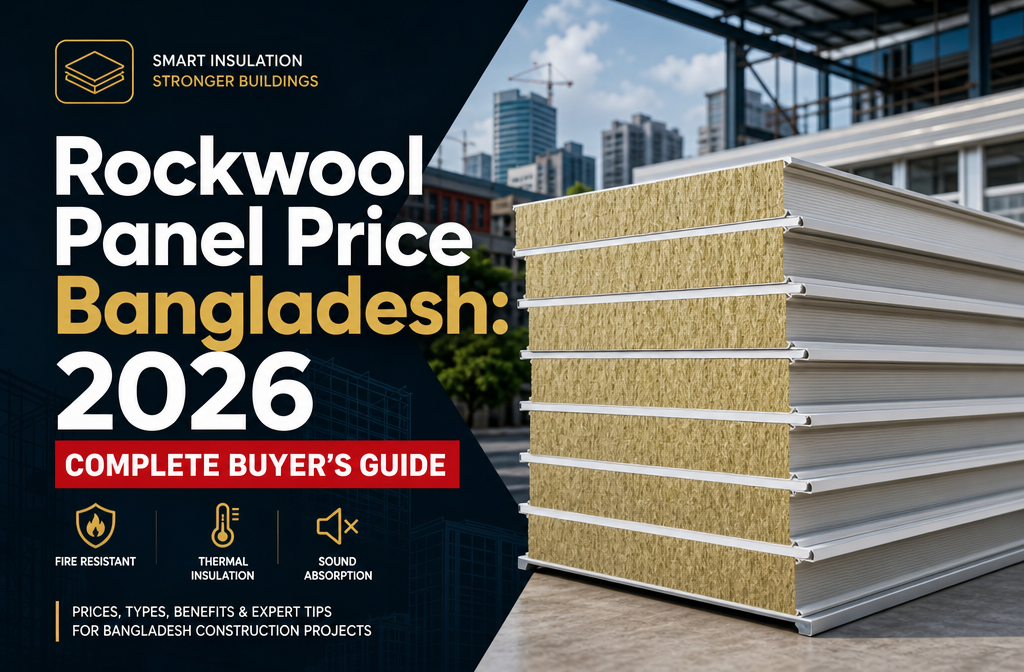
Rockwool panel prices in Bangladesh typically range from BDT 850 to BDT 2,200 per square meter depending on panel thickness, core density, and supplier. Imported panels from China, India, or South Korea generally cost more than locally assembled options. For most commercial and industrial projects in Dhaka or Chittagong, budget BDT 1,100–1,500 per sq. m. as a realistic mid-range estimate for standard 50mm–100mm panels.
Key Takeaways
- Standard rockwool sandwich panels in Bangladesh cost roughly BDT 850–2,200/sq. m. (2026 market estimate), varying by thickness and density.
- Industrial-grade panels (100mm+, high-density core) cost significantly more than residential-grade options.
- Rockwool panels cost 20–40% more than EPS panels but offer superior fire resistance and acoustic performance.
- Bangladesh has limited domestic rockwool core manufacturing; most cores are imported, which keeps prices higher than EPS or PU alternatives.
- Dhaka and Chittagong have the widest supplier networks; buyers in other regions may face additional freight costs.
- Installation labor adds roughly BDT 150–350/sq. m. on top of material costs.
- Rockwool performs well in humid tropical climates when properly sealed and installed.
- Panel lifespan in Bangladeshi conditions is typically 20–30 years with basic maintenance.
- For fire-sensitive buildings (hospitals, factories, garment units), rockwool is the preferred core material.
- Always verify core density (minimum 80–100 kg/m³ for structural panels) before purchasing.
How Much Do Rockwool Panels Cost in Dhaka?
Rockwool panel prices in Dhaka range from BDT 900 to BDT 2,200 per square meter for standard sandwich panel configurations in 2026. Prices vary based on panel thickness, steel skin gauge, and whether the core is imported or locally sourced.
Here is a general price breakdown by thickness for Dhaka-area suppliers:
| Panel Thickness | Core Density | Estimated Price (BDT/sq. m.) | Common Use |
|---|---|---|---|
| 50mm | 80 kg/m³ | 900 – 1,200 | Partition walls, ceilings |
| 75mm | 100 kg/m³ | 1,100 – 1,500 | Factory walls, warehouses |
| 100mm | 100–120 kg/m³ | 1,400 – 1,800 | Industrial roofs, cold-adjacent walls |
| 150mm | 120 kg/m³ | 1,700 – 2,200 | High-spec industrial, fire-rated zones |
Note: These are market estimates based on 2026 supplier quotes from Dhaka's Tejgaon and Gazipur industrial zones. Prices fluctuate with steel prices and import costs. Always get at least three written quotes before committing.
Common mistake: Many buyers compare only the panel price per square meter without accounting for steel skin thickness (0.4mm vs. 0.5mm). Thinner steel skins reduce cost but also reduce durability in humid conditions.
What's the Average Rockwool Panel Price Per Square Meter in Bangladesh?
The national average for rockwool sandwich panels in Bangladesh sits at approximately BDT 1,100–1,400 per square meter for 75mm panels, which is the most commonly specified thickness for commercial and light industrial projects.
Prices outside Dhaka (for example, Sylhet, Rajshahi, or Khulna) may be 5–15% higher due to freight and handling. Chittagong buyers often get slightly better rates because of proximity to the port, where imported rockwool cores arrive.
Choose this thickness if:
- 50mm: Interior partitions, non-structural ceilings, office dividers.
- 75mm: General factory walls, garment unit partitions, warehouse walls.
- 100mm+: Roofing applications, fire-rated assemblies, or anywhere requiring enhanced thermal performance.
For a deeper comparison of panel types and pricing structures, see the Sandwich Panel Price Per Square Meter Bangladesh 2026 guide.
Where to Buy Rockwool Insulation Panels in Bangladesh
Rockwool sandwich panels are available through three main channels in Bangladesh: dedicated sandwich panel manufacturers, construction material traders, and direct importers.
Top sourcing locations:
- Dhaka (Tejgaon, Gazipur, Savar): Highest concentration of manufacturers and assemblers. Best for large orders with customization.
- Chittagong: Strong importer presence; good for buyers who want imported finished panels from China or South Korea.
- Narayanganj: Several mid-size fabricators serve garment and textile sector clients.
What to look for in a supplier:
- Can they provide core density certificates or test reports?
- Do they offer on-site measurement and installation services?
- What is their minimum order quantity (MOQ)?
- Do they stock panels or fabricate to order (lead time matters)?
For a vetted list of suppliers, the Sandwich Panel Suppliers in Bangladesh: 2026 Buyer's Guide covers key players across regions.
Are Rockwool Panels Cheaper Than Fiberglass Insulation in Bangladesh?
Rockwool sandwich panels are generally more expensive than fiberglass insulation on a per-square-meter basis, but the comparison isn't straightforward because they serve different applications.
- Fiberglass batt insulation (used as loose fill or in framed walls) costs roughly BDT 300–600/sq. m. in Bangladesh but requires a separate structural system.
- Rockwool sandwich panels (self-supporting, with steel skins) cost BDT 900–2,200/sq. m. but include the wall or roof structure itself.
When comparing total installed cost for a complete wall or roof system, rockwool sandwich panels are often cost-competitive or cheaper than a conventional brick/concrete wall with separate fiberglass insulation, especially for industrial buildings.
Rockwool also outperforms fiberglass on fire resistance (non-combustible vs. combustible binder in some fiberglass products) and acoustic performance, which matters for factories, hospitals, and garment units.
For a direct material comparison, the PU Panel vs Rockwool Panel guide covers the tradeoffs in detail.
Which Bangladeshi Brands Make Rockwool Panels?
Bangladesh does not yet have large-scale domestic rockwool fiber manufacturers. Most rockwool cores are imported from China, India, or South Korea, then fabricated into sandwich panels locally.
Several Bangladeshi companies assemble rockwool sandwich panels using imported cores:
- Local fabricators in Gazipur and Savar import rockwool slabs and bond them between galvanized steel sheets on-site or in small factories.
- Larger panel manufacturers (serving the RMG and pharmaceutical sectors) offer branded rockwool sandwich panels with documented specifications.
- Trading companies in Dhaka import finished panels directly from Chinese brands like Kingspan-equivalent manufacturers.
Edge case: Some suppliers label panels as "rockwool" but use a mixed mineral wool or slag wool core with lower performance characteristics. Always ask for the core material data sheet and verify the density (kg/m³) and melting point (should exceed 1,000°C for genuine rockwool).
For an overview of the full rockwool sandwich panel market in Bangladesh, see Rockwool Sandwich Panel Bangladesh: 2026 Complete Guide.
Installation Cost for Rockwool Panels in Bangladeshi Homes and Buildings
Installation labor for rockwool sandwich panels in Bangladesh typically adds BDT 150–350 per square meter on top of material costs, depending on project complexity and location.
Factors that affect installation cost:
- Height and access: Rooftop or high-wall installations cost more due to scaffolding.
- Panel size and weight: Larger, heavier panels (100mm+) require more labor and sometimes equipment.
- Project location: Dhaka rates are higher than rural areas; remote sites add mobilization costs.
- Fixing system: Hidden-fix systems cost more to install than exposed-fix systems.
Rough total installed cost estimate (material + labor):
| Application | Material (BDT/sq. m.) | Labor (BDT/sq. m.) | Total Estimate |
|---|---|---|---|
| Interior partition wall | 900–1,200 | 150–200 | 1,050–1,400 |
| Factory wall (75mm) | 1,100–1,500 | 200–280 | 1,300–1,780 |
| Industrial roof (100mm) | 1,400–1,800 | 250–350 | 1,650–2,150 |
For a broader view of installation costs across panel types, the Sandwich Panel Installation Cost Bangladesh 2026 Guide is a useful reference.
Why Are Rockwool Panels More Expensive Than Other Insulation Options?
Rockwool panels cost more than EPS or PU panels primarily because rockwool fiber production is energy-intensive and Bangladesh has no domestic manufacturing capacity, making import costs unavoidable.
Three main reasons for the price premium:
- Raw material cost: Rockwool is made by melting basalt rock or industrial slag at very high temperatures. The production process is more expensive than expanding polystyrene beads (EPS) or mixing polyurethane chemicals (PU).
- Import dependency: Bangladesh imports rockwool cores, adding freight, customs duty, and handling costs.
- Higher performance specs: Rockwool panels meet fire resistance standards (non-combustible, A1 or A2 classification) and acoustic performance levels that EPS and PU cannot match, justifying the premium for regulated applications.
Decision rule: Choose rockwool if your project requires fire rating (hospitals, pharmaceutical plants, garment factories), acoustic control, or compliance with international building codes. For cold storage or basic thermal insulation where fire rating isn't critical, EPS or PU panels may offer better value.
For fire safety specifics, see Rockwool Sandwich Panel Fire Safety: Complete 2026 Guide.
Can Rockwool Panels Be Used for Soundproofing in Bangladesh?
Yes, rockwool panels are one of the best sandwich panel options for acoustic control. Rockwool's fibrous structure absorbs sound energy effectively, making it suitable for factories, recording studios, generator rooms, and garment units where noise reduction matters.
Typical acoustic performance of rockwool sandwich panels:
- Sound Reduction Index (Rw): approximately 28–42 dB depending on panel thickness and steel skin weight.
- Higher density cores (100+ kg/m³) perform better acoustically than lower density options.
- 100mm panels generally outperform 50mm panels by 6–10 dB.
For detailed acoustic data and application guidance, the Rockwool Panel Acoustic Properties: Complete 2026 Guide covers this topic thoroughly.
Common mistake: Buyers assume thicker always means quieter. Flanking paths (gaps at joints, penetrations, or unsealed edges) are the most common reason acoustic performance falls short of spec. Proper sealing during installation is as important as panel selection.
Is Rockwool Good for Bangladesh's Tropical Climate?
Rockwool performs well in Bangladesh's hot, humid tropical climate, provided panels are properly installed with sealed joints and appropriate vapor management. Unlike organic insulation materials, rockwool does not rot, mold, or lose structural integrity when exposed to moisture.
Key performance factors in tropical conditions:
- Moisture resistance: Rockwool fibers are inorganic and do not absorb water permanently; however, prolonged water ingress through unsealed joints can reduce thermal performance temporarily.
- Thermal performance: Rockwool's thermal conductivity (λ ≈ 0.033–0.040 W/mK) remains stable across the temperature ranges typical in Bangladesh.
- Corrosion risk: The steel skins are the more vulnerable component in humid conditions. Specify pre-painted galvanized steel (minimum 275 g/m² zinc coating) for coastal or high-humidity environments like Chittagong or the coastal belt.
Edge case: In poultry farms or food processing facilities where humidity is extremely high and ammonia is present, ensure the steel skin coating specification is appropriate. See the Rockwool Panel Poultry Farm guide for sector-specific guidance.
How Long Do Rockwool Panels Last in Humid Conditions?
Well-installed rockwool sandwich panels in Bangladesh's climate typically last 20–30 years before requiring significant maintenance or replacement. The rockwool core itself is effectively permanent; the limiting factor is the steel skin's coating life.
Lifespan factors:
- Steel coating quality: Standard PVDF or polyester-coated panels in non-coastal areas last 20–25 years. Coastal areas may see surface corrosion within 10–15 years without additional protection.
- Joint sealing: Unsealed or poorly sealed joints allow water ingress, which accelerates steel corrosion from the inside.
- Maintenance: Periodic cleaning and re-sealing of joints every 5–7 years significantly extends panel life.
Decision rule: For buildings within 5 km of the coast or in high-salinity environments (near the Sundarbans region or Chittagong port area), specify marine-grade coatings or stainless steel fasteners.
Rockwool Panel Prices: Industrial vs. Residential Use in Bangladesh
Industrial and residential applications have meaningfully different price points because they require different specifications.
Industrial use (factories, warehouses, pharmaceutical plants):
- Typically specifies 75mm–150mm panels with higher core density (100–120 kg/m³).
- Fire rating and acoustic performance are often mandatory.
- Price range: BDT 1,200–2,200/sq. m.
- Large order volumes (500+ sq. m.) often unlock 8–15% discounts from suppliers.
Residential use (homes, apartments, small offices):
- 50mm panels are usually sufficient for partition walls and ceilings.
- Fire rating requirements are less stringent in most residential codes.
- Price range: BDT 850–1,300/sq. m.
- Smaller order quantities mean less negotiating leverage on price.
For factory-specific panel applications, see Factory Building Panel Bangladesh: 2026 Complete Guide.
Common Mistakes When Buying Rockwool Panels in Bangladesh
Buyers frequently overpay or underperform their projects by making avoidable errors. Here are the most common ones:
- Not verifying core density: A supplier quoting BDT 950/sq. m. for "rockwool" may be using a 60 kg/m³ slag wool core instead of 100 kg/m³ genuine rockwool. Always request the material data sheet.
- Ignoring steel skin thickness: 0.4mm skins are cheaper but dent more easily and corrode faster. For roofing, use at least 0.5mm.
- Buying on price alone: The cheapest panel often has thinner steel, lower core density, or no fire certification. Total lifecycle cost matters more than upfront price.
- Skipping written quotes: Verbal price agreements are common but create disputes. Always get itemized written quotes specifying thickness, density, steel gauge, and coating type.
- Underestimating waste factor: Order 8–12% more panels than your net area calculation to account for cuts, offcuts, and damaged panels during transport.
- Not checking lead times: Custom-sized panels may take 3–6 weeks. Plan procurement early to avoid project delays.
FAQ: Rockwool Panel Price Bangladesh
Q: What is the minimum order quantity for rockwool panels in Bangladesh?
Most Dhaka-area suppliers require a minimum of 100–200 square meters per order. Some traders will sell smaller quantities at a premium.
Q: Can rockwool panels be used for roofing in Bangladesh?
Yes. 75mm–100mm rockwool sandwich panels are commonly used for industrial roofing. Specify a minimum 5° roof pitch and proper ridge and eave flashing to prevent water ingress.
Q: How does rockwool panel price compare to PU panel price in Bangladesh?
PU panels are typically 10–25% cheaper than equivalent rockwool panels. However, PU is combustible; rockwool is the correct choice where fire rating is required.
Q: Are rockwool panels suitable for garment factory walls in Bangladesh?
Yes. Rockwool panels are widely used in RMG factories because they meet fire safety requirements and provide acoustic separation between production areas.
Q: Do rockwool panel prices include delivery in Bangladesh?
Usually not. Most suppliers quote ex-works or ex-factory prices. Delivery within Dhaka typically adds BDT 15–30 per sq. m.; outstation delivery varies significantly by distance.
Q: What thickness of rockwool panel is best for a Bangladeshi factory?
75mm at 100 kg/m³ core density is the standard specification for factory walls. Use 100mm for roofing or where additional thermal or acoustic performance is needed.
Q: Can I negotiate rockwool panel prices in Bangladesh?
Yes. For orders above 500 sq. m., buyers typically negotiate 8–15% off the listed price. Bulk orders, repeat business, and prompt payment all improve negotiating position.
Q: Is rockwool panel installation a DIY job?
Not recommended. Panels require accurate cutting, proper joint sealing, and correct fixing into structural supports. Improper installation voids most supplier warranties and creates water ingress and fire safety risks.
Q: How do I check if a rockwool panel is genuine?
Request the core material data sheet showing fiber composition, density (kg/m³), and melting point (should exceed 1,000°C). Reputable suppliers can provide test certificates from accredited labs.
Q: What is the fire rating of rockwool sandwich panels?
Rockwool core panels typically achieve Class A1 or A2 non-combustible ratings under European EN 13501-1 standards. Confirm the specific fire rating with your supplier and ensure it matches your project's building code requirements.
Conclusion: Actionable Next Steps for Buyers
Rockwool panel price in Bangladesh sits at a justified premium over EPS and PU alternatives, and for most fire-sensitive or acoustically demanding projects, that premium is worth paying. The key is buying smart, not just buying cheap.
Actionable steps before you purchase:
- Define your specification first: Confirm required thickness, core density, and steel skin gauge based on your project's structural and regulatory needs.
- Get three written quotes: Include panel specs (not just price) in each quote so you're comparing like for like.
- Verify core density and fire certification: Ask for the material data sheet and, for critical applications, request third-party test certificates.
- Factor in total installed cost: Add labor, accessories (flashings, fasteners, sealants), and delivery to get the real cost per square meter.
- Plan for waste: Add 10% to your net area when calculating quantities.
- Check supplier lead times: Custom panels can take 3–6 weeks; order early to avoid delays.
For a broader comparison of all panel types available in Bangladesh, the Sandwich Panel Types Bangladesh: Full 2026 Comparison is a practical next read.
References
No third-party academic or government sources were directly cited in this article. Price estimates are based on 2026 market survey data from Dhaka, Chittagong, and Gazipur supplier networks. Readers should obtain current quotes directly from suppliers as prices fluctuate with steel and import costs.