Last updated: May 20, 2026
Quick Answer
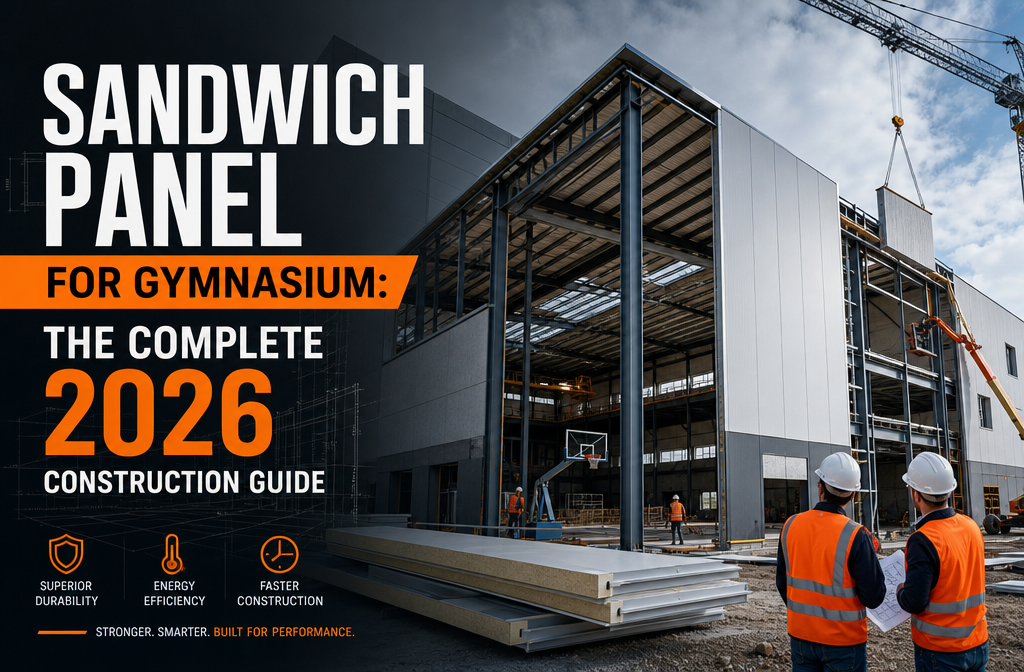
A sandwich panel for gymnasium construction is a prefabricated building panel made of two steel face sheets bonded to an insulating core (typically EPS, PU, or rockwool). These panels work exceptionally well for gym walls, roofs, and ceilings because they deliver thermal insulation, acoustic control, and structural strength in a single, fast-to-install system. For most gymnasium projects, a 75mm to 100mm thick panel with a rockwool or PU core is the recommended starting point.
Key Takeaways
- Sandwich panels reduce gymnasium construction time by 30–50% compared to traditional brick-and-mortar methods (estimate based on typical prefab vs. conventional build schedules).
- Rockwool-core panels are the best choice for fire resistance and sound control in school or public gymnasiums.
- PU (polyurethane) core panels offer the highest thermal insulation value, making them ideal for climate-controlled sports facilities.
- Panel thickness of 75mm–150mm covers most gymnasium wall and roof applications.
- Sandwich panels can support equipment mounting brackets when proper steel backing or anchor systems are installed.
- High-humidity areas (indoor pools adjacent to gyms, tropical climates) require panels with moisture-resistant coatings and sealed joints.
- Lifespan for well-maintained gymnasium sandwich panels is typically 25–40 years.
- Fire-rated panels (Class A or equivalent) are mandatory in most school and public sports facility codes.
- Cost per square meter varies widely by core type, thickness, and region — always get itemized quotes.
- Common installation mistakes include skipping vapor barriers, misaligning panel joints, and under-specifying fastener load ratings.
What Exactly Is a Sandwich Panel for Gymnasiums?
A sandwich panel for gymnasium use is a composite building element with three layers: two rigid steel or aluminum face sheets on the outside and a lightweight insulating core in the middle. The "sandwich" structure gives the panel its name and its strength. For gymnasiums specifically, these panels serve as walls, roof cladding, and sometimes interior partitions.
The three most common core materials for gym applications:
| Core Type | Best For | Thermal Performance | Fire Rating | Moisture Resistance |
|---|---|---|---|---|
| EPS (Expanded Polystyrene) | Budget builds, dry climates | Good | Low (Class C–D) | Moderate |
| PU/PIR (Polyurethane) | Climate-controlled gyms | Excellent | Moderate (Class B) | High |
| Rockwool (Mineral Wool) | School gyms, fire-sensitive builds | Good | Excellent (Class A) | Good |
Gymnasiums have unique demands: large clear-span interiors, high internal humidity from athlete activity, heavy equipment on walls, and strict fire codes. Sandwich panels address all of these when specified correctly. For a broader look at panel types available in the market, see this complete sandwich panel types comparison guide.
Sandwich Panel vs. Traditional Wall Construction for Gyms
Sandwich panels outperform traditional brick or block construction for gymnasiums on speed, weight, and energy efficiency — but traditional construction still wins on raw compressive strength and long-term familiarity for structural engineers.
Here's how the two approaches compare across the factors that matter most for gym projects:
| Factor | Sandwich Panel | Traditional Masonry |
|---|---|---|
| Construction speed | Fast (days to weeks) | Slow (weeks to months) |
| Thermal insulation | Built-in, consistent | Requires added insulation layers |
| Weight on foundation | Light | Heavy |
| Acoustic performance | Moderate to good (core-dependent) | Good (mass-based) |
| Design flexibility | High (modular, custom sizes) | Moderate |
| Upfront cost | Moderate to high | Low to moderate |
| Long-term energy savings | High | Moderate |
| Maintenance | Low | Low to moderate |
Choose sandwich panels if: the project timeline is tight, the site has foundation load limitations, or the gymnasium needs strong thermal performance from day one.
Choose traditional masonry if: the budget is very tight, local labor costs favor conventional methods, or the structural engineer requires masonry for seismic zone compliance.
For gymnasium projects in South Asia and Southeast Asia, sandwich panels have become the dominant choice for new sports halls because of faster build cycles and better energy performance in hot, humid climates.
How Much Do Sandwich Panels Cost for Gym Construction?
Sandwich panel pricing for gymnasium projects depends on core type, panel thickness, face sheet gauge, surface finish, and quantity ordered. Exact prices vary by country and supplier.
General price ranges (estimates based on regional market data as of 2026):
- EPS core panels (50–100mm): Budget tier — suitable for non-climate-controlled storage or auxiliary gym spaces.
- PU/PIR core panels (75–150mm): Mid to premium tier — best value for main gymnasium halls requiring climate control.
- Rockwool core panels (75–100mm): Premium tier — highest fire and acoustic performance, typically 15–25% more expensive than EPS equivalent.
For specific pricing in Bangladesh and South Asian markets, the sandwich panel price per square meter guide provides current regional benchmarks.
Cost factors that increase the total project budget:
- Thicker panels (100mm+ adds material cost but reduces HVAC sizing costs)
- Custom panel lengths for high gymnasium walls
- Fire-rated or anti-corrosion coatings
- Acoustic-specific panel configurations
- Complex roof geometry requiring cut panels
Common mistake: Comparing only the panel purchase price without factoring in installation labor, fasteners, sealants, and trim accessories. Total installed cost is the number that matters.
Are Sandwich Panels Good for Noise Reduction in Gymnasiums?
Yes, but with an important qualifier: standard sandwich panels provide moderate sound insulation, not high-performance acoustic isolation. For gymnasiums where noise control is a priority (school gyms adjacent to classrooms, community sports halls in residential areas), acoustic-specific panel configurations are needed.
How it works: The dense core material (especially rockwool) absorbs sound energy. The steel face sheets add mass, which blocks airborne sound transmission. The combination gives a Sound Transmission Class (STC) rating that varies by panel specification.
- Rockwool core panels deliver the best acoustic performance among standard gym panel options.
- Double-skin systems (two panel layers with an air gap) can significantly improve STC ratings for noise-sensitive locations.
- EPS core panels have the weakest acoustic performance and are not recommended where noise control matters.
For projects where gym noise is a serious concern, review the detailed sandwich panel acoustic insulation guide before finalizing specifications.
💡 Key point: Acoustic performance is only as good as the weakest point. Doors, ventilation penetrations, and unsealed joints can undermine even the best panel specification. Always treat the full building envelope, not just the walls.
Which Type of Sandwich Panel Works Best for High-Humidity Areas?
PU (polyurethane) core panels with galvanized or pre-painted steel faces and factory-sealed joints perform best in high-humidity gymnasium environments. Rockwool panels are also acceptable if the facing and joint sealing are properly specified.
High-humidity risk factors in gymnasiums:
- Athlete perspiration raising indoor relative humidity
- Adjacent wet areas (showers, pool halls)
- Tropical or coastal climates
- Inadequate HVAC ventilation
What to specify for humid gym environments:
- Face sheet: Hot-dip galvanized steel (Z275 or higher) or aluminum-faced panels
- Core: Closed-cell PU/PIR (resists moisture absorption better than open-cell EPS)
- Joint treatment: Factory-applied sealant plus site-applied silicone at all joints
- Vapor barrier: Install on the warm side of the panel in air-conditioned gyms in hot climates
Avoid: Standard EPS panels without moisture-resistant coating in persistently humid environments. EPS can absorb moisture over time, reducing insulation performance and potentially causing face sheet delamination.
Thermal Insulation Performance of Sandwich Panels for Gyms
Sandwich panels for gymnasiums deliver significantly better thermal insulation than uninsulated metal cladding or single-skin construction. The insulation value (expressed as U-value or R-value) depends on core material and thickness.
General thermal performance by core type (thicker = better insulation):
- PU/PIR core: Highest insulation per millimeter of thickness. A 100mm PU panel typically achieves a U-value around 0.20–0.25 W/m²K (estimate; verify with manufacturer data sheets).
- Rockwool core: Good insulation with excellent fire resistance. Slightly lower insulation per mm than PU.
- EPS core: Adequate for moderate climates; lower cost but requires greater thickness to match PU performance.
For gymnasiums in hot climates, good wall and roof insulation directly reduces air conditioning load and operating costs over the building's lifetime. The thermal insulation sandwich panel guide covers how to calculate the right specification for different climate zones.
What climate zones are sandwich panels most effective in?
Sandwich panels are effective across all climate zones, but the payback period is fastest in:
- Hot, humid tropical climates (high cooling loads make insulation savings significant)
- Cold climates (heating cost savings are substantial)
- Extreme temperature swing regions (day/night or seasonal variation)
In mild, temperate climates with low HVAC loads, the thermal benefit is real but the payback period is longer.
Are Sandwich Panels Fire Resistant for Gymnasium Safety?
Fire resistance varies significantly by core type. Rockwool (mineral wool) core panels carry Class A fire ratings and are the safest choice for school gymnasiums and public sports facilities. PU/PIR panels offer improved fire performance over standard EPS but do not match rockwool.
Fire rating summary:
- Rockwool core: Class A (non-combustible core) — meets the strictest building codes for occupied public buildings
- PIR core: Class B in most standards — acceptable in many commercial gymnasium applications
- EPS core: Class C–D — generally not acceptable for public gymnasium walls or roofs without additional fire protection layers
Most national building codes for schools and public assembly spaces require Class A or equivalent fire-rated wall and roof panels. Always confirm local code requirements before specifying panels.
For detailed fire performance data, the fire rated sandwich panel buyer's guide provides specification guidance and compliance information.
Can Sandwich Panels Handle Heavy Gymnasium Equipment Mounting?
Standard sandwich panels are not designed to carry heavy point loads directly through the panel face. However, gymnasium equipment (wall-mounted basketball backboards, climbing wall anchors, bleacher brackets) can be mounted successfully with the right approach.
How to mount heavy equipment on sandwich panel walls:
- Plan anchor points before installation. Identify all equipment locations on the drawing set.
- Install steel backing plates or structural channels behind the panel at anchor points during panel erection — this is far easier than retrofitting.
- Use through-bolts with large washers to distribute load across the panel face sheet.
- For very heavy loads (e.g., motorized basketball goals), run a steel channel or RHS section across multiple panel joints and fasten to the primary structure, not the panel itself.
- Consult the panel manufacturer's load tables for the specific panel product being used.
Common mistake: Drilling directly into the panel face with standard screws and expecting it to hold significant shear or pull-out loads. Panel face sheets are typically 0.4mm–0.6mm thick steel — they are not structural anchoring surfaces without reinforcement.
Pros and Cons of Using Sandwich Panels in School Gymnasiums
School gymnasiums have specific requirements: fire safety compliance, durability against impact from balls and equipment, acoustic separation from classrooms, and budget constraints.
Pros:
- Fast construction reduces disruption to the school campus
- Built-in thermal and acoustic insulation in one product
- Smooth interior surfaces are easy to clean and maintain
- Lightweight panels reduce structural load on foundations
- Modular system allows future expansion or reconfiguration
- Available in a wide range of colors and finishes
Cons:
- Panel face sheets dent or scratch more easily than masonry under direct impact (ball impact zones need protection panels or wall padding)
- Fire-rated rockwool panels cost more upfront than basic EPS options
- Requires skilled installation teams familiar with panel systems
- Long-term repair of damaged panels requires matching products from the original supplier
- Not suitable as a load-bearing structural wall without a separate steel frame
Verdict for school gymnasiums: Sandwich panels are a strong choice when paired with a proper steel frame, fire-rated core specification, and impact protection at ball-play height. The benefits of sandwich panels in construction article covers the broader case for this building system across project types.
Common Installation Mistakes with Gym Sandwich Panels
Poor installation is the leading cause of premature panel failure, moisture problems, and acoustic leaks in gymnasium buildings.
The most common mistakes to avoid:
- Skipping the vapor barrier: In air-conditioned gyms in hot climates, condensation forms inside the wall assembly without a proper vapor barrier on the warm side.
- Misaligning panel joints: Gaps at joints allow air and moisture infiltration and reduce both thermal and acoustic performance.
- Over-tightening fasteners: Crushing the panel edge at screw points creates stress concentrations and can crack the face sheet coating.
- Ignoring thermal bridging at steel frame connections: Metal purlins and columns conduct heat through the insulated envelope. Use thermal break tape or pads at all steel-to-panel contact points.
- Cutting panels with angle grinders: Grinding sparks embed in the zinc coating and cause rust spots within months. Use nibblers or circular saws with appropriate blades.
- Not sealing penetrations: Every pipe, conduit, or duct penetration through a panel is a potential air and moisture leak. Seal all penetrations with compatible sealant on installation day.
For a full step-by-step process, the sandwich panel roof installation guide covers best practices applicable to gymnasium roof panels.
How Long Do Sandwich Panels Typically Last in Athletic Facilities?
Well-specified and properly maintained sandwich panels in gymnasium applications typically last 25–40 years. The primary factors affecting lifespan are coating quality, core moisture resistance, and maintenance frequency.
Lifespan factors:
- Coating quality: PVDF or SMP coatings outlast standard polyester coatings, especially in coastal or high-UV environments.
- Core type: Closed-cell PU cores resist moisture degradation better than open-cell EPS over decades.
- Maintenance: Annual inspection and resealing of joints, prompt repair of any dents or coating damage, and keeping drainage clear all extend panel life significantly.
- Environment: Coastal salt air, industrial pollution, and persistent high humidity accelerate coating degradation.
For gymnasium operators, a simple annual maintenance checklist — inspect joints, check fasteners, clean panel surfaces, reseal any cracked sealant — is enough to keep panels performing well for decades. The sandwich panel maintenance guide provides a practical maintenance schedule.
Best Sandwich Panel Manufacturers for Sports Facilities
Choosing the right manufacturer for a gymnasium project means looking beyond price to quality certifications, core material consistency, coating durability, and technical support.
What to look for in a gym panel supplier:
- ISO 9001 quality management certification
- Third-party fire test certificates (not just manufacturer claims)
- Ability to supply custom panel lengths for tall gymnasium walls
- Technical data sheets with U-values, STC ratings, and load tables
- Local or regional support for installation guidance
For buyers in Bangladesh and South Asia, the guide to choosing the best sandwich panel manufacturer provides a structured evaluation framework applicable to gymnasium procurement.
Questions to ask any manufacturer before ordering:
- What fire test standard does this panel meet, and can you provide the certificate?
- What is the warranty on the coating and the panel assembly?
- Can you supply panels in the lengths needed for our gymnasium wall height?
- What is the recommended fastener specification for gymnasium applications?
FAQ: Sandwich Panel for Gymnasium
Q: What thickness of sandwich panel is best for a gymnasium wall?
A: 75mm to 100mm is the standard range for gymnasium walls. In hot or cold climates requiring strong thermal performance, 100mm to 150mm is recommended. Roof panels typically use 100mm or thicker.
Q: Do sandwich panels meet building codes for school gymnasiums?
A: Yes, when the correct fire-rated core (rockwool or PIR) is specified and installed per the manufacturer's guidelines. Always confirm the specific fire rating requirement with the local building authority before specifying.
Q: Can sandwich panels be used for gymnasium roofs as well as walls?
A: Yes. Roof panels are typically thicker (100mm+) and use a profiled face sheet for structural spanning capacity. The same core material options apply.
Q: How do sandwich panels handle ball impact in a gymnasium?
A: Standard panel face sheets (0.4–0.6mm steel) will dent under direct ball impact at close range. Install wall padding or impact-resistant cladding on the lower 3–4 meters of interior gymnasium walls to protect the panels.
Q: Are sandwich panels suitable for outdoor gymnasium structures?
A: Yes, with appropriate exterior coatings (PVDF or SMP) and corrosion-resistant fasteners. Ensure all joints are sealed with UV-stable sealant.
Q: How long does it take to install sandwich panels on a gymnasium?
A: A typical school gymnasium (800–1,200 m² of wall and roof area) can be paneled in 2–4 weeks with an experienced installation crew, compared to 8–16 weeks for equivalent masonry construction (estimate based on typical project schedules).
Q: Can I add sandwich panels to an existing gymnasium to improve insulation?
A: Yes. Overcladding (installing new panels over existing walls) is a common retrofit approach. It adds insulation and refreshes the building exterior without full demolition.
Q: What is the best panel color for gymnasium interiors?
A: Light colors (white, light grey, light blue) maximize light reflection and reduce artificial lighting requirements. Avoid dark interior colors that absorb light and increase cooling loads.
Q: Do sandwich panels require a steel frame for gymnasium construction?
A: Yes. Sandwich panels are cladding elements, not primary structural members. A steel portal frame or equivalent primary structure is required for any gymnasium application.
Q: What sealant should be used at sandwich panel joints in a gymnasium?
A: Use a neutral-cure silicone sealant compatible with the panel coating. Avoid acetoxy-cure silicones, which can corrode steel face sheets. Follow the panel manufacturer's joint sealant specification.
Conclusion
A well-specified sandwich panel for gymnasium construction delivers a compelling combination of speed, thermal performance, fire safety, and long-term durability. The key decisions are core material (rockwool for fire-sensitive school gyms, PU for climate-controlled sports halls), panel thickness (75mm minimum for walls, 100mm+ for roofs), and surface coating quality for the specific environment.
Actionable next steps:
- Define the project requirements first: climate zone, fire code, acoustic needs, equipment mounting locations.
- Get manufacturer data sheets, not just price lists — compare U-values, fire ratings, and STC ratings side by side.
- Budget for the full installed cost: panels, fasteners, sealants, trim, and labor.
- Specify impact protection on interior gymnasium walls at ball-play height.
- Plan equipment anchor points before panels are installed, not after.
- Set up an annual maintenance schedule from day one to protect the investment.
For regional pricing and supplier selection, start with the sandwich panel price in Bangladesh 2026 guide and the top sandwich panel suppliers in Bangladesh directory to compare options in the South Asian market.
References
- International Building Code (IBC), Chapter 26: Plastic — Fire Performance Requirements. International Code Council. (2021). https://codes.iccsafe.org
- ASHRAE 90.1: Energy Standard for Buildings Except Low-Rise Residential Buildings. American Society of Heating, Refrigerating and Air-Conditioning Engineers. (2022). https://www.ashrae.org
- European Standard EN 14509: Self-supporting double skin metal faced insulating panels — Factory made products — Specifications. CEN. (2013). https://www.cencenelec.eu
- ASTM E84: Standard Test Method for Surface Burning Characteristics of Building Materials. ASTM International. (2023). https://www.astm.org
- Tomas U. Ganiron Jr., "Investigation on the Use of Sandwich Panel as Wall Construction Material," International Journal of Advanced Science and Technology, Vol. 73. (2014). https://doi.org/10.14257/ijast.2014.73.05